
Nagra Preamp II-S
NAGRA PREAMP II-S REVIEW
Janine takes a listen to the iconic Swiss brand’s Preamp II-S, costing £21,998 with the Compact PSU and £18,348 without a PSU.
About the same size as my legendary Nagra IV reel-to-reel (at least sideways) and with its iconic “Modulometer” meter on the left, now comes the Nagra Series II Preamp II-S, which reintroduces that status symbol and clever double-VU meter. It feels like Nagra has come home again to the identity that set it apart from other reel-to-reel companies in my childhood, though one mustn’t forget the P-PL battery-operated preamp from 1998, which was actually the first to reintroduce the VU meter, Nagra’s first “domestic” HiFi product. The Series II is higher up the ladder of Nagra status than the Compact Player I recently reviewed and is getting closer to their top-rung Reference line. Consequently, at £21,998 including their Compact PSU, it is quite a lot of Swiss pounds. But anyone who knows Nagra will realise this is the Patek Philippe of Swiss watches, and represents the highest precision engineering quality.










Nagra was set up by Stefan Kudelski in 1951, a 22-year-old Polish engineer who, noticing a gap in small professional portable field recorders (there weren’t any!), created the “Nagra 1”, a tiny portable tape recorder for sound engineers, a fraction of the size and weight of the mains recorders available at the time. “Nagra” simply means “will record” and became the first in a long line of reel-to-reel recorders bearing this name. Stefan set up his manufacturing hub in a workshop at the family home in Prilly, near Lake Geneva in Switzerland. From there, the Kudelski Group then produced the II and III in the late 1950s, which were regularly used in radio broadcasting, cinema and music. Indeed, many famous recording artists, such as David Bowie, have had their music recorded on Nagra machines, and the company even won two Oscars and two Emmys for its work in the cinema and television world, respectively. It was only from 1997, however, that they added high-end audio equipment for domestic use to their portfolio, and in 2012, a separate company called Audio Technology Switzerland was spun out of the Kudelski Group. Based in Romanel, 5km from Lausanne, this company now runs the Nagra brand, though the Kudelski family are still the main shareholders. Whilst the days of its reel-to-reels are sadly long gone, it now creates professional digital recorders and great consumer HiFi, and provides services in different industries.
BUILD AND FEATURES OF NAGRA PREAMP II-S
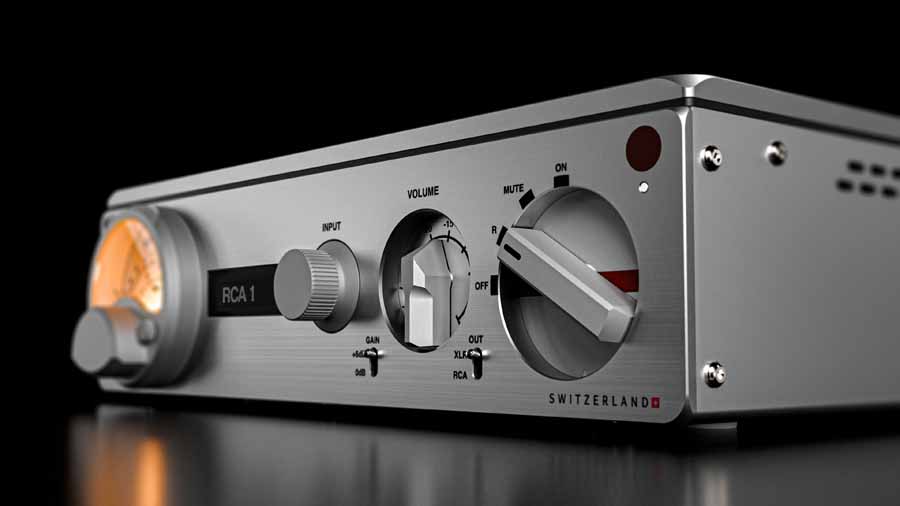
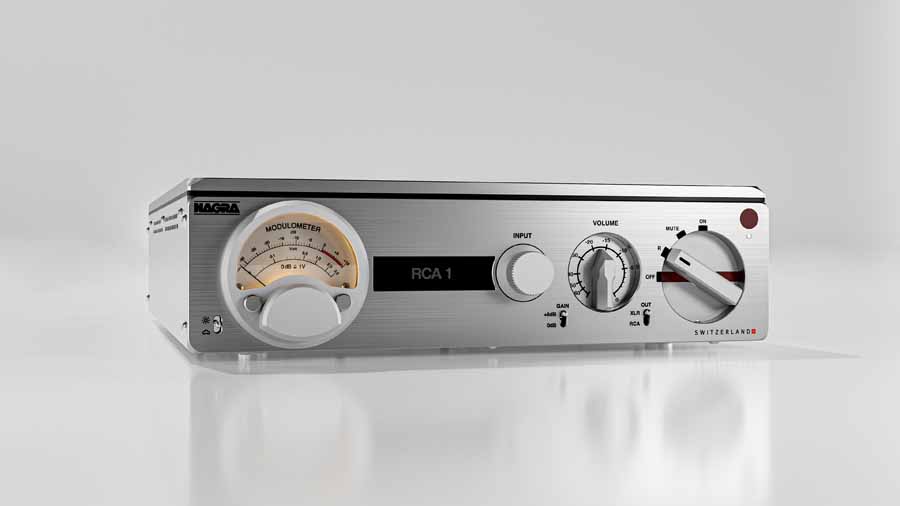
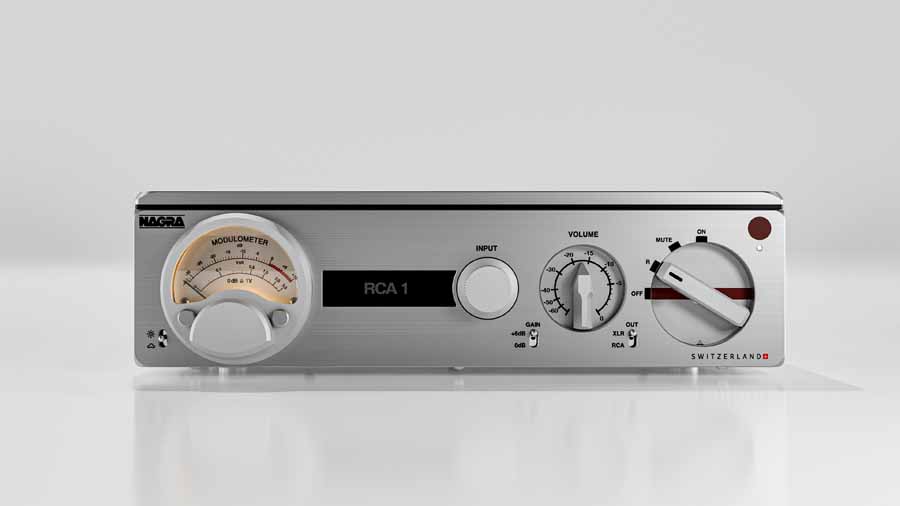
With almost identical looks to the cheaper Classic Preamp, the most identifiable part of the Preamp II-S is undoubtedly that Modulometer, first introduced on the Nagra II tape recorder. This is no ordinary VU meter in two regards. Firstly, both left and right channel pointers are in one meter, so you can easily see discrepancies in levels between left (black) and right (red) channels (interestingly, different colours from those on my Nagra IV-SJ). The BBC mixing desks I stared at for a quarter of a century use PPMs (Peak Programme Meters – these work faster than general VU (Volume Unit) meters, which provide more of an “average” level indication) with left and right on one meter, and the mono and stereo information on the other, so you can check if there is actually any stereo or if it’s out of phase. I so loved that clever philosophy, dating from the 1930s. The second clever aspect of the Modulometer is that, like PPMs, it is faster, meaning you are more likely to see sudden peaks in levels that a slower geriatric meter might not have time to react to, making it much more accurate. Incidentally, the BBC designed PPM meters before we even had VU meters (and my first tape recorder has the almost useless “magic eye” meter, if you remember them!)
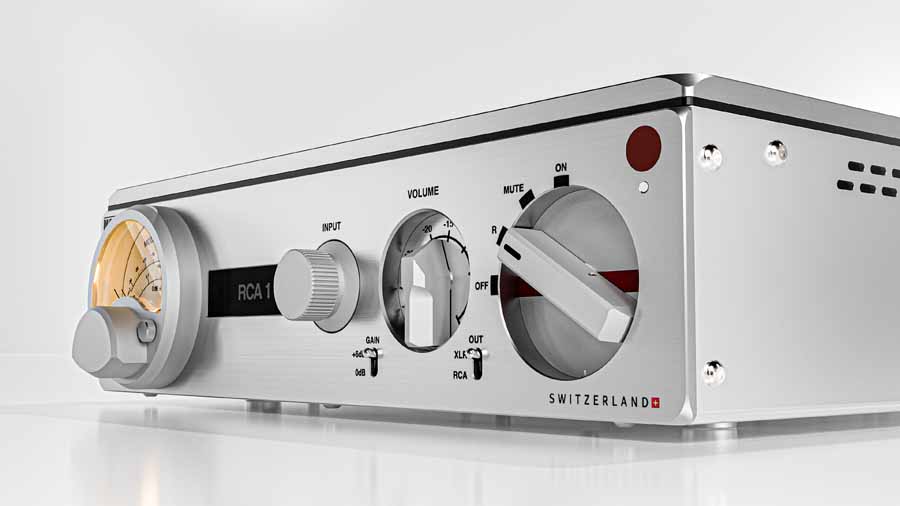
The 380 x 280 x 76 mm dimensions of the Preamp II-S are a bit larger than my Nagra IV, but both deploy the rotary selector on the right, again linking visibly with the past. Where that selector operated tape play and record on the reel-to-reel, on the preamp it operates standby, triggering an “on” position if you switch it on from the unique-looking accompanying remote when set to “R”, a mute position, and a fully operational mode if you turn the knob fully clockwise, should you wish to use some energy and operate without the remote at any point. They have thought of everything. The volume control to the left of this is similar in looks to my gorgeous IV-SJ record-level controls (which I much prefer to the less exotic IV-S record knobs) and, like professional audio equipment, is embossed from less than -60dB to 0dB at full level.










The Preamp II-S is professionally well-specced, with an exceptionally low 9-ohm output impedance and a greater than 125dB dynamic range. With a +6dB gain switch to the left and an XLR/RCA output selector to the right of the volume control, it should satisfy everyone. Their more expensive (just add another £50K) valve HD Preamp takes this number crunching even further to a mind-boggling 160dB. Balance can be adjusted from the centre by up to 4.8dB, but only from the remote. Interestingly, if the selector knob is set at “on”, the remote does everything except turn the unit off when you go to bed. The input selector and accompanying OLED screen are to the left of the motor-driven volume control. At the far left, a two-way toggle switch varies the Modulometer and screen brightness through five levels, including off, to ensure that your eyes are looked after as much as your ears are.
That OLED display is shared with the HD PHONO and Reference DAC, and notably offers excellent readability, even from a distance.
The front panel does look very high quality, and much care has also been put into the inside to ensure the components are protected.
As developed for the Reference turntable and Reference electronics, the PREAMP II-S comes with advanced vibration control, a phenolic damping layer that has been glued and screwed beneath the aluminium top cover. This also makes it look highly professional, and when the unit is combined with their optional £2298 VFS support (Vibration Free Support), that stability can be improved even further. Interestingly, the four tiny feet underneath are just plastic. The Preamp II-S comes as standard with the excellent Compact PSU, as recommended for their Compact range of streamer, streamer/DAC and phono-stage products. However, it can be supplied without one if you already own the Compact range – though goodness knows why you wouldn’t want to use more than one Nagra product simultaneously. The Compact PSU, sold separately at £3,650, has a toroidal transformer and plenty of filtering to eliminate interference, with the whole unit weighing in at a heavy 3.5kg. Connection to the Preamp II-S is via a special DC to screw-in Lemo connector, a feature Nagra has regularly used. If you really want to make the Preamp sound special and have another £15K, then the Classic PSU (and this one has a meter, though not a Modulometer) is available, too.
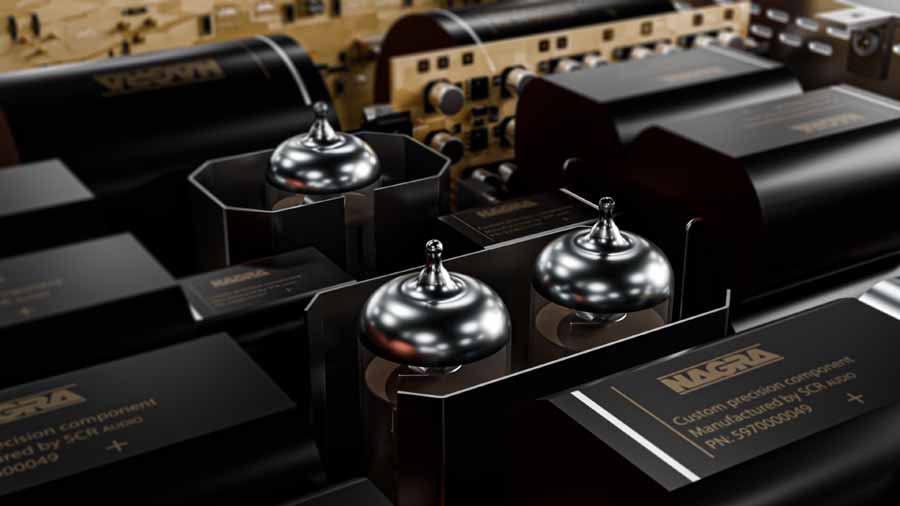
The second really significant feature of the Preamp II-S, for me, is the use of vacuum tubes: two 12AX7/ECC83 valves for amplification and a single 12AT7/ECC81 buffering valve. The former is regularly used in pre-amplification. The side and underside ventilation holes help keep this preamp remarkably cool in operation. It does not get warm!
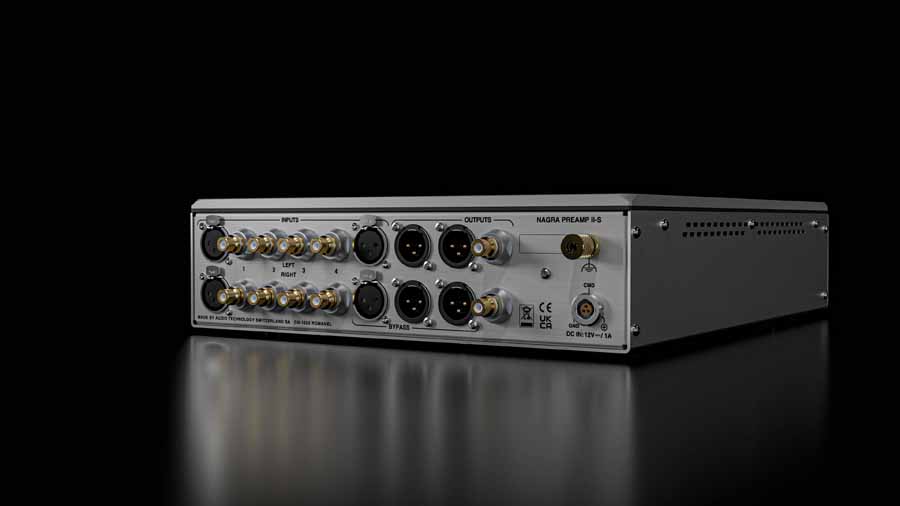
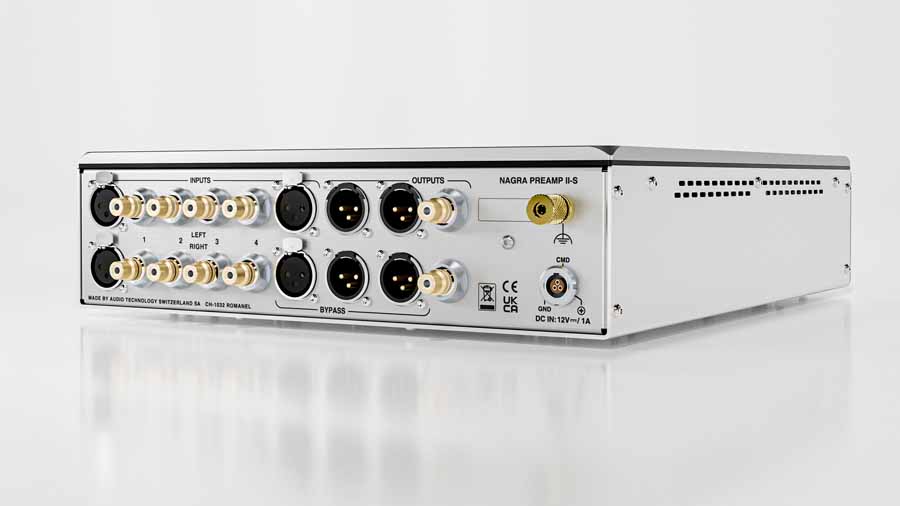
The rear is compactly furnished with 4 RCA inputs but only 1 XLR. A single bypass XLR pair allows connection to AV outputs, so that when the preamp is switched off, the bypass input will be directly connected to both the XLR outputs. Just one caution: when you switch off the Nagra, this output will be at full unattenuated level, so keep your AV amp volume set at a minimum! The output block has two XLR and a single RCA output. In common with Nagra products, there is also a grounding connector to reduce the noise floor as much as possible. It is important, however, to stress that, weirdly, the XLR inputs and outputs are unbalanced. Indeed, the manual recommends that you just use the RCA inputs (which explains why they are favoured 4:1!) They suggest you ring Nagra if you wish to go the balanced route. Going the balanced route would add to the complexity of the design, require more wiring and, hence, increase the price; the valves might each house two triodes in one glass sphere (dual triodes), but balancing would require both “halves” to be extremely closely matched to work well in a balanced scenario. Nagra does stress, however, that the tubes they use are extremely high-grade. If you do want to have a balanced life, then add-on floating-signal input and output Symmetrical Transformer Kits are available to keep you happy.
To the far right, under the IR sensor, is a yellow LED that flashes yellow when you press the remote, and the remote flashes red in sympathy.
Indeed, one of the delights of the box is not only the super NAGRA gloves for you to wear to protect the unit when setting up, but the very unique Star Wars-looking remote. Its shape and ergonomics are great, even allowing you to sit it upright should you so desire, but in plastic, it does look a lot cheaper than the accompanying preamp! I guess the priority is in the sound. The lettering layout (and not numbering) for the channels might be a little confusing to a few neurodiverse folk, with A for XLR and B for RCA 1 on one level, and C to F below that for RCA 2-4. The unmarked black off/on button to the right of “A” and “B” will only function if you set the main rotary selector on the preamp to “R” (for Remote), though the “mute” option does. With iPod-style volume up/down and balance left/right controls, plus a central mute button, this Philips RC-5 protocol remote (in case you should wish to use a universal remote) is great to operate and a lot more comfortable in the hand than its looks might suggest.
The cheaper Classic Preamp, which is almost identical in looks, has a headphone output, something that would have been nice in the Preamp II-S.
SETUP AND USE
Having just reviewed the Compact Player and being familiar with its sound, I unsurprisingly made this one of the sources for the review, connecting it to my 24-bit Qobuz app. To complete the holy grail, I also used reel-to-reel tapes through my Nagra IV. As in the Compact Player review, I used my Krell power amp and Wilson Benesch Arc/Torus set-up. Cables were TQ and Nordost. As this is basically a non-gain preamp unless you select the +6dB, it is closer to my MFA passive preamp than many preamplifiers I have heard over the years. On switch-on, the screen tells you it is “Heating” the valves’ cathodes, ready for listening when all is OK. With Swiss timing, this took just 1’ each time I began listening sessions. Generally, serious listening began 15 minutes after switching on.
SOUND QUALITY
As a pianist presently getting ready for a recital, I decided to listen to a few of the piano works I intended to perform to give me some ideas on how to make my playing sound special. Playing pieces recorded on a Steinway grand through your HiFi often sounds anything but their distinctive sound, but the Nagra sounded as realistic as I have ever heard through my system. Lang Lang’s 2011 ‘Liszt – my Piano Hero’ (Sony Classical) to celebrate the composer’s 200th anniversary is full of my favourites, such as “Consolation No. 3 in D-Flat” and the gorgeous “Liebestraum No. 3 in Ab”. While the former was bright and telling, the “Liebestraum” was darker in performance and exuded the emotion and love that Lang Lang conveys so passionately. The Nagra Preamp was as transparent as my passive MFA yet made the music even more musical. The 9ft Steinway Model D sounded as big in my living room as in the recording studio. Detail was all there, including the damper pedal work and the fast freeform notes extravagantly running up and down the piano in the middle and end of the piece, showing off his incredible playing technique. If only I could play them that fast – more practice, I guess. The excellent noise floor (again as quiet as my passive pre) allowed those fortissimo sections to fire on all cylinders distortion-free, while also allowing me to hear a pin drop in the pianissimo sections. Everything was played with such precision and detail, and Lang Lang’s heart and soul similarly excelled through the speakers. With this exceptional noise floor, I then played the Swiss band Yello’s “30’000 days” track that I had tested on the Compact Player review. That was already great through my set-up, especially with the optional Compact PSU, but now using a second Compact PSU with the Preamp II-S, this was even more musical, very fast and with tighter stereo detail, while the high-frequency electronica contrasted well with the deep organic vocal.
Performing the Miles Davis album ‘In a Silent Way’ was appropriate with such a quiet amp, though this 38-minute 1969 recording does have plenty of tape hiss. This album of just two tracks has “Shhh/Peaceful” as track one, followed by “In a Silent Way”, and is a rock-jazz album featuring no fewer than three keyboards (Herbie Hancock and Chick Corea on the distinctive Fender Rhodes, plus Joe Zawinul also on organ), guitars, soprano saxophone, drums, double bass and trumpet (Miles), all creating a thick canvas of musical timbres and textures. Despite all the complexity of form, with lots of listening going on between the keyboards and trumpet as they intertwine, the Nagra also allows space for the silences and space, plus that bowed double bass ‘drone’ knitting it all together seamlessly. The tracks might be long (one per side on the LP version), but each is actually made up of lots of sections (often badly) spliced together to create the “whole”. The Nagra will hide nothing. My favourite is track 2, which starts with a gorgeous 4’14” section of double bass drone on an “E” and a sensitive performance from the other musicians on top, and ends just as it began. Literally. This is a copy-and-paste job that brilliantly opens and closes the chapter; even the split trumpet note at 29” reappears at 19’22”, and the two wrong notes at 3’47” are back again at 19’26”! Not that this spoilt my enjoyment. This is a passionate and hypnotic album that still uses the modal scale as in ‘Kind of Blue’, and the tape hiss just adds to the magic.
For precision, I turned to Paul Weller’s “Wild Wood”. This has a brilliantly bright and detailed track structured around a metal-strung acoustic guitar. The beautifully gentle song from 1993 hides the fact that he once led the “New Wave/Punk” band ‘The Jam’. Whilst he always had a liking for Motown and Soul, the songs from this period show how previously “daring” pop musicians seem to mellow as they get older, such as Ray Davies, Mark Knopfler, Sting, etc. The Nagra doesn’t allow the detail to mellow, though, giving a tight, fast, secure, and very transparent performance that just exudes musicality. That last part sounds a bit like an oxymoron. Usually, transparency can suggest clinical performance, but what the Nagra Preamp II-S does so well is allow everything in the recording to be performed – one reason I generally like passive preamps. But this active preamp does more than my own reference model, something I also noticed once I returned to using my home system again. Ray Davies’s ‘Americana’ (2017) album has every instrument perfectly positioned on the stage, with extremely fast transients. Ray has always had an affair with America, turning much of his music and words into Wild West remakes. There is nothing special in the sound engineering of this album; the detail just comes through so clearly – such as the heavy percussive beats in “Change for Change” – and is presented with abundant dynamism and joie de vivre.
I couldn’t possibly review the Nagra Preamp II-S without my IEC-set Nagra IV reel-to-reel. I have always enjoyed the voice of Madeline Bell, and her 2002 ‘Blessed with Your Love’ easy-listening album just made this 1942-born American Soul singer sound as smooth and inviting as the Swiss Toblerone I still had left from the Compact Player review. The tighter bass, clearer saxophone solos and tighter grip on the drum kit all sounded so resolute and fluid on this brilliantly re-engineered 7.5ips master copy, with the glockenspiel even clearer on “Sail on Sailor” than I am used to hearing. To think she was in her 60th year when she sang this is truly amazing. Her “Beach Boys Medley” is similarly filled with greater passion and energy, and following this with some 1950s copies of Peggy Lee and Dinah Shore favourites (‘Diamond Voices of the Fifties’) just added to the sense of bringing such great artists back to life. The valves gave their voices a very human touch, though the transparency and speed were as I would expect from transistors.
QUIBBLES
I was mightily impressed by the Preamp II-S, but just wished that the XLR connections were balanced as standard. Oh, and please rename the source buttons on the remote with numbers!
CONCLUSION
I really loved using this preamp. It might not be filled with unnecessary features, but it certainly is brimming with all the necessary ingredients that make listening to music even more special. All except balanced output, but its specifications are so good, you will probably not even hear what you would have been missing anyway! I thoroughly enjoyed reviewing this preamp and fully appreciated all the time, energy and technical skills put into producing such speed, bass extension, detail and – most importantly – musicality to make my music such a joy to listen to. £22K might not exactly be cheap, but this is a truly professional product that well deserves the name “Nagra” imprinted (albeit very small) on the front. For its audio perfection, I gladly award the Preamp II-S Reviewer’s Preference.
AT A GLANCE

Build Quality and Features:
Brilliantly put together and looks to die for, with not only the iconic Modulometer and off/on knob, but also smoothed edges on the top plate that reminded me of fancy Swiss chocolates!
Sound Quality:
A transparency that never lies, but still with great musicality
Value For Money:
£21,998 is certainly not cheap, and the preamp joins many other preamps at this price point, but the Nagra has something most others miss out on, and that just kept me smiling
We Loved:
Rhythmic drive and speed
Excellent noise floor
Gorgeous looks including the famous Modulometer!
Transparency
Fluidity
We Didn’t Love So Much:
Not balanced
No headphone socket
Elevator Pitch Review: Nagra is a name from the past, particularly endeared to reel-to-reel lovers for its looks and sound quality. Their present-day domestic audio products are also well loved at HiFi shows, though their prices might not be quite so. But as I always tell people, you only get what you pay for, so at £21,998 you know you are going to come away with something very special. But would the fact that the XLR connections aren’t balanced worry me? Certainly not after I started to listen.
Price: £21,998 inc. Compact PSU (£18,348 without a PSU)

Janine Elliot
SUPPLIED SPECIFICATIONS
ELECTRONICS
Output impedance:
18 Ω – Gain selection switch @ +6 dB
9 Ω – Gain selection switch @ 0 dB
Frequency response:
10 Hz – 50 kHz (+0 / -0.5 dB)
Dynamic range:
>125 dB (Gain selection switch @ +6 dB)
Input level to reach 0 dB (Modulometer):
1 V rms (Gain at +12 dB) (Gain selection switch @ 0 dB, volume potentiometer @ 0 dB)
Total harmonic distortion (THD):
<0.01% @ 1 kHz, 1 V rms out, no load
Crosstalk:
>85 dB @ 1 kHz, 1 V rms out, no load
Vacuum tubes (selected by Nagra Laboratory):
2x 12AX7/ECC83
1x 12AT7/ECC81
Power consumption:
PMAX 12.6 W
Power supply:
12 – 12.6 V DC / 1 A
Operating temperature:
+15°C to +35°C Standby < 1 W
+59°F to +95°F
Operating environment:
Indoor only Moderate climate
CONNECTIONS
Inputs:
XLR
RCA 1 to 4
Outputs:
2 x XLR
1 x RCA
GENERAL
Dimensions:
380 x 280 x 76 mm (15 x 11 x 3 inches)
Add 3 cm or 1.2 inches with a VFS plate placed underneath
Weight:
4.8 Kg (10.6 lbs)