
Nagra Compact Player
NAGRA COMPACT PLAYER REVIEW
Janine Elliot takes a listen to the compact Player from iconic Swiss brand Nagra.
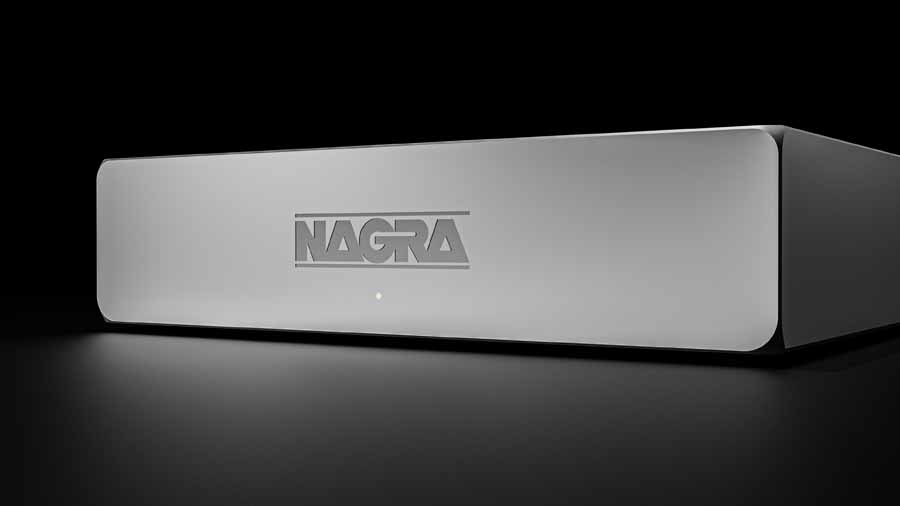
Having got used to seeing Nagra tape recorders with as many buttons, switches and sockets as can fit on each side, it was quite a contrast to be sent their tiny new streamer/DAC that is totally bare apart from an amber LED on the front. However, it’s what is inside that determines how large the sound is, and Nagra never fails there. In this day of big touch-screen displays with VU meters and buttons to do everything from changing DSP EQ settings to making the tea, all you will need to do to use the Compact Player is open Tidal, Roon, Qobuz or Spotify App. The Nagra puts the technology where it is needed, and not unnecessary frippery. When you play it, though, you are in for a shockingly good time. My experience of owning a few of their brilliantly engineered reel-to-reel recorders meant that it would now be an honour to try out this and the Nagra Preamp II-S for HiFiPiG.










Nagra needs very little introduction. Set up by Stefan Kudelski in 1951, the 22-year-old Polish engineer created the “Nagra 1”, a tiny portable tape recorder for sound engineers to use at a fraction of the size and weight of the mains recorders available at the time for professionals. “Nagra” simply means “will record”, and became the first in a long line of reel-to-reel recorders bearing this name. Nagra was set up in a workshop at Kudelski’s family home in Prilly, near Lake Geneva in Switzerland; this is the same country responsible for equally intricate and great watchmaking. After his first machine, the Kudelski Group then produced the II and III in the late 1950s, which were regularly used in radio broadcasting, cinema and music. Indeed, many famous recording artists have had their music recorded on Nagra machines, and the company even won two Oscars and two Emmys for its work in the cinema world. It was in 1997 that Nagra began developing high-end audio equipment for domestic use to add to its professional products. In 2012, a separate company called Audio Technology Switzerland was spun out of the Kudelski Group, and based in Romanel, 5km from Lausanne, this company now runs the Nagra brand, though the Kudelski family are still the main shareholders. This new company has taken the consumer and professional audio products to even greater heights, and whilst the days of its reel-to-reels are sadly long gone, it now creates professional digital recorders, great consumer HiFi, and services in different industries. With electronic products in ascending order of quality, the Compact is at the cheaper end, with the Reference range as the pinnacle of quality.
Nagra has always been a special name for me, having had that desire to own a piece of their precision reel-to-reel engineering since a child. Luckily, a few years ago I picked up a Nagra IV-sj reel-to-reel, designed for professionals to take intricate recordings for instrumentation and measurements, such as whales or ultrasonic waves, and based on the IV-S unit I was sometimes allowed to use at the BBC when not using their usual Uher 4000. Brilliantly engineered like the very best Swiss watches, and one of the best-sounding machines ever, it was their minuscule SN (Série Noire) tape recorder, measuring just 6 inches across, that really took the world by storm. Commissioned by President John F. Kennedy for the US CIA and FBI intelligence agencies for covert surveillance during the Cold War to make secret recordings in the 1970’s and also to be used on the Apollo space missions (though unfortunately not quite making it to landing on the moon) and later as a reporter’s recorder, I still am still in awe every time I go to look at and play my own machine (Note, it was silver, not black as its name might suggest. No, that SN name reflects the dark world of undercover deployment).
BUILD AND FEATURES OF NAGRA COMPACT PLAYER
The Compact player takes its roots from the Streamer, even with a similar sound signature, but now adds a digital-to-analogue converter so you can connect it straight to your analogue amp/pre-amp.









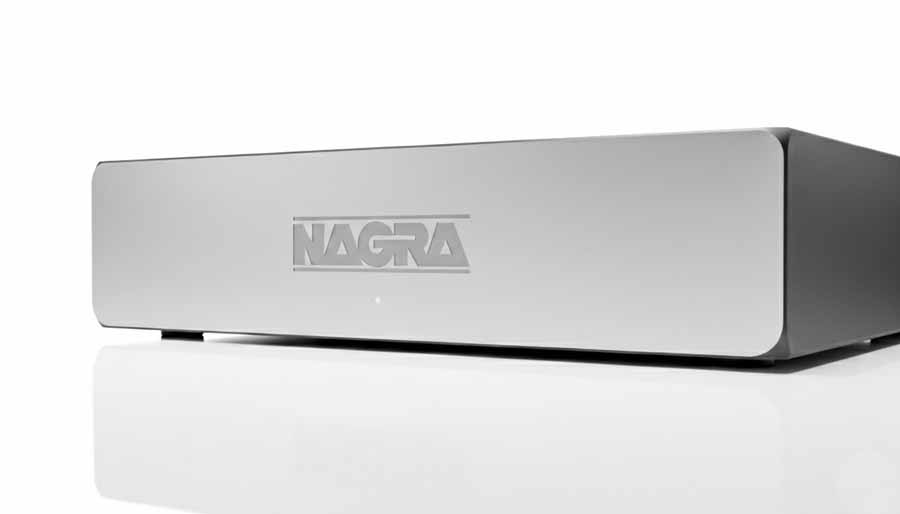
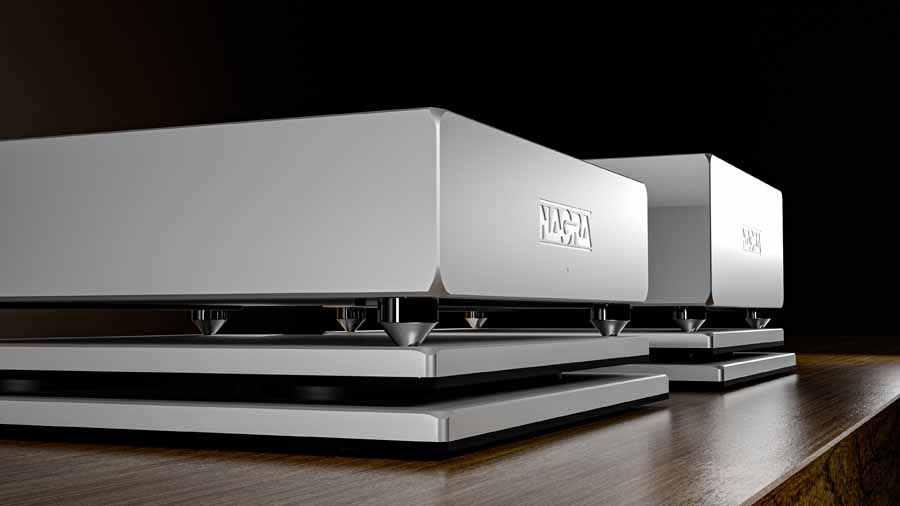
The chassis might be very small, matching the Nagra Streamer and Compact Phono, but the aluminium is precisely CNC-machined from a solid billet, with gorgeous curved corners at the top. Rigid, heavy and vibration-resistant, it is excellently made, though it lacks in the looks department, unlike their iconic reel-to-reel and Reference range. Even the “Nagra” logo at the front is simply printed on. However, as the important bits are inside and it just needs to sit in the rack, all’s good.
It comes with a basic power supply, but the review sample was supplied with the better, and matching, Compact PSU at £3,650, so I could see if the sound could be improved further. This has a toroidal transformer and plenty of filtering to eliminate interference, all weighing in at a heavy 3.5kg. In addition, the £1,350 Compact VFS isolation platform allows it to be placed on this special stand to improve things further. All this technology comes at a price, and being Nagra don’t expect that to be cheap, but expect their iconic musical sound.
The Compact Player weighs in at £5,798, equating to £3 per gram.
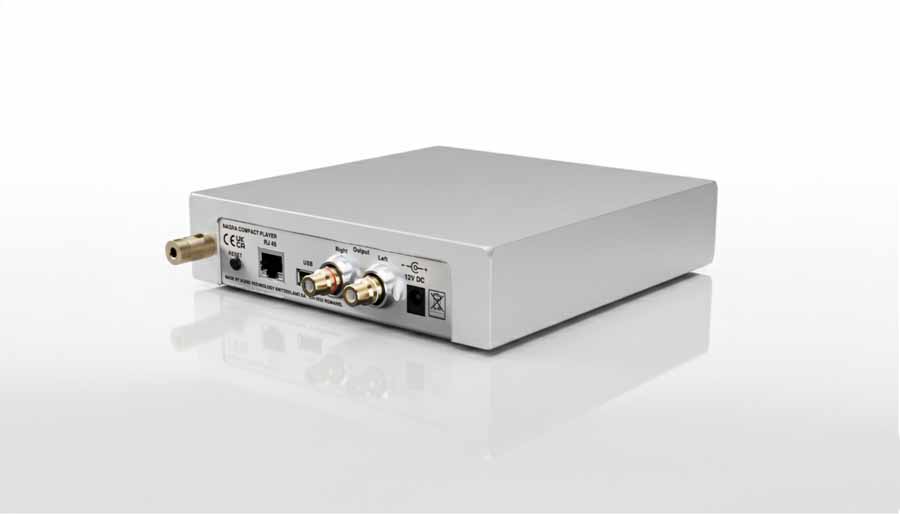
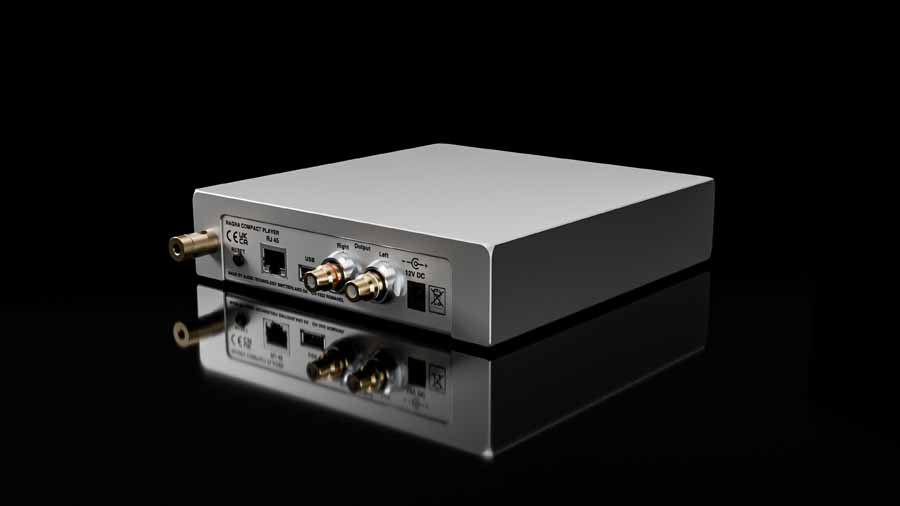
Compatible with Qobuz, Tidal and Spotify Connect, AirPlay 2, Roon ready and Roon tested, this is also JPlay certified, has access to thousands of radio stations with a connection at the rear for RJ45, and it also has a USB socket. It has good quality RCA line outputs, a handy grounding connection (as is regularly supplied on their gear), and the vital 12V DC input socket. Supporting PCM up to 32bit/384kHz, by installing the mConnect Control App using UPnP/DLNA support you are also able to play local files on your phone/tablet or from a USB stick or separate hard drive attached to the USB socket, including DSD 256 (DSD 4x). It also permits you to get software updates and play files from Network Attached Storage, Dropbox, OneDrive and iCloud. Using mConnect you can also rename your Compact Player into something more appropriate, should you so wish, plus create a multi-room group. The 20-page instruction book is clearly written with photos to enable you to get the most from this streamer with the various player Apps, though it limits the amount of technical jargon.
Inside the aluminium block is, of course, the most important bit (or bits!). As with all digital players, it is the combined technology that creates the sound, so stating that it uses an ESS Sabre ES9039 with dual-DAC architecture so that it processes the 2 channels separately is only a small part of the whole story, and actually why Nagra don’t mention it at all in the manual. I often find I’m disappointed hearing DACs with ESS chips, and that is not because of the chip itself, but simply that it is let down by everything around it, with companies concentrating just on the DAC chip, and using that as the “selling point”. Many circuits using ESS chips can sound bright and rather clinical, but luckily some manufacturers can make the same chips sound anything but, and, handy for this review, I was very impressed with Nagra’s Compact Player, as will be explained later.
The Compact is… compact, so it doesn’t incorporate Nagra’s FPGA-based NADM technology as used in its more expensive DACs. However, it still uses their unique clock generator, has meticulous power regulation and multi-layer PCB circuitry including faultless network audio architecture and analogue amplification. With an excellent noise floor of -140dB and output impedance of 14ohms, it will plug perfectly into today’s amplifier line inputs, and Nagra has ensured that the sound quality supplants any rhetoric or technical jargon.
SETUP AND USE
Setting up couldn’t be easier, and at 7.2” x 6.5” x 1.6”, this is smaller than the Bluesound Node that I regularly use. I initially listened to the Compact Player with the enclosed power supply, but later swapped it for the Compact PSU once I was sent the appropriate cable. Output was fed into my Music First Audio Baby Reference pre/Krell KAV250a power combination and feeding my Wilson Benesch Arc/Torus duo, as these speakers are incredibly fast and accurate. They are not as musical as my LS5/9s, but I wanted to hear not just the detail from digital sources, but also how musical they could get. Sources came from Qobuz and USB storage. On plugging in, the LED flashes until it has connected to your Ethernet, when it then stays constant amber.
SOUND QUALITY
My initial thought on the Compact Player was the effortless accuracy of the music, whether low- or high-frequency sounds, and the excellent soundstage detail. Whether pop, jazz or classical music, there was a notable 3D soundstage allowing each instrument to be positioned with great precision across the stage. I really didn’t need to think about playing about with digital filters to get the best sound, or selecting a distracting VU meter display as there isn’t a screen. Nor did I need to think about whether it uses the latest ESS, AKM or Burr-Brown “DAC of the day”. Indeed, being almost unaware of the technology made it more fun and realistic to review, just as I still don’t know what is inside TQ cables or my Moji2. I just wanted to hear musicians in my living room, and first to be heard was Beethoven’s 9th symphony (Karajan, Deutsche Grammophon). All nine symphonies were recorded between 1961-2, and this makes a very collectable compendium that I have always enjoyed. The performance was musically engaging with clear presentation of all instruments, including their position on the stage. Whether quiet or loud sections, both had appropriate amounts of delicacy or punch.
Being Swiss-made, it was appropriate to play Arthur Honegger’s Symphony No. 3 (Musiques Suisses), the 20th-century Swiss composer creating very emotional and detailed music that, despite limited tonality but plenty of energy, just sounded so controlled and correct through the Nagra. Adding the Compact PSU gave greater detail in the bass, especially the excellent double-bass and cello lines, and there seemed more contrast between the textures and timbres. Brass was bold, and the strings shimmered effortlessly. Within all this, though, was a very human emotion to the music. The 5th Symphony’s second movement had a delicate openness and very clear short string chords, creating a great atmosphere to let the listener’s imagination work overtime.
In a completely contrasting genre, Yello’s “30’000” is an equally thick-textured track from this Swiss electronica duo of musician and conceptual artist Dieter Meier (apparently also an entrepreneur, and ex- poker player and gambler) and composer Boris Blank. I always love listening to their highly emotive and adventurous music, and always get drawn into the musical colours of Yello’s music. Particularly noticeable was the naturalness of all the electronic music through digits into my speakers. This streamer/DAC is highly musical, maintaining that signature Nagra sound, even at this “low” price. I could well have been playing my analogue Nagra IV tape recorder. All I needed now was a Toblerone to enjoy a wholly Swiss experience. “Kiss the Cloud”, also from their 2016 ‘Toy’ album, has an extremely pertinent bassline that really tests out my Torus subsonic generator, and which only gets clearer and extended using the Compact PSU.
Spark’s new ‘Live on the Moon’ album was apparently recorded in front of an audience on the Taruntius crater on the moon, but being Sparks, and particularly Ron Mael, you never know whether they are being serious or not. Keyboard player Ron’s deadpan face and conversational moustache made “This Town Ain’t Big Enough for the Two of Us” very famous in 1974, and I also recorded the brother duo of musician Ron and singer Russell at the BBC when I was a sound engineer. A very special day. With Russell’s highly theatrical vocals and Ron’s complex musicianship, I was taken in by the duo right from the start, though by the beginning of the 21st century and already into their 19th studio album, their music seemed, for me at least, to lose some of its pizzazz and direction. So, with apprehension, I tried out this new 2026 release. It is full of old and new, including some of their most famous tracks. The original “This Town…” track sounds very aged and held back in comparison with their version on this new album. The Compact Player really shows off the atmosphere of this “live” version, and the energy and soundstage are even greater than in the original, with more forward vocals. Indeed, Russell’s voice seems better positioned and more elevated above the speakers, and the Nagra really shows off the speed of delivery to a greater extent, making me prefer this version of the famous track. Adding the Compact PSU adds even more depth and soundstage. This is also true in their live “Reinforcements” track. This album is a highly operatic rock performance, especially at the very start in “Do Things My Way”, and listening with my Torus sub just added to this engagement with masses of synth bass and their colourful style that only Sparks could deliver.
Leaving the moon, Holst’s Planet Suite (London Symphony Orchestra, Antonio Pappano, 2026) is a live recording at London’s Barbican Centre recorded using DSD x4 technology, and has surprisingly good spatial depth and excellent textures and timbres from this great British composer, brilliantly sculptured with precision and passion by the Compact Player. Gustav was Head of Music in a London school at the time but had a fascination with the planets since a child, something he referred to as his “private vice”. The Planet Suite is probably the best-known classical work by schoolchildren today.
Clarity and fluidity are particularly noticeable from this player, so I played another old favourite of mine, Talk Talk’s ‘The Colour of Spring’. Brilliantly engineered across the soundstage, I knew this would perform well on the Nagra, but it is the vocalist’s unique voice that has always seemed to make it hard at times to understand the words he is singing, and his vocal strain adds to it, making tracks such as “I Don’t Believe in You” sound more like he is singing underwater! The Compact Player won’t hide any flaws, but will embrace naturalness and musicality wherever it is.
QUIBBLES
Much as I would like to see more features and their own App, and perhaps even WiFi, I guess that would just add to the asking price. As would adding their iconic Modulometer on the front. Shame, though!
CONCLUSION
The Nagra is professional; it won’t lie, and just as the undercover SN micro recorder was there to hear just the truth, the Compact Player gives a very honest, valve-like characteristic, with an exceptionally detailed and musical performance so you can really hear the essence of the music. This entry-level streamer/DAC is effortlessly realistic in all that it delivers, just as I always expect from the best tape recorders in the world, also made by this company.
AT A GLANCE

Build Quality and Features:
Brilliantly engineered inside, where it is most important, but needs the mConnect App to get all the features
Strongly made and can be placed on your rack securely where you can simply forget all about it, and just listen to your music!
Sound Quality:
Fluid, faithful, effortless in its detail. This has a highly engrossing musical delivery
Value For Money:
You’ll need to check your wallet, as it isn’t cheap, but in terms of Nagra build and sound quality, it is a small price to pay. If you can add £3,650, the heavyweight Compact PSU will be a worthy upgrade.
We Loved:
Almost 3D soundstage, especially so in live music
Highly musical performance of digital sources
Speed of delivery
Excellent bass detail and speed, especially with the Compact PSU
Forget gadgets, this is all about the sound
We Didn’t Love So Much:
Not cheap! And this is their entry machine!
Elevator Pitch Review: Where so many streamer/DACs these days are full of fancy features and various VU meters to get your attention, this slab of aluminium just wants to deliver an accurate and highly musical sound. Nagra doesn’t add unnecessary complexities in the design of the Compact Player; this one is quite simply just designed to work, and boy, does it sound good. But will it be worth £5,798, and £3,650 more if you add their matching power supply upgrade?
Price: £5,798 (standard PSU)
Optional upgrades: Compact PSU £3,650; Compact VFS £1,350

Janine Elliot
SUPPLIED BY Absolute Sounds < https://absolutesounds.com/>
SUPPLIED SPECIFICATIONS
Connections: Network Ethernet RJ45, USB hard drive or memory stick
Outputs: RCA connectors
Power: 12V DV ~0.7A, 10W (May increase with a USB HDD)
Operating temperature: +15 °C to +35 °C / +59 °F to +95 °F
Overall Dimensions: 185 x 166 x 41 mm / 7.2 x 6.5 x 1.6 inches
Weight: 1.9kg/4.1lb
Noise: -140dB
THD+N: 0.04% @1kHz, -3dBFS