

SINE MC40 Mains Conditioner
SINE MC40 MAINS CONDITIONER REVIEW
Stuart takes a look (and listen) to the SINE MC40 Mains Conditioner.
Power is something many of us only think about when it goes wrong, yet it sits quietly at the foundation of every HiFi, and it’s something that is becoming increasingly talked about on audiophile social media groups. I’ve conducted my own experimentation over the years and have used a variety of conditioners and balanced mains units. In the end, I ended up with a Torus Power unit, which is essentially a huge toroidal transformer in a box, but I’ve also got a lower-powered kit on the end of a Puritan conditioner. Discussions over the efficacy or otherwise of mains conditioners are akin to the cable discussion and cause a fair bit of conflict. However, like many others, I am wholly convinced that some of these units do have a very positive effect. I must point out, however, that they are not a silver bullet, and one box of tricks might not work as well for one bit of kit as it does for another; or that is my experience, anyway. From my perspective (and I’m not going to pretend I care about or understand any of the science or pseudo-science that is put forward), mains electricity is rarely as clean or as stable as we would like, and the idea that controlling and conditioning that supply can benefit audio equipment is something I buy into. There are also the effects of RFI and EMI to take into account, and the claims are that these sources of interference can also adversely affect the final sound we hear through our speakers.
This is the space SINE occupies, with a clear belief that high-quality power is not an accessory but a requirement.

SINE is based in Hong Kong and specialises exclusively in power supply products for audio and video systems. The company places strong emphasis on both electrical integrity and physical construction, working on the principle that interference, resistance, and mechanical noise all have the potential to compromise system performance. Rather than treating power conditioning as a single solution, SINE approaches it as a combination of shielding, materials science, and mechanical control.
Central to SINE’s manufacturing philosophy is its CRYO minus 196 degrees Celsius process. This involves cooling conducting materials to minus 196 degrees Celsius for a period of 48 hours. According to SINE, this deep freezing process alters the molecular structure of metals, reducing internal electrical resistance and helping to minimise losses as power flows through the system. This treatment is not limited to wiring alone but is applied across a wide range of internal conductors and hardware. Alongside this, SINE uses high-grade materials throughout, including aircraft-grade metals for shielding and platinum plating on contact points to maintain consistent conductivity.
BUILD AND FEATURES OF THE SINE MC40 MAINS CONDITIONER
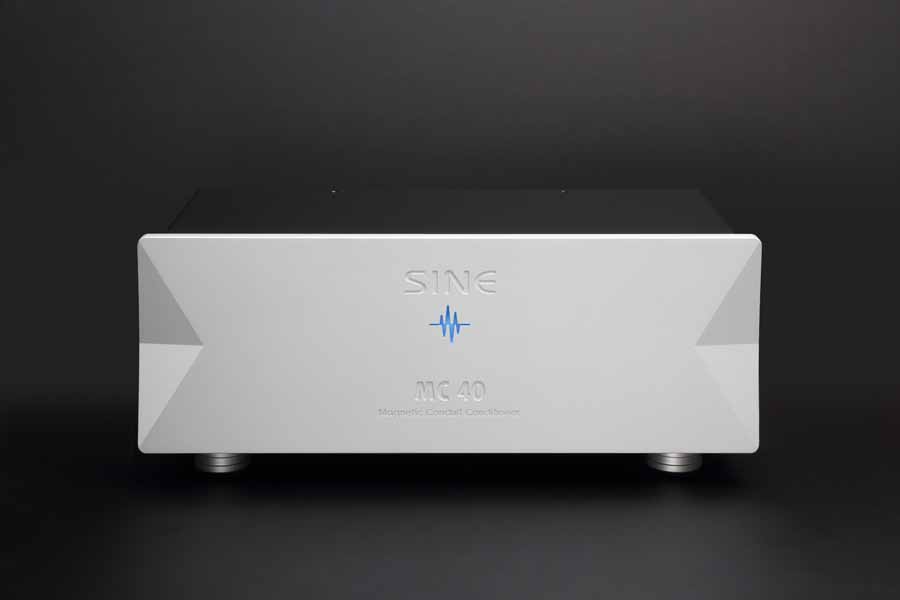
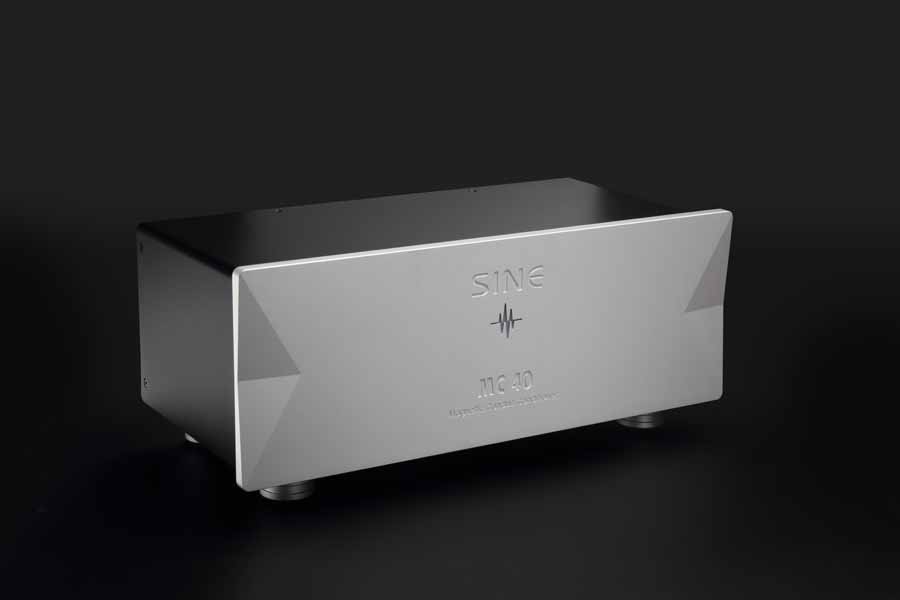
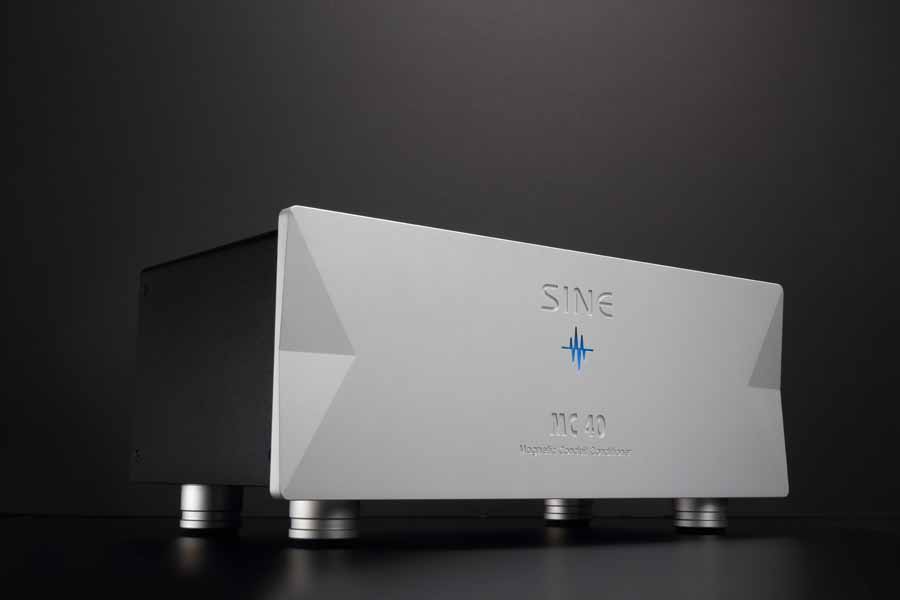
The MC40 power conditioner is designed as a compact yet substantial solution for HiFi and home cinema systems. Its slim form allows it to be placed either vertically or horizontally, making it easier to integrate into a variety of setups. Despite its relatively modest footprint, the MC40 is built with a heavy chassis and a 10mm thick aluminium alloy front panel, intended to act as a physical barrier against electromagnetic and radio frequency interference.

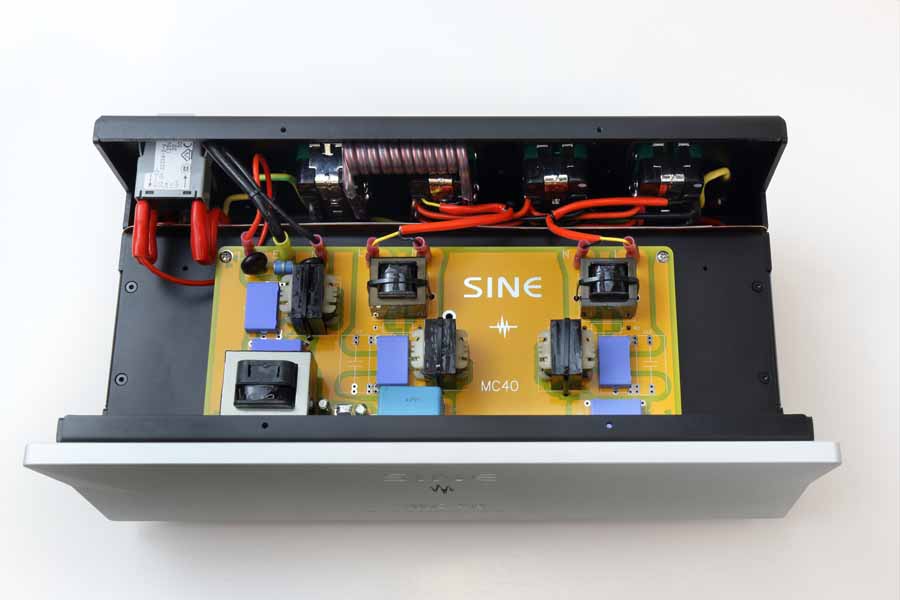
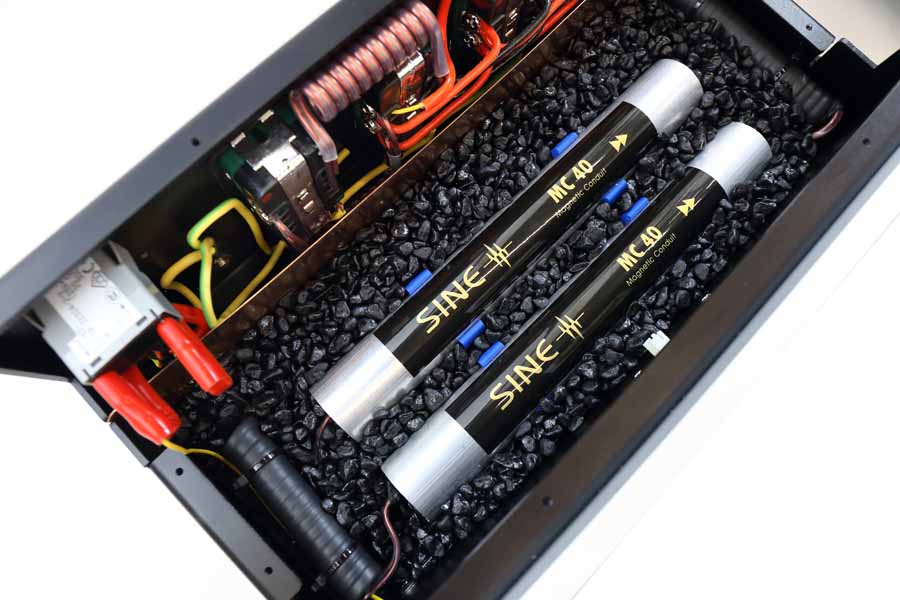
Internally, the MC40 uses a combination of aluminium alloy magnetic conduits and multiple compensation circuits to manage the flow of electricity to connected equipment. Two 40-amp magnetic conduits are used, upgraded from earlier PVC designs to aluminium alloy, alongside three sets of compensation circuits that are intended to smooth and stabilise power delivery. High current demands are supported by 13 AWG solid-core copper internal wiring.
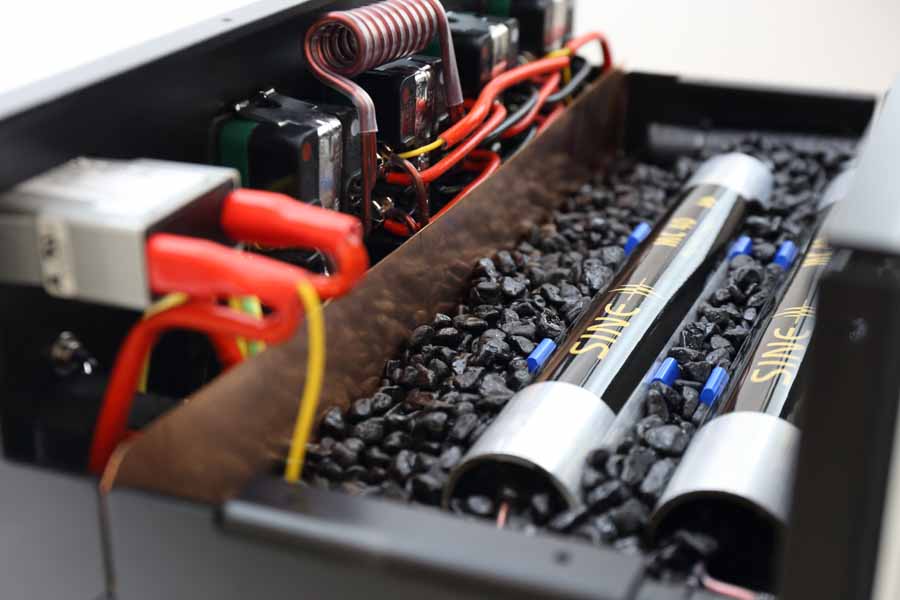
Mechanical and electrical noise control also plays a role in the MC40’s design. The lower section of the chassis is filled with damping materials to reduce resonance and unwanted vibration, while natural minerals are used to neutralise static electricity and absorb internal electromagnetic interference. These physical measures are intended to address both airborne and internally generated electrical noise. This was a cause for concern when the unit first arrived; the graphite chips in the base of the unit rattled about, and my immediate thought was that something had come loose in transit. A call to SINE reassured me, with them telling me that “the lower chassis chamber is filled with damping materials to reduce resonance and unwanted vibration. Some other HiFi companies might use epoxy to fill the chamber, but the sound will be too dull as there will be too much damping.” Note these are SINE’s claims, and I’m really only interested in the effect the unit has (or otherwise) on the final sound of my system.
That cryogenic treatment I mentioned is applied extensively throughout the MC40. All internal conductors, the platinum-plated outlets, the IEC male connector and the 20 amp circuit breaker undergo the same minus 196 degree Celsius process. SINE’s intention here is to ensure that the entire electrical path within the unit benefits from reduced resistance and consistent conductivity, rather than focusing on a single component.
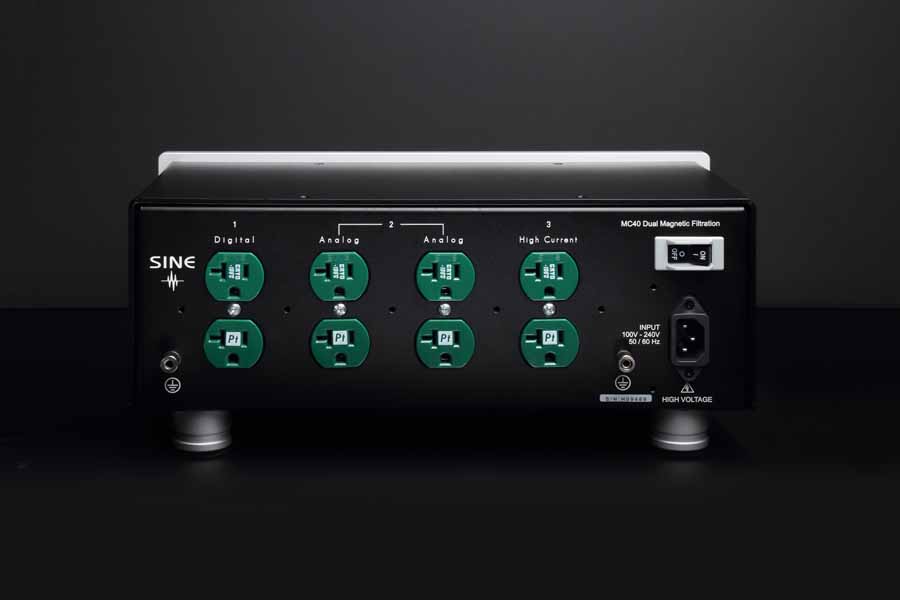
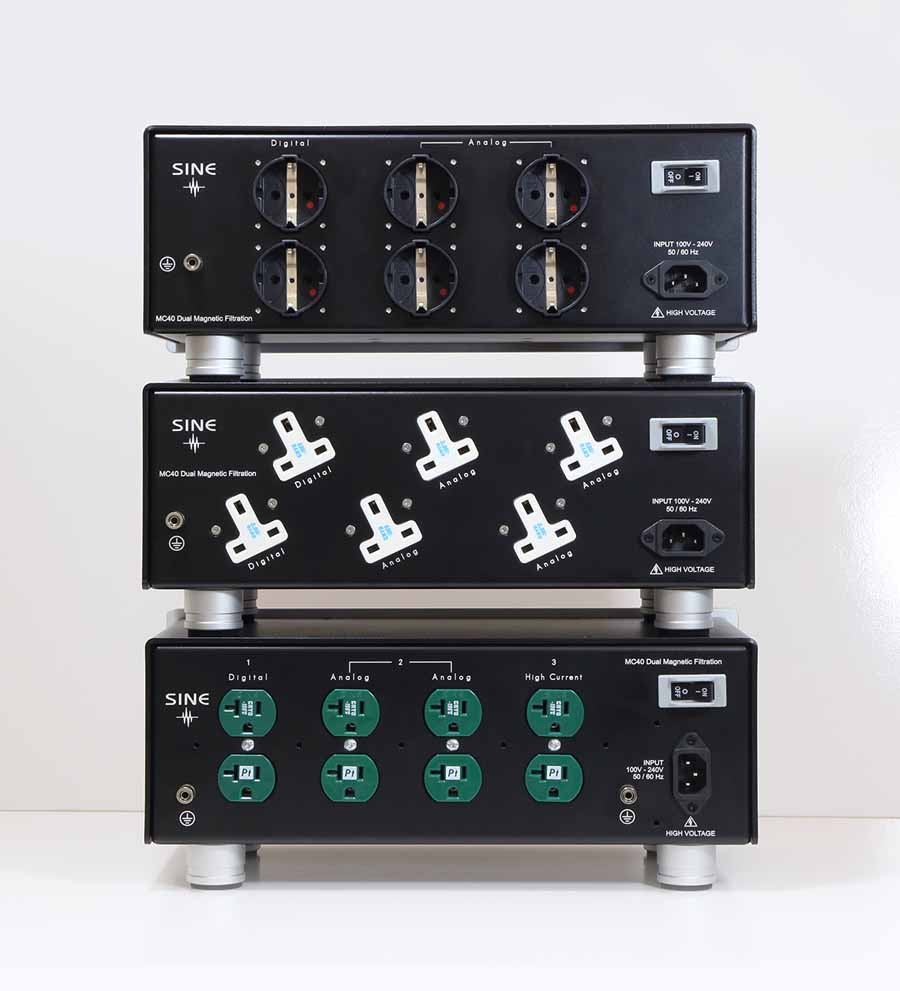
In terms of capacity, the MC40 is rated to handle a maximum continuous power of 6000 watts at 220 volts, with total transient power quoted at 10600 watts. It measures 372mm wide, 180mm deep and 160mm high, and weighs 10kg. The rear panel is fitted with platinum-plated outlets and high-current sockets, designed to provide secure and reliable connections for demanding systems.
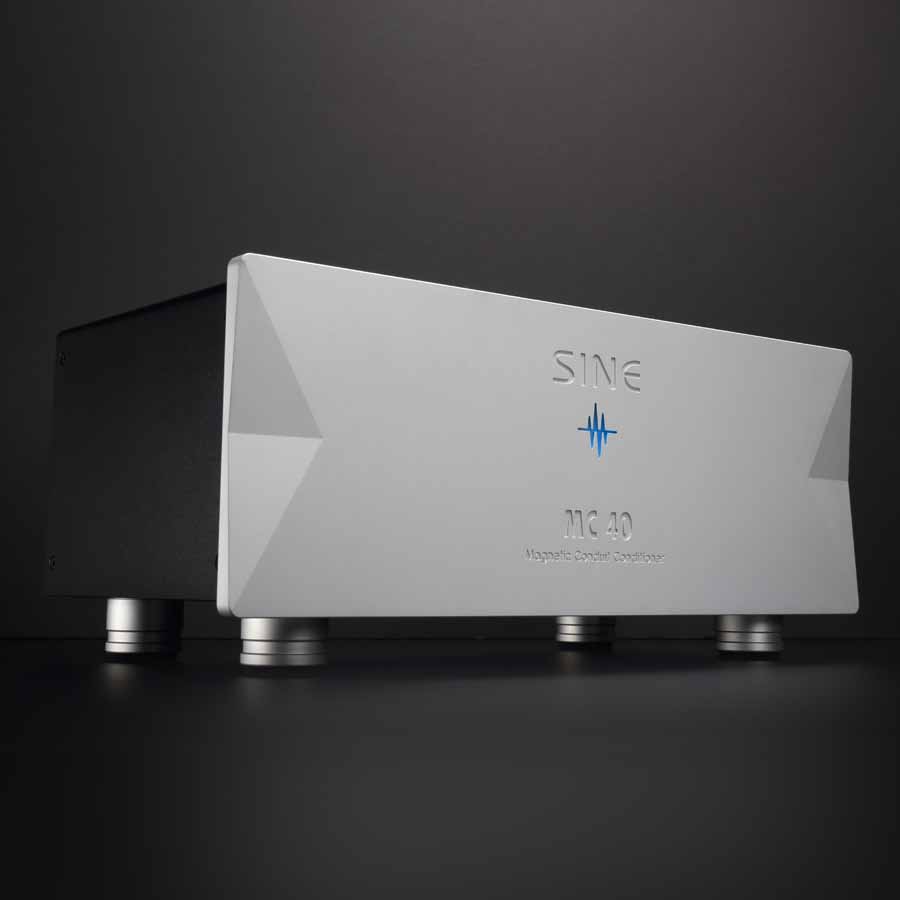
It’s a good-looking, fairly compact unit that came with a well-made cable. Everything was very well packed.
SET UP
Plug it into the mains, plug your kit into it, and turn it on.
We run a large toroidal transformer system from Torus, through which all our reference system components are routed. For this review, I removed it from the system. The Torus is a brilliant unit and has been in place from the moment it was plugged in. However, the Torus was expensive – about 10 times the cost of the Sine unit.
I had amps, DAC, streamer, and turntable plugged into the Sine unit at various times, which will become apparent through the review.
Before plumbing the sine in, I took a while to listen to the system with no mains treatment on any main components, though I did keep the network, Roon host computer, and NAS drives running from a Puritan unit.
I think it’s fair to say that I’m pretty sceptical of mains conditioning, but by the same token, I have found some to be useful and others to be less so. I don’t count the Torus as a mains conditioning unit, per se.
SOUND QUALITY
I’m not going to go into all the tunes I played and the details therein, as I don’t think that is relevant here.
Our system is very quiet with the Torus unit in place, and this has the effect that low-level detail and spatial cues are very evident on everything we play. Removing it from the system doesn’t exactly destroy the sound. Still, once you hear it in a system, you don’t like to have it not in there.
Plugging everything into the SINE unit rather than the Torus does have an effect, and this did surprise me – as I said, I’m sceptical of this kind of product. There is a quieting of the noise floor, but not to the extent I get from the Torus unit, and it is perceptible.
I wanted to experiment more.
At one point, I had the whole system (apart from those bits plugged into the Puritan) into a normal mains block (no Torus), apart from one amplifier that I plugged into the SINE. I played a mono recording of Pet Sounds, and this was interesting as, apart from the Torus, my experience of putting amps through a mains filter has been that they tend to affect the dynamics negatively. Oddly, I found that my perception was that the channel with the amp connected to the SINE sounded (minimally) louder than the other channel. I don’t think the dynamics/speed were affected, but this experiment didn’t exactly have the rigour of a CERN experiment and listening to the same track through two speakers and trying to discern differences was an “interesting” experiment.
I then put our DAC through the SINE unit after having listened to it through the Torus and then the normal mains block. I had the same experience of feeling something was missing with the normal mains block, but the SINE did have some effect in lowering the perceived noise floor. Again, it’s not to the same extent as with the Torus, but it is there, and it is noticeable.
I then plugged the Streamer into the normal mains block and then into the SINE. In this experiment, I noticed no difference between the normal mains block and the SINE. The rest of the system was through the Torus. I repeated the same experiment with the turntable and noticed no difference between the mains block and the SINE.
I repeated a few different variations of things in and out of the SINE rather than a standard mains block, and surprisingly, I found that the most positive effect was having the power amps through the SINE. Adding the DAC through the SINE rather than a standard mains block, along with the amps, also had a positive effect on sound. Look, we aren’t talking night and day here, but the SINE definitely has an effect, and that is cumulative – on some pieces of kit! Here, apart from a perceived lowering of the noise floor when compared to the standard mains block, the SINE unit also seems to have an effect of tightening the sound somehow; a little more control, perhaps?
QUIBBLES
My main quibble, if you can call it a quibble, is that the SINE unit is not effective on all pieces of kit in the chain, but then cumulatively, it does seem to have an effect. For example, our streamer and turntable didn’t appear to benefit from using the SINE as opposed to a standard mains block.
CONCLUSION
The SINE MC40 works, but it is not some magic bullet that will work on every component in your system. This presents a challenge, I guess. However, speaking positively, it did have an effect over and above a standard mains block on the amps and our DAC – we use a passive TCV pre, and so I cannot comment on the effect on preamplifiers.
If someone were going to buy this unit, I guess that they would just plug all their components into it, and whilst I feel some bits of kit might not benefit, there is certainly no negative effect on things like turntables and streamers. However, there does seem to be a positive benefit on some components (amps and DAC).
I do recommend the SINE MC40 over and above a standard mains block, but be aware that it’s not going to work on every bit of kit you have – or it didn’t in my experience. But then, there are no deleterious effects in using it. It does have a positive effect on some bits of kit, and so worth the upgrade from a standard mains block. You need to try it in your system to get a feel of whether you think it is worth the money or not.
It also looks pretty cool!
AT A GLANCE

Build Quality and Features:
Really nicely built and comes with a good quality mains lead
Sound Quality:
Has the effect of tightening the sound and lowering the noise floor when used on some items
On some items, it does not have an effect
Used in the real world, all items in a system would be plugged into it, and the products it has an effect on would benefit without harming other items plugged into it
Value For Money:
We Loved:
On our amps and DAC, the effect over nd above a normal mains block was positive
Looks great
We Didn’t Love So Much:
Not a universal silver bullet for all kit, but then it doesn’t hurt their performance either
Elevator Pitch Review:
Price: EUR 1380 ex VAT

Stuart Smith
SUPPLIED SPECIFICATION
What are the Physical Elements Used in the MC40 and What are their Purposes?
1. External Shielding
The unit acts as a physical barrier against airborne electrical noise.
• Thick Metal Housing: The MC40 features a 10mm thick aluminium-alloy front panel and a heavy-duty chassis,.
• Interference Blocking: This heavy construction, which uses aircraft-grade materials, is specifically designed to block Electromagnetic Interference (EMI) and Radio Frequency (RF) noise from entering the circuit,,.
2. Internal Structural Components
The MC40 uses specific hardware to regulate the flow of electricity and manage magnetic fields.
• Magnetic Conduits: The device contains two 40A magnetic conduits made of aluminium alloy,. These have been upgraded from PVC to aluminium to improve their ability to condition the power.
• Compensation Circuits: There are three sets of compensation circuits that work to enhance and smooth the way electricity flows and is supplied to your devices,.
• High-Quality Wiring: The internal wiring uses 13 AWG solid-core copper to handle high power demands,.
3. Physical Fillings for Noise and Vibration
The MC40 is filled with specific materials to manage mechanical and electrical “pollution.”
• Static and EMI Absorption: The unit contains natural minerals,. These minerals serve two physical purposes: they neutralise static electricity and absorb EMI that may be present inside the unit,.
• Vibration Damping: The lower chamber of the chassis is filled with damping materials,. These are used to reduce resonance and unwanted vibrations, which can otherwise cause subtle distortions in sensitive audio equipment,.
4. Molecular and Surface Treatments
The components themselves are treated to improve how they conduct electricity.
• Cryogenic Treatment (CRYO -196°C): All internal conductors, the 20-amp circuit breaker, and the outlets undergo a 48-hour deep-freeze at -196°C,,. This process realigns the molecular structure of the metal, which reduces electrical resistance and prevents the loss of signal quality.
• Platinum Plating: The contact points, including the outlets and the IEC male connector, are plated with platinum,. This provides superior conductivity compared to standard metals and ensures a more reliable connection.