
ONIX XDA20 DIGITAL TO ANALOGUE CONVERTER
Onix is a name some music lovers of a certain age will be well aware of. In this review, Michael Fairbairn takes a listen to their £2399 XDA20 Digital-to-Analogue Converter.
The XDA20 DAC (Digital-to-Analogue Converter) belongs to the modern era of the British ONIX brand, which is a partnership with Shanling. The Taiwanese/Chinese manufacturer of HiFi audio components has played a key role in revitalising the ONIX name for a global audience. This collaboration preserves the original spirit and heritage of the Brighton-based ONIX company, which first rose to prominence in the late 1970s and early 1980s, while integrating the advanced engineering and manufacturing expertise of Shanling.
Launched as the second device in the Zenith line (introduced internationally at Munich High-End 2023), the XDA20 is part of a dedicated series of products crafted specifically for high-end desktop and full-system Hi-Fi setups. The range is a blend of traditional British audio values with modern design and technological innovation. At £2399, it is an attractive proposition with much to offer.










BUILD AND FEATURES OF ONIX XDA20 DIGITAL TO ANALOGUE CONVERTER
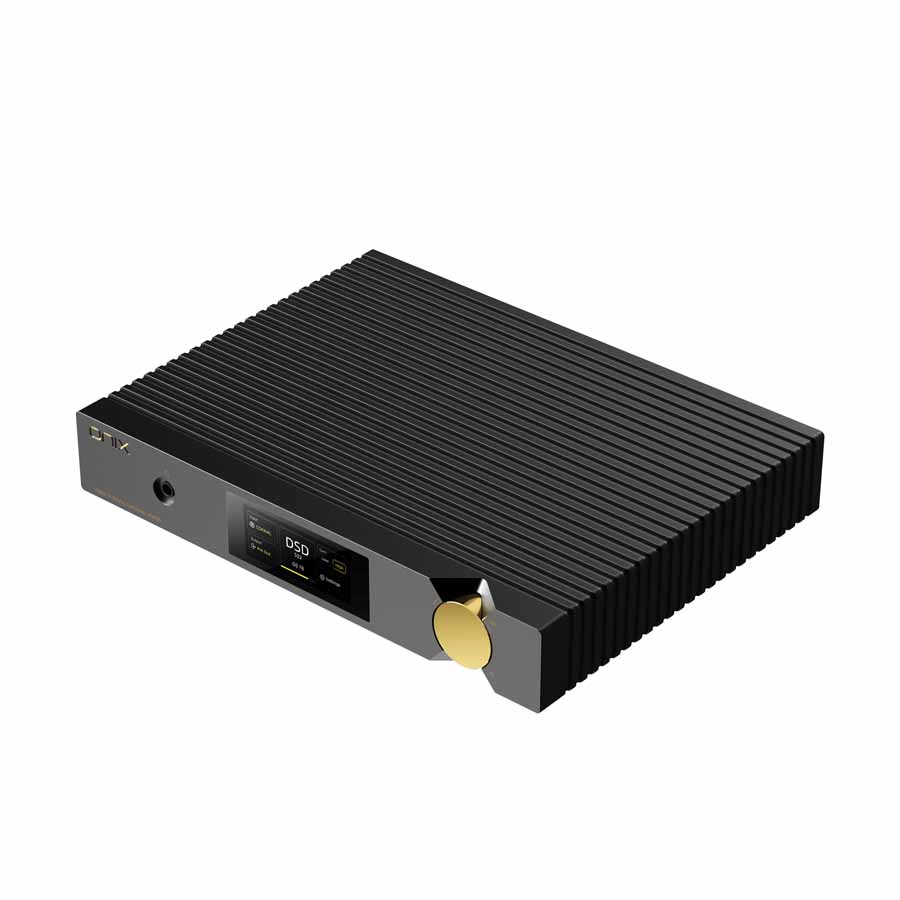
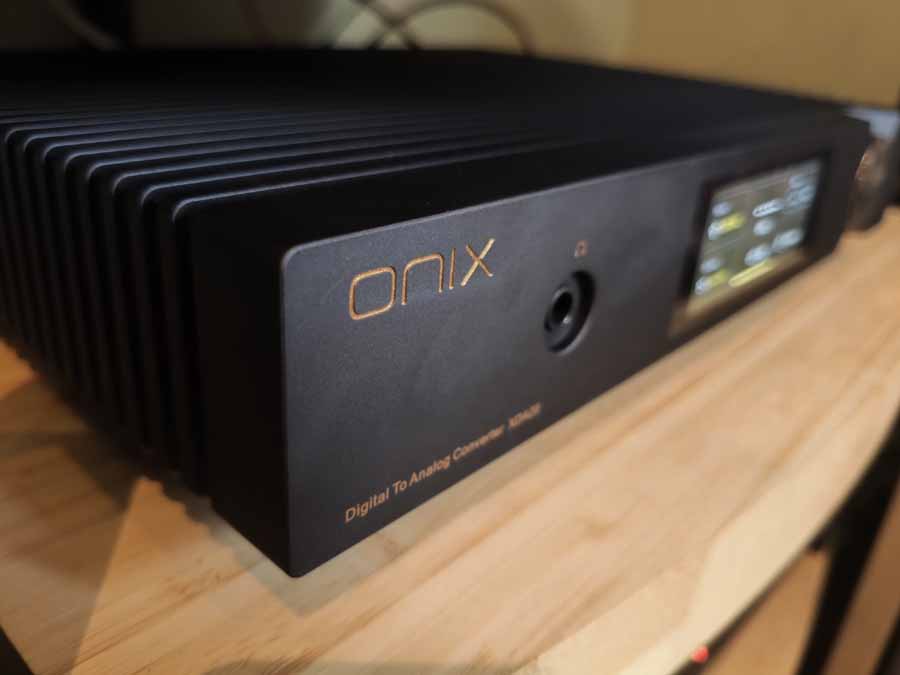
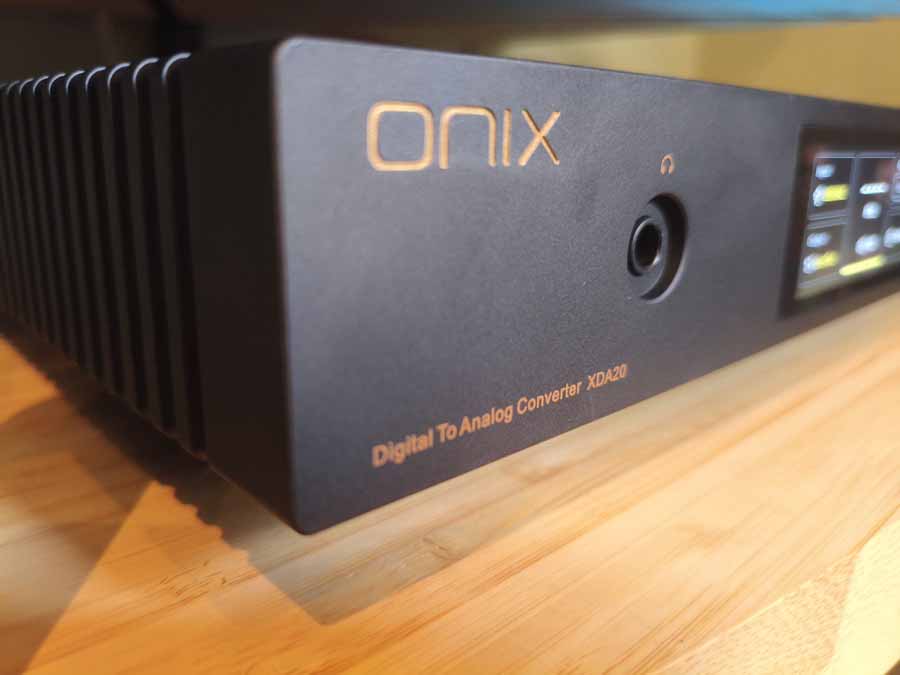
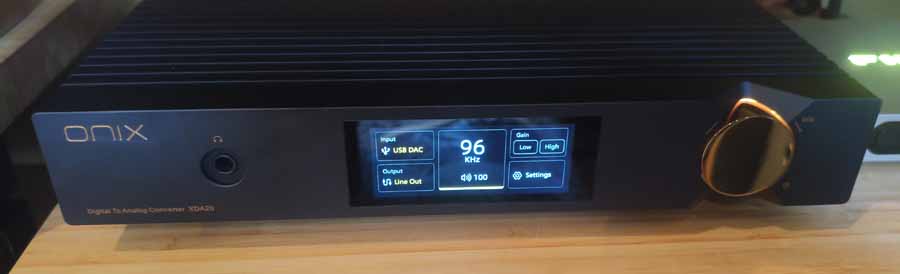
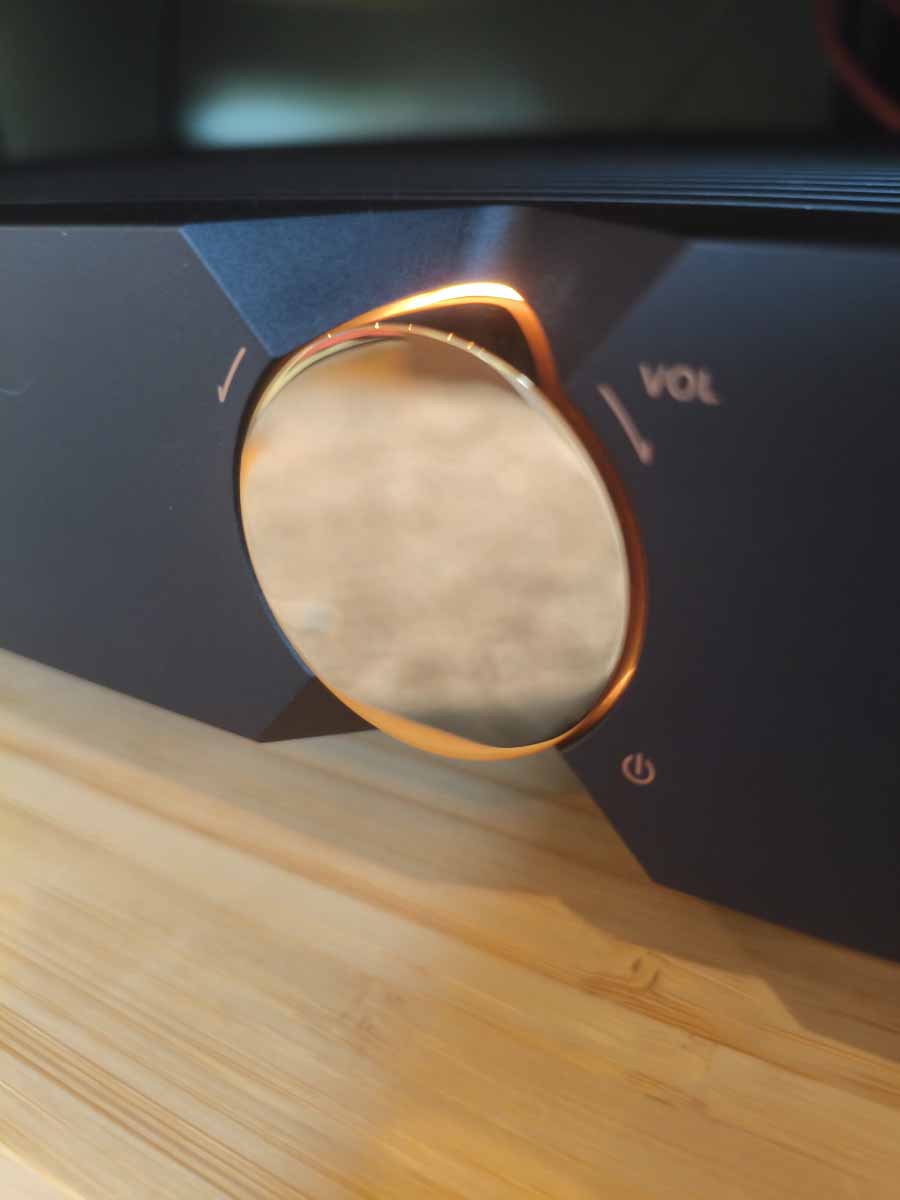
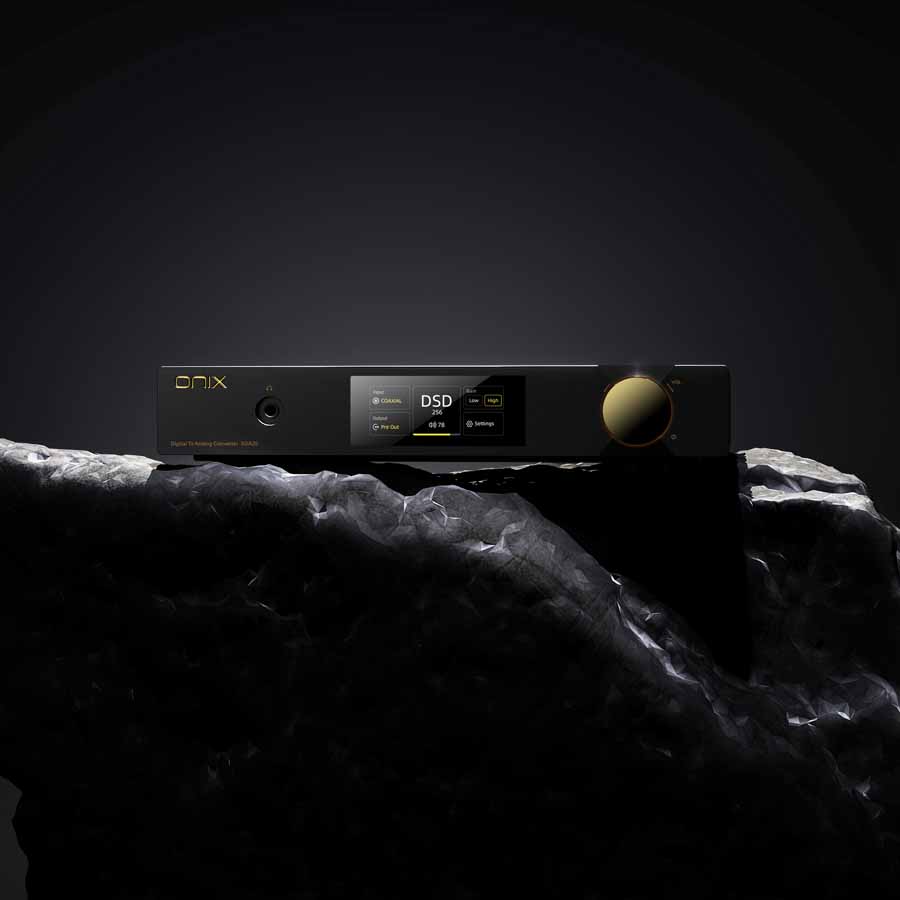
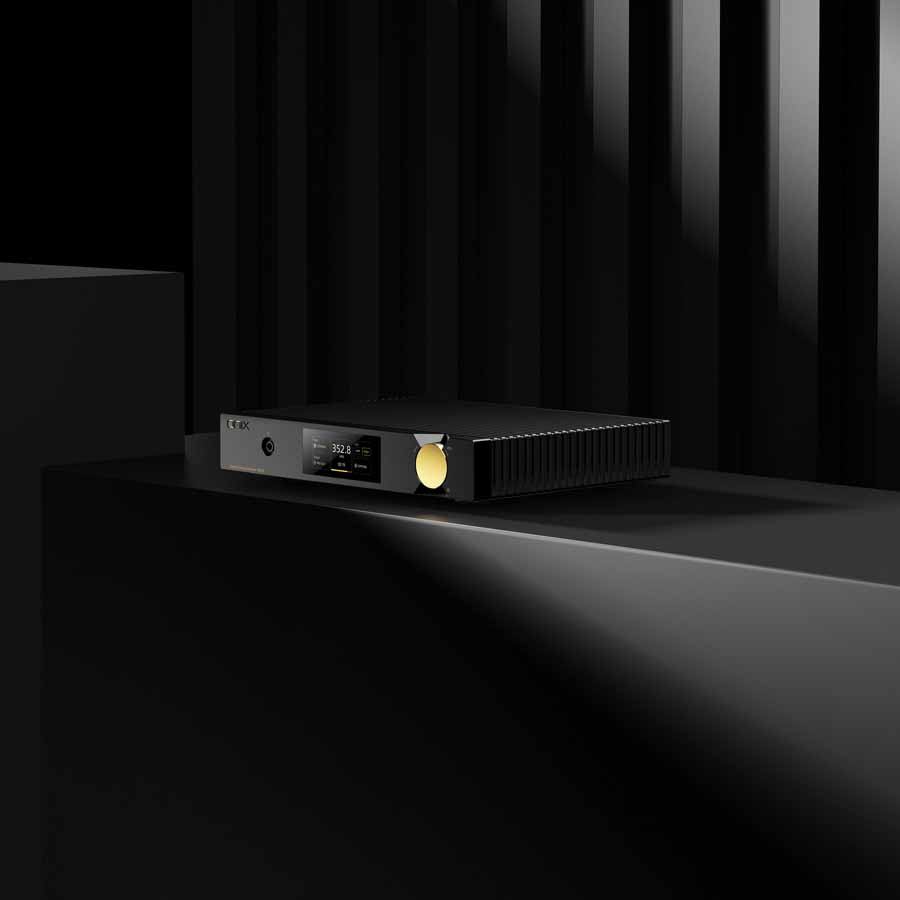
The ONIX XDA20 has a black, ridged aluminium chassis with a stylish, machined appearance, and at 5.7kg there is a surprising heft for its footprint. The front panel has classic ONIX design elements, including gold accents for the logo and product type script. Completing that look is a large rotary dial situated on the far right, which serves a dual purpose: controlling the volume and acting as the power button via a single press.
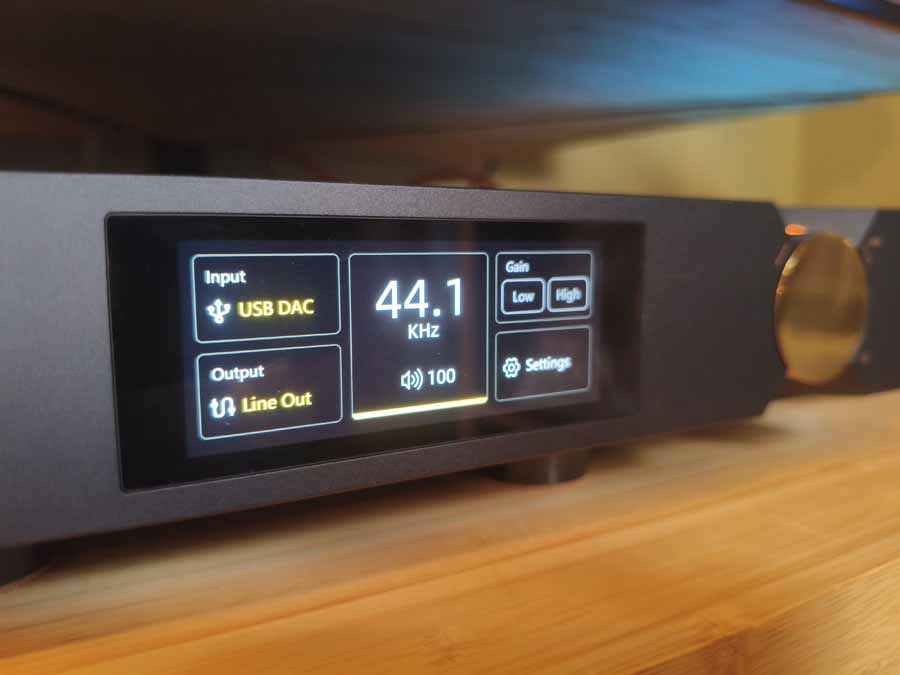
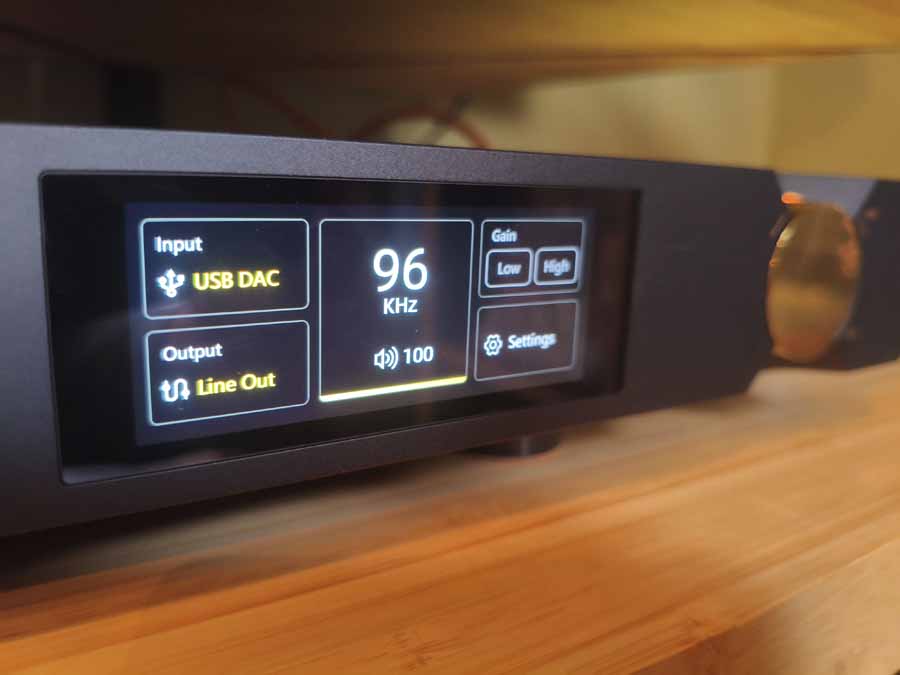
The 3.4” front panel touch screen has a crisp, clear display offering an intuitive layout of options. Through the menu, you can access and adjust input sources such as USB, coaxial, optical, AES/EBU, BNC, and advanced I2S input. Switching between these is straightforward, requiring just a few taps on the screen with no lag or glitches.
You can also quickly navigate through settings for sample rate, multi-filter selection, and display brightness. Other options accessible via the menu include activating the pre-amp mode, configuring the DAC’s operational parameters, and viewing real-time playback information.







Output modes are also easily selectable, allowing you to toggle between the line-level and headphone outputs, with the added ability to set gain to low or high for the latter, depending on listening preferences. To the left of the screen is a 6.35mm headphone output which uses a TPA6120 amp capable of 1.6W @ 32Ω.
The long, slim remote control is also logically designed, allowing you to change the same settings from the comfort of your seat. It has a brushed finish, tactile buttons, and is very responsive.
In keeping with the ethos of modern functionality, the back panel connections include an advanced I2S input. This was incorporated to provide its best performance as part of “the ultimate Source – DAC pairing.” Reclocking, jitter cleanup, and filtering are managed by an FPGA-assisted I2S circuit, which ONIX has included “…for easy matching with all types of transport” on account of its 10 different pinouts. The full Zenith series features the I2S connectivity and includes the XST20 SACD/CD and the newly launched XMT20 streaming transport, both of which have been designed to be ideal partners for the XDA20. The RCA and XLR outputs provide the analogue options.
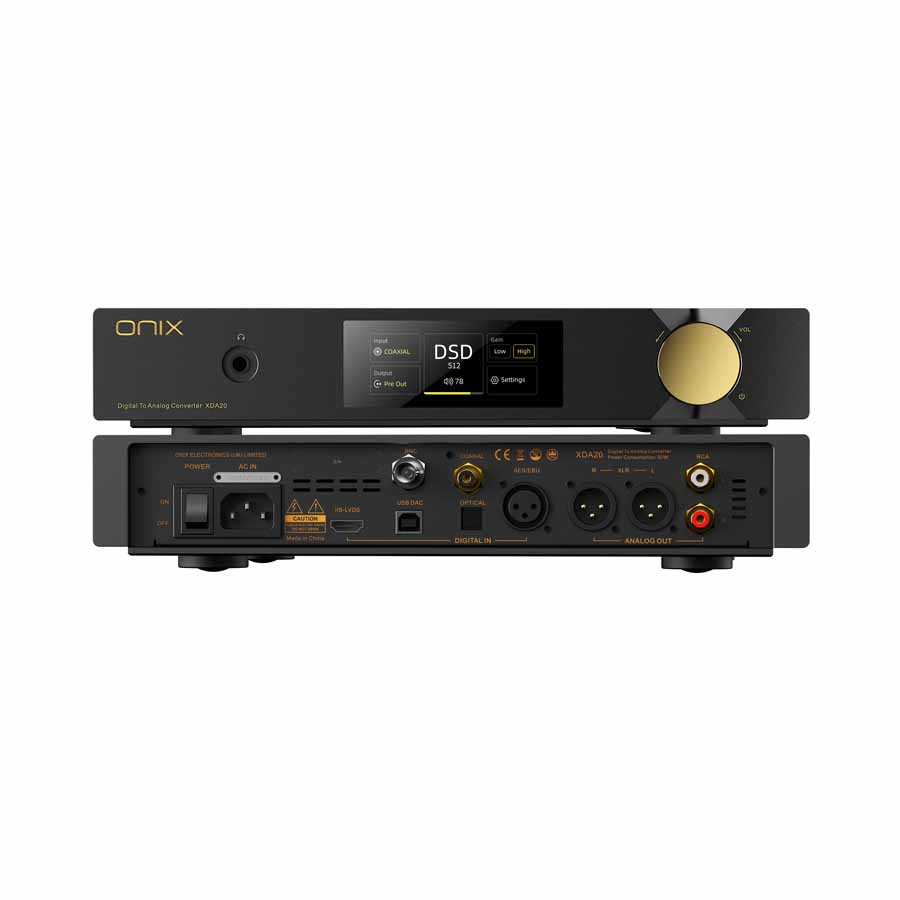
Should you wish to pair a laptop with the XDA20, for example, your preference is catered for with the inclusion of the XMOS XU316 USB input. It offers top-tier performance, future-proof sample rate support, low noise, low jitter, excellent compatibility with streamers, extremely low latency, and stable signal transmission. Further connections are the aforementioned BNC, Coaxial, Optical, and AES/EBU.
At the core of the XDA20 is a pair of ESS Sabre ES9039Pro DAC chips. ONIX developed and built their own current-to-voltage conversion stage, with a DAC circuit that uses eight OPA1611 operational amplifier chips to ensure minimal noise and distortion and excellent linearity, all of which are crucial for the high quality of the analogue output.
The system supports high-resolution PCM up to 32-bit / 768 kHz and provides DSD compatibility, including native DSD512 capability. Additionally, the power supply incorporates both 15W and 25W Talema transformers, complemented by premium Vishay capacitors for effective power filtering.
SETUP AND USE
I appreciate a product that comes in its own drawstring bag. Effort and consideration have been given to these nice touches, and everything was very well packaged.
This unit was plug-and-play. I paired it with my CEC CD player, FiiO SR11 streamer, Lab12 Pre1, and Merrill Audio Thor monoblocks. The size is ideal: not a tiny desktop box and not a full‑width component. It slotted neatly into my rack beside the FiiO. Streaming was via Roon/Qobuz for most of the review, but I did also compare CD playback for a couple of tracks. A little more on that shortly.
SOUND QUALITY
My first impression was that the XDA20 just lifts everything up. It was an initial feeling of hype with forward tuning, but it’s not that. It was about the DAC giving more life to the recordings.
The immediate surprise I got was from the quality of drums and the low end. A kick that is both felt and audibly clear is a big win for me. It can be a real letdown to have guitars and vocals in the midrange full of life, grit, and presence, only to have the critical pulse of a track be lost or muddied when arrangements are denser. So, what a joy to hear the ONIX delivering punch, depth, precision, and excitement in the rhythm section.
For Evigt by Volbeat is an upbeat, driving hard rock track that relies on the drums to be full, taut, and focused, which is what the DAC delivers so confidently. It’s a huge song with expansive depth and height. Think arena-filling proportions. Michael Poulsen’s vocals soar, extending far beyond the speakers with a reverb decay which lingers that bit longer. There is a breakdown section with banjo and acoustic guitar, which is handled to great effect, giving the feeling of real depth, space, and layering in the arrangement.
Similarly, the lead vocals on Fell On Black Days by Soundgarden remain centred throughout, even as the mix gets more involved. Chris Cornell’s rasp is natural, never grating. Excellent diction and sibilance too. The emotion comes across very well amidst the layers of guitar, bass, and drums. Matt Cameron plays the kit with real authority and control, and you get every element of the thud from the kick and the snap from the snare. It’s clear what he is playing; cymbals have a natural shimmer.
I wish I had had this quality as my reference in my teens when I was learning the bass line to play with a band. Ben Shepherd’s parts are deceptively complex and almost melodic in places. I heard none of that when I was analysing the track back then. Here I can follow every note, and it underpins the track so well. It’s a very thick sound but never dull or lacking texture.
Guitars never get congested, and harmonic overtones and subtleties are very well preserved. Overall, there is great width to the stereo field, but it always feels like the track can breathe, with a tight and coherent band at its core. A lesser DAC could easily drop the ball, resulting in a cluttered sound.
The CEC’s internal DAC is no slouch, with a warm and musical presentation. When the CEC was hooked up to ONIX, the Volbeat and Soundgarden tracks on CD had a touch more punch, separation, and a vivid feel with a real sense of scale and immediacy.
Everlong by Foo Fighters is a stress test because it can easily become a mess of indistinct mush. Imagine something like, “It sounds like a flight of stairs falling down a flight of stairs.” I found the XDA20 deftly giving me a clean bite from the guitars that never felt harsh or jarring due to the controlled upper mids. There are some big, rung-out chords that also have an excellent, smooth treble and more of that lingering decay.
At points I started to get something a bit softer and more rounded in the low register, but it never resulted in a sluggish feel. I suspect some room issues were at play here more than anything. Here and there the cymbals veered into less distinct territory, but only briefly, and I still felt the ONIX was holding everything together admirably without losing its composure. Crucially, Dave Grohl’s vocals sounded natural, with presence and body. He’s really going for it at points, and that strain came across very well. Fantastic job, ONIX/Shanling!
Conversely, a much more mellow affair is Royals by Lorde. At its heart is a sub-bass pulse which needs to be extremely well controlled. The ONIX keeps it tight and never boomy, with no smearing into the mids. This allows the vocals to really excel without distraction from the lower register. Lorde’s vocals have real intimacy and richness. You get the breathiness and clarity of phrasing from every lyric, especially once the layered backing vocal harmonies come into play. These have perfect placement and never detract from the lead.
Another consistent element of the arrangement is repeated finger snaps with a percussive quality. These ring out and expand beyond the boundaries of the speakers with crisp, fast delivery. The airiness to the overall track is the true winner here, though, with a dead, inky black silence in the background.
Hide and Seek by Imogen Heap allowed me to further test this quality of vocal handling. A vocoder is used, layering vocal harmonies that are super smooth and clean. Despite the electronic influence of that, it’s still a natural sound that comes across with a beautifully textured feel. There is nowhere to hide here, as it’s purely a vocal arrangement. The separation is fantastic; the swells feel natural and flowing, never forced.
There is drama from the mix that washes over me and into the distance behind as it rises outward and upwards. Digital processing could result in an overly clinical presentation, but that is not the case here at all.
Next, I wanted to hear just how well the DAC could handle a fully instrumental piece. Rachmaninoff – Adagio Sostenuto (from the Piano Concerto No. 2, performed by Yuja Wang & The Los Angeles Philharmonic) is a completely different test for the ONIX. Yuja’s piano has a wonderful midrange richness, with a sweetness to it. It touches the heartstrings. Talking of strings, you can actually hear the felt of the hammers hitting them in softer passages. That level of detail is just brilliant. There is a great resonance to the piano; at points, it really feels physical as Yuja digs into the more intense and percussive sections.
The DAC also demonstrates just how resolving it can be when tackling the strings of the orchestra. It’s simply lush and warm, with impeccable layering that is always supporting the piano, never dominating, despite its fullness. The dynamic swells are tangible too, never dull or flat. There is fluidity as these build and lift. The depth of the imaging is outstanding.
With a pair of Sendy Apollo planars, the headphone stage proves surprisingly capable. It is balanced, non‑fatiguing, and has enough drive to make Everlong enjoyable even at higher volumes. On gentler tracks like Wicked Game (Chris Isaak) and Don’t Know Why (Norah Jones), the presentation is immersive and smooth. I could easily see this DAC doing a brilliant job in a desktop headphone setup.
QUIBBLES
If I were hard-pressed to think of something that might be a quibble for some people, it would be the gold colour of the wording and power/volume dial on the front panel. It may not be everyone’s taste. Providing the option of an alternative finish might be wise to broaden its appeal. From my perspective, though, there is nothing gaudy about the look.
The various filter settings, while nice to have, provide only subtle changes to the overall sound.
CONCLUSION
The combination of solidity, intuitive operation, and musical performance makes it enjoyable. What stood out most was how consistently it brought clarity, punch, and presence to every track: from dense rock mixes to sparse vocal arrangements and full orchestral swells. It’s a DAC that brings out the best in my existing gear rather than imposing its own character. Its flexibility, build quality, and listenability make it a compelling choice in the £2–3k bracket. I give this product a 5/5.
AT A GLANCE

Build Quality And Features:
Robust, heavy aluminium chassis. Excellent machining
Reassuring weight
Clear, intuitive touchscreen with a sharp response. No lag or glitches
I2S – This kind of flexibility is what you might expect of a DAC such as this
Sound Quality:
Forward presentation and a very lively, vibrant presence
Dynamic, punchy low end
Clear midrange
Stable imaging
Excellent vocal handling
Value For Money:
Impressive performance for the price; competitive with DACs in the £2-3k range
We Loved:
Drum realism
Vocal intimacy
Connectivity options
Distinctive and attractive finish
We Didn’t Love So Much:
The various filter settings may be of value to some but didn’t bring much to the party for me
Elevator Pitch Review: The ONIX XDA20 is a beautifully built, highly engaging DAC. Drums hit with realism, vocals have intimacy and texture, and the midrange stays clean and expressive even in dense mixes. It has excellent connectivity, intuitive controls, and a refined aesthetic. It performs so well that the best thing I could say is that it really makes me want to revisit much more of my collection.
Price: £2399 $2399 €2600

Michael Fairbairn
SUPPLIED SPECIFICATIONS
Weight: Approximately 5.7kg
Dimensions (including base): 32 X 24 X 6.2 cm
USB DAC Input: XMOS XU316
Controls: Touchscreen / Remote Control / Volume Wheel
Packaging Includes: Remote, Power Cable, Manuals
Interface:
Digital Inputs: COAXIAL / OPTICAL / BNC / AES EBU / I²S / USB
Analog Outputs: RCA / XLR
Headphone Output: 6.35mm
Supported Hi-Res Specifications:
SPDIF Inputs: PCM: 192kHz / 24bit, DSD: DOP64
I²S Input: PCM: 768kHz / 32bit, DSD: DSD512
USB DAC Input: PCM: 768kHz / 32bit, DSD: DSD512
RCA Output:
Output Level: 2.1V
Frequency Response: 20Hz-40kHz (-0.5dB)
THD+N: 0.0003% ([email protected])
Dynamic Range: 123dB
Channel Separation: 122dB
Signal-to-Noise Ratio: 123dB (A-Weighted)
Noise: 117dB
XLR Output:
Output Level: 4.2V
Frequency Response: 20Hz-40kHz (-0.5dB)
THD+N: 0.0003% ([email protected])
Dynamic Range: 127dB
Channel Separation: 126dB
Signal-to-noise ratio: 127dB (A-weighted)
Noise: 114dB
6.35mm Headphone Output:
Output power:
Low gain: 101mW@32Ω (1.8Vrms@32Ω)
High gain: 1620mW@32Ω (7.2Vrms@32Ω)
High Gain: 252mW@300Ω (8.7Vrms@300Ω)
Frequency Response: 20Hz-40kHz (-0.5dB)
THD+N: 0.003% (A-Weighted @ 1Vrms)
Dynamic Range: 121dB
Channel Separation: 69dB
Signal-to-Noise Ratio: 120dB (A-Weighted High Gain)
117dB (A-Weighted Low Gain)
Noise: 112dB (Low Gain)
Output Impedance: 3.3Ω