

MW Stands Cyntaf HiFi Rack
MW STANDS CYNTAF HiFi RACK REVIEW
I don’t normally get that excited by HiFi stands, but the new stands from MW really got me interested when I visited Audio Show Deluxe earlier this year, and particularly with creator Michael Wall turning up with a four-tier stand to place into my music room.
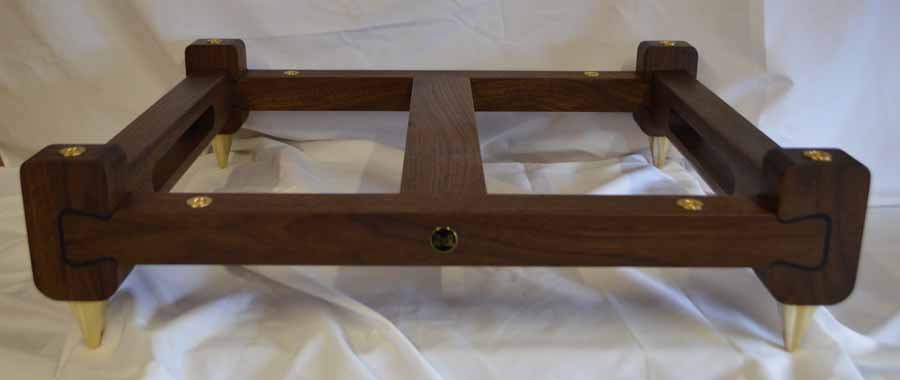
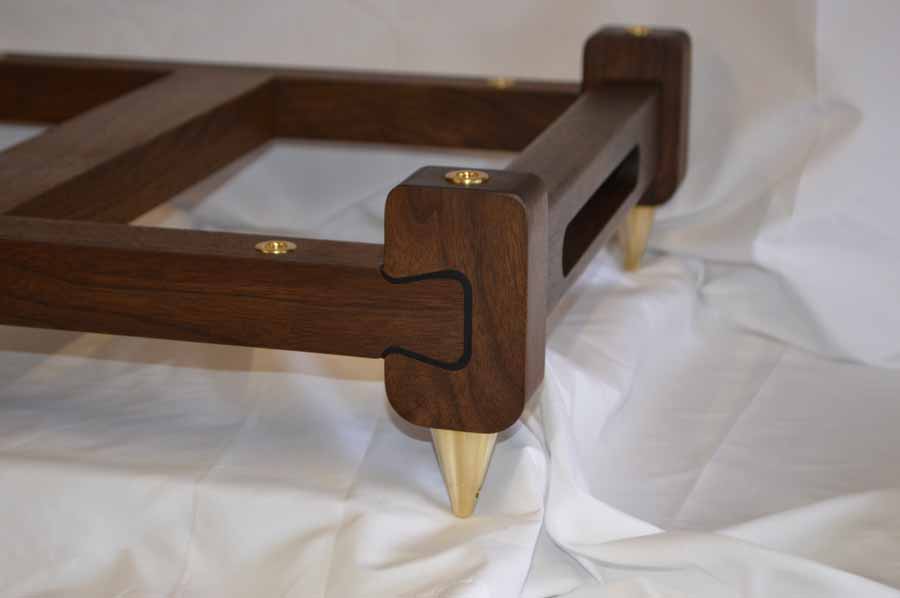
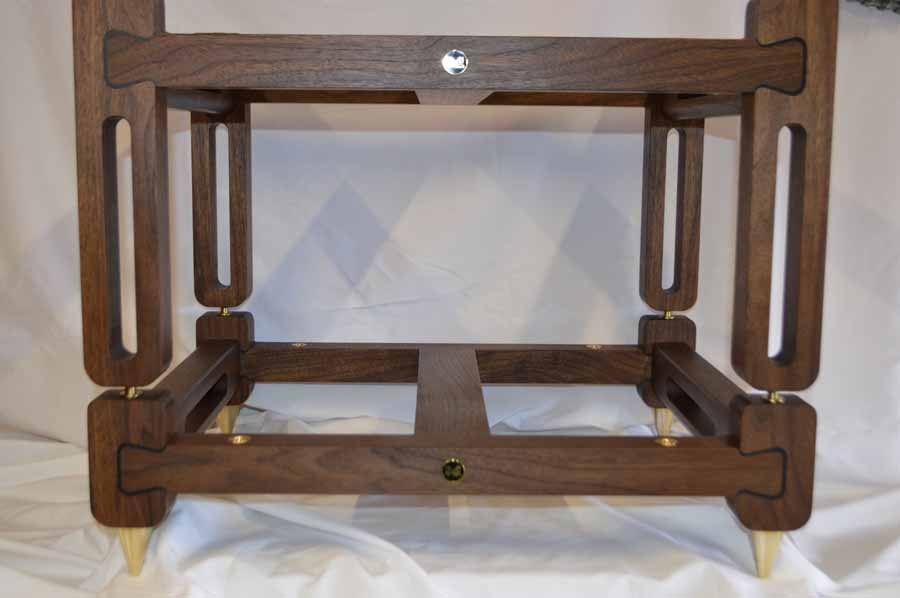
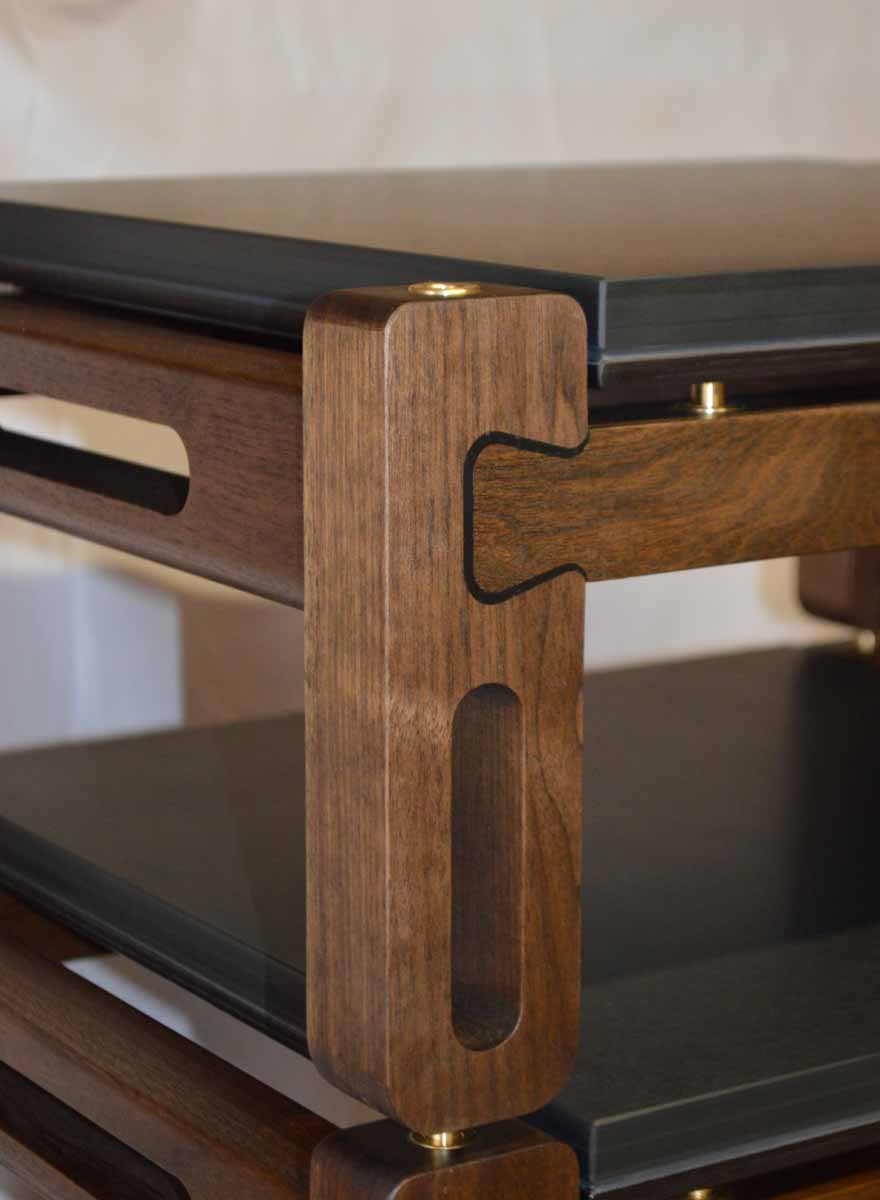
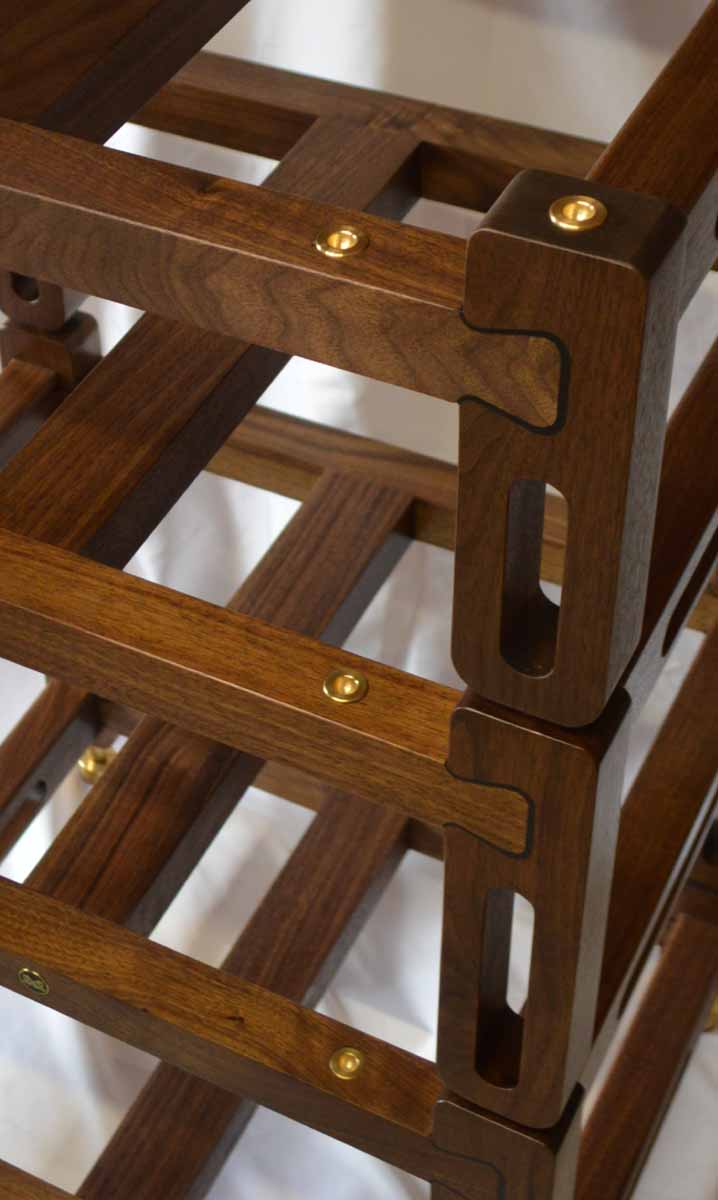
Forget for a minute the technology; just admire the looks and jigsaw-puzzle dovetail joints. The stand would look just as good in Tate Modern as in my house. The Cyntaf (meaning “first”) is certainly the first of its kind, a new stand from a new company, though its looks are as important as the components in the design. It isn’t cheap, but neither are original paintings and sculptures in Tate Modern. The amount of work in constructing each one – around 50 hours – let alone the components, will not be cheap. As in life, you get what you pay for, just as I heard recently some new “cheap” EV’s are rusting quicker than their batteries are discharging. At £3,000 per “level”, the 4-tier stand sent to me for review comes in at a heavy £12,000, but if you have decent-looking and expensive HiFi you wouldn’t want to sit it down on anything less. You will also need muscles and decent flooring to put these into position, all in at over 100kg. With a mixture of brass, wood, slate and lead, these are no lightweights.










There are generally two types of HiFi stands: those with rigid coupling not only keep everything firmly in place to prevent micro-movements, but the coupling can also improve bass tightness and musical timing, whereas elastomer or sprung support generally gives a cleaner and more open soundstage. The Cyntaf is the former. With Welsh wood and slate, and the name Cyntaf, it comes as no surprise that these come from a village in Wales, and the name MW is not Michael’s initials, but rather they are short for “Mid Wales”, all constructed by a passionate master carpenter and joiner of 35 years.
Michael first built a few stands some 20 years ago, but only now has he returned to do it as a career and passion. His love of audio comes from his childhood, learning about playing records from his uncle, and as an adult with various HiFi set-ups, he found that one of the best upgrades was actually what the components sat upon, hence his desire to build the “Cyntaf” stand. The styling and detailed construction are nothing less than first class. Michael admits to wanting to create the very best with the very best materials, just as a violinist would like to choose Stradivari and a pianist Steinway. Anything less just wouldn’t be good enough. But looks alone aren’t everything; “The priority was finding materials from nature that were suitable for dealing with vibrations and resonances from those given off from music reproduction.” It’s just the same with the varnish on a Stradivari and the wood grain on the Steinway soundboard that gives them that special sound. Having worked with so many timbers, he knew that close-grained Maple was the perfect choice for his stands. As well as Maple, he also found a supplier that could guarantee a supply of black Walnut that comes from the heart of the tree; very expensive but, as he told me, “It meant the Walnut was classed as close-grained”. Walnut further away from the centre of the trunk is more open-grained, but it is not really suitable. The tighter grain meant it contains more micro dampers within the structure. Having black walnut also enabled a contrasting colour to the Maple. “I tried using dyes and stains, but due to the very tight grain of Maple I could not get consistent results, and I would not put my badge on them. I scrapped a total of four full Maple stands trying different finishes!” Thus, MW makes two versions: the lighter-looking wood using Maple and the darker-looking Black Walnut, which is what came to me for review.
The design of the Cyntaf took much work and thought. Having originally made a stand with Maple and nothing else, he found that the music lost its direction, becoming too stark and less enjoyable. “Slate was something I had known about for a good few years as a material that could help with using too much Maple. As I was building one of the best stands on the market, the only slate suitable was Welsh!” The finest slate comes from the Welsh Slate quarry, a mud stone made up of layer upon layer of compacted slate. It is incredibly dense and stable, and dissipates unwanted vibrations to provide a rock-solid, non-resonant surface for your components, and even better with a layer of lead in the middle. As Michael told me, “It’s this make-up that makes it special, unlike granite or any ceramics. It is not cold and lifeless sounding. Combined with the Maple, it was a revelation in terms of performance”.









BUILD AND FEATURES OF THE MW STANDS CYNTAF HiFi RACK
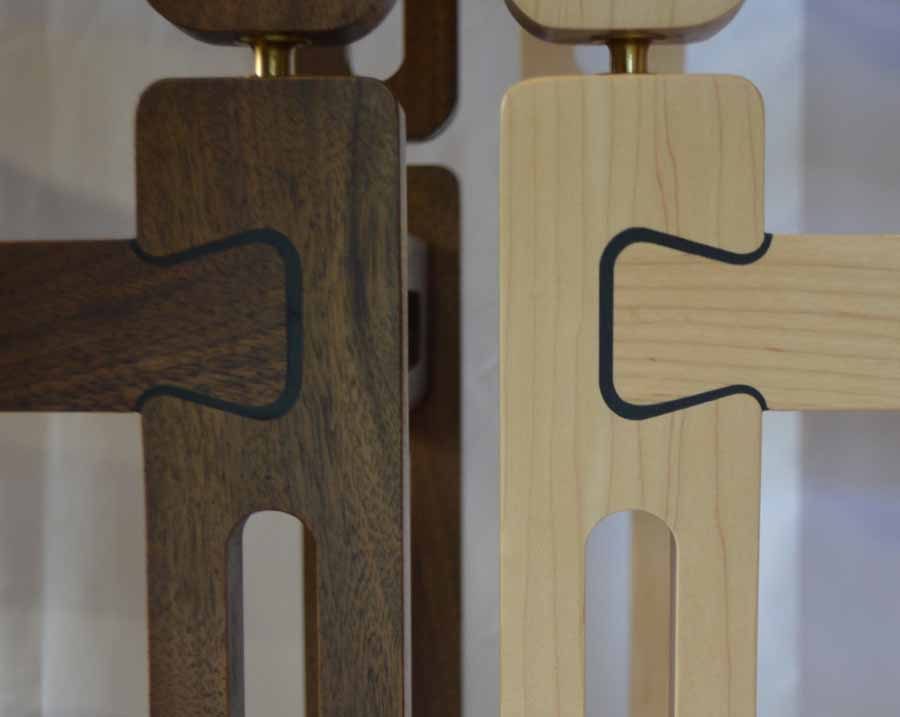
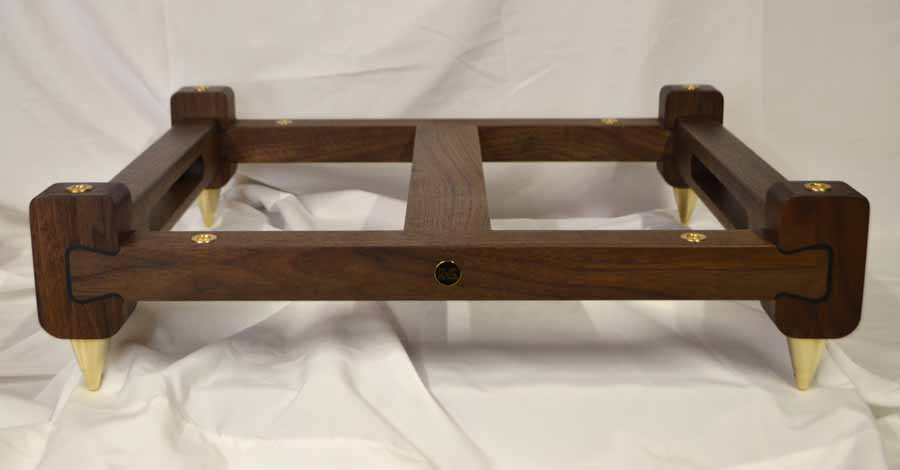
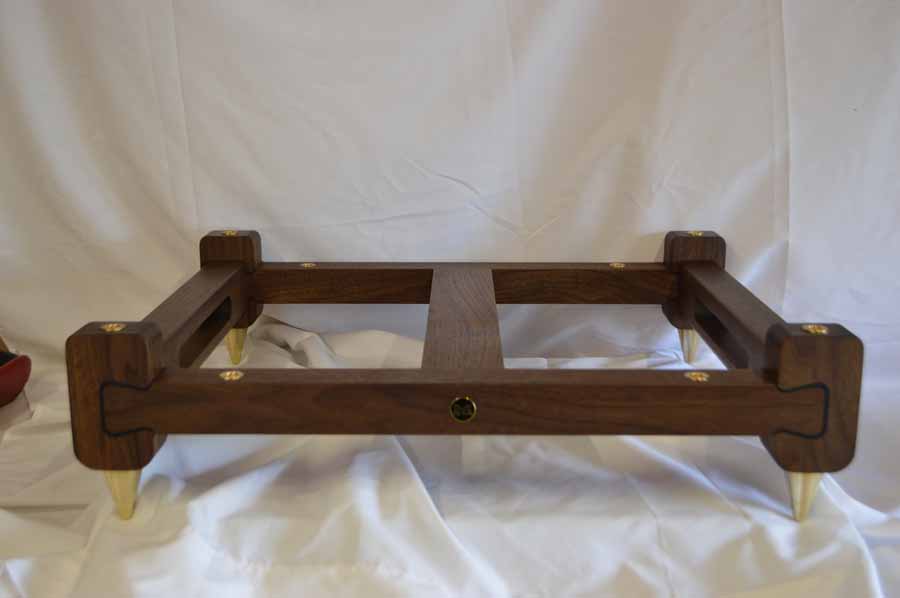
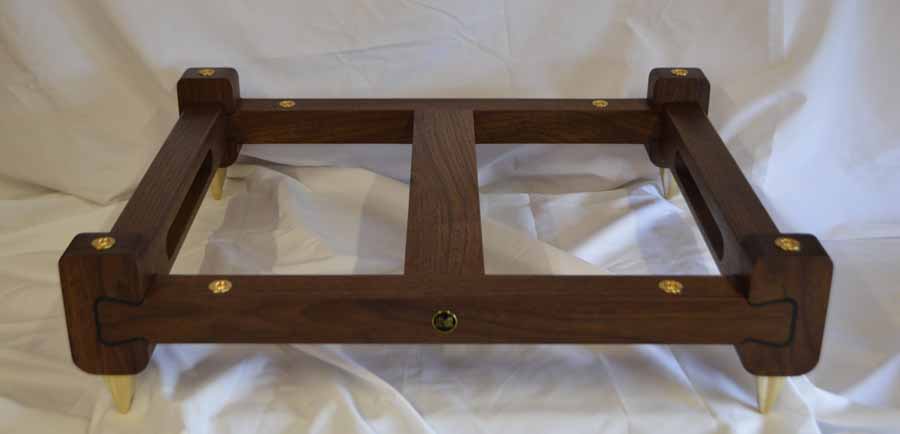
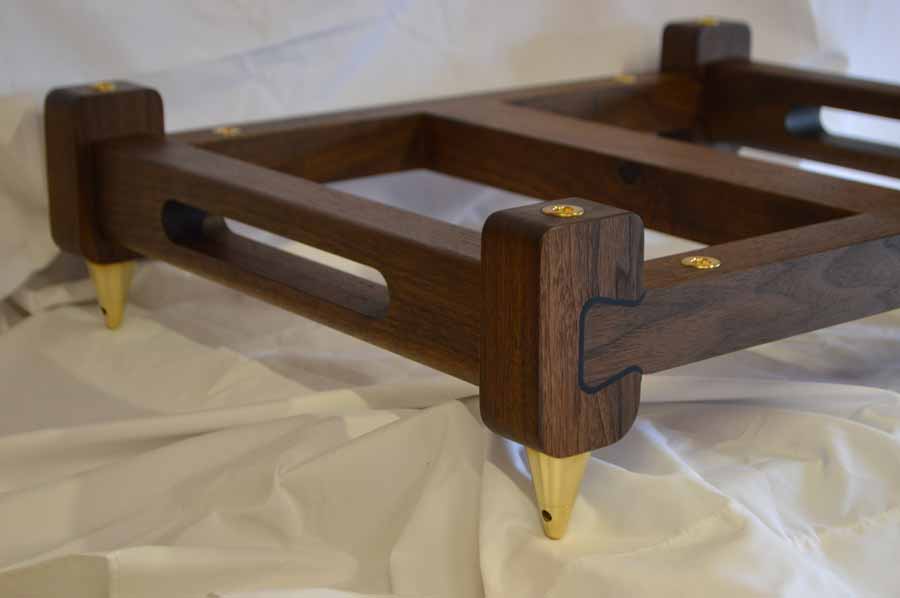
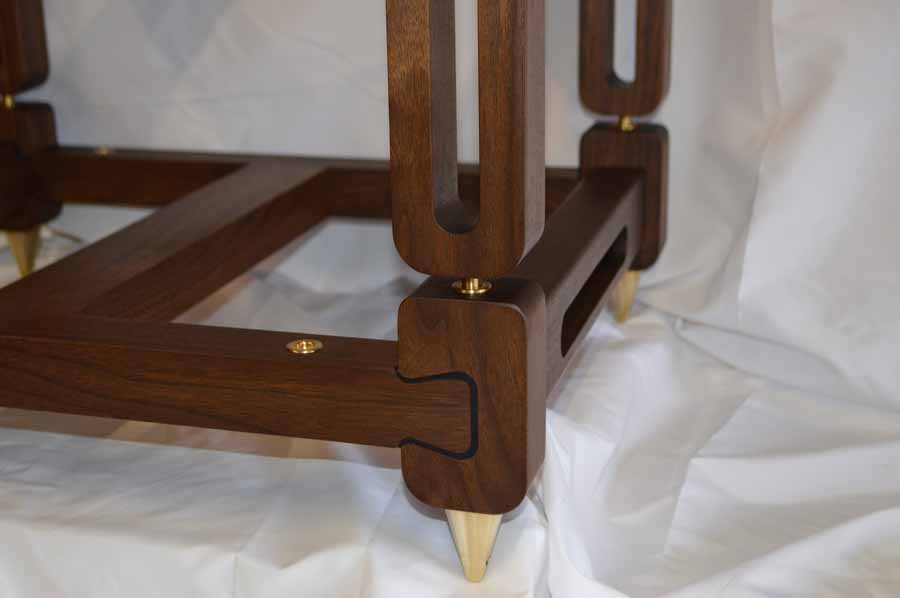
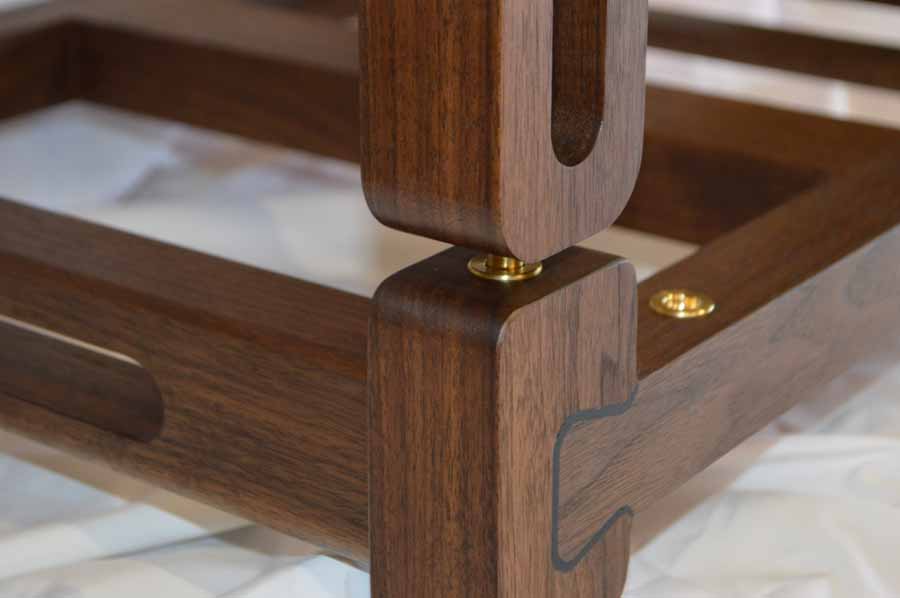
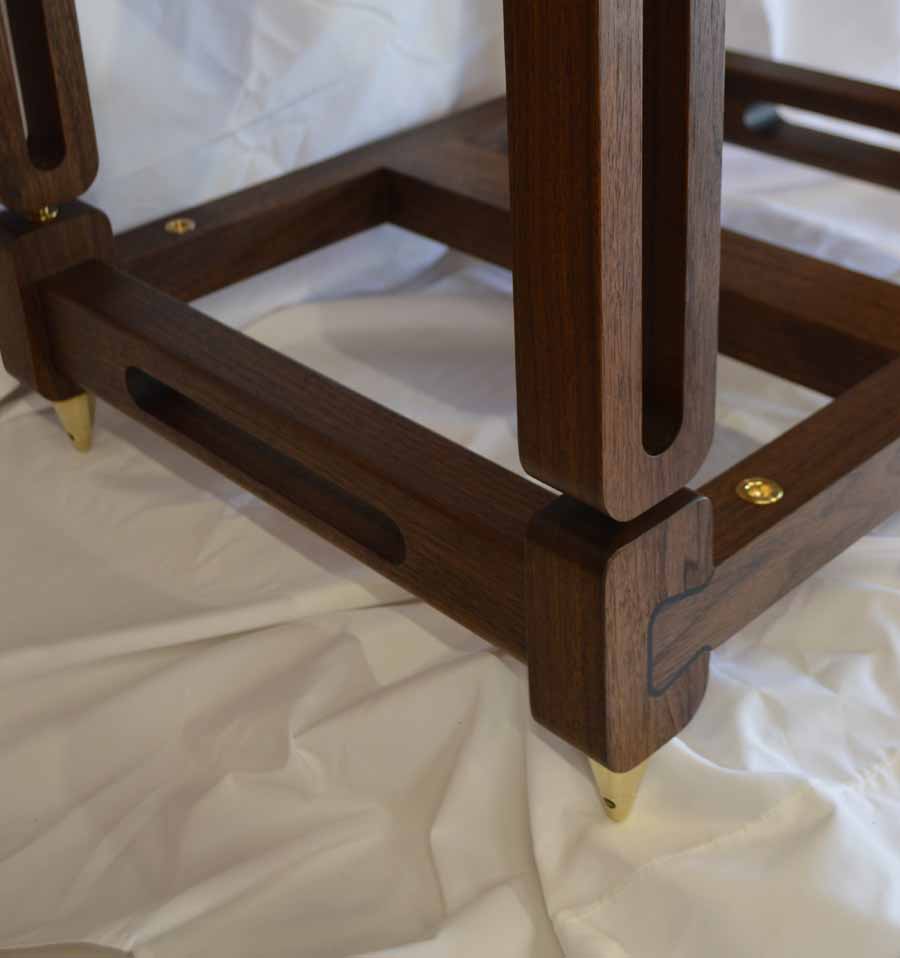
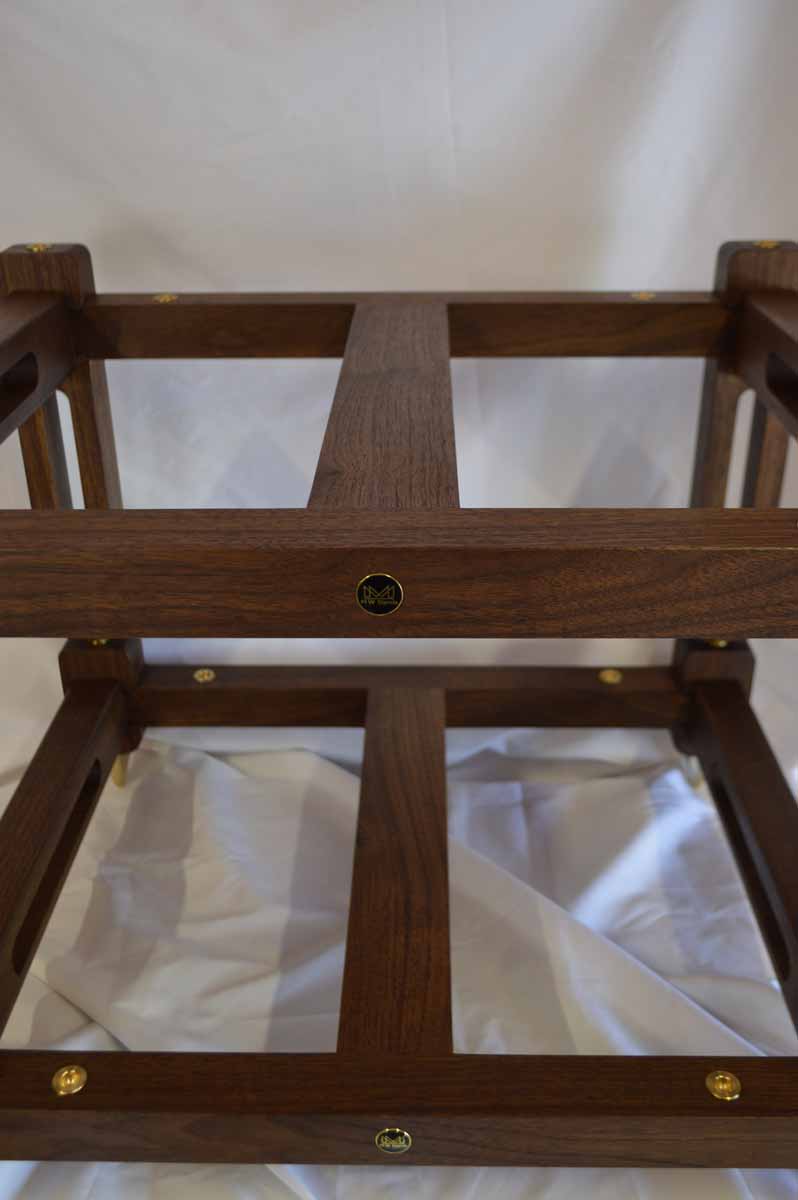
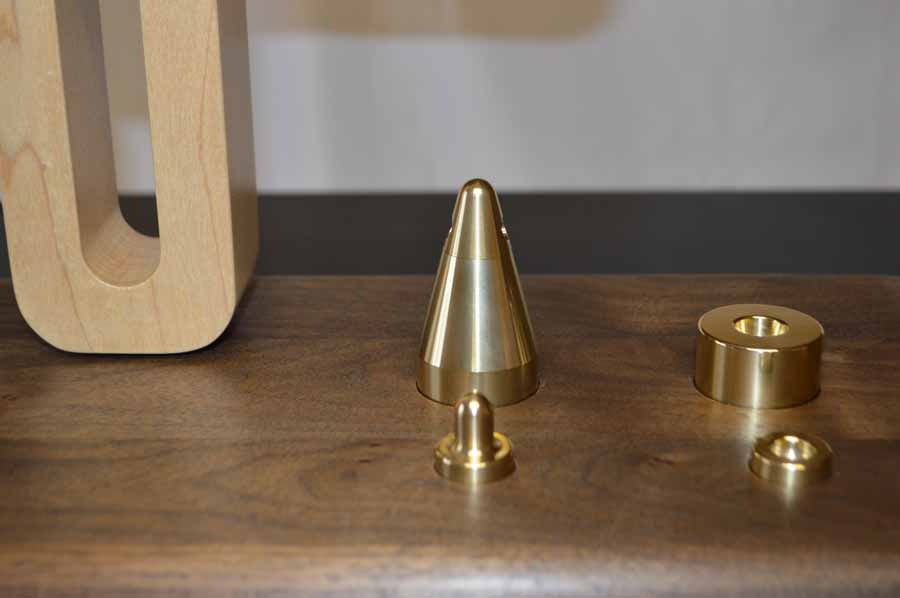
There is a lot that goes into the design of a stand that performs to improve the sound of your HiFi components. Michael’s research and testing showed him that open-grained hardwoods such as Oak and Ash just didn’t perform as well as the close-grained Maple. He found that they muddied the sound somewhat and lost some of the life from the music. As well as the choice of wood, the resin used in the dovetail joints is equally important in stemming the vibrations. Michael refers to it as “the connection that dis-connects”. He started with a straight-sided dovetail, but it didn’t look good, so he doodled and came up with what we have now. Having tried several resins, adhesives and techniques of inserting and hardening it (In the design stages, resins leaked or didn’t look right at the joints), he has finally come up with an extremely high-grade resin that not only works but also looks really good, creating a pseudo-floating joint. The joint is intended to prevent vibrations from travelling into the core frame, where your electronics are, or from travelling between tiers. Similarly, cuts in the wood to the front and sides not only look great and slightly reduce the mass, but are also handy as a holding point when carrying them into place, like a well-designed bed dinner tray for your lazy in-laws. The surface for your HiFi not only needs to look good, but it should be specifically designed to dampen any vibrations, so for this reason there is a sandwich of 20mm slate, 1.5mm code-4 lead sheet and a 9.5mm Birch plywood base to ensure that your HiFi is held as still as possible. Michael found that when tapping the slate, it was “deader” after adding the lead layer. Each tier of the stand is connected via brass fittings (domed brass pins on the underside that fit into a brass socket at the top of the stand section below) and with exquisite adjustable brass coned feet that sit on a brass ring on the floor. Brass was chosen as an alternative to stainless steel as it is denser but softer. Centre front is the understated brass/black MW badge to show off its pedigree; anything bigger or bolder would make it look like Citroen as opposed to Bentley. The Cyntaf therefore combines a deliberate system of constrained layer damping in a very solid design, with every material chosen to make this effective, dealing with air- and ground-borne vibrations as well as damping down those resonances from the electronics.
SETUP AND USE
Luckily, apart from creating the space to put it down, the setup was all done for me, but it really is a piece of (four-tier) cake. Each layer is pre-assembled, and only the heavy slate sandwich needs to be put into place. The supplied stand allowed access for 19” rack-sized apparatus to be easily configured where I wanted it. Available in three heights, 165, 215 and 265mm, with overall width and depth 632mm and 500mm respectively. Each size is the same price as it requires the same time, brass and slate to manufacture. Michael can also build it to any other specification you desire. For the review, I really wanted to test that vibrations were minimised and that the equipment could behave at its best, so I placed my Rock 7 turntable at the top, my Krell CD player next, and then my valve mono-blocks below that. I also used my Leak Stereo 20 tube amp, because that can add microphony if not held on a rigid surface; whilst the dated audio design is great, the chassis is not ideal. Whilst I had added damped feet when I mod’d it, the metalwork and valves can ring like mad! I also purposely removed the damping rings on the EL84’s and ECC83’s for that very purpose.
SOUND QUALITY
I was quite startled by just how good the stand was when I started playing. My CD player tracks just seemed “tighter” and more in focus. This was a big surprise for me because the Krell KPS20i has lots of mass and support. The turntable similarly was quieter and more confident in its playing. Everything seemed more controlled and lifelike. Heavy components could really benefit from this stand. Many stands seem to accentuate the errors in the HiFi separates, whereas this stand seemed more to show errors in the recordings, like the bad mic’ing in a few albums I played. Most noticeable improvement, though, was the extended and confident lower bass. The lower strings in Beethoven’s Symphony No. 7 second movement (Herbert von Karajan, Berlin Phil), particularly from 4’21”, were really rich and poignant. The stand helps to unpack the music really clearly, with both great passion and compassion, in this highly emotive movement. I forgot I was listening to a digital source. The “Szene an Bach” second movement of the Pastoral Symphony was equally precise with great spatial awareness, especially the bird sounds in its final minute. Vocals were also allowed to breathe and become lifelike, for example Alison’s voice in Goldfrapp’s “Annabel” (‘Tales of Us’), even if this close-mic’d vocal is EQ’d and reverb’d to the hilt. This is actually a really gorgeous track that became even more intimate through this stand, though the 3D soundstage wasn’t quite as good. Turning to vinyl via my valve Manley Steelhead, I played the epic “Kind of Blue” album from Miles Davis. The track “Blue is Green” was very colourful with expansive sound, especially from the trumpet. His playing just sounds almost like a clarinet in the sense of its sweetness and emotion. There really is beautiful playing aided by the tight brushed snare drum on the right, sounding like someone is sweeping the floor on the stage. I just love the repeating melodic and rhythmical lines in this album, which hold it all together and remind me somewhat of the excellently recorded ‘A Day in the Life’ album from (also) trumpeter Quentin Collins. Both these albums shout jazz, emotions, and audiophilia.
From trumpet to piano, the stands really did help to gain an authoritative and compelling performance from this percussion instrument. “Funeral for a Friend” and “Bennie and the Jets”, two of my all-time favourites from Elton John, really did give the 9ft grand piano a few extra feet, sounding more life-like than I was used to, especially when tried through the Leak Stereo 20. The acoustic guitars in the latter track also appeared more forward than I was used to. Even the synthetic strings at the start of the Yes album ‘Mirror to the Sky’ sounded almost real; a very open sound that widened the soundstage more than I expected. Even the distorted guitars on the right speaker on “Cut from the Stars” cut across with great detail and speed. The microphony on the LS20 is such that banging any surface will cause noises, and whilst this still happened from the shelf it was on, it lessened slightly when tapping other areas. I always get out my phone vibration meter when testing stands or turntables, as that is so important to check. The MW is not sprung, like my Townsend rack, which reduces vibrations really well, but the depth of musicality from the MW far outweighed any savings I might have in that respect. Just as sprung and solid turntables sound so different, the solid MW Cyntaf really does add to that bass extension and mid-band detail. It’s all springs and roundabouts, I guess! “Luminosity” is my favourite track from the Yes album with its deep bass and lead guitars and constant key modulations, and the stand helped give more defined and quicker initial transients than I had ever heard this track on the ancient Leak. Old meeting the new really was a marriage made in mid Wales.
QUIBBLES
Apart from wishing Michael would work for free to bring down the cost, it is actually hard to find any faults in the build and design.
CONCLUSION
There are basically two choices with HiFi stands: solid structures and those with springs or bellows. Each works in different ways and with different sonic results. I have both sprung and solid stands for different types of components. The MW Cyntaf gave me much improvement and extension in the lowest frequencies, plus a more human touch for vocals and violins, with notable changes particularly from the amplifier and turntable.
If you have expensive HiFi that you need to give the best platform, not just for looks but to get even greater musicality from, then these wonderful-looking designs from Mid Wales will certainly be giving your separates a Cwtch (Welsh for a safe place or loving cuddle). Plus, being a modular design, you can just keep adding more tiers when you need to. It certainly won’t be tears.
AT A GLANCE

Build Quality and Features:
Exemplary build and design, with much thought into use of materials
Sound Quality:
Notably extended bass from my valve amps, and warm mid-frequencies with greater detail
Value For Money:
This is for those who have pride in build and value their HiFi to reside on only the best platforms
As the saying goes, you get what you pay for, and this certainly is the Rolls-Royce of stands
We Loved:
Build quality
Looks; your HiFi will also look its best on this stand
Improved detail in bass
Better timing
Improved musicality in mid-frequency vocals and violins
We Didn’t Love So Much:
That I’ll need to save up my pocket money to buy it
Elevator Pitch Review: We might well be happy to spend lots of money on our HiFi components, but cabling and stands tend to be more of an afterthought. During my half-a-century of collecting HiFi, I have realised that these two elements really are the blood that feeds the heart of the system, keeping the music alive. Whilst I don’t normally get my own heart racing at the sight of stands, this one really got my attention, especially in its unique looks and use of vibration-deadening slate, so I wanted to find out if my music would similarly come to life. At £3000 per tier, your wallet will need to be well fed, though.
Price: £3,000/tier (this 4-tier version is £12,000)

Janine Elliot
SUPPLIED SPECIFICATIONS
Model Name: Cyntaf
Configuration: 3- or 4-tier rack (customisable)
Shelf Material: Honed Welsh slate (natural riven pattern)
Legs: Solid Maple or black Walnut, single-length cut, hand-finished
Finish Options: Natural oil, custom finish available on request
Fixings: Solid brass precision hardware
Width: 498mm internal /632mm externalChoice of Dimensions (W × D × H): 632 x 500 x 165mm / 632 x 500 x 297mm / 632 x 500 x 247mm / 632 x 500 x 709mm / 632 x 500 x 1,006mm
Weight: Base 25kg; others between 26kg and 26.7kg (3 Tier Rack 77.7kg; 4 Tier Rack 104.4kg)
Load Capacity: 140kg base, 80kg per tier
Origin: Handcrafted in Wales