
Technics SC-CX700 Speakers and SL-40CBT Turntable
TECHNICS SC-CX700 SPEAKERS AND SL-40CBT DIRECT DRIVE TURNTABLE REVIEW
I’m a bit of a Technics fanboy and have several of their turntables in the house, including a pair of Mk7s, a MK2, and a G, with the latter being the heart of the current reference system at Hifi PiG Towers, though we ordered the latest iteration immediately on hearing at the launch in Warsaw late last year – I can’t wait for it to arrive and get it plumbed in. I’m also a big fan of brands that recognise that not every music lover is an audiophile who wants a whole load of boxes of gear in their homes. The vast majority of music lovers want something easy to set up and use, but which also offers great sound for their tunes, and increasingly to act as a hub for their home entertainment system, which might include TV, gaming, streaming, and physical media.
BUILD AND FEATURES OF THE TECHNICS SC-CX700 SPEAKERS AND SL-40CBT DIRECT DRIVE TURNTABLE
I think the easiest way to tackle this review is to look at the two products that make up the package (the speakers and the turntable) individually, when it comes to their build and features and thereafter to treat them as a full system. Frank Balzuweit and Simon Pope of Technics went to great efforts to go into a good deal of detail on the two items during a 45-minute online presentation, and so I think the products deserve to be explored and explained in detail.










Let me say, I like the concept of this system and believe that outside of the dyed-in-the-wool audiophile community, these are the kinds of products that will have mainstream appeal. It may be that these products, and other systems like them, act as gateway products where folk move on to explore a more committed and complex audiophile setup, or they might well offer a buy, fit, forget, and enjoy experience where the consumer finds the products perfectly acceptable and sees no need to get into the whole upgrade cycle.
Technics SC-CX700 Wireless Speaker System
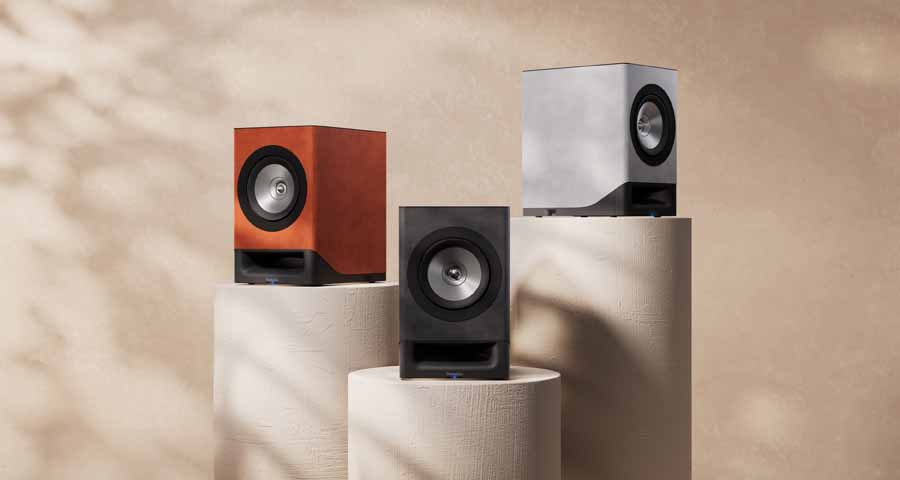
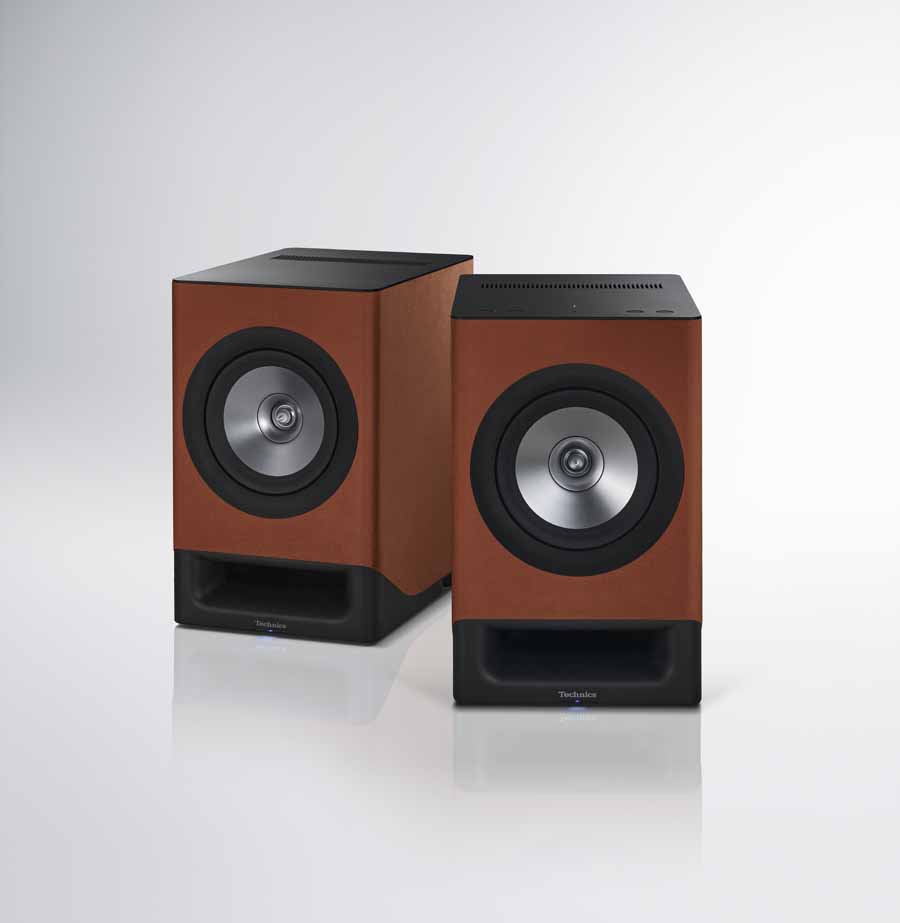
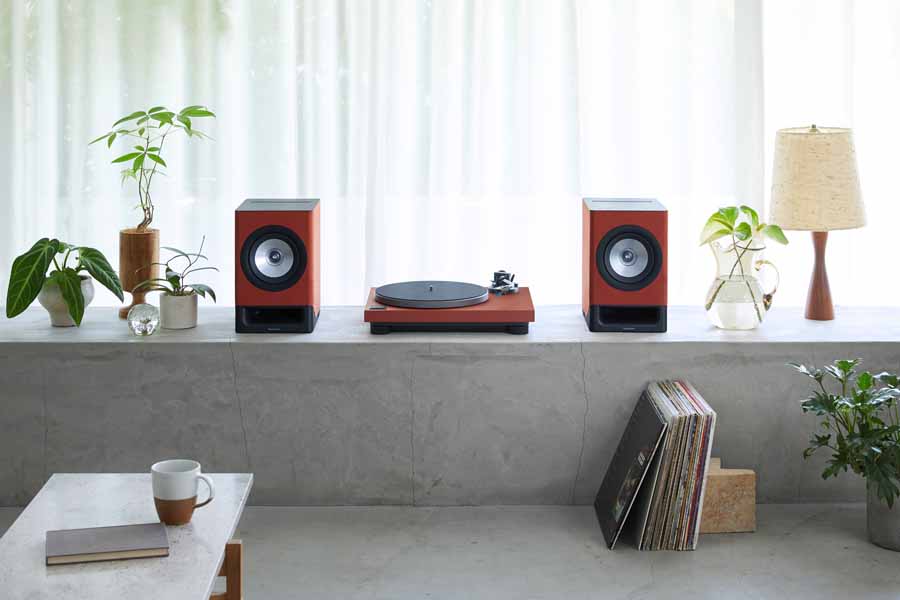
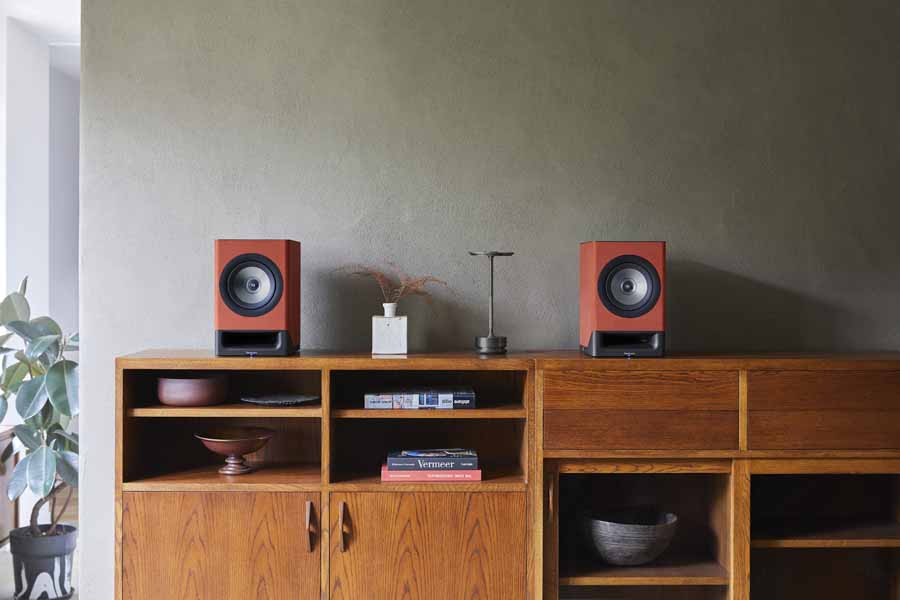
The SC-CX700 features a premium exterior finish in Dinamica™, a high-quality microfiber material with a suede-like texture, produced in part from recycled polyester. It is available in three finishes: Terracotta Brown (which I had), Charcoal Black, and Silky Grey.
The system comprises a primary speaker weighing 9.1kg and a secondary speaker at 8.9kg. Each unit measures approximately 201 x 313 x 276 mm, maintaining a compact footprint suitable for flexible placement. Placement is a primary concern for this kind of speaker, and I believe the vast majority of buyers will choose to use them placed on shelves or existing furniture, not on dedicated stands. With this in mind, the front-firing port (I’m a fan of front-firing ports) is a sensible consideration.







Technics describes the SC-CX700 as offering a layout-free experience. The left and right speakers can connect wirelessly, supporting PCM 96kHz 24bit. For higher resolution playback, a wired connection supports PCM 192kHz 24bit. The included connecting lead is a bit short for anything other than placement at either side of a television. However, I reckon that many will place them in exactly this position.
Physical and wireless connectivity options include HDMI ARC for integration with televisions, a PHONO MM input for turntables, plus Wi Fi, Bluetooth, and AirPlay compatibility. Again, I really like this concept and believe that users are likely to see this Technics system as a digital hub for their home. TV, Gaming, and music all dealt with by a pair of speakers, and in this case, a turntable.
Operation is handled via the Technics Audio Center app (iOS and Android), the included remote control, or an integrated touch panel located on the top of the primary speaker. I used primarily the app and the remote.
Space Tune™ technology is included to optimise sound quality based on the installation environment. It provides four presets, an Auto adjustment mode, and a Measured mode for more precise calibration using iOS devices. This is clever stuff, and whilst it’s not real-time DSP control (as such), it does use real-world modelling to adapt the speakers’ performance to the space they are being used in. I played about with the speakers in standard mode and then did the whole Measured mode thing.
At the heart of the SC-CX700 is the Technics Orchestration Concept, integrating speaker, amplification, and signal processing expertise into a unified system design.
Acoustic Solitude Construction physically separates the amplifier chassis from the speaker enclosure within the unit to improve vibration resistance and prevent unwanted transmission between sections.
The Phase Precision Driver 4 coaxial unit follows Technics’ point sound source and linear phase concepts. It incorporates a lightweight ring tweeter.
Model Based Diaphragm Control uses movement simulation to reduce harmonic distortion caused by long diaphragm excursion in compact speakers, with the aim of improving sound separation.
Each speaker contains its own full digital JENO Engine amplification stage. By equipping both the primary and secondary speakers with the JENO Engine, signal degradation along the transmission path is minimised. Like the rest of the tech used in these speakers, the JENO Engine amplifier stage is developed in-house by Technics and is not off-the-shelf Class D amplification. It is digital from front to back, but Frank was keen to emphasise that it is not Class D.
The enclosure design includes a Balanced Driver Mounting Architecture, fixing the speaker at its centre of gravity to reduce unwanted vibrations. A Smooth Flow Port and flare positioning based on CAE sound analysis are used to reduce noise and support responsive low-frequency performance.
A Twin Power Supply Circuit System separates the power supply for the power amplifier from the signal processing circuit to reduce internal interference.
The SC-CX700 also incorporates environmental considerations. In addition to the partially recycled Dinamica™ exterior material, Technics has moved from styrene foam to cardboard for cushioning and packaging, reducing marine plastics and overall environmental impact. I like this, and the folding of the cardboard is a bit of an art in itself; kind of origami-like, I guess.
Technics SL-40CBT Direct Drive Turntable System
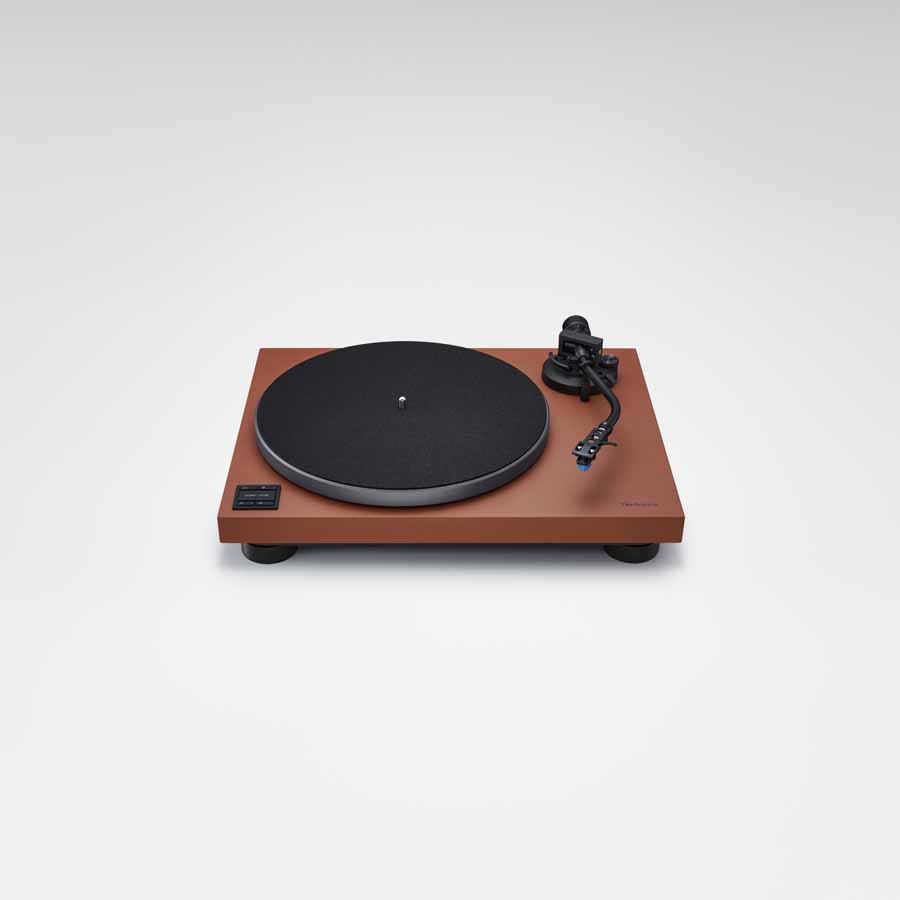
The Technics SL-40CBT is designed to bring HiFi tech into modern living spaces in a compact and easy-to-set-up form. Its engineering draws directly from Technics’ long-standing direct drive heritage, inheriting developments from the revived SL-1200 series, of which regular readers will already know I’m a big fan of.
The SL-40CBT is MDF, and the platter features ribs on the underside to ensure rigidity and flatness (and extra pleasure?), while the motor magnet is mounted directly to the turntable to provide reliable torque transmission without axis slipping.
The newly designed tonearm incorporates a horizontal rotation mechanism that combines a highly polished stainless steel centre shaft with sliding bearings made from high-density super engineering plastic. This construction achieves high sensitivity and rigidity.
The turntable also uses optimally tuned insulators (feet). These combine newly designed rubber elements with the spring coil and housing used in the SL-1500C. The design positions the resonance frequency outside the audible range, reducing the influence of external vibrations.
Internally, the electronics are arranged across separate boards for the power circuit, motor control, and phono equaliser. The board-to-board wiring is configured in a non-crossing layout to reduce mutual interference and maintain sound purity.
At the heart of the SL-40CBT is a 12-pole, 9-coil coreless direct drive motor. By removing the iron core found in conventional designs, the system eliminates cogging, which is caused by uneven magnetic attraction during rotation. The motor is specifically tuned to the platter’s weight, achieving wow and flutter of 0.025% and a start-up time of 0.7 seconds.
Motor drive is handled digitally using a high-precision sine wave signal stored within a microcontroller. The system measures and learns offset voltage variations in the drive circuits and applies correction to minimise rotational irregularities.
Speed detection is managed using a Frequency Generator system. The rotor magnet is magnetised in 108 segments, and a double pattern FG coil on the stator board generates voltage to detect speed with high accuracy. This approach is similar to that used in the SL-1200GR2 and SL-1500C models.
The SL-40CBT includes a built-in MM phono equaliser designed specifically for moving magnet cartridges. It is housed within a shielded case and uses high-quality components, including film and electrolytic capacitors, to minimise external noise and maintain accurate frequency response. Some folk will make use of this and connect to the speakers by wire, but for this review, I’ve gone full Bluetooth as outlined below.
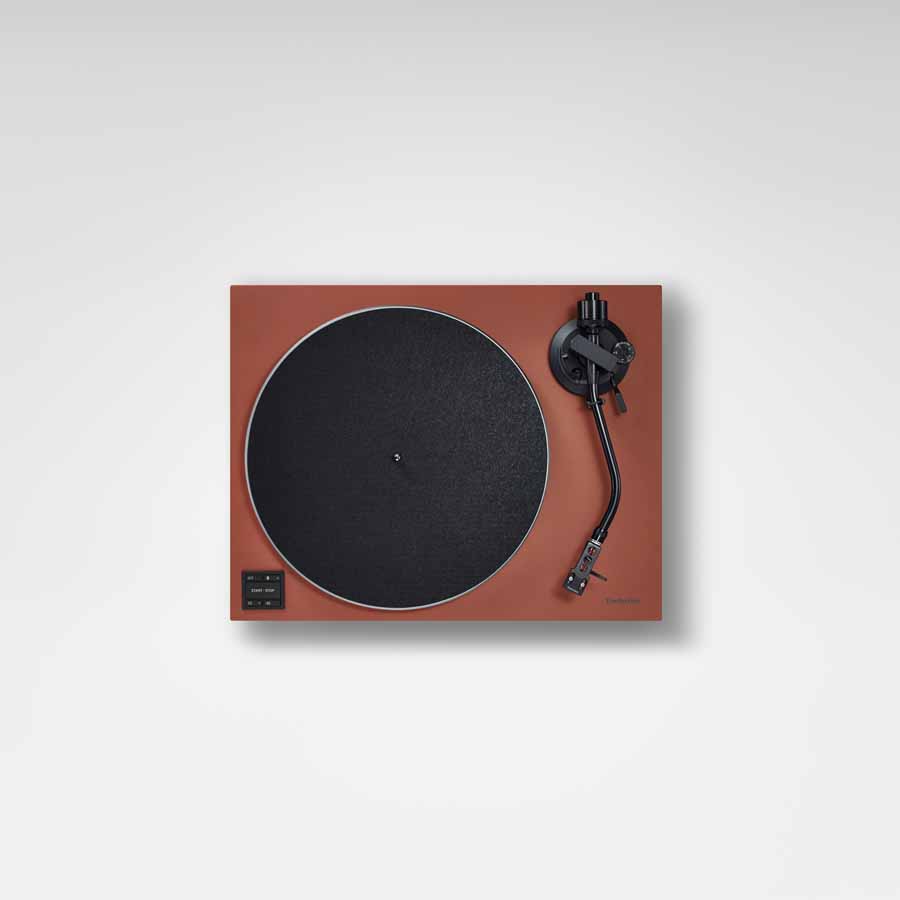
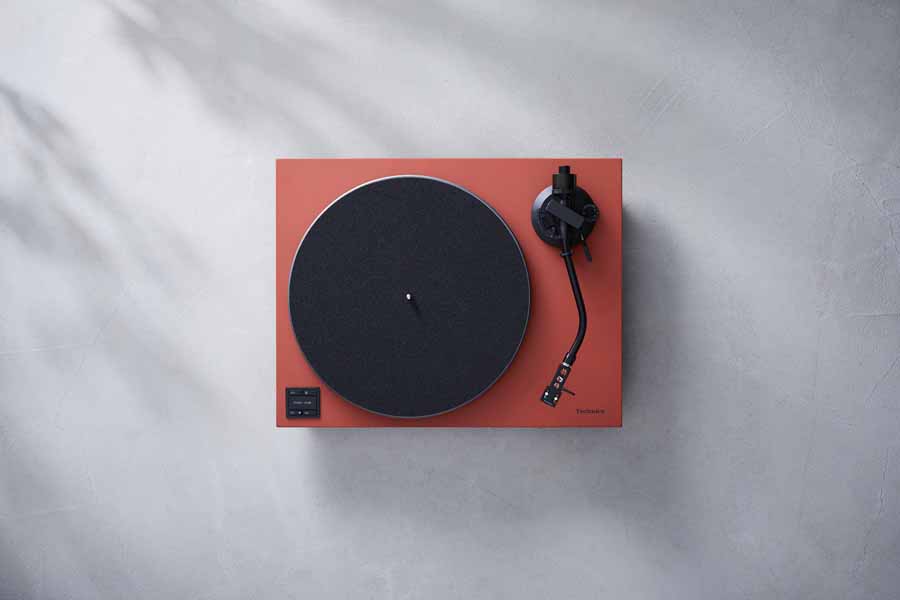
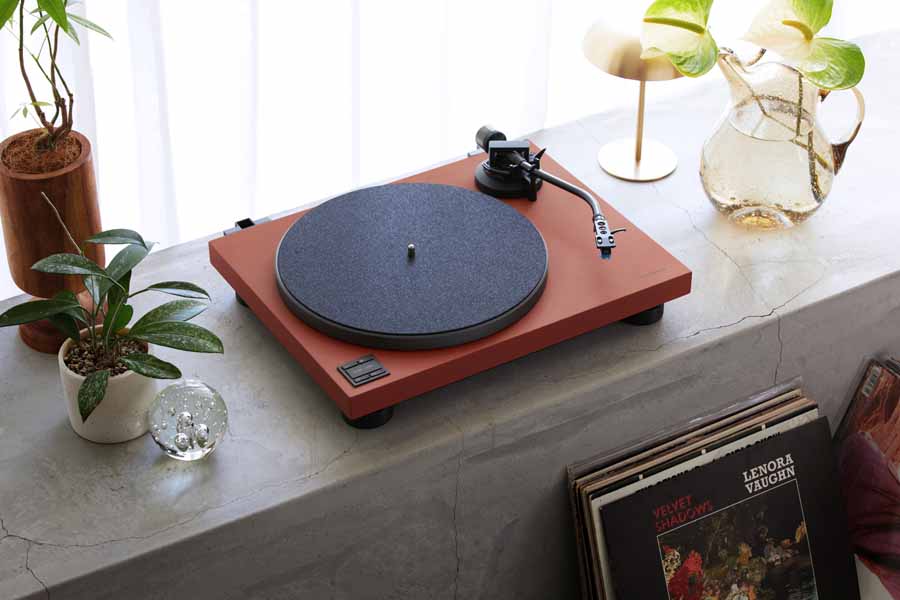
For added convenience, the turntable also incorporates a built-in Bluetooth transmitter supporting aptX Adaptive and SBC codecs, allowing wireless streaming to compatible speakers or earphones. This might be a bridge too far for the audiophile community, but I reckon this is a very sensible way to go. It not only allows for wireless connection to the speakers, but also allows you to connect the turntable to a pair of Bluetooth headphones or other Bluetooth speakers. Being able to lie in bed or late at night and listen to vinyl wirelessly on headphones is cool!
The turntable arrives with an Audio Technica cartridge already fitted, so that the whole experience is as plug-and-play as possible.
Like the speakers, the SL-40CBT uses corrugated cardboard packaging in place of traditional Styrofoam, reducing the use of marine plastics.
SET UP
I want to say a little about my methodology of how I set this system up and why. I wanted to mirror the kind of environment the system would find itself in. To this end, I set it up in our living space and not the listening room area of the house. This is where we sit of an evening to watch a film and relax, and I think this is just the kind of setting users are going to put the system. In this space, Bluetooth was by far the most convenient method of connecting the turntable to the speakers. I had the turntable on a wire shelf unit behind where I usually sit and the speakers at the front of the room.
Unpacking the turntable and speakers is a simple enough operation, and everything is as well-packed as you would expect from such a well-known brand as Technics.
The speakers and turntable come in a rather fetching orangey bronze colour, and the speakers have a finish made of Dinamica™, “a microfiber material with a soft, suede-like texture”. Overall, this is a very home-friendly package, and, as previously mentioned, you can get the whole package in a couple of other colours too, should they suit your environment more.
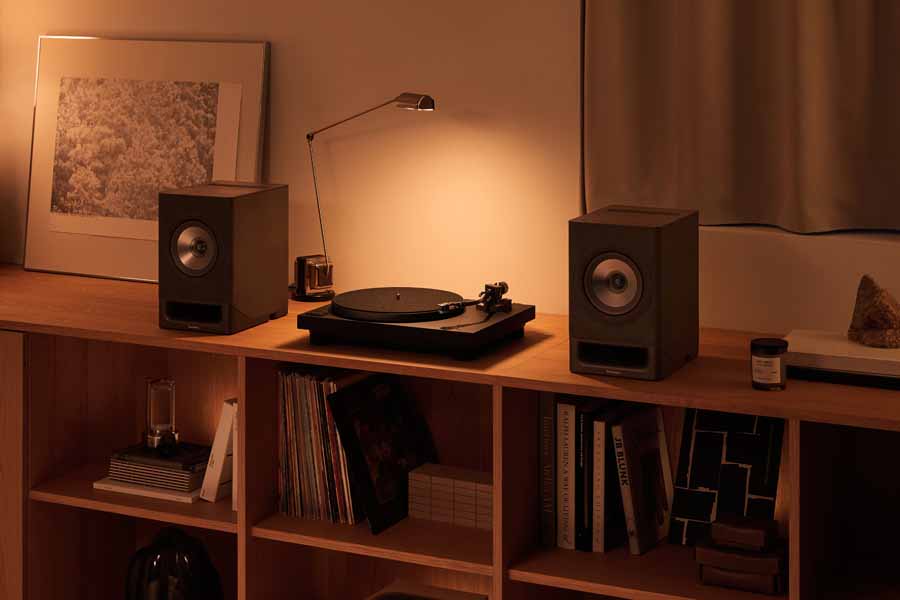
The turntable is pretty lightweight when you compare it to the 1200G, and it weighs a couple of Kg less than the 1200 Mk7s I use for DJing. However, the turntable is good-looking and well finished. Remember, we are not looking at a turntable that is looking to wow the turntable purists and make their hearts all a flutter; we are looking at a turntable that is meant for everyday folk who want to listen to some tunes.
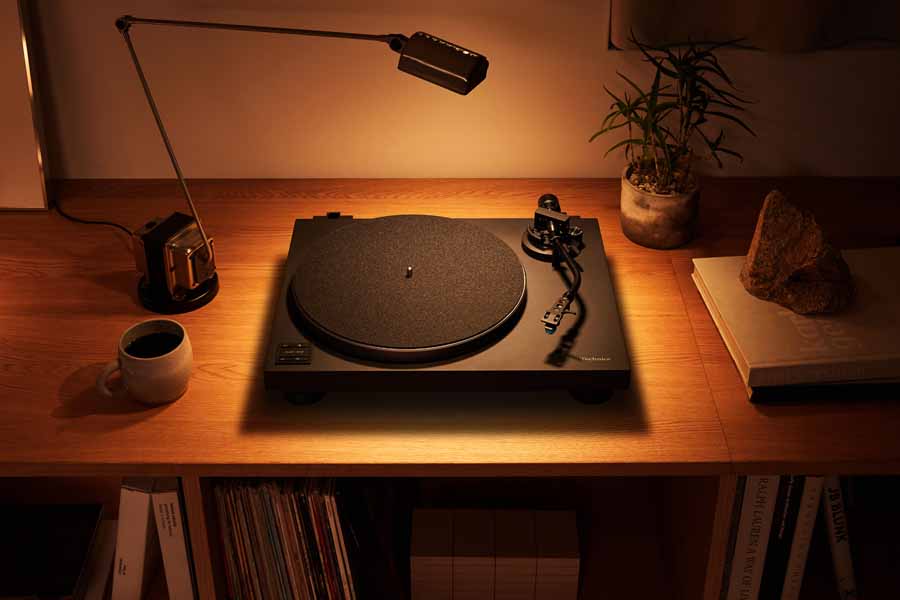
Controls on the turntable are straightforward, and around the back, you have standard outputs so you can use an external phonostage (I won’t be), a line out when you want to use the internal phono, and the IEC power input. On the top, you have speed buttons (33/45), a main power button, start/stop, and a Bluetooth button. As mentioned, I aim to use this set-up in Bluetooth only, as I think that is how most will set it up. I know there are other reviews out there that have gone into assessing the internal phonostage and hooking the turntable up to flashy external phonostages, but (again) that’s not how I think this system is most likely to be used.
The speakers have good weight to them and are compact enough to be unobtrusive in the home, though they look rather nice, I think. Around the back of one speaker you have connections for wiring up the turntable directly to the speakers (you can wire whatever line level device you fancy to this, should you wish), and analogue out for a subwoofer (I won’t be using one), a button to assign which speaker is left and which is right (a clever feature, I thought), an HDMI terminal, a USB terminal, a LAN terminal, an optical input, and a power input. The other speaker has a LAN input to connect the speakers together and a power inlet. Wiring the telly into the speakers is easy and gives users the option of improving on the generally crap speakers found in televisions.
You also get a remote control in the box that covers all the main functions of the speakers.
Please note, I am going to use this package in Bluetooth and Network modes only, as I genuinely think that is how most music lovers will use it, and my comments regarding sound quality are limited to this aspect. I would expect there to be marginal improvements in sound quality with a wired connection between the speakers and the turntable being plugged straight into the back of the speakers. Apart from this being how I expect the package to be used, there is the issue that if you wire the turntable to the speakers, you have to have them in close proximity, and that wasn’t convenient in the space I’ve already described. Yes, I am eschewing some functionality and potential sonic benefits, but (again) I wanted to give a real-life user experience here.
Firstly, I downloaded the Technics Audio Center for iOS. This was painless and speedy. You follow the onscreen instructions, the app finds your home network, and the speakers are connected. Firstly, I went to “radio” on the app and found BBC 6 Music…bloody hell, it works. Setting up the app to the system to play music was literally about a minute. That bloody hell was a genuine reaction, as this kind of thing usually involves me prodding like some demented chimp at the screen on my phone and then a degree of shouting. Much shouting!
On the app, I then prodded the QOBUZ button, searched for Neil Young…and hey presto, Tell Me Why was belting out of the system! I think I commented to Linette that this is some kind of witchcraft, to which her response was “Nah, all that’s fairly standard stuff, the witchcraft is the turntable…if it works!” There are buttons to prod on the app for all the major streaming services and the ROON button works as expected once you set up the speakers as the player. All very good and all pretty much as straightforward as it comes. This is all very important as there’s one thing I, and I assume others, hate is the whole faffing about making like the aforementioned chimp for hours on end to get something to work properly. Technics have nailed this.
However, the main thing for me, review-wise, is the ability to have the vinyl connected by Bluetooth and to get to hear records. So, press Bluetooth on the app (I’d already done the pairing of the speakers and the turntable) and put a record on. It works flawlessly, although there is a delay between playing the record and the music playing through the speakers. This is a bit weird to get used to, but on the plus side, it gives you a chance to park your arse before the music starts playing. Yep, this is witchcraft!
A quick note on the setup of the turntable. It’s as simple as can be if you have ever set a turntable up before. Balance the arm. Set the appropriate weight for the already attached and aligned cartridge. Done!
Space Tune was next on my “to-do list”, and I scrolled through the presets (Free, Wall, Corner, In a Shelf, and Custom) before going the full hog and going for a measured adjustment. The app calibrates your phone’s microphone, and then there’s a series of pops and sine-wave tones, which are a bit worrying and certainly scared the cat. However, it’s over in a flash, and the speakers are calibrated to your room. You can then choose to have Standard or other playback styles – I kept with standard. This is very cool, very intuitive, and, importantly, very simple and quick to sort out!
The remote is a small plastic affair, but perfectly servicable. It allows you to select the source, volume, enter Space Tune, turn the speakers on and off and change the brightness of the blue LEDs. Again, all very intuitive and all very cool.
SOUND QUALITY
I’m going to base the majority of the sound bit of the review on the turntable playing in Bluetooth mode for the reasons I’ve outlined previously. However, I did listen to a lot of radio and some streamed music.
As I often do in reviews, I’ll let you know what my preconceived thoughts were about how this system would sound. I wasn’t expecting much at all, is the truth of it. A fairly lightweight turntable feeding through Bluetooth to a pair of powered speakers? Come on, this has got to be a bit crap…hasn’t it?
Well, no, it’s not at all terrible! In fact, the sound is pretty damned good!
First of all, you get a really good representation of soundstaging and imaging, despite my having one speaker on a solid wooden block stand affair and the other on a TV unit and brought to the same height as the other by a couple of coffee table books and an IsoAcoustics Aperta doodad. There’s really good width, and the image comes out into the room in a pleasing way. Sounds within the stereo image are easy to pinpoint, and there’s decent height to the image, too. I have to mention again that my set-up of the speakers is (deliberately) a bit Heath Robinson (similar to Rube Goldberg for our American readers), as I don’t think most folk buying this package will go out and buy dedicated speaker stands – I wanted this to be as real-world as I could make it.
Detail from the speakers, playing both streamed radio, Qobuz, and the turntable, is surprisingly very good even at really low volume. Up the volume (you can crank these speakers up to very high volumes), and detail is still there, but a little more apparent and in your face.
As I listened more and more, there is a real sense that Technics have managed to get a really balanced sound out of this system. Nothing is overblown or screaming for attention over anything else in the mix. This is good!
At volume, the bass is prodigious and tight, though it does drop off at low volumes. In our 50m² room (though I have them set up in the smaller zoned area), I’d have no qualms about using these to supply the tunes for a party.
I did listen to a fair amount of radio on these speakers, and spoken word was clear and accurate, though there was a bit of sibilance apparent at times. I used the system for a lot of background listening whilst working and found nothing to moan about.
On hectic techno tracks, the speakers didn’t get at all confused and presented a solid representation of the music playing. On gentler music, I found the sound to be very pleasing.
I’ve purposefully not gone into loads of specific tracks; suffice to say, I was really impressed by the sound of this system. No, it doesn’t match up to our main system, but then the Technics offering was never going to, given the massive price difference – apples and oranges, and all that. However, what I will say is that this 3K€ (depending on where you look) package needs to make no excuses for its sound quality. There is detail, subtlety, clarity, and heft that just left me enjoying the music I was listening to. Bass goes low enough and is punchy enough to satisfy even this confirmed bass head.
On the continent, you can pick this whole package up for a smidge less than €3K, and in the UK it’s about £2700 if you shop around. The price from Technics is £749 for the turntable and £2399 for the speakers, or €861.55 And €2759.53 in Europe.
QUIBBLES
The setup of the Space Tune gubbins was a bit scary, as it seemed very loud, and I feared for the speakers’ safety. I guess Technics know what they are doing, though!
You have to have a clear line of sight and point the remote at the master speaker to get it to work.
CONCLUSION
What’s not to like?
This is pricing that is realistic for regular people to spend on a good-sounding and massively convenient system, and for that kind of money, I think they’d be getting very good value.
The tech on this system is excellent, and the easy-to-set-up Space Tune™ technology ensures you get a response in your room that is appropriate.
The app is easy to set up and is a breeze to use, and the included remote does all you need it to.
Sonically, there is very little to moan about for the asking price. The turntable isn’t the best in the world, but at this level, and given the convenience of Bluetooth connection to the speakers, once again, there is very little to moan about.
I genuinely enjoyed my time with this system and can heartily recommend it to those who want to enjoy music (and specifically vinyl) with a huge degree of convenience, but without getting all nerdy and spunking a whole lot of cash on a dedicated vinyl system, only to lose the convenience factor and gain the fear of becoming a social pariah…sorry, audiophile.
I’m giving this system Five Hearts as I reckon it offers a good deal of bang for your buck, is stupidly convenient, and it sounds exceptionally good, even in Bluetooth mode.
For folks wanting to sacrifice a smidge of convenience for better sound quality, the wired connection of the turntable is obviously going to surpass that of Bluetooth, but if I weren’t a dyed-in-the-wool audiophile (…sorry, social pariah), I’d have the system set up just how I did for the review.
AT A GLANCE
Build Quality and Features:
Speakers are packed with clever tech
Turntable has built-in Bluetooth and phono equalisation, though you can output to a separate phonstage should you wish to go that route
The Space Tune™ technology is a breeze to use
The matching colour scheme looks great
The turntable is a bit lightweight, but it is fine
Remote is lightweight but does what it is supposed to and has the functions you would expect
Sound Quality:
Punchy, detailed and clear
Value For Money:
Around three grand (give or take and depending on where you buy) is still a bit of a chunk of money for most people, but I can’t see folk buying this having anything to complain about
We Loved:
Ease of set-up
Compact and convenient
Use the remote, app, or the haptic controls on top of the master speaker
Sonically punch and hugely enjoyable
We Didn’t Love So Much:
The Space Tune™ technology was a shock volume-wise when it started up
You have to make sure the remote is pointing at the master speaker for it to work
Elevator Pitch Review: For a bit under three grand, folk looking to enjoy their TV, streamed music, and vinyl through good quality speakers, but without getting all nerdy and audiophiley. The SC-CX700 speakers and SL-40CBT turntable are packed with tech that ensures good sound and maximum convenience in a great-looking package.
Price: £749/€861.55 for the turntable and £2399/€2759.53 for the speakers

Stuart Smith
SUPPLIED SPECIFICATION
SL-40CBT Turntable
- Drive Method
- Direct Drive
- Motor
- Brushless DC motor
- Turntable Speeds
- 33-1/3, 45
- Build-up Characteristics
- 0.7 s. from standstill to 33- 1/3 rpm
- Braking system
- Electronic brake
- Wow and Flutter
- 0.025% W.R.M.S.
- Turntable Platter
- Aluminium die-cast
Diameter:300mm
Weight:Approx. 1.26kg (Including Turntable mat)
- Aluminium die-cast
Tonearm Section
- Type
- Static Balance
- Effective Length
- 230mm
- Overhang
- 15mm
- Tracking Error Angle
- Within 2° 32’ (at the outer groove of 30cm record)
Within 0° 32’ (at the inner groove of 30cm record)
- Within 2° 32’ (at the outer groove of 30cm record)
- Offset Angle
- 22°
Phono equalizer section
- Gain
- 36.5dB
Cartridge section
- Model Name
- audio-technica AT-VM95C
Bluetooth® section
- Bluetooth® system specification
- Bluetooth® Ver. 5.4
- Wireless equipment classification
- Class 1
- Supported profiles
- A2DP
- Supported codec
- Qualcomm® aptX™ Adaptive, SBC
- Frequency band
- 2.4 GHz Band FH-SS
- Operating distance
- Approx. 10 m Line of sight*¹
*1 Prospective communication distance。
Measurement environment: Temperature 25 °C / Height 1.0 m
- Approx. 10 m Line of sight*¹
Terminals
- Audio Output
- PHONO (Pin Jack) x 1
EARTH TERMINAL x 1
LINE (Pin Jack) x1
- PHONO (Pin Jack) x 1
Turntable:
- Power Supply
- AC 220 – 240 V, 50/60 Hz
- Power Consumption
- 4 W (Power ON)
0.3 W (Power OFF)
- 4 W (Power ON)
- Dimensions (W x H x D)
- 430 x 128 x 353 mm
- Weight
- Approx. 7.1kg
- Operating temperature range
- 0℃ to +40℃
- Operating humidity range
- 35% to 80% RH (no condensation)
- Accessories
- Turntable, Turntable mat, Dust cover,
EP record adaptor, Balance weight,
Head shell with cartridge, PHONO cable,
PHONO earth lead, AC power supply cord,
Owner’s Manual
- Turntable, Turntable mat, Dust cover,
SC-CX700 SPEAKERS
General
- Dimensions (W x H x D)
- 201 x 313 x 276 mm (Primary)
201 x 313 x 272 mm (Secondary)
- 201 x 313 x 276 mm (Primary)
- Power Supply
- AC 220-240V, 50/60Hz
- Power Consumption
- 40W (Primary)
35W (Secondary)
- 40W (Primary)
- Network Standby
- Approx. 2.0W (Primary)
Approx. 2.0W (Secondary)
- Approx. 2.0W (Primary)
- Weight
- Appx. 9.1 kg (Primary)
Appx. 8.9 kg (Secondary)
- Appx. 9.1 kg (Primary)
Amplifier Section
- Output Power
- Total Output Power 200W (100W x2)
100W : Woofer 60W
Tweeter 40W
- Total Output Power 200W (100W x2)
Speaker Section
- Speaker Unit
- 2-way 2-speaker Bass Reflex (Coaxial 2-way Woofer/built-in tweeters)
Woofer : 15 cm Cone Type x1
Tweeter : 1.9 cm Ring Type x1
- 2-way 2-speaker Bass Reflex (Coaxial 2-way Woofer/built-in tweeters)
Terminal
- Analogue Input Terminal
- PHONO(MM) x1 (Primary), AUX IN x1 (φ3.5mm) (Primary)
- Digital Input Terminal
- Optical Digital x1 (Primary), USB-C(USB-DAC) x1 (Primary)
- Analog Output Terminal
- Subwoofer Out x1 (Primary)
- Digital Output Terminal
- HDMI ARC x1 (Primary)
- Headphone Output
- N/A
- Ethernet Interface
- LAN
- LAN (100 Base-TX / 10 Base-T) x1 (Primary)
- P/S LINK
- RJ-45 Connector x2(Primary, Secondary) *for wired connection
- LAN
Wi-Fi Section
- Wi-Fi
- IEEE 802.11 a/b/g/n/ac/ax, 2.4 GHz / 5 GHz Band
Network
- Google Cast
- ○
- Works with Google Assistant
- ○
- AirPlay
- ○
- Bluetooth® (Support Codec)
- ○ (AAC, SBC)
- Internet Service
- Spotify Connect, Deezer, Amazon Music HD, TIDAL, Qobuz, Internet Radio, Roon Ready(OTA)
- CD
- N/A
- Tuner
- N/A
Format
- USB-C
- USB Audio Class Specification
- USB 2.0 High-speed
USB Audio Class 2.0, Asynchronous mode
- USB 2.0 High-speed
- Support Codec
- LPCM (32, 44.1, 48, 88.2, 96, 176.4, 192kHz / 16, 24bit)
DSD (2.8MHz, 5.6MHz)
- LPCM (32, 44.1, 48, 88.2, 96, 176.4, 192kHz / 16, 24bit)
- DSD control mode
- ASIO Native mode, DoP mode
- USB Audio Class Specification
- LAN(DMR)
- Support Codec
- WAV (32, 44.1, 48, 88.2, 96, 176.4, 192, 352.8, 384 kHz / 16, 24, 32bit)
FLAC (32, 44.1, 48, 88.2, 96, 176.4, 192, 352.8, 384kHz / 16, 24bit)
AIFF (32, 44.1, 48, 88.2, 96, 176.4, 192, 352.8, 384kHz / 16, 24, 32 bit)
ALAC (32, 44.1, 48, 88.2, 96, 176.4, 192, 352.8, 384kHz / 16, 24bit)
AAC (32, 44.1, 48, 88.2, 96kHz / 16-320kbps)
MP3 (32, 44.1, 48kHz / 16-320kbps)
DSD (2.8MHz, 5.6MHz, 11.2MHz)
- WAV (32, 44.1, 48, 88.2, 96, 176.4, 192, 352.8, 384 kHz / 16, 24, 32bit)
- Support Codec
Speaker Connection
- Format
- Wireless Connection
- PCM 96kHz / 24bit
- Wireld Connection
- PCM 192kHz / 24bit
- Wireless Connection
Accessories
- Accessories
- AC Cord x2, Remote Control x1, Batteries for Remote Control, Speaker Link cable(3m) x1, Speaker nets x2, Owner’s Manual