
SOLEN CV40-EL84 Integrated Amplifier
SOLEN CV40-EL84 INTEGRATED AMPLIFIER REVIEW
Janine Elliot takes a listen to the French brand SOLEN’s CV40 amplifier, which uses EL84 tubes as its power tubes.
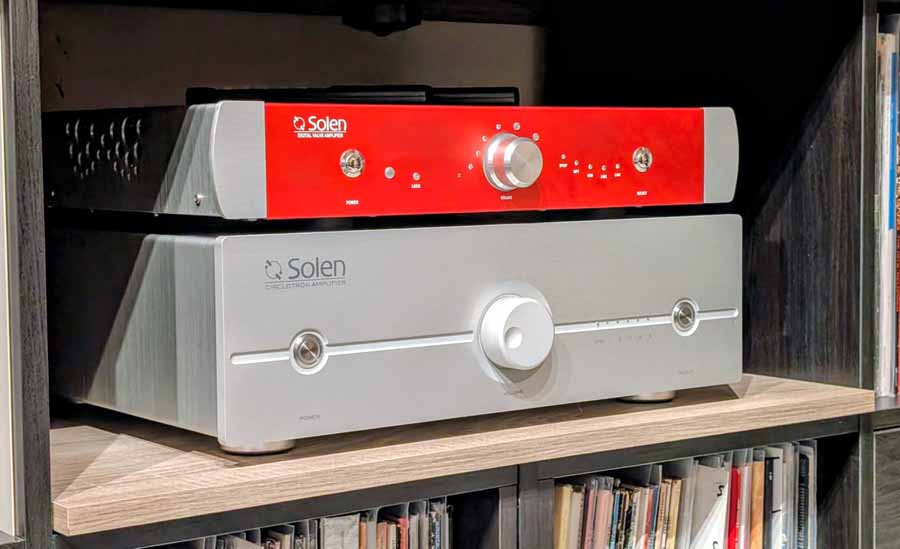
As soon as I switched on the £4,550 French Solen 40CV integrated amplifier and listened, I felt on home territory, reminding me somewhat of my trusty power amp from the 50s. That amplifier uses ECC83s in the input stage and two EL84s per channel in the power stage. This new amplifier for review looks nothing like my aged valve amp, or actually even like a regular valve amplifier; you would never know it has 11 tubes tucked away inside the aluminium casing. In each channel of this 22kg 450mm wide unit there is an ECC803 for the driver stage and four EL84s in the output, plus there is also an ECC81/12AT7. This amplifier is actually called “VC40 – EL84”, so that it is not confused with last year’s model, which had EL34 pentodes.
From the southern city of Grenoble, near the border with Italy and referred to as the Capital of the Alps due to its closeness to the mountains, Solen was set up in 1988 to produce products that were both affordable and good looking, producing unusual-looking amplifiers, such as the Tigre B50, its first amplifier, a triangular-shaped hybrid with upward-facing fins on either side. With six models in their history books, they presently make 4 electronic products, including a phono-stage, a DAC, and two integrated amplifiers; the £4,550 CV40-EL84 here for review and the gorgeous looking CV20-N (20W and again with EL84s) at £ 3,775 that also provides digital inputs. Their original design philosophy is equally matched in their HEL (Hybrid Enclosed Line) loudspeakers. Despite Solen shutting down its audio business between 1997 and 2011 in order to focus on radio-frequency systems, it is good to see that from 2011 they began making amplifiers again.










BUILD AND FEATURES OF SOLEN VC40
You might have gathered by now that the CV40 is a 40W amplifier. Its own CV, though, is perhaps a little disappointing these days; there is no phono-stage or any digital inputs. However, I am not at all worried as this amplifier concentrates just on the important delivery of sound. With its low-noise design, it is a very quiet and highly musical Class AB amplifier, and Solen do make a phono-stage and DAC, should you wish to add them. Encased in a solidly built aluminium case with a thick 10mm front plate, this fully tube amplifier has four EL84 tubes per channel for the output in parallel pairs, meaning that there are two EL84s in parallel in each leg of the push-pull configuration. There is an ECC81 in the first amplifier stage (the 5751 tube is also suitable, but not the ECC83, as in my Leak Stereo 20, because of its higher gain) and an ECC803 per channel for the driver/phase splitter just before the push-pull (it’s in a bootstrapped Schmitt configuration). Thus, there are two floating power supplies per channel, i.e. one per EL84 parallel pair. “Push-Pull” in vacuum tubes means that whilst one does the positive signal, the other does the negative. This method means that there is very low distortion (the two halves being opposites cancel it out), and an increased efficiency. Therefore, in the CV40, each channel has its own power transformer with two high-voltage windings, one for each EL84 push-pull pair loading the cathode, and each floating power supply is regulated by a transistor circuit. This circuitry forms what is called Circlotron technology, invented by Electro Voice back in the 1950s. Sounding like something out of a Star Wars movie, this design helps to lower output impedance. Although not commonly deployed these days (amplifiers are more likely to be Output Transformerless, – OTL), Solen took over the Circlotron design and has improved it since 2011. The result is a very low impedance output, resulting in high efficiency, and most importantly, eliminating DC current from the output. As Solen told me;
“Because the EL84s are in a cathode follower configuration, the output transformer is driven at a low impedance, so the primary requires less inductance. As a result, there is less leakage inductance and an extended bandwidth on the low and high sides. In the same way, less inductance means fewer turns, so the output transformer is more efficient.”
These high-voltage power supplies being regulated enables the EL84s to achieve just under 40W power output per channel. The Stereo 20 only has…ten. The design, therefore, creates, as I later found out, not just a tube-like musicality, but also the transient speed that you would normally associate with transistors, and certainly faster than my sleepy Leak. There is no comparison in this review with that model. They are unique in their own way. It is also configured as dual mono. Whilst the CV40 works with speakers from 4-8 ohms, if you wish to drive even lower impedance offerings, then Solen can alter the output transformer to meet your needs. Unlike my KT88 monoblocks, which need manual trim pot bias regulation to get them at their best, the CV40-EL84 amplifier regulation is greatly simplified by its automatic polarisation mode. Just plug in and play!







On switching on the unit at the front (a blue LED-lit button), the unit then takes around a minute to be ready for you to start listening; firstly, by supplying a filament voltage to the tubes, and then the necessary high voltage after this. Deploying this technique helps to improve the lifetime of those valves.
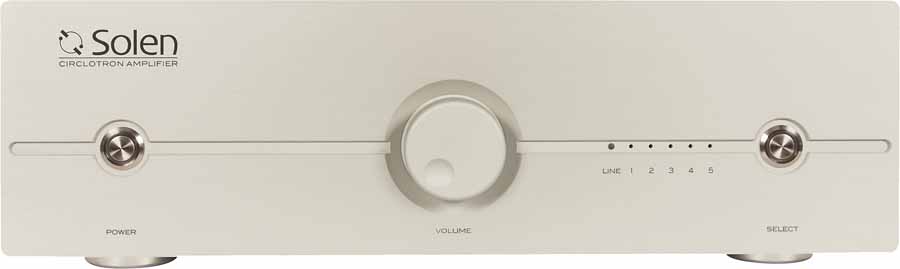
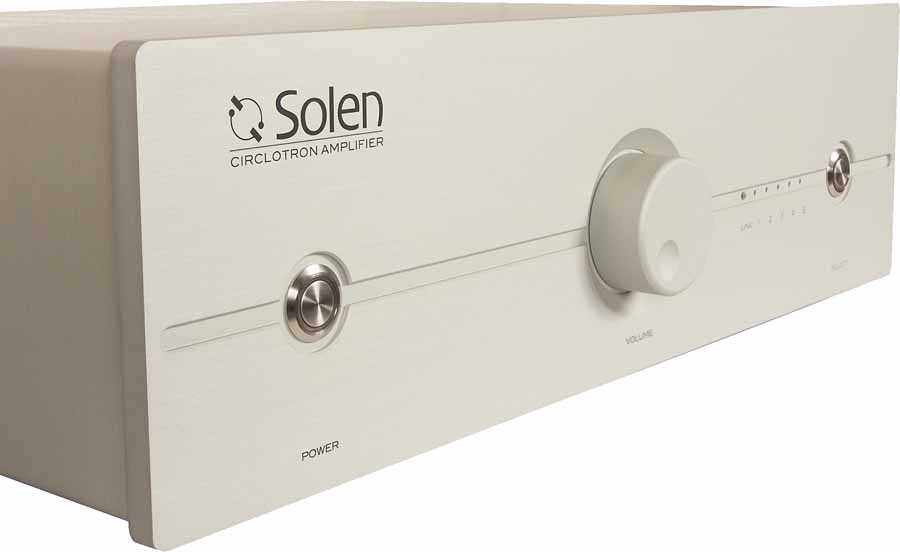
The front of the unit is very minimalist. At first sight, all you see is a central volume knob flanked on either side by a button. The left button is the illuminated on/off switch, and the right button selects a source each time you press, with the relative LED lighting up blue to its left to indicate each of those five RCA line inputs. Those LEDs also register the volume setting as you adjust the volume control, changing as they do to red. Relays switch the input sources, and the infinite volume control is of pulse generator design. Having added a ¼” headphone jack would have removed the symmetry of the front panel, but it would have been a useful feature.
At the rear are 5 pairs of RCAs (input 1 and 2 have these positioned further apart so you can connect those chunky RCAs with ease). A pair of 4mm binding posts are at either end for connection to your loudspeakers. An IEC socket plus fuse completes this simple layout. The accompanying plastic remote is very narrow and very simple, with just an off/on switch, source and volume up/down selectors, and a mute button.
SETUP AND USE
This is a very easy unit to set up and use. Similarly, the remote control was very simple with large buttons. Pressing the mute button just removes the input LED on the front to warn you. A dimmed or flashing “on” indicator might have been a good idea. The amplifier does get very warm, as you would expect from having 11 tubes inside, so be careful with positioning in your music space.
SOUND QUALITY
My initial observations on the sound were of that great combination of ECC’s and EL’s, giving me a similar, but much faster sound than from my Leak Stereo 20. That was no surprise, though I felt that whilst mids and tops were excellent and “sparkly”, the bass was perhaps just a little too well behaved. I am used to the deep, punchy bass sounds from KT88s, and having pairs of EL84s helps to give that amplifier that power and confidence. The percussion at the start of Dire Straits’ “In the Gallery” is very precise and detailed. Similarly, that detail extends to the stereo spread; the amplifier excels in detail across the soundstage. That is also the case with the hard-left and hard-right acoustic guitars in Anna B. Savage’s “Talk to Me”; her very forward vocals at the centre are complemented with other instruments on either side, forming a very relaxed and musical performance.
That detail and extension at the top-end persuaded me to try a track that was my favourite from 1978, The Motors’ “Airport”. As a child, I loved to play my cassette recording of it on a top-of-the-range TDK SA, as it made the frequency range seem so good from my Akai deck (we all wanted it to sound like a Nakamichi, didn’t we!) Actually, this is just an over-bright performance, particularly vocals, where I doubt there is a U47 or U87 microphone anywhere in sight! The percussion is similarly top-heavy, and whilst the Solen provides very fast transients, it can sound a little too bright. That dual power supply creates a low feedback rate, which assists in guaranteeing an excellent stereo image. Similarly, the very low output impedance by paralleling the EL84s ensures excellent speed of transients.
That clarity of sound is equally good in the more depressing-sounding music of Ray LaMontagne. His albums have some brilliantly engineered clarity, especially the equally depressively titled albums ‘Till the Sun Turns Black’ and ‘Trouble’. Having had his parents split up when he was born, and he and his 5 siblings moving about from town to town with their mum looking for work and missing out much of his schooling, it is no surprise that his music is serious. The albums and particularly his vocals are a perfect example of musical clarity, especially from his unique husky sandpapery voice. The Solen performs the title track from ‘Till the Sun Turns Black’ with great panache. Only that the lowest bass guitar notes weren’t quite as confidently delivered as on my beefy KT88 amp. The EL84 is much more well-behaved. This is not a problem, though, as the EL84s deliver with more control and precision. The detail from the acoustic guitars, especially the depth to the guitar chords, the controlled piano and highly reverberant and almost angelic vocals in “Broken Sky” made me listen with almost religious fervour.
Pentatonics “Gallego” similarly starts with tons of atmosphere in this 2024 Alternative and Indie track. The Solen delicately crafted the music with transparency and fluidity, especially with the detail across the large soundstage; the amplifier has a great ability to highlight accurately where each part of the music was coming from.
RAYE’s ‘This Music May Contain Hope’ extended that immense soundstage even further. This, for me, is the best album I have heard so far in 2026. With an equally depressing title and track names, this is a masterpiece of stage and sound. After the 1’13” “Girl Under a Grey Coat” spoken introduction to welcome you to this mammoth production (plus several other spoken interludes along the way), this might well have been a 1950s 35mm film musical with the loud thunder claps setting the scene and her very Amy Winehouse style of singing in “I Will Overcome” with lots of orchestral violins and other vocal interjections. “I Hate the Way I Look Today” sounds as if Ella Fitzgerald has returned to the world again, all brilliantly carved together by the sound engineers and musicians, but equally well performed by the Solen; this amplifier crafts each instrument, vocal line or sound effect with professionalism that helps you almost see what is going on in the music. This is the beauty of the EL84. It might not have the drama of a KT88, but this is what makes this amplifier so special. This album might appear to be quite depressing by its titles, but you would never know that from the music. This is highly entertaining artwork, and the sound engineering is as dramatic as the content. The last track, “Fun”, is not just a very grand closing to the musical, but the artist even reads off the name of each person who has been party to the epic production in a lengthy roll call. The amplifier really is the star here, though, with its immense sound-staging, detail, and control.
Playing Mahler’s depressive 2nd symphony “The Resurrection” (Sir Simon Rattle conducting), the detail and speed were equally good. Just as in the start of RAYE’s epic, this Symphony needs “oomph” from an amplifier to put across its emotions (especially when Rattle is conducting it), and the CV40 was certainly no slouch. With both quiet and loud sections dispersed across its lengthy duration, the amplifier was good at sensing and acting on all those emotions.
The dual mono power supply and the associated low feedback rate guaranteed an excellent spatial awareness in all that I played, and by paralleling those EL84s, ensured that the low output impedance gave far more impressive dynamics than I ever expected from these tubes.
Only in Procol Harum’s 1969 “A Salty Dog”, and “Can’t Get Enough” from Bad Company did I feel perhaps I needed to hear just a little more drive. Free’s “All Right Now” did, however, give me a sense that overall, the CV40 was indeed All Right; the precision in all these ancient energetic masterpieces from my youth enabled me to enjoy the music as if I had never heard them before. The music was not only high on transparency and musical coherence, but also had a dynamism that I really didn’t expect to hear from an army of EL84s. There is a lot of electronics – and valves – in this heavyweight, which provided me with heaps of enjoyment during my review. Whilst the best EL84 amplifier in the distant past was undoubtedly the Stereo Twenty, and that very few manufacturers now make amplifiers using these pentodes, it is very clear from my listening that this valve does actually have a very important future ahead and for Solen, its raison d’être.
QUIBBLES
A headphone output would have been good at this price, and also perhaps a balanced XLR input.
CONCLUSION
The Solen CV40 might be sparse on inputs and features, but what that amplifier does do is concentrate on the sound. This integrated amplifier brings together the speed and neutrality of transistors with the musicality and emotion of tubes, creating an integrated performance. £4.5k might not be cheap, but this amplifier delivers what so many tube amplifiers don’t at this price, so it is worthy of being awarded five stars.
AT A GLANCE

Build Quality and Features:
Brilliantly constructed and with the look of a transistor amplifier. You would never know there are 11 tubes hidden inside
Sound Quality:
Very fast sounding with great soundstage and neutrality
Value For Money: There are many amplifiers at this price point with more features and perhaps more courageous looks, but this amplifier gives you honesty in the music rather than tempting you with features you probably don’t need
We Loved:
Speed and neutrality
Musical detail
Valve warmth
Cheaper valves means cheaper maintenance
We Didn’t Love So Much:
Would like to see more features and XLR input
Remote could be better looking
Elevator Pitch Review: The curriculum vitae of the CV40 might seem rather short, but this amplifier would be a well-deserved member of your musical family. With 11 tubes hidden inside, this brings my Leak Stereo 20, with its EL84s and ECC’s, firmly into the 21st century, with a far greater sense of emotion and gusto. Solen might be new to the UK, but this French product comes with lots of L’amour.
Price: £4,550

Janine Elliot
SUPPLIED BY REPLAY AUDIO DISTRIBUTION
SUPPLIED SPECIFICATIONS
Output power: 40 W / 4-8 ohms at 5% distortion
Bandwidth : 10 Hz-30 kHz at 20 W
Distortion : 0.03 % at 1 W / 1 kHz
Number of inputs: 5 (RCA)
Remote control
Dimensions : 450 x 380 x 135 mm
Weight : 20 kg