
Kimber Kable NEO-CU Interconnect
KIMBER KABLE NEO-CU INTERCONNECT REVIEW
I have always been impressed with Kimber Kable, established in 1979 by Ray Kimber in Utah, USA. Ray became good friends with Russ Andrews here in the UK, who is known for supplying accessories such as cables, mains conditioners, balanced mains units and Torlyte stands. Ray’s products are sold in the UK through Russ Andrews. Russ introduced Kimber Kable to the UK when he established his business 40 years ago. Ray Kimber’s first products were the 4PR and 8PR speaker cables, introduced in 1979 and still manufactured today. They use braided conductors designed to reduce electromagnetic interference. For me, it is the braiding that really identifies Kimber Kable, and these new NEO-Cu interconnects also use this technique. In Kimber Kable’s early days, braiding the cables by hand was a hugely time-consuming task, so Ray developed the machinery and processes in-house to automate it more quickly and economically. This approach to cable design has been adopted by other manufacturers. Sony, for example, has used Kimber Kable wiring in its digital audio players and headphones. Kimber Kable’s interconnects span seven ranges and price points, from entry-level products to the new flagship NEO range. According to the company’s website, the NEO range draws together the best elements of its previous products, representing the pinnacle of its accumulated expertise.
To understand Ray’s philosophy on braided cables, we need to look back to his early career in the mid-1970s. Ray was then working at a sound and lighting company in Los Angeles. These were the early days of discotheques, and most installations ran audio and lighting cables close together. As a result, speaker cables acted as antennas, picking up interference from the lighting systems and introducing noise into the audio. Ray reasoned that counter-rotating sets of conductors could reduce magnetic interaction and, consequently, noise. Ray also noticed that, as well as rejecting radio-frequency interference, braided wire seemed to improve the sound of the music. Kimber’s next major innovation was the Vari-Strand (VS) conductor, which uses copper strands of different diameters inside polyethylene insulation. The aim is to avoid favouring particular frequencies and provide performance across the full audio range. These ideas also form the basis of the NEO range, which combines braided construction with stranded and thicker solid-core conductors.










BUILD AND FEATURES OF NEO-CU
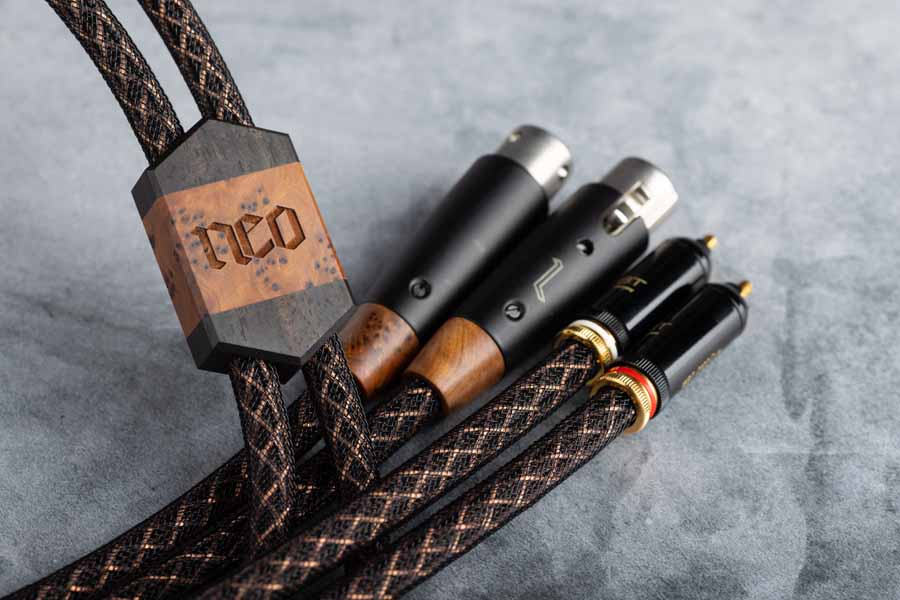
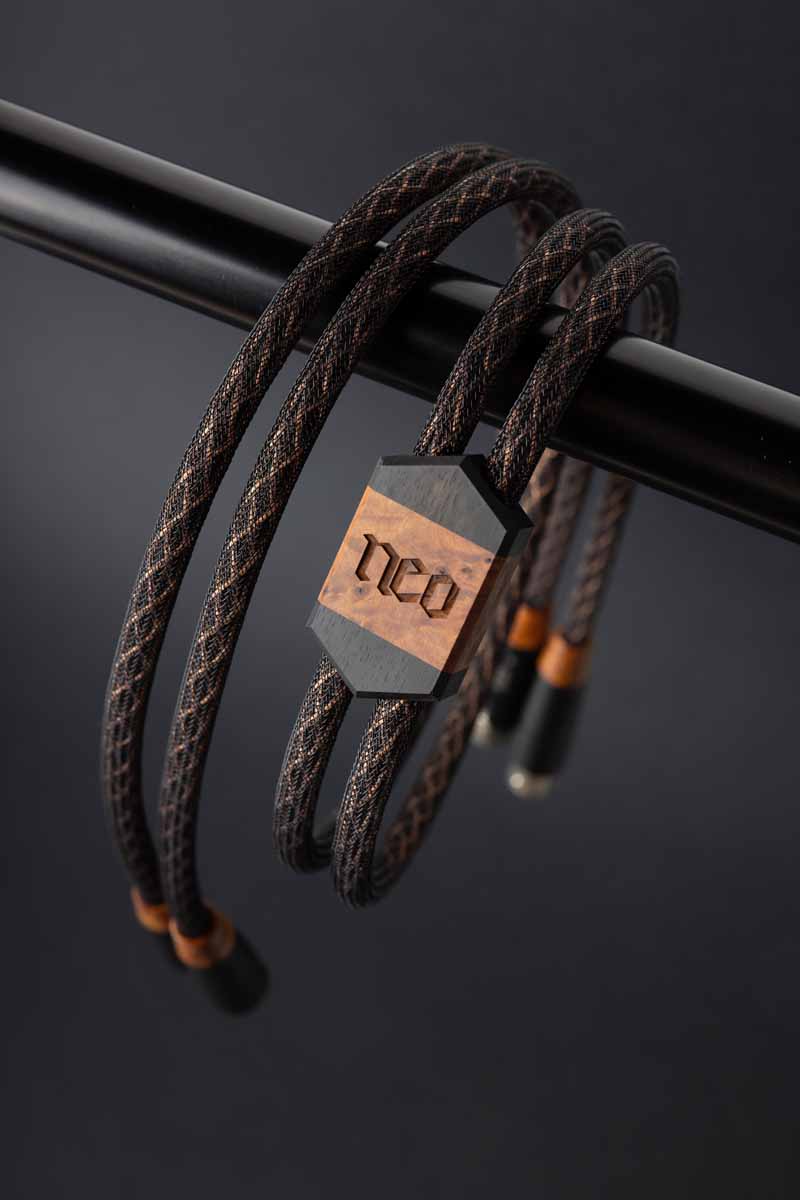
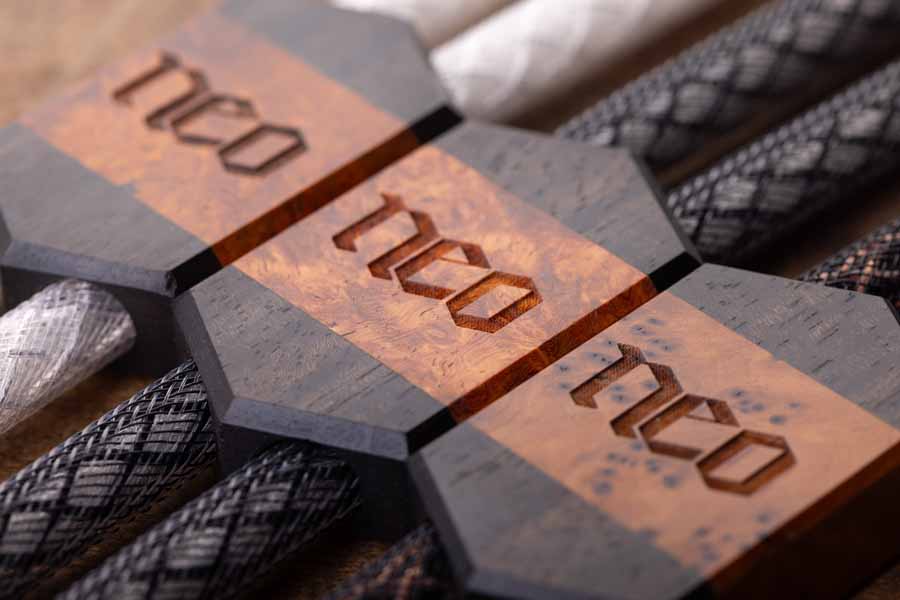
Looking similar to the KS-1016 but starting at four times the price, the NEO comes in three versions: copper (Cu), hybrid (copper ground and silver signal) and solid silver (Ag). The NEO-Cu reviewed here costs £4,700 for a 0.5m length; the NEO-AG at the top is £10,880 for the same length. Arriving more than 20 years after the last new interconnect range, Ray’s latest model certainly makes a statement, not least in its appearance. Hand-built with a distinctive two-tone thuya burl and Gaboon ebony wooden pendant that keeps the two cables of a stereo pair together, the product comes in a gorgeous cylindrical walnut box made from two solid blocks that fit neatly together. Well, I guess you can at least keep your jewellery or watches in it once the cables are connected up to your HiFi. Using the excellent WBT 0102Cu RCA locking connectors, this is also the first Kimber Kable interconnect to have a mixture of solid-core and stranded wiring (only previously used in their Select range of loudspeaker cables). Each type of wire gives a different sonic signature, and only the very best copper is used. There are eight braided conductors in the signal path: four solid-core and four stranded, running through the centre of the cable. Outside the fabric-braid insulation, eight braided stranded wires form the ground connection. An outer braided fabric jacket holds and protects the assembly and also provides mechanical damping. The absence of conventional dielectric materials and the generous air space within the fabric help to make this a very special cable audibly. I have always asserted that the most important part of the cable – and hence the part that makes it sound good or bad – is the housing around the copper or silver wiring; it is what is happening on the edge of the wiring that makes the sound slow or fast; air or vacuum are best. To my eyes, the copper NEO looks better than the more expensive versions, as the contrasting colours of the copper and housings make it look almost like a snake. The more expensive NEOs are not quite so colourful (even the copper ground cable in the HB version is black rather than ‘copper’) and their wooden pendant is made from Amboyna Burl/ Gaboon Ebony (in the HB) and Desert ironwood or Amboyna Burl/Gaboon Ebony (in the AG). A lot of time and effort has been put into both the quality of the components and design of these analogue interconnect cables, available with both RCA and XLR terminations and at the same price.
SETUP AND USE
With only one pair of cables supplied, I decided to use the NEO across the various inputs to my Music First preamp, with my regular Nordost XLRs into the Krell power amp. I know the sound of that final section very well and find it completely uncoloured, so any audible changes should come from the NEO. Loudspeaker connections are TQ Ultra Silver IIs. The NEO was run in before I began listening. Russ Andrews offers a comprehensive service of burning-in your new cables, if you so wish. The connectors were really good quality and easy to tighten into place to get full contact with the socketry.
SOUND QUALITY
I always come away from Kimber Kable reviews with a smile on my face and very happy ears. The entry-level PBJ amazed me when I reviewed it a year ago, and with the NEO-CU at the other end of the scale, at £5,400 for the 1m review pair, I really expected something magical. As expected, I wasn’t to be disappointed this time either. Having recently been enjoying Liszt piano works from Lang Lang on his 9-foot Steinway, I thought I’d begin again with “Liebesträum No. 3”. Lang’s powerful playing on the piano really needs a great system – including cables – to give a full-on performance, not just the intricacy of the free-flowing pin-sharp high notes, but also the forceful fortissimo bass chords. I wasn’t disappointed. The powerful Hungarian Rhapsody No. 6 in D-flat major taxes not only any pianist but also any HiFi set-up, and the cables gave an exceptionally fast speed and immaculate timing of the music. Indeed, the Bluesound Node had never sounded this good, with my Wilson Benesch Arcs working brilliantly in the bass end even without the Torus sub switched on. The fortissimos didn’t sound overloaded when played at full stretch. All the music was produced fluidly and organically. Another piano favourite is Chopin’s Nocturne in E-flat major. Listening to my favourite version of this from the aged Arthur Rubinstein in 1965 has always given me immense enjoyment with the pianist’s beautiful singing melody and the tonal lustre in the bass, even if there is a slight wow from the tape recorder, and an out-of-tune top G on the Steinway. In contrast, the young Jan Lisiecki’s version from 2021 might have a better sound quality, but this performance has tons more digital reverb, and his playing is a much lighter, gentler and generally slower interpretation that really just doesn’t seem to go anywhere. Perhaps this version of the night piece was set on a foggy evening and he got lost as it takes an aged 5:05. Rubinstein’s is much more closely miked and quicker at 4:30. Whichever you prefer, the cables give a very exacting performance of both interpretations, allowing me to get deeper into the music than I have previously experienced with this piece. Nothing is added, or worse, taken away. I was always told to think of an event or scenery when learning to play a new piece of piano music as a young student, as it helped give it meaning, purpose and ultimately emotion. Jan didn’t seem to have an imagination.







Turning to electronica and ethereal music, I played *Birmingham Frequencies* (Higher Intelligence Agency + Biosphere), an album evoking memories of five years in Birmingham studying for two degrees when I was younger. “Gas Street Basin” is a track about the area around Broad Street, which once had a mega gas storage gasholder and a dirty and dilapidated canal when I was in the city in the 1980s. Now it forms the base of the canal’s mega social area with lots of noises of people, water, music, etc., with the canal a major part of modern Birmingham life. This piece celebrates that life with lots of rhythms and melodies, with an intense detail of open space. The cable doesn’t hold back any of that life or atmosphere. Initial transients from the drum rhythm are exceptionally fast and clear. The next track, “Narrowboat” has the water propelled by the diesel motor’s blades and the electronica as centre space, with a minimalist Steve Reich-style pattern as rhythmical as the boat’s motor, with Asian drums creating an incredible 3D atmosphere from my two speakers. Norwegian Geir Jenssen really captures images of Birmingham in this experimental work, as he does from nature in his solo “Birds Fly by Flapping their Wings”. Not only do we have feathered fowl, but a drum jazz rhythm that holds it all together. The speed and detail really do show off just how fast and accurate these cables are. Glass Animals’ “Flip”, from the album *ZABA*, also blends indie and electronica, this time with vocals. Plenty of ambient music to relax your mind, with plenty of drums and an equal amount of reverb. The amount of detail captured from my WB Arcs and the KK NEOs was quite astounding. The same was found in both orchestral classical and heavy rock music I played. All the instruments were positioned precisely in their own place in the soundstage with great detail and speed from each voice, but the whole fused together to produce a musical coherence that similarly kept me pinned to my own chair. It just worked so well. Where some cables find it hard to exude detail or even cope with fortissimos, this cable took it all with ease, with no tonal distortion. Anyone who thinks all cables sound the same really needs to visit an audiologist. This cable is exceptionally fast and clear at all frequencies. Having never reviewed such an expensive cable per metre (the NEO-AG would be £17,760 for a similar length – and I’m assured is even better), I really could hear why this is indeed this price. Interestingly, the NEO-Cu, like other Kimber Kable products, is not directional, unlike the many metres of cable I use at home.
QUIBBLES
I cannot fault the precision and detail; I only wish the price were more favourable.
CONCLUSION
I am always amazed at Kimber Kables. Maybe it is the braiding or maybe the connectors, but I have always come away having really enjoyed the music that they had to connect with. The Kimber PBJs I reviewed in 2025 were just over £100 and I really liked them, so would I really notice a difference in a cable 5,000% more expensive? Unsurprisingly, I really did hear just how much better it was in its rhythmical drive and accuracy, bringing out the very best in my equipment and the music. The music just sounded more real, and whilst transparent still had a musical glow of warmth. Not all cables are equal, and while some may think expensive cables are all snake oil, this snake-looking and beautifully constructed interconnect surprised me by just how good it all can get. Reviewer’s Preference.
AT A GLANCE

Build Quality and Features:
Very carefully assembled and using the best materials and connectors.
Sound Quality:
Very fast and precise with a startling amount of musicality coming from the music.
Value For Money:
Anything that is among the best will be expensive, and this cable certainly got me enjoying my music more than I have for ages, which is extremely good value whatever the price. If your separates are the best, then you really need the best cables, too.
We Loved:
Speed, detail and fluidity of the music I played
Excellent soundstage
Excellent build quality
How it improved the music in my system
We Didn’t Love So Much:
I wish it cost less.
Elevator Pitch Review: Interconnect cables should ideally not take anything away or add anything to the music, and, as Peter Walker of QUAD famously said, the perfect amplifier is a straight wire with gain. A perfect amplifier shouldn’t add anything or take anything away from the music. If only he could have experienced the NEO-CU from Kimber Kables when he said that. These cables not only look spectacular but I was surprised at just how much they improved the rest of my equipment. At £5,400 for the 1m review sample this copper cable is actually significantly cheaper than the pure silver variety, and whilst this is the pinnacle of Ray Kimber’s portfolio, it was the sound – and not the price – that really amazed me.
Price: £4,700 (0.5m), £5,050 (0.75m), £5,400 (1m) in both RCA and XLR terminations (price for a stereo pair)

Janine Elliot