

Electrocompaniet EC 5 Preamplifier
ELECTROCOMPANIET EC 5 PREAMPLIFIER REVIEW
In what we believe to be the world’s first review, HiFi PiG’s editor Stuart takes a detailed listen to the £18.5K Electrocompaniet EC 5 line-level preamplifier.
I’ve been aware that the EC 5 Preamplifier from Norwegian brand Electrocompaniet has been in the pipeline for some time, and I put an order in pretty much immediately after speaking with the designer back in 2025 at the last Munich High End. Regular readers will be well aware that I’ve been running Electrocompaniet AW800 amps for a good while now; first I ran one amp in stereo mode, and now I run two amps in mono mode. You can read my review of the AW800s here. Yes, I am aware that it’s a pretty bold move to place an order for a product based on a look and a chat with the designer, but I was confident that the EC 5 had been conceived and designed to complement our reference amps perfectly, and it seemed to both Linette and me to be the obvious choice. We did finally get to hear the pre properly and at the Warsaw show later in 2025, but it has taken up until a couple of weeks ago for the final production models to begin rolling out of the factory.










As a bit of an aside, I don’t think I’ve been this excited about receiving a bit of HiFi that we actually know we have purchased in a long time. However, I am aware of my excitement, and I will try to be as clear-headed during the review process as I usually am.
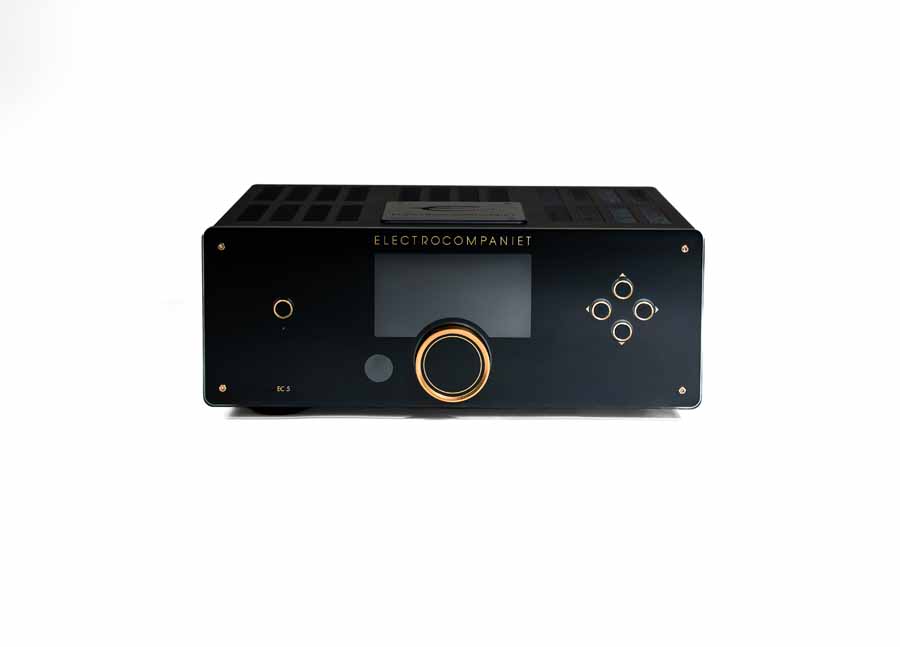
BUILD AND FEATURES OF THE ELECTROCOMPANIET EC 5 PREAMPLIFIER
I think it’s worth looking at the design of the EC 5 in a little more detail than I ordinarily would, not least because I genuinely enjoyed chatting with the designer, Geir Svihus, and I’ve included a snippet of our chat after the techy stuff, more for the sake of completeness and I thought it would be of interest to readers. There may be a little overlap, but I hope you find it as interesting as I did.
DESIGN AND DEVELOPMENT
Work on what would eventually become the Electrocompaniet EC 5 began around ten years ago, which seems like a long time for any product to be in the development stage. The intention was to develop a new generation of preamplifiers that represented a significant step forward from the company’s previous designs, both in terms of circuit performance and the way the preamplifier could be controlled. Given that the Electrocompaniet site mentions preamplifiers (plural), I”m guessing we will see trickle down tech from the EC 5 se its way into more affordable products in due course.









Central to the project was the development of a new volume control that could be integrated directly into the AmpliWire circuit topology used throughout Electrocompaniet’s amplifiers. Rather than placing a separate volume-control stage between input and output buffers, the company wanted the level control to become part of the amplifier circuit itself. Electrocompaniet says this allows the signal path to be kept very short while removing the need for additional buffers around the volume control, which could potentially introduce further noise and distortion. In layman’s terms, the EC 5 preamplifier is built around the two principal sections of the AmpliWire topology (I’ve had this explained a little more below), with the volume control incorporated into the input stage.
The wider design brief included eliminating conventional potentiometers, avoiding mechanical switches within the audio signal path, and providing fully balanced inputs with high common-mode rejection. Electrocompaniet also wanted extremely fine adjustment of both volume and channel balance, without audible switching noise as the level was changed.
I’ll go into a bit more detail about each of the bits of technology that make up the amp, as I think this will be the easiest way to introduce you to the concept of the EC 5 preamplifier. Some of this tech is beyond the scope of what I would usually consider in a review, but I do think it’s useful information to share with you. I’m not an electrical engineer, but most of what I’ve written here is pretty understandable for me and I hope it wil be for you, too.
THE AMPLIWIRE TOPOLOGY
The AmpliWire topology has been central to Electrocompaniet’s amplifier designs for much of the company’s history. It was originally developed in response to the transient distortion associated with some amplifier designs of the 1970s and 1980s. Transistor technology has, of course, advanced considerably since then, but Electrocompaniet continues to use the topology because of the particular way it divides the amplifier circuit.
AmpliWire separates the circuit into two main sections. The first provides the fully balanced input, while the second supplies the required output voltage and current. The output section employs a short local feedback loop rather than relying on large amounts of overall negative feedback across the complete amplifier.
According to Electrocompaniet, this arrangement allows modest levels of negative feedback and open-loop gain to be used while maintaining low distortion. It also simplifies the stability compensation of the local feedback loop and reduces the need for compensation capacitors in critical areas of the circuit. Such capacitors can restrict slew rate and high-frequency performance if used extensively, say Electrocompaniet.
The claimed result is a wide-bandwidth circuit with low distortion and consistent behaviour across the audio-frequency range. Claims regarding fast and controlled bass, clean midrange and smooth high frequencies can wait until the listening part of the review, but the underlying point is that Electrocompaniet has designed the circuit to treat all audio frequencies in the same way and with the same amount of feedback.
VOLUME CONTROL
Previous generations of Electrocompaniet preamplifiers used conventional potentiometers to control volume. For the EC 5, the company developed an electronically controlled resistor network that is integrated into the AmpliWire input stage.
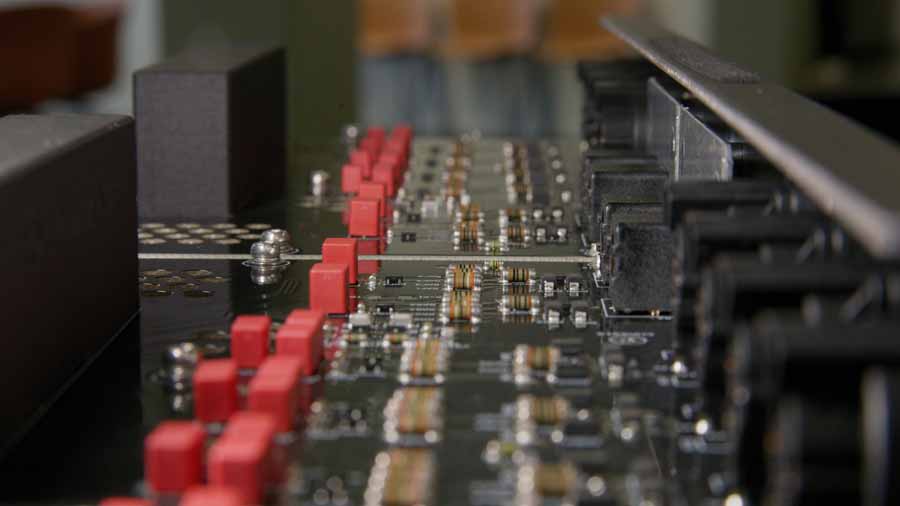
MOSFET switches select different combinations of parallel resistors, which determine the output level of the input section. These switches float with the incoming signal, meaning that there is effectively no voltage differential across them. Electrocompaniet says that, as a consequence, they have no meaningful influence on the signal and do not introduce additional noise or distortion.
Irrespective of the selected volume level, the audio signal passes through two resistors between the input of the volume-control circuit and the output of the EC 5. The final output voltage is established by a single fixed resistor. It is an interesting approach because the signal path does not become more complicated as the volume is reduced or increased.
Over most of its operating range, the EC 5 provides volume adjustment in steps of 0.1dB. This allows particularly fine control of listening level and balance while also maintaining close level matching between the left and right channels. The electronic system also avoids the low-level channel imbalance that they say can occur with conventional potentiometers.
INPUT SELECTION
Input selection is also performed electronically rather than by mechanical relays or switches. Once again, Electrocompaniet uses MOSFET devices that operate without a significant voltage swing across them.
The only additional component placed directly in the signal path is a fixed resistor with a value of a fraction of an ohm. Electrocompaniet says that this arrangement avoids the contact deterioration that can eventually affect mechanical switches carrying very low-level analogue signals.
DUAL-MONO CONSTRUCTION
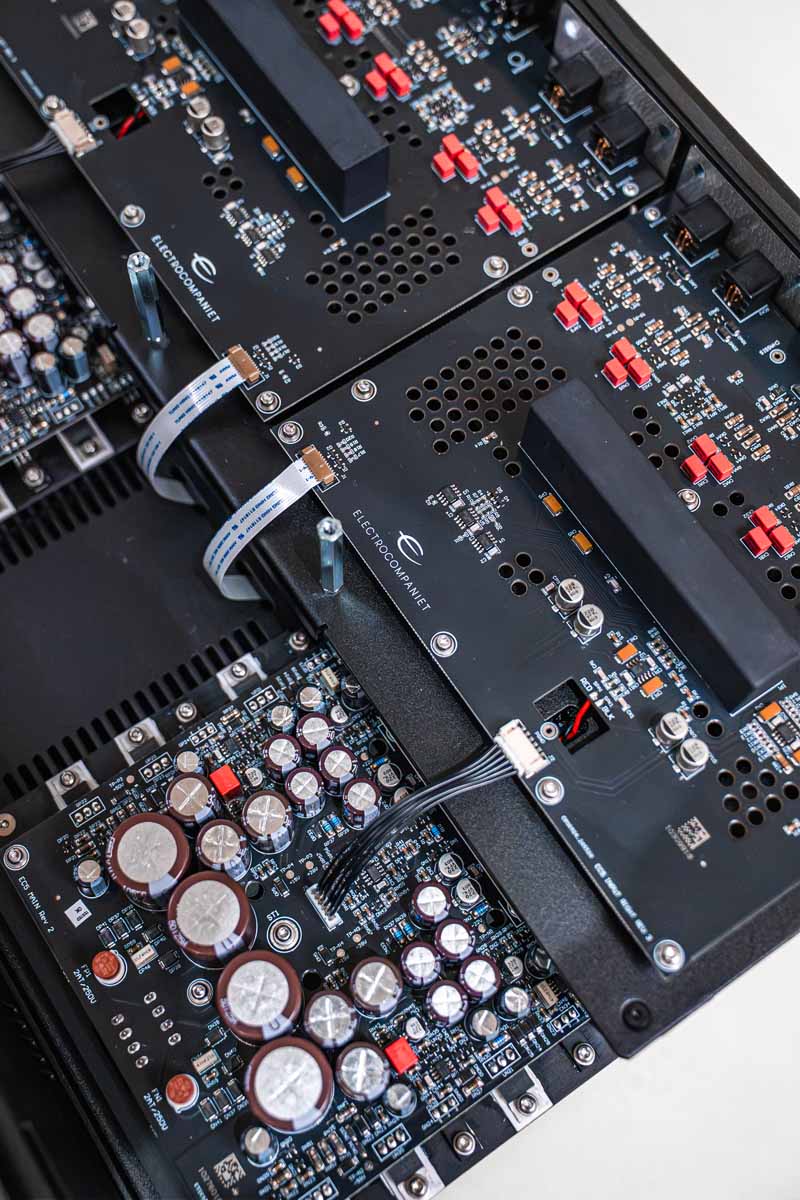
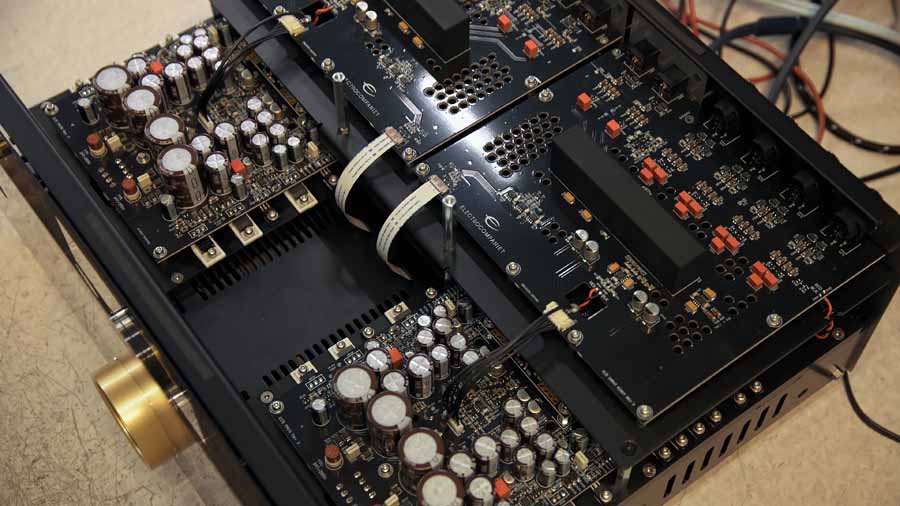
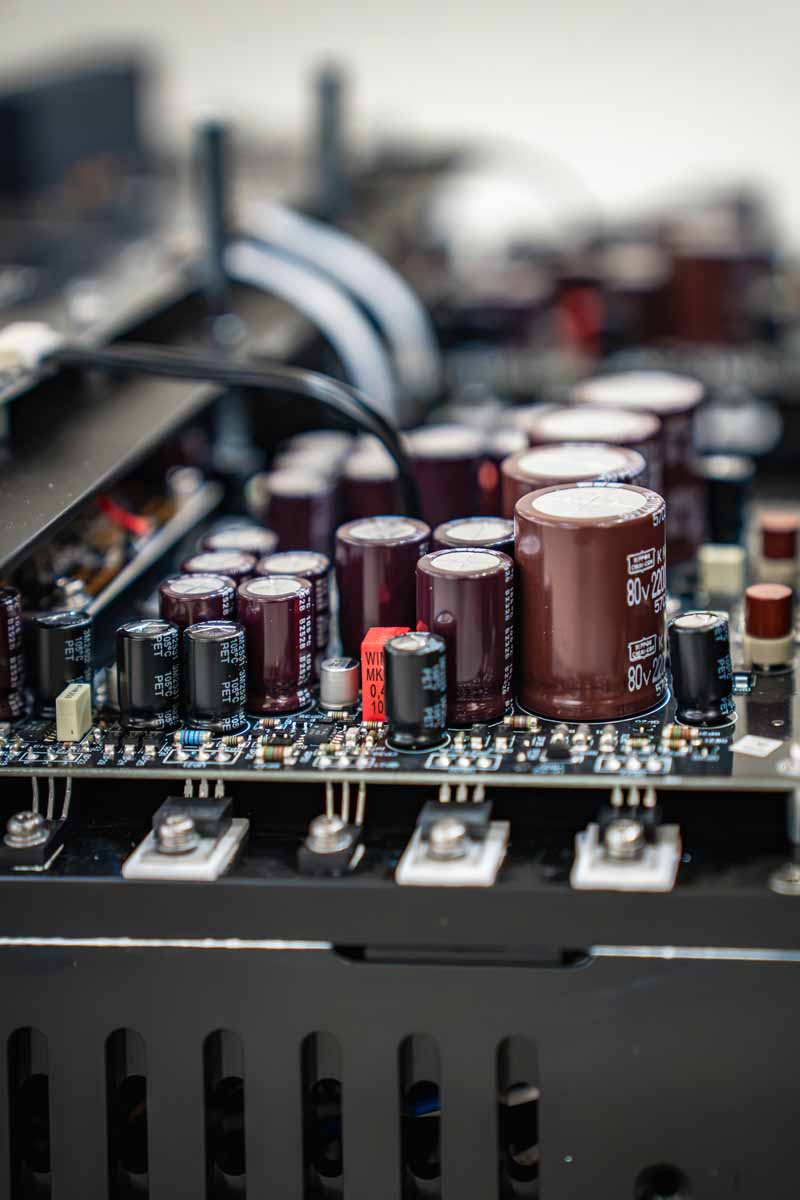
Internally, the EC 5 follows a dual-mono layout, with separate audio circuitry and power supplies for the left and right channels. The input-selection circuits are also mounted on two independent printed circuit boards to minimise interaction and crosstalk between the channels.
All the transistors within the audio circuit operate in Class A. They are arranged so that the voltage swing across each device is either eliminated or kept as small as practicable. This is intended to prevent the operating parameters of the transistors from changing significantly in response to the music signal. Electrocompaniet combines this arrangement with local feedback to keep measured distortion low.
OUTPUT STAGE
The EC 5’s output stage has been designed with considerably more current capability than would ordinarily be required by a preamplifier. This allows it to drive relatively demanding loads and long interconnect cables without the output stage operating close to its limits.
The additional capacity also allows Electrocompaniet to use a low-value resistor within the feedback loop, helping to minimise output noise. An automatic bias circuit continuously regulates the Class A bias current, compensating for changes in signal level, operating temperature and the length of time for which the preamplifier has been switched on.
POWER SUPPLIES
Each channel is supplied by its own toroidal transformer and discrete power supply, including a substantial bank of reservoir capacitors. The most sensitive parts of the circuit receive three stages of power-supply regulation.
The voltage rails are monitored continuously, and the protection system will register a fault if any of them move outside their specified operating range. This is intended to ensure that the analogue circuitry always operates under controlled and consistent conditions.
MECHANICAL CONSTRUCTION AND ISOLATION
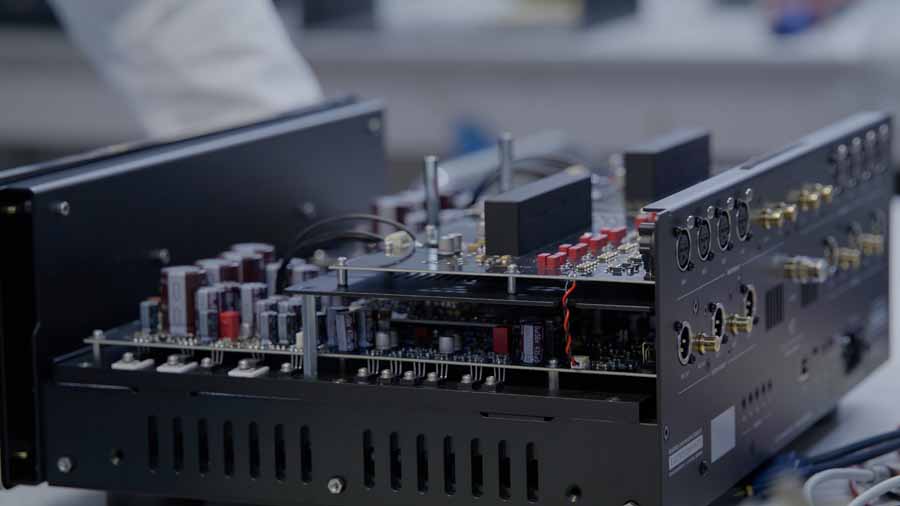
A horizontal steel plate divides the EC 5’s chassis into two separate sections while also providing shielding against electrical and magnetic interference. The upper section contains the analogue audio circuitry, while the transformers and digital control electronics are housed below it. When I first saw the EC 5 back at the last Munich High End show, this separation of analogue and digital sections of the preamp really impressed me when looking inside the open-chassis display sample.
Control and status information passing between the two sections is transmitted either optically or across an electrically floating barrier. This prevents unwanted currents from flowing between the control and audio circuitry. In effect, the internal division allows the single outer chassis to function as two separate enclosures, with the electrically noisy control components isolated from the low-level analogue signal path.
There is clearly more going on inside the EC 5 than its relatively uncluttered exterior might suggest. I first met Geir Svihus, the designer of the EC 5, at Munich High End, and he was clearly very excited and very proud of his creation. I took the opportunity to ask him a few questions about its development, the thinking behind it, and what Electrocompaniet wanted to achieve. Here are his responses, which go some way to explaining the implementation of the techy stuff above.

What is the design philosophy behind the EC 5, and how has that philosophy translated into the electronic design of the EC 5?
It has long been our goal to incorporate a modern volume control into our topology, which we call AmpliWire. All our amplifiers are based on this topology, but it has proved difficult to integrate a state-of-the-art volume control fully into it. With the EC 5, this has been accomplished for the first time.
The benefits are a very short signal path, with very low noise and distortion, and a constant, fixed signal path that remains the same irrespective of the volume setting. The signal path through the EC 5 essentially comprises the input selector, a single volume-setting resistor and a fixed resistor in the output stage. That’s it!
Both the volume control and the input selector are free from mechanical switching elements, which can degrade over time through wear. For the volume control, this was also necessary in order to implement a very high-resolution system that comes close to the feel of an analogue control, but without the drawbacks of a potentiometer-based design, such as noise, channel imbalance and wear.
The input selector has only a fixed-value resistor of a fraction of an ohm in the signal path and introduces no noise or signal distortion.
To complement the volume control, we developed a low-noise, low-distortion output stage for the EC 5 using circuit elements taken from the AW 800 M. This has been significantly over-engineered to drive demanding input loads and long signal-cable runs easily.
What were you looking for in the sound of the EC 5?
We wanted to make the EC 5 very transparent. It sets the volume and selects a source—nothing else. Sound parameters such as fine detail, soundstage, explosive dynamics and a black background must remain intact.
That being said, the EC 5 incorporates the AmpliWire topology, which excels in its reproduction of the midrange, particularly human voices, as well as providing a very smooth high-frequency performance. These qualities should be present without becoming dominant. The output stage, incorporating design elements from the AW 800 M, also results in a very controlled and powerful bass performance.
Above all, the EC 5 was intended to be a state-of-the-art reference preamplifier that matches the AW 300 M and AW 800 M in both technology and performance. In combination with the AW 800 M, or any other power amplifier, the EC 5 should, to a large extent, “get out of the way” and simply present the selected and attenuated source signal to the power amplifier.
The EC 5 is voiced to be very close to neutral, but with a touch of the AmpliWire magic.
Was the final design voiced, and what equipment did you use to test the EC 5?
Regarding voicing, see my response to the previous question. We used AW 800 M monoblock power amplifiers with loudspeakers from TAD, Monitor Audio and MartinLogan, as well as our own The Nordic Tone loudspeakers.
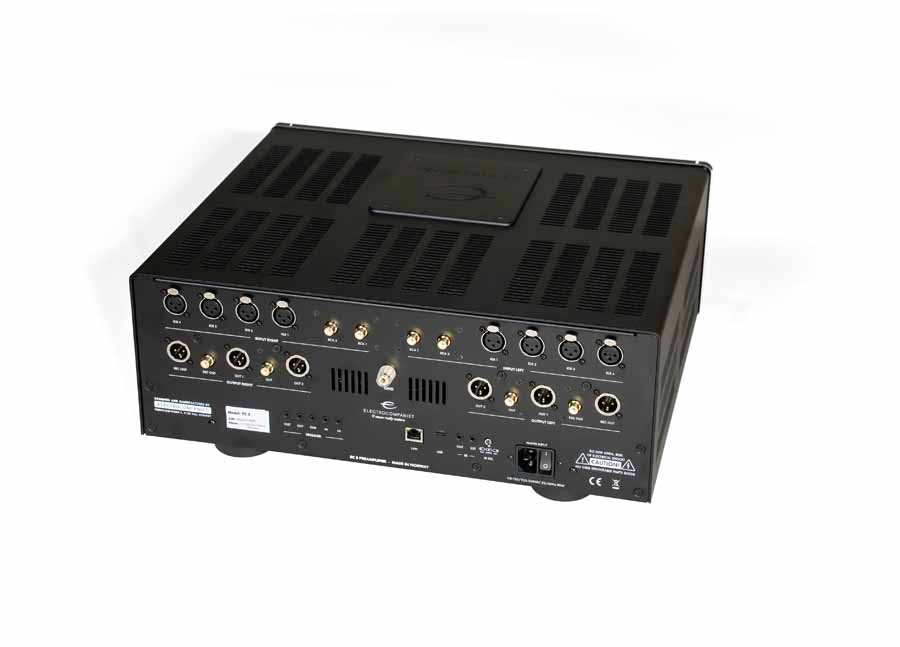
Without going over the circuit design already discussed, the EC 5 is a comprehensively equipped preamplifier. It provides four balanced stereo inputs on XLRs and two single-ended stereo inputs on RCAs. Outputs comprise two balanced XLR pairs and one single-ended RCA pair. Separate recording outputs are also provided in both balanced and single-ended form.
For integration with the rest of a system, there are two 12V trigger inputs and three 12V trigger outputs, along with an IR output. The infrared receiver can be configured to use either the sensor built into the EC 5 or an external sensor, or it can be switched off completely. I didn’t quite understand the idea of using an off-board sensor, but I’m sure Electrocompaniet have their reasons. However, I did like the inclusion of the 12V trigger (hardly revolutionary, I know), andI did buy suitable mono mini-jack-terminated cables to connect the pre to the two AW800M amps. If you don’t know what this trigger does, then it’s pretty simple – turn on the pre and the amps spring to life too. The remote matches the finish of the pre and amps and is very nice to use and covers all the basics.
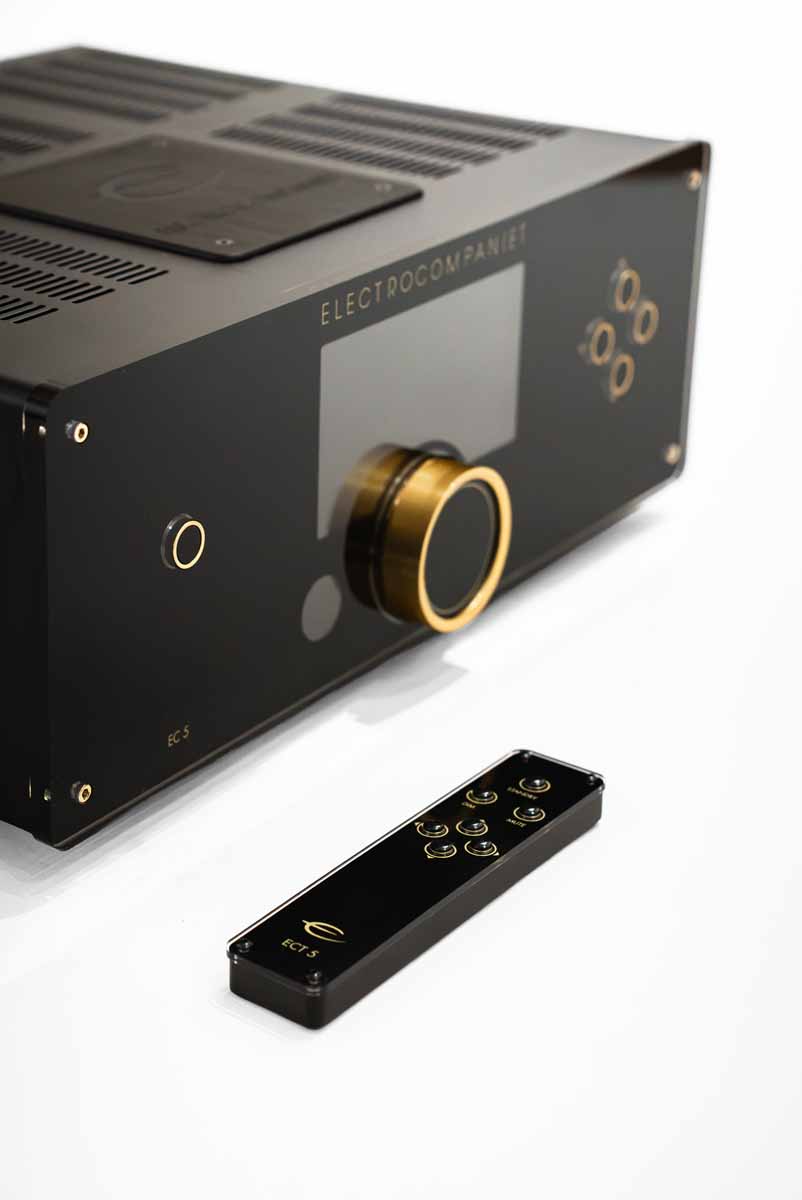
There is a remote control included in the box, and it’s a very nice-looking unit that echoes the design of the pre and amps (all Electrocompaniet kit has the same look). It covers everything you will likely ever need from a remote.
An Ethernet port provides access to app-based control and firmware updates (I’ll mention the app a little later on in this review). The Ethernet port is a control connection rather than a streaming input—the EC 5 remains a purely analogue preamplifier.
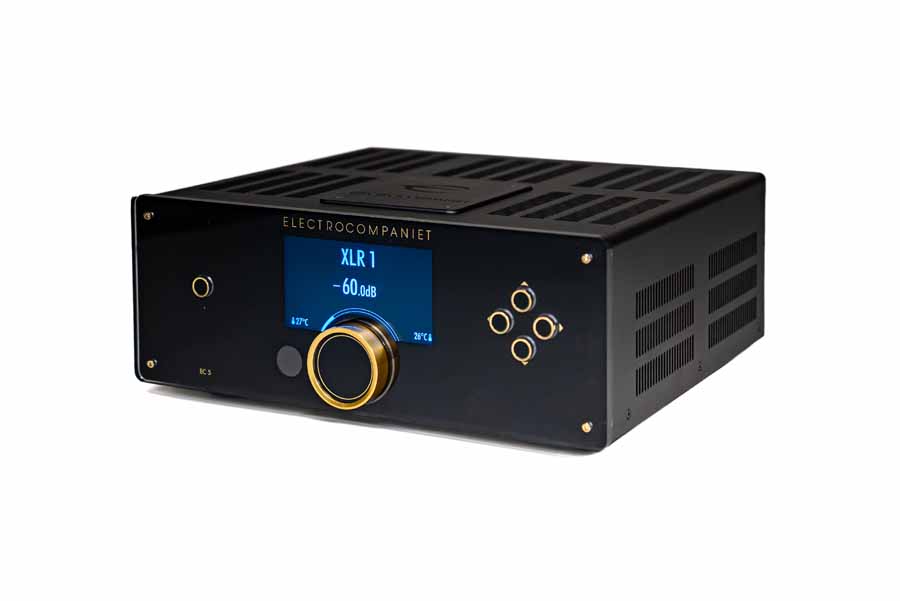
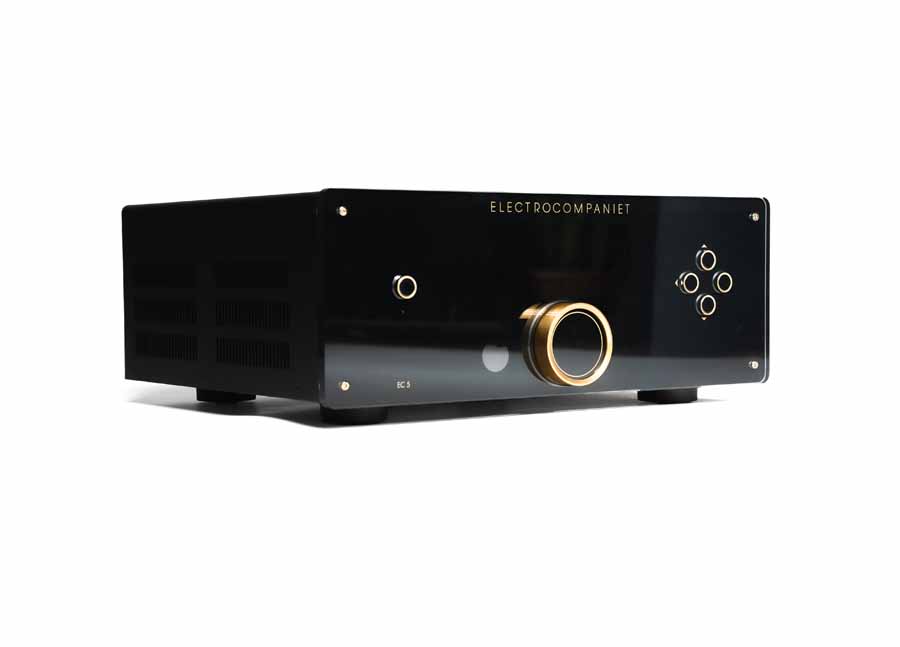
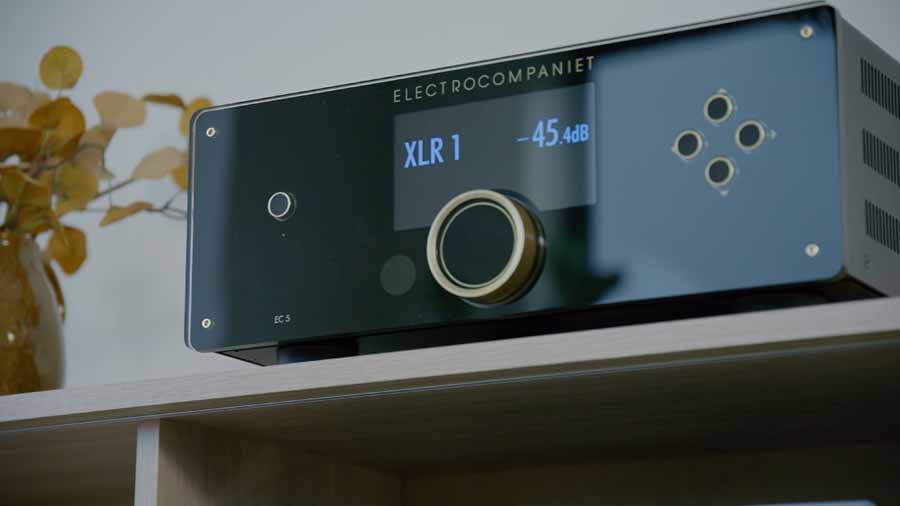
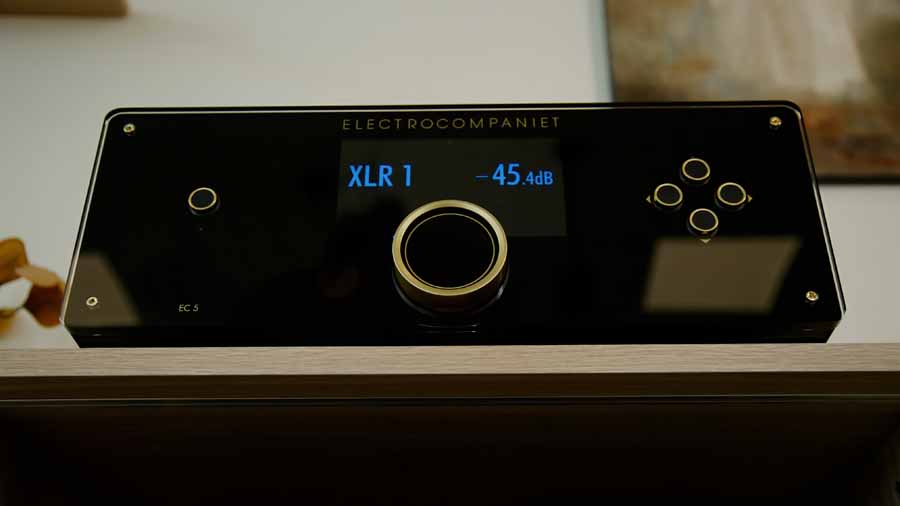
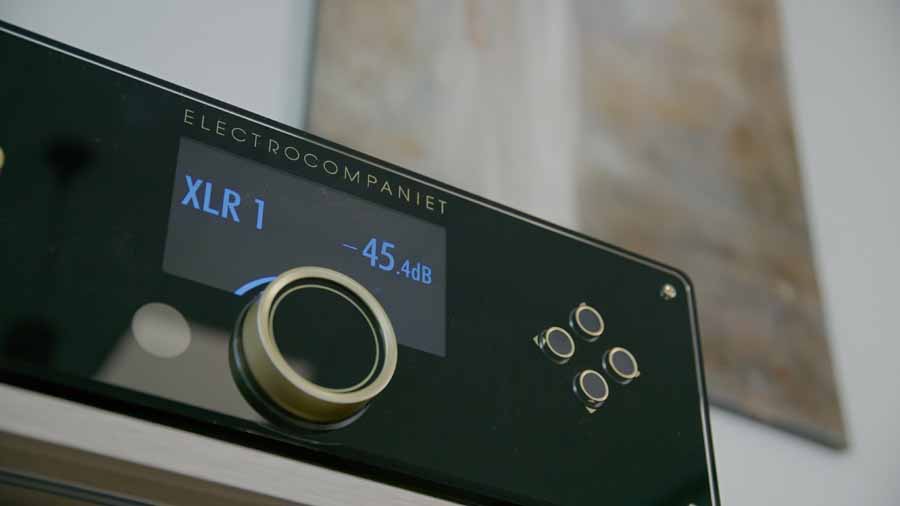
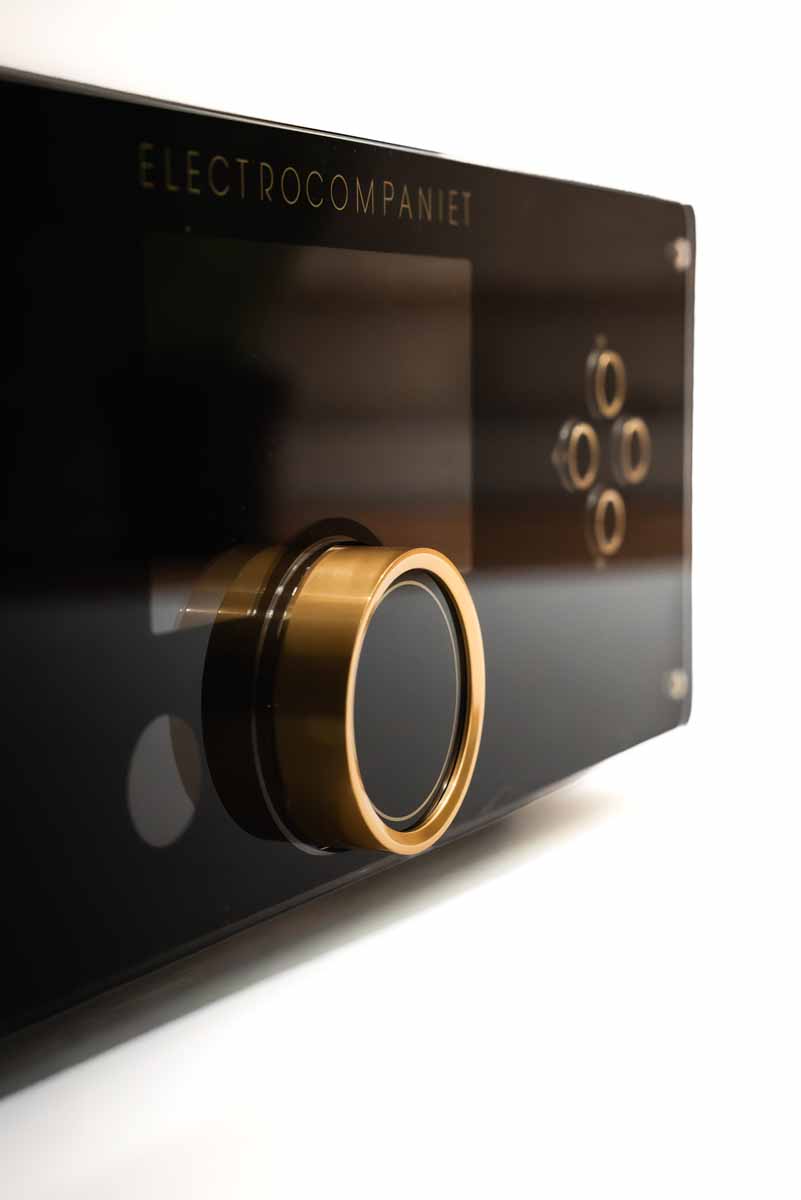
A large volume wheel (I’ll call it a knob), mounted on ball bearings and set into the acrylic front panel, provides physical control of listening level. There are exactly 1,000 volume steps across an adjustment range of −100dB to +20dB. Between −70dB and +20dB, adjustment is available in precise 0.1dB increments. This knob is an absolute joy to use, but I did find that I ended up using the remote control pretty much exclusively.
The EC 5 also provides balance adjustment, source naming and individual source-level matching. The latter allows the levels of connected components to be brought more closely into line, reducing sudden changes in volume when switching between them. Balance adjustment seemed to have gone out of favour somewhere in the 80s or 90s, but I am pleased to see it is coming back into fashion and very pleased to see it included on the
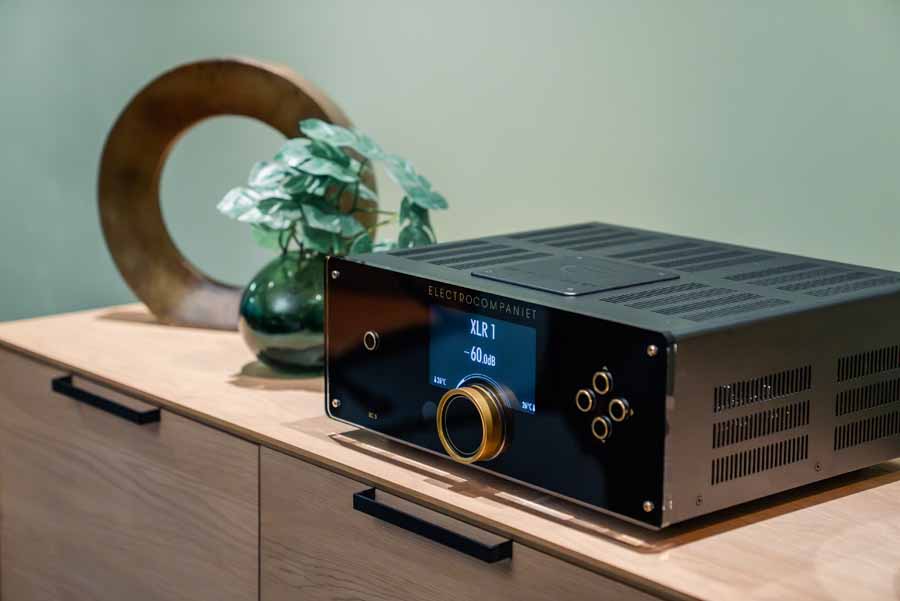
Information is presented on a seven-inch IPS colour display positioned behind the acrylic front panel. As well as showing the selected source and volume level, the display can show the incoming mains voltage.
The preamplifier automatically accommodates nominal 115V and 230V mains supplies, without the need to operate a manual voltage selector. Standby power consumption is quoted as being below 0.5W.
Protection systems monitor internal temperature and the presence of DC at the outputs. A separate grounding terminal is also provided for connection to an external system ground where required. I didn’t try this during the review process, but may well hook it up to our CAD grounding box in the future.
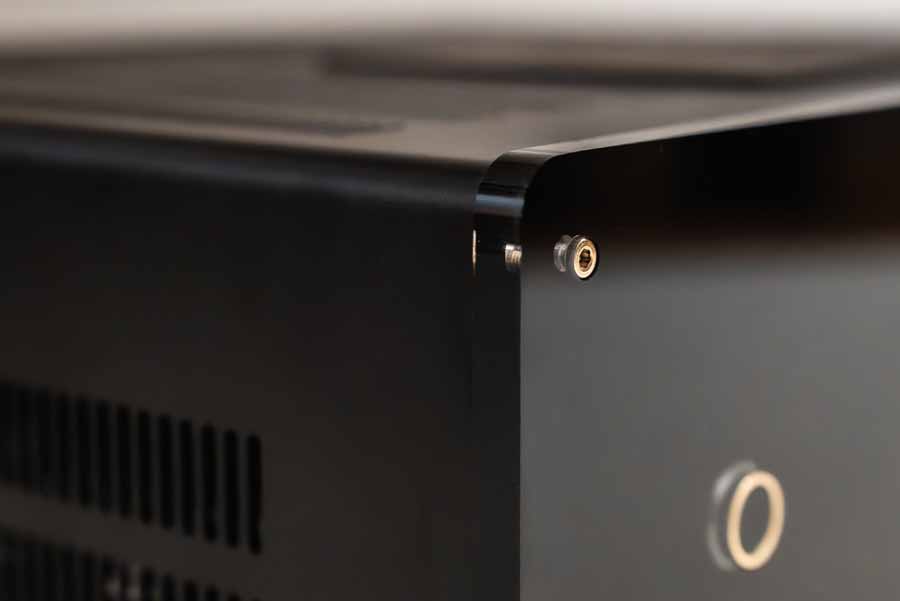
At 470mm wide, 190mm high and 400mm deep, the EC 5 is larger than many conventional preamplifiers. It is also unusually substantial, weighing 25kg. A suitably sturdy equipment support will therefore be needed, along with sufficient space around the chassis for ventilation.
Lasse at Electrocompaniet got in touch with me to let me know there had been a firmware update to the EC 5, and I must confess, these things fill me with dread. However, the process couldn’t have been simpler. Download the EC Play app from the App Store (it’s free), plug one end of a network cable into the back of the EC 5, the other into the internet box, and turn the preamplifier on. After the 140-second start-up period, the screen on the preamp tells you that an update is in progress. A minute or two later, the screen tells you that you need to restart the pre, and that’s it.
The EC Play app is pretty cool in itself. It sees any Electrocompaniet products on the network, and in the case of the EC5 it allows you to set the maximum volume, gives you a bit of information about your network and how the EC 5 is connected, info about the serial number of the unit (21), and what version of the firmware is installed. You can also play with preferences that allow you to change the frontpanel’s backlight intensity and whether to display the temperature of the EC 5 and AC voltage. You can also control the volume from the app and which input is active. You can even set the maximum volume of each of the inputs individually and mute the whole of the pre. Click standby, and it will give you a couple of options for what standby mode you want to have the EC5 idle in.
SET UP
If you have set up a preamplifier before, then you know the drill here, and there were no surprises. Sources go to inputs and outputs go to the amps. I used balanced XLRs to the amps, and inputs were all balanced XLRs.
Turning on the pre results in it going into start-up mode, and a 140-second countdown shows on the screen of the preamp.
I had our Lampizator DAC going into the pre as well as a Technics SL1200G via our LAB 12 melto 2 phonostage. In addition to the HiFi inputs, I also had my DJing set up going through the pre and spent a good deal of time banging tunes through it before I sat down to listen properly. Speakers were the Ø Audio ICON 12s, which I know that Electrocompaniet have used in the past at shows with this same pre and power combination. Cables were by Tellurium Q, Chord, Esprit, Anzuz and Atlas.
The EC 5 does get warm, and Electrocompaniet does suggest that you leave enough space for air to circulate around the unit.
The final bit of setting up that I did was buying appropriate cables for the 12V trigger so that I could turn on the EC 5 and that would trigger the powering up of our two AW 800M amplifiers.
SOUND QUALITY OF THE ELECTROCOMPANIET EC5 PREAMPLIFIER
I’ll make a few “tasting” notes on the EC 5 based on my experiences whilst not really actively listening, as I think they’ll set the scene for a more thorough description in the paragraphs that follow. Also keep in mind I’m coming from a very purist (and excellent) TVC preamplifier by Music First, which is a very different preamplifier in its make-up than the EC 5. Key words that I kept bringing to the fore with the Electrocompaniet unit were drive, clarity, punch, detail, and a seemingly effortless sense of control. These are broad notes, of course, but they’ll convey to you, dear reader, what the EC 5 brings to the table. You could stop reading there, but I hope you’ll stick around to find out why I’ve enjoyed having the EC5 in our system quite so much, and why I think I made a good decision in ordering it all those weeks and months ago.
The first track I actually sat down and listened to was Smells Like Teen Spirit by Nirvana from their Nevermind album. My first reaction was one of the sheer scale of the music I was presented with – the room seemed to fill with sound in an all-enveloping kind of way. It was a physical reaction rather than an auditory one, and I felt myself reaching for the volume button on the remote to dial it back a little – I needn’t have, as it wasn’t the actual volume that caused this reaction; it was something else that initially felt a little overwhelming until I relaxed into the music. The opening guitar riffs seemed to occupy real physical space somewhere a couple of feet above my head before the drums snapped me into the record and the onslaught began. The record became something to experience rather than simply passively listening to a tune. Something visceral. I felt fully immersed in the recording and the “feeling” it brought rather than looking to “listen” to whether this hi-hat (or whatever) was placed correctly or not – I’ll get onto all that in due course, but for the moment I wanted to try and convey a little of the feeling I got from my first proper connection with the EC 5. Had I been sat in a retailer’s and had this same experience, I’d have been reaching for the credit card pretty much immediately.
Continuing the theme somewhat, I reached for Songs For the Deaf by Queens of the Stone Age and specifically the track No One Knows. The onslaught and visceral sense of the music being real and “in the room” continued. However, this time I was ready for it and was able to listen more attentively to details in the recording. One thing I pulled out was the timing and speed that the EC 5 brought to the experience of listening to music. Nothing seemed to hang in the air, and yet nothing seemed overly etched into the soundstage – there was a naturalness to the feeling of the music and a punchy liveness to it, too. The play between the bass, drums, and that riff on the track was wonderfully well done, and that sense of speed and punch brought a feeling of “rightness”. However, the wall of sound that was in front of me was detailed, too – the instruments had texture, and smaller details in the mix were clear to hear. By the end of the tune I felt like I’d been holding my breath for the whole four minutes and thirty-eight seconds. I’ve re-read that paragraph, and it sounds like I’m describing being punched in the face but enjoying the minute detail of the blow – that’s kind of how it was.
“Inky blackness” is one of those old audiophile phrases that got trotted out so often, and subsequently had the piss taken out of it so thoroughly, that it pretty much disappeared from reviews. I’m slightly wary of dusting it off now, but sod it, that’s what kept coming to mind when listening to the EC 5. There’s a stillness behind the music that makes the phrase feel entirely appropriate, however much I might once mercilessly mocked anyone who used it. Thinking back to the couple of tracks I pulled out of my notes and described above, it’s pretty obvious to me that the feeling of power with subtlety I got from this pre in this system is in part down to the silence from which the music comes. There’s simply nothing else there in the background, though the same was perhaps true of our previous preamplifier. What the EC 5 adds is a degree of punch and drive that I hadn’t realised I was missing. Combine that with its transparency and the result is music that feels more alive, with even the smallest details contributing to that sense of energy. It’s a combination I haven’t heard from this system before. At this point, any normal reviewer would bang on about microdynamics and leading edges, but you get my drift without me having to do that, I’m sure.
The opening drums on Stevie Wonder’s Superstition had a snapiness and a genuinely in-the-room feel to them, but it was the detail that can only come from an exceptionally transparent and quiet (pre) amplifier that really knocked me off my feet…or would have done if I hadn’t been lounging on the sofa. And then the funky Clavinet riff came in, full of texture and bite, with each note clearly defined while retaining that wonderfully dirty, chunky sound. And then the horns cut through the mix in a way I’ve genuinely not experienced before in our system. And then… I let the track play through a few times and then went back many times to listen to particular parts of the tune (this is how I tend to listen when reviewing), and the one part that I went back to lots on this spectacularly produced recording was the drum track. I’ve heard this record many times, but this was the first time I’d really appreciated the human touch in Stevie Wonder’s drumming, and just how much it holds the whole thing together. I listened to the whole of the album (Talking Book) and was taken aback at how connected I felt with the music. I genuinely don’t care about any of the technology any bit of kit brings to the table; it is this connection I’m looking for, and the EC 5 just seems to connect me with the music that I already love, but in a natural and unforced way. Yes, there is the punch and drive I’ve already mentioned, but there is also something undefinable that I can’t quite put my finger on. The secret sauce. The addition of just a touch of seasoning that brings a dish alive on your palate and elevates it from being a tasty forkful of food to being something that stops you in your tracks and brings you the full experience and explosion of flavour. Specifically, the way the organ cuts in on Young Gifted and Black made the hairs on my legs stand on end. That’s all a bit la-di-da, and it’s a tiny detail, but I hope it gets across what I’m trying to convey about my experience of listening to this pre in the system.
There’s a mental tick-box kind of system in use when you are reviewing a new product. Did I mention bass, soundstaging, blah, blah…? And all those things are present and very correct with the EC 5, but strip away all the things that you naturally expect to find in pretty much any piece of decent audio hardware these days, and you are left trying to explain why one product sounds better to your ears than another similarly specified (on paper) product. That’s a hard task to achieve and then convey via the written word, but there is definitely something with the EC 5 that is about connection to the music. Yes, it’s a technically superlative product (at this price you would naturally expect it to be), but there is something indefinable that it brings to the party that is just so very right. Yes, it’s deadly quiet. Yes, it’s detailed. Yes, it’s got great rhythm. Yes, there’s a certain “je ne sais quoi” that I can’t quite put my finger on that lifts this from being a technically wonderful product to being a machine for bringing joy to the listening experience.
QUIBBLES
The 140-second start-up is a bit frustrating.
Line level only.
CONCLUSION
The preamplifier is the heart of the system, and our previous preamplifier had sat in our system for four years, having replaced the previous model by the same company. Preamps have been in and out of the system, but nothing had made me consider replacing it until the EC 5 came along. Yes, I’d already committed to buying it based on what I’d heard at a handful of shows, but I could have very easily moved it on quickly had I not liked it; once the music began to pour through it, from the very moment those first bars of Smells Like Teen Spirit hit me, I knew it was a keeper.
The EC 5 by Electrocompaniet straddles that fine line between remarkable engineering for the well-heeled music lover and audiophile esoterica really well. Let me explain: You feel like you have something really quite special sat on your rack, but it’s robust enough and user-friendly enough to be usable every day of your life. Think of it as being the Rolex Submariner of the audio world – feature-rich and cool enough to be your everyday beater, but recognisable and dressy enough for a posh night out. The analogy isn’t perfect, but you get my drift. I’ll give you an example of why I chose that watch analogy. The EC 5 genuinely feels like a luxury product, but one without the bling (a steel Submariner rather than a gold and diamonds affair). For example, when you touch it, the volume knob feels like a luxury item, though I rarely used it given the remote did everything I needed. However, I knew it was there, and I knew it was gorgeous!
If you have the AW800 M amplifiers (or just one of them), then my advice is pretty simple – go buy the EC 5 as it pairs perfectly with them. I strongly suspect that the same will be true if you own any of the other power amplifiers from this Norwegian brand. I’ve said in the past that great audio products shouldn’t really have synergy (great is great wherever you put it), but I do think that the EC 5 and the AW 800 Ms work so well together that it is worth emphasising. However, I have no qualms in suggesting that this preamplifier will work in just the same manner with whatever quality power amp you put after it!
From a features perspective, the EC 5 has enough to be useful (dimable display, balance controls, mute button on the remote, 12V triggers), but they are all genuinely useful, and nothing feels like it’s been added to the feature set or build purely to make a better selling story for the retailers out there. Indeed, on the face of it (before you look at the actual stuff going on inside this preamplifier), the EC 5 is a pretty basic machine (volume knob, selector switch, enough inputs and outputs), but plumb it in and play your tunes and it becomes something else, something truly magical, a machine for bringing joy into your musical world. I love it!
If you’ve made it this far through this rather long review, it will come as no surprise that I’m giving the Electrocompaniet EC 5 the HiFi PiG Editor’s Choice award. I’ve bought expensive things outside the world of audio on the strength of the hype or the specifications, waited ages for them to arrive, and then been left feeling a bit disappointed once they were finally in my hands. With the EC 5, the delight of having it in my system has more than matched the anticipation. I’m absolutely cock-a-hoop with it, and I reckon it’ll be the last preamplifier I ever buy!
AT A GLANCE

Build Quality And Features:
Built like a tank but still beautiful to look at – undeniably an Electrocompaniet product
The feel of the volume knob is fantastic
Lots of inputs on RCA and XLR
Lots of outputs, including dedicated recording outs
12V Triggers
Updates are simple via Ethernet
Nice and matching remote
Dimmable screen
The inclusion of balance will be useful for many people
The app is genuinely useful
Very nice remote
Sound Quality:
Punch and power whilst retaining detail and microdynamics
The connection with the music is second to nothing I’ve experienced at home before in this system
Speed and dynamics are amazing!
Value For Money:
The best part of 20K in sterling is a chunk, but then you know that’s par for the course already if you are investing in quality home audio (and that’s whatever the brand you have nailed to your mast). However, this is one product I’m very happy to say feels worth the money
We Loved:
Speed, dynamics, detail…
Build quality is fantastic
App, remote…
We Didn’t Love So Much:
The 140-second start-up obviously has a purpose, but it is a minor irritation
I don’t really know what the configurable IR sensor is for, but by the same token I didn’t feel the need to find out
Elevator Pitch Review: The EC 5 line-level preamplifier by Norwegian company Electrocompaniet has been a long time coming, but, boy, has it been worth the wait. You don’t get an onboard phonostage or DAC, but what you do get is brilliant electronic engineering in a package that looks great and sounds even better than the specs might suggest. If you have any of the power amps from Electrocompaniet, then it’s a no-brainer. If you have a power amp from a different brand and can afford it, then I heartily recommend you get a listen to this pre at your earliest convenience; you will not be disappointed!
Price: €21,999, £18,599, and $25,500

Stuart Smith
SUPPLIED TECHNICAL SPECIFICATIONS
Inputs: Four balanced stereo inputs; two single-ended stereo inputs
Outputs: Two balanced stereo outputs; one single-ended stereo output
Recording outputs: One balanced stereo output; one single-ended stereo output
Trigger connections: Two 12V inputs; three 12V outputs
Other control connections: Ethernet, IR output and configurable IR sensor
Input impedance: 47kΩ
Output impedance: 22Ω
Frequency response: 0.5Hz–450kHz
Maximum voltage gain: 20dB
DC present at output: Less than 1mV
THD+N: 0.0002%
SNR (ref. 1V, 20-20kHz, A-wht): 113 dB
Channel separation: > 120 dB
Maximum input voltage: 10 Vrms
Maximum output voltage: 10 Vrms
DC output voltage: < 1 mV
Accuracy internal temperature sensors: +/- 5 %
Accuracy internal mains voltage sensor: +/- 2 %
Power consumption idle: 80 W
Power consumption standby: < 0.5 W
Standby power consumption: Less than 0.5W
Dimensions (W × H × D):470 × 190 × 400mm
Weight: 25kg