

ADMD Audio Line DAC (RCA)
ADMD AUDIO LINE DAC (RCA) REVIEW
Stuart Smith takes a listen to the 12 990 Euro Audio Line DAC from ADMD
ADMD Audio presents itself as a master of sound technology, formed by a team that describes itself as children of the digital age. The company is built on a transition from high-stakes IT infrastructure and industrial electronics, areas where unpredictable malfunctions are not acceptable, into high-end audio. This background shapes how the company approaches sound systems, with complexity treated as something to be explored rather than avoided. The team brings together technical specialists, sound engineers, musical talents, and DJs, a combination intended to inform how their equipment is developed and how it ultimately sounds. Their stated position is that simply good is never enough, leading them to continue refining their designs until they reach what they consider superb quality. This is an engineer’s mindset, and one that can be both very positive in that they forever strive for perfection or a bit negative in that because they are forever seeking perfection, they never get a product to market; I’m delighted that ADMD have mostly avoided this latter pitfall, though the afterword to this review shows that the engineer’s mindset is still very much in evidence.
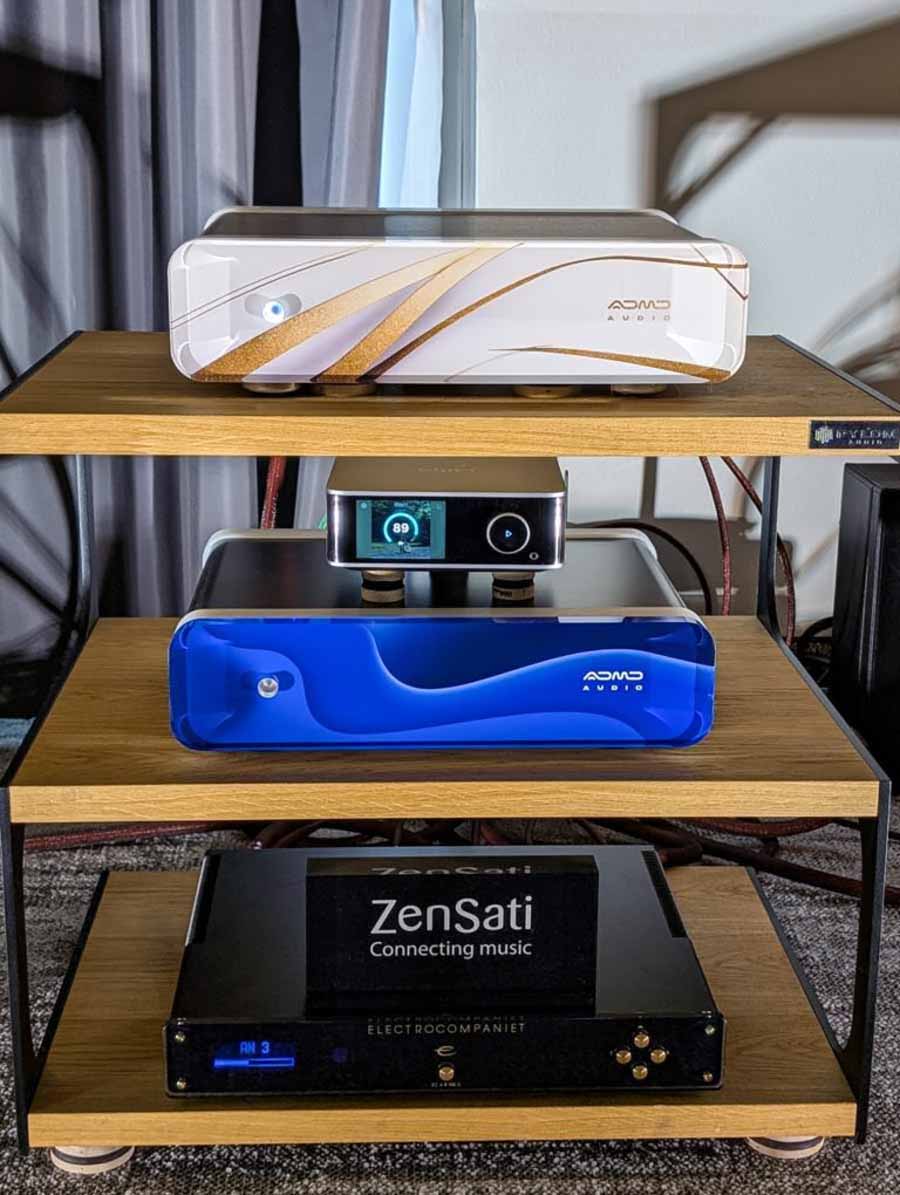
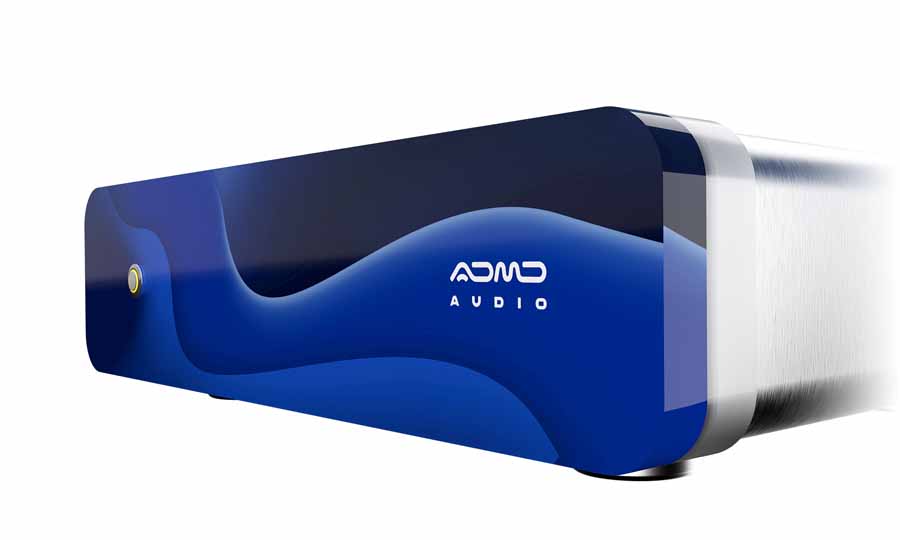
ADMD Audio also emphasises the physical construction of its products, viewing them as objects rather than purely technological tools. Devices such as the line DAC are hand-made using metal alongside carefully selected wood (or resin, as in the case of this model), chosen for both its appearance and its acoustic properties, which are intended to contribute to overall performance. I love the look of this DAC, and because you can specify the front panel, it’s always going to appeal to your personal aesthetic preferences, and the aesthetic of your home/rack.










From an engineering perspective, the company highlights the use of dual R2R ladder DA converters (more on those in a moment) and “precision anti-resonant composite” cases as central to maintaining sound integrity.
The company makes two DACs (well, kind of three if you want to be pedantic), the ADMD Audio ArcEdge DAC that uses Quad R-2R ladder DA converters and has a balanced output, and the model we have in for review, the ADMD Audio Line DAC that uses Dual R-2R ladder DA converters and outputs a single-ended signal via RCA. The ADMD Audio line DAC comes in two flavours: one with a choice of wooden front panels, and the model we have, which comes with resin front panels.
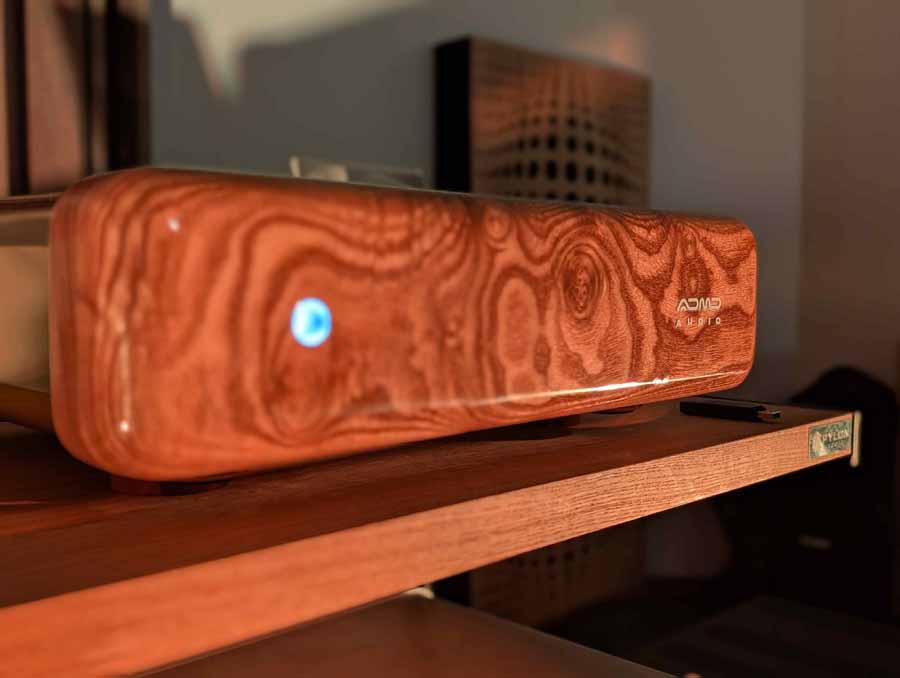
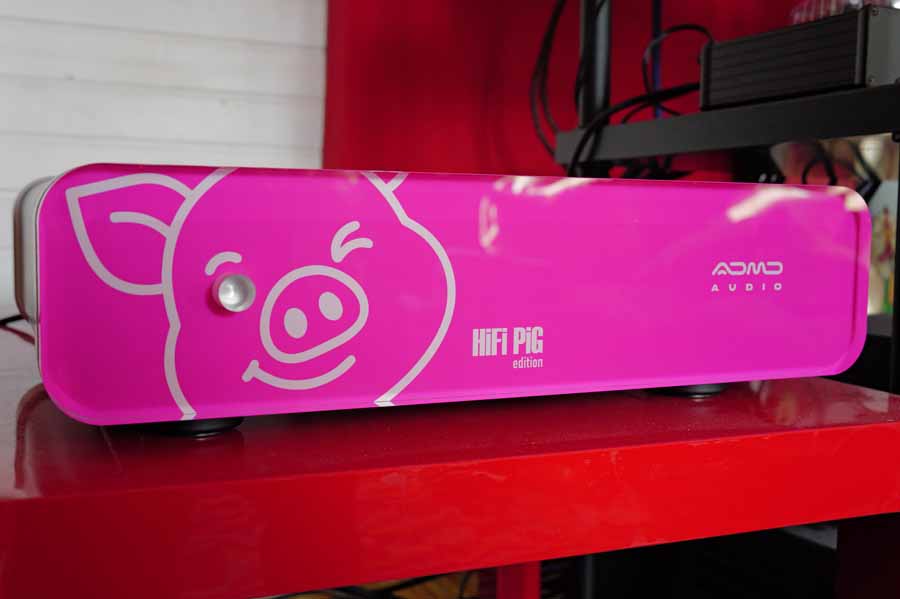
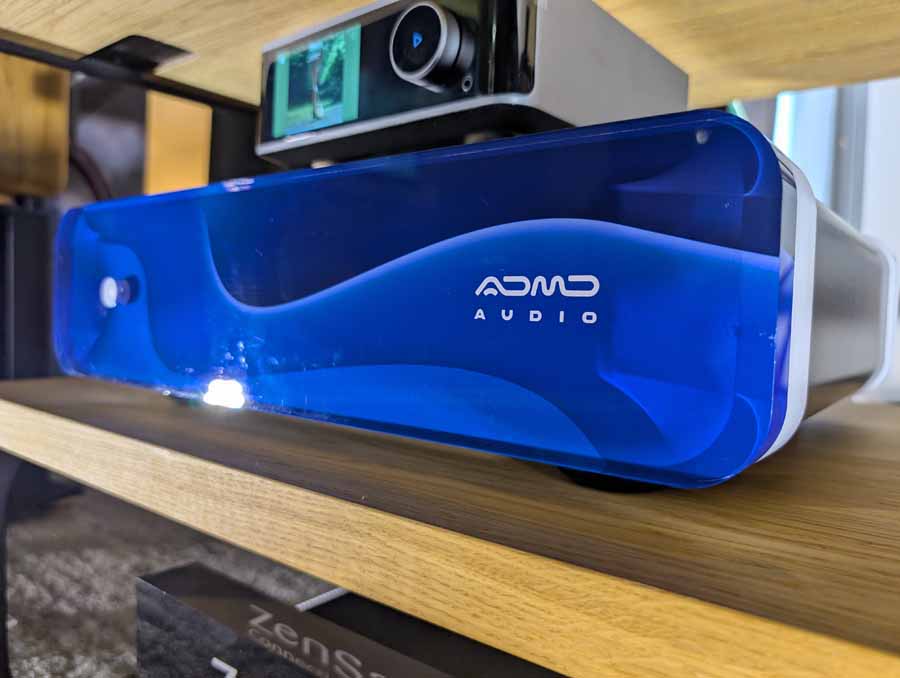
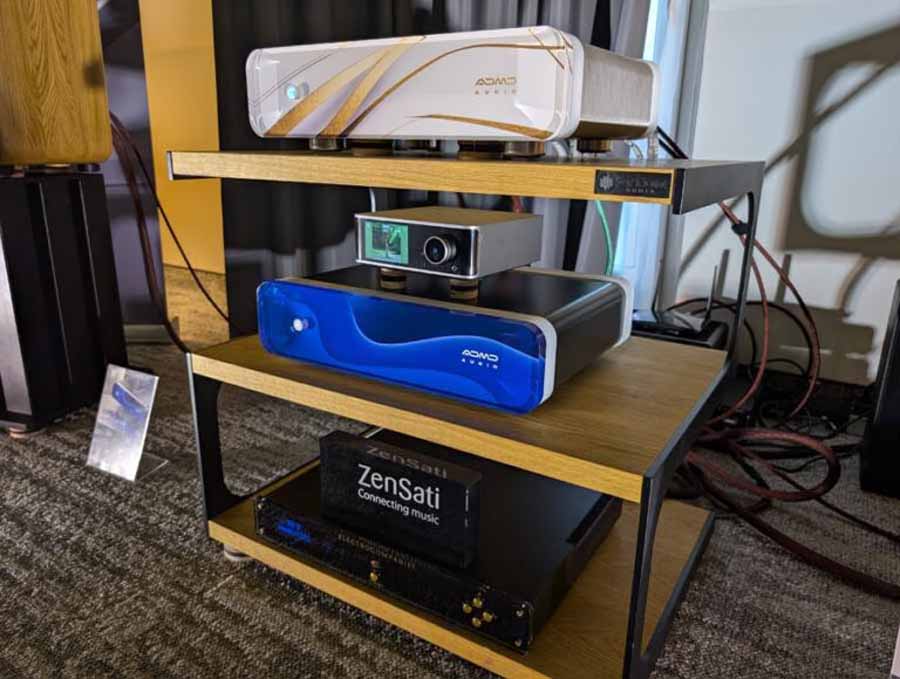
When we were invited to the company’s booth at Munich 2025, I was taken aback at how beautiful the DAC looked with the totally different resin front panels – they really are quite beautiful. However, the review sample came with a bespoke HiFi PiG finish in pink that was exceptionally cool, and with it came a note to say that they’d done this to demonstrate what kind of finishes could be provided. I’m sure most folk will be happy with the standard (though they are far from standard – think black with gold accents, or blue with an inlaid wave pattern), but these days folk are pretty demanding and being able to provide such beautiful and quirky bespoke finishes can only be a good thing for the company.








As well as the pair of DACs that ADMD produce, they also have the Syntra system that includes a DAC and a pair of their own active loudspeakers. You can read more about this integrated system from ADMD here.
BUILD AND FEATURES OF THE ADMD AUDIO LINE DAC
I’ve already touched on the aesthetics of this DAC, and I genuinely love it, and did so the moment I saw it in that booth in Munich.
The front panel is stripped back to nothing but the on-off switch (a master power switch is around the back) and the resin front panel. However, things look a little more involved around the back, where you will find a knob to change between “Linear” and “Wintage”, the digital inputs and a selector knob, and finally the RCA outputs.
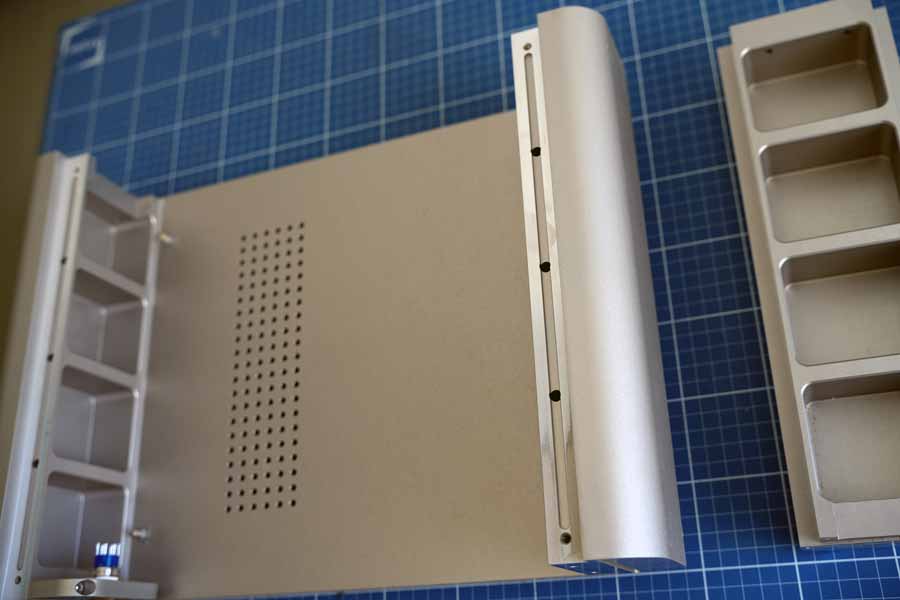
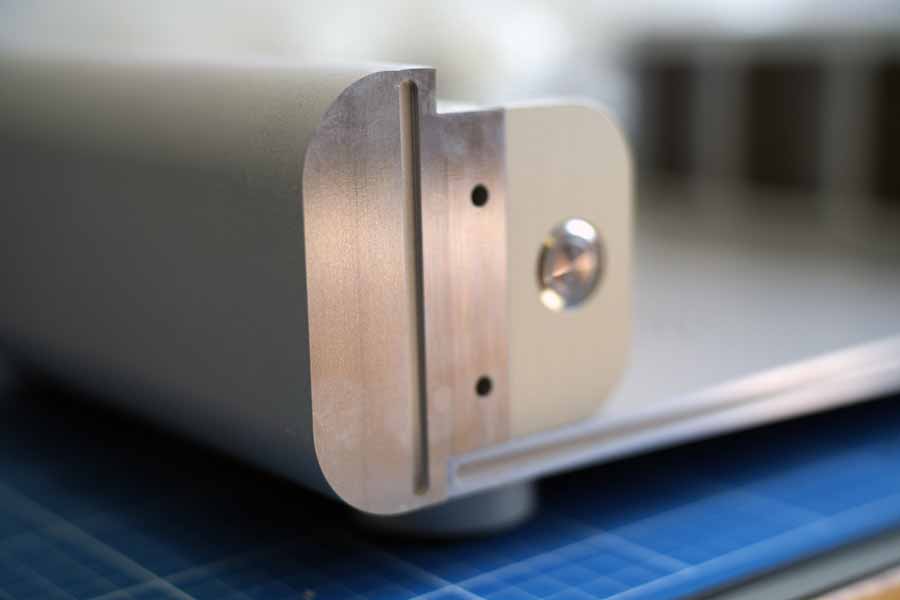
The ADMD Audio line DAC is built around a high-performance dual R-2R ladder DA converter and supports high-resolution playback up to 24-bit and 192 kHz. It is a substantial, but relatively standard-sized piece of kit, weighing 12 kg and measuring 450 mm by 360 mm by 100 mm. The enclosure is an anti-resonant composite case that is hand-made using a combination of metal and then resin front and back panels.
The internal architecture provides a range of digital inputs, including SPDIF, AES EBU, and USB operating in asynchronous mode. These inputs feed stereo RCA outputs with an unbalanced output level of 2 V and an output impedance of 100 ohms. The DAC also offers selectable filter options, allowing the user to choose between linear and vintage-like (spelt Wintage on the company’s website, which I thought was really quaint) presentation styles.
Technical figures include left and right crosstalk better than minus 112 dB. The noise floor performs better than minus 92 dB with 16-bit data and improves to better than minus 110 dB with 24 bit data. Power is supplied via a standard IEC input, with average power consumption of 10 W and a maximum of 30 W during operation.
I turned to Wiki to explain what R-2R DACs are and make no excuses for paraphrasing Wiki’s content here.
If you are reading this, I guess you already know basically what a DAC does in your system. Digital audio can be understood as a sequence of instructions that define signal level at extremely small time intervals, and an R-2R ladder follows these instructions using a network of resistors arranged so that each bit acts as a switch controlling a specific weighted amount of current. The most significant bit controls the largest portion, with each subsequent bit controlling half of the previous amount, and the combined result produces a precise output voltage that forms the analogue signal. The R-2R design relies on only two resistor values, one being exactly double the other, which simplifies manufacturing while maintaining precision. In a voltage mode implementation, the bits switch between zero volts and a reference voltage, with the output derived from this reference scaled by the digital value. A key advantage of the design is a constant output impedance, which contributes to predictable and fast operation. Conversion accuracy depends entirely on how closely the resistors are matched, and this requirement becomes increasingly demanding with higher resolution data, as small errors in the most significant bits can overwhelm lower-level detail. Because the output is a stepped voltage, filtering is used to refine the signal, with selectable linear or vintage-like (in the ADMD DAC) options provided. So there you have it.
SET UP
Plug the source streamer (via USB in my case), select USB on the knob on the back, connect the analogue outputs to the preamplifier, find the source and DAC in ROON, and play some music. No dramas or hassles here. Everything just worked as expected, though I did wonder why there was no music to start with: correct input…check, switch between linear and vintage…check, correct output on ROON…check, correct input selected on the pre…check. Oh, it helps if you actually turn your power amplifiers on! Happens to the best of us! The system used was the usual Music First pre into the Electrocompaniet AW 800M monos, and Ø Audio ICON 12 loudspeakers.
SOUND QUALITY
Jeff Buckley’s Grace album has been a bit of a staple here at HiFi PiG Towers for several years now, though I rarely mention it in reviews. My go-to track on the album is Lilac Wine. It’s a track that reminds me of my childhood and early teens, though back then it was the Elkie Brooks version that my folks would play in the pub they ran. But the tune goes back to the 50s and has been covered by loads of folk, including Nina Simone. The recording and production on this record are excellent. The ADMD didn’t miss a beat here and allowed the production to shine. Buckley’s vocal was bang central in the mix and a little forward, but the main takeaway was the detail that this DAC brought to the party. If we listen to music to connect us to the artist and the emotion they are trying to convey, this DAC is a winner. The lack of any background noise ensures that his voice comes out of a space that, when there is no music playing, is as good as silent. This, in turn, allows the listener to hear the emotion and small inflexions in his delivery. And when there is music playing, such as in the opening guitar chords, you can hear the player moving across the strings and the reverb of it fading into nothing. Likewise, the reverb on Buckley’s voice fades into inky blackness. Drums, such as they are in this track, are presented as they should be: slightly subdued and barely there. This is an excellent opening from this DAC, and as I listened to the rest of this recording, my appreciation of it didn’t diminish in any way, and I found myself enjoying the music very much. I suppose the main thing a DAC should do is to present the file it is playing without embellishment, but also without losing any detail. The ADMD pulls this off with aplomb, and even as the volume and raucousness increase on tracks like So Real, the DAC doesn’t feel it is being pushed or losing control. I also didn’t feel like I was being presented with a sound that became overly delineated in the soundstage; there is detail, but it is presented as a whole rather than a collection of stems that sit isolated in the mix. Yes, you can pick the mix apart, and you can focus on the spatial details if you want, but the inclination isn’t there to do that with this DAC. The inclination is to sit and listen to the music. I’m not going to say this is a “musical” DAC in the sense that some reviewers use it to describe a product that isn’t really cutting it. I am going to say that this is (so far) a musical DAC in the sense that you want to listen to the tunes rather than the product. This record really did sound glorious with the ADMD plumbed into the system!
Green Tea Peng has been around for a good while now and is getting a good bit of airplay on BBC Radio 6, and I’ve been listening to her a fair bit. I’m a huge fan of Lee Scratch Perry, too, and so the Tricky mix of 100lbs of Summer really does it for me. The ADMD does its thing again with this track. It’s pretty sparse, but there’s a fantastic 808 (I think) bass kick that cuts through the tune and provides a hugely solid foundation, and this DAC allows it to come across powerfully and deeply. There is clarity and detail again, but once more, there is music that fills the room. The key thing with this kind of tune is the space in between the music (if that makes sense), and this DAC just seems to get out of the way and let the music play. There’s no added shine, no added sheen, and very little embellishment.
Jamila Woods’ Good News comes on, and there is a feeling to me that there’s an element to the percussion that has been pushed too far in the mix that spoils the tune for me. The ADMD doesn’t hide this, and, as such, I’d say that this is an honest DAC where poorer mixes don’t have anywhere to hide.
I’d been listening to this on Linear mode, but switching to Wintage (I really love this quirk) added a little more space to the top end. It’s fairly subtle, but I did quite enjoy it, and I did find I tapped along a little more enthusiastically with this mode engaged. It’s not as honest to the source as the Linear mode, but to be frank, when I’m listening to music outside the review process, I’m looking for musical enjoyment, not looking to pick a mix apart. The ADMD Wintage mode works very well in this respect.
I’m not going to list tune after tune that I listened to, and I’ll try to sum the ADMD Audio Line DAC up as best I’m able to, pulling out its clear strengths and any obvious weaknesses.
Whatever I listened to, I was reminded that I was listening to music and not a bit of electronics. The noisefloor on this DAC is pretty incredible, and that allows the listener to dive into the tunes and pull out details and spatial cues like reverbs and other effects without effort. However, it doesn’t seem to want to present you with an overly analytical sound. This is a fine balancing act to get right and I think this DAC pulls it off very well. Yes, you can delve into a mix if you want, but I genuinely didn’t find myself doing this much at all, and mostly just sat down with pen and pad in my lap, pressed play, and then listened to music without taking much notice of what I was supposed to be doing. This is surely a positive sign.
I genuinely have no idea of the price of this DAC as I’m writing up my notes, but I’m guessing it’s going to be around the €10K mark. Below this, I reckon the ADMD Audio Line DAC is a bit of a bargain (if a 10K box of electronics can be called a bargain). If it comes in at €15K, I reckon it’s still a viable option. Above this, we are getting into the esoteric world of DAC technology, where your personal sonic preferences are going to take precedence, and any chatter about cost is a bit of a sideline. As I’m writing up my notes, I ping a message off to the guys at ADMD to ask the price; I get a message back telling me that it’s 12990 Euros. This kind of falls (sort of) in the middle of my two estimates, and whilst I wouldn’t say this price is a cold-stone bargain, I do think it offers reasonable value when we consider the sonic virtues on offer.
QUIBBLES
The left and right outputs were labelled incorrectly, but this was highlighted to us before we began playing with the ADMD Audio Line DAC.
Crap mixes aren’t given a coat of veneer and made to sound better than they actually are, so if you are ripping your tunes from YouTube (why would anyone do this?) or using MP3s (why would anyone do this?), you will want to look elsewhere.
Selector knobs are around the back. This is a good move aesthetically, but if you change how you feed the DAC (SPDIF, USB, AES EBU) then you might find it to be a bit of a pain in the arse. Likewise, switching between Linear and Vintage. However, most folk don’t change sources in this way all the time and will decide once whether they prefer linear or wintage and stick with it, making this quibble less quibblesome.
CONCLUSION
The special HiFi PiG finish this DAC arrived with was cool and fun, but I’ve seen the more standard finishes, and I reckon this to be one of the best-looking bits of HiFi equipment in the world right now, though I don’t like the wooden finishes – your opinion and taste might differ.
Sonically, what we have here is a transparent and honest reproduction of the files you feed the DAC. Sounds really do come out of a silent background, and this adds to the feeling of detail the listener experiences. However, this level of detail is presented in such a way that you never feel overloaded, and it is the music you end up getting drawn into rather than trying to analyse the sound you are experiencing.
Aesthetically, the ADMD Audio Line DAC isn’t going to be everyone’s cup of Darjeeling, but there are so many standard choices in wood or acrylic that there’s bound to be one that does it for you. If not, ask them to do something bespoke.
I’m giving this DAC the Editor’s Choice award as I believe its sonic capabilities are outstanding, though that does come with a pretty hefty price tag. Had the DAC been 10K Euros, I’d be lauding it as the best value product I’ve heard this year. Had it been 15K Euros, I’d have tempered my enthusiasm a bit and given it a high 5 Hearts award.
AT A GLANCE

Build Quality and Features:
Love the different looks, though there are no bells and whistles to play with
The limited selection knobs are around the back, which might present a problem
Essentially, this is a fit-and-forget box of tricks
Build quality is excellent, and the choice of knobs is very good, though you don’t see them
Sound Quality:
Pure and clean without undue embellishment
A very low noise floor
Detailed without being overly analytical
Basically, this is a DAC that is made for those who want to listen to their music rather than the equipment it is being played on.
The Wintage filter is slightly less accurate, but more engaging – I found it hard to decide which I preferred, as both had their own positive sonic attributes
Value For Money:
The DAC falls roughly in the middle of where I thought it would, and I think it offers decent value for money based on its sonic performance and the price of other, similarly performing DACs I’ve heard.
We Loved:
The Looks
Ease of falling into listening to my tunes
Plenty of detail without feeling overwhelmed or wanting to pick stuff apart
We Didn’t Love So Much:
Selector switches are around the back
Elevator Pitch Review: ADMD is a company made up of technical specialists, sound engineers, musical talents, and DJs. The DAC Audioline DAC (RCA) is a R-2R ladder-type device which costs 12 990 Euros. The DAC majors on detail, allied with musicality, in a design that can be bespoke to your needs and tastes.
Price:
DAC RCA 12.990 EUR (Reviewed here)
DAC XLR 14.990 EUR
Syntra 21.990 EUR

Stuart Smith
Since reviewing this DAC, ADMD have been in touch to let me know that the unit I received has now been discontinued and replaced with a new CNC-machined aluminium chassis.
They also explained that the RCA version uses the same internal design as the review sample, with the only difference being the enclosure itself.
The second-stage XLR version is a completely new internal design, featuring a new motherboard, although ADMD says the sound remains the same.

SUPPLIED SPECIFICATION
Key Features
- Dual R-2R ladder DA converter
- USB interface
- UP to 24 bit/192 kHz support
- Precision anti-resonant composite case
Digital inputs:
SPDIF, AES/EBU, USB Asynchronous mode
Stereo analog outputs: RCA
Output level: unbalanced: 2 V
Output impedance: 100 Ω
Filter settings: linear, wintage like
L-R crosstalk better than -112 dB
Noise:
16 bit data better than -92 dB
24 bit data better than -110 dB
Power supply: 230 V/50 Hz
Power Comsumption: 30 W max., 10 W average
Dimension: 450 mm x 360 mm x 100 mm
Weight: 12 KG