
Reel-to-Reel Review: Yello Flag — 15 IPS Master Tape Edition
As you wander through HiFi shows, leaf through audiophile collections and surf Facebook groups, some records keep sort of peeping out of the corners or are omnipresent in the background – somehow there but also overlooked – and, at times, that can make them seem passé or “old hat” – and at shows that’s not uncommon. We all know the stalwart show demo tracks! The recordings folks use to show off their wares aren’t random – they are there to showcase, to highlight and to lay bare to the masses just how great their system is. This means the recordings need to be great – they want strong mastering, great dynamics, sans “the veil”, great separation, and it doesn’t hurt if the music also just happens to be head-nodding, foot-tapping, kick-ass superb. Familiarity with a piece helps us compare and contrast to what we know of the recording, but “overfamiliarity” can breed contempt, and fashion is a fickle mistress, so certain records get put back in the rack, lie against the wall in demo rooms but never get played, or indeed can be sneered at as “Oh, not that again”. Often it’s unfair and we then forget just how stonkingly great a record is. “Flag”, I think, for some, is just such an album.
For almost 50 years Yello have made great records and still do – with Boris himself putting out incredible work like “Resonance”. They made records that seem to have been built rather than merely performed. “Flag”, their sixth studio album from 1988, is the purest example of that instinct, and finding it here, threaded onto 2 metal reels as an officially licensed, fully analogue 15 ips reproduction of the original master tape is, frankly, astonishing.
The men behind the flag
I’ll not labour on Yello’s history (check my previous “Stella” and “One Second” review for that) but just in case you arrived on a spaceship last week and are still working through your choices of music, Yello are two Swiss gentlemen who could not, on paper, be more different, and who between them constitute one of electronic music’s great odd couples. Boris Blank is the sound-sculpter. He is obsessive and wordless in the studio, forever cataloguing noises the way other men catalogue stamps. Dieter Meier is another thing entirely — professional gambler, conceptual artist, sometime golfer, and the owner of a baritone so dry you could cure meat with it. Ask yourself how a band survives that pairing for decades, and the answer is written all over “Flag”. Blank builds the world, Meier strolls in wearing sunglasses and a fedora, and tells you a joke you won’t understand until next Tuesday. Luckily, Boris is also fastidious when it comes to production values and retained all analogue tapes of at least 5 of his albums before the digital world fully took over. Even luckier is that he handed these over to Revox/Horch House so that we mere mortals get to hear them as close to the original as the man intended!










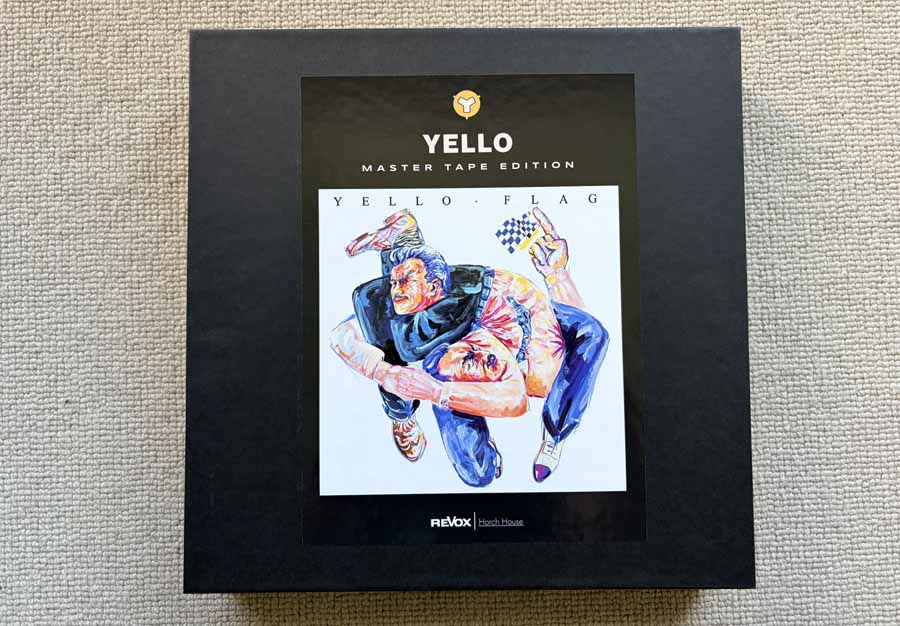
Of course it wasn’t only that duo involved. As with previous albums, Beat Ash was drafted for percussion and drum fills to counter what Boris felt were overly stiff electronic beats and hi-hats; the amazing Billy Mackenzie provided backing vocals and Chico Hablas once again gave us his wonderful guitar skills. Leos Gerteis was the man on clarinet. The iconic Flag cover graphic was designed by Ernst Gamper, who is still creating some fascinating artwork in the digital realm.
Here is where “Flag” stops being an album and starts being a story worth telling at dinner parties, or, as is my preference, over a collection of great single malts!
“The Race” has some interesting roots; initially, it was developed to provide the fast-paced rhythmic backing soundscape for the French magician duo Tempest & Cottet for their stage shows (the 12-inch vinyl release’s B-side reflects this) and then, with the addition of engine sounds and horns, became the theme tune to the German music show Formel Eins (Formula One) and then, finally, after adding vocals and extending it to 8 minutes, it became what we know today – and Flag was constructed around it. Blank did not so much play “Flag” as assemble it.






His primary instrument was the Fairlight CMI, and by this point he had reportedly built a personal library of something like fourteen thousand individually created and named sounds. And as anyone familiar with the Fairlight will understand, these were not preset noises pulled off a shelf. Blank recorded the world: voices, objects, impacts, the incidental clatter of ordinary life, then pitched, gated, layered and generally interfered with them until the source was almost completely unrecognisable.
What’s amazing is that none of this began with the digital age. Long before the Fairlight, Blank was splicing loops and collages together with Revox tape machines, cutting and joining by hand. The sampler simply let him do at speed what he had always done with a razor blade and infinite patience. There is a lovely circularity, then, in listening to “Flag” on open reel – the format that taught Boris Blank how to think, handing his most elaborate creation back to us on its own terms. Even his synth basses were treated as raw material rather than notes, with an ARP line-recorded, compressed, gated and drowned in reverb until it became a character in its own right rather than a bassline. This is music mastercraft!
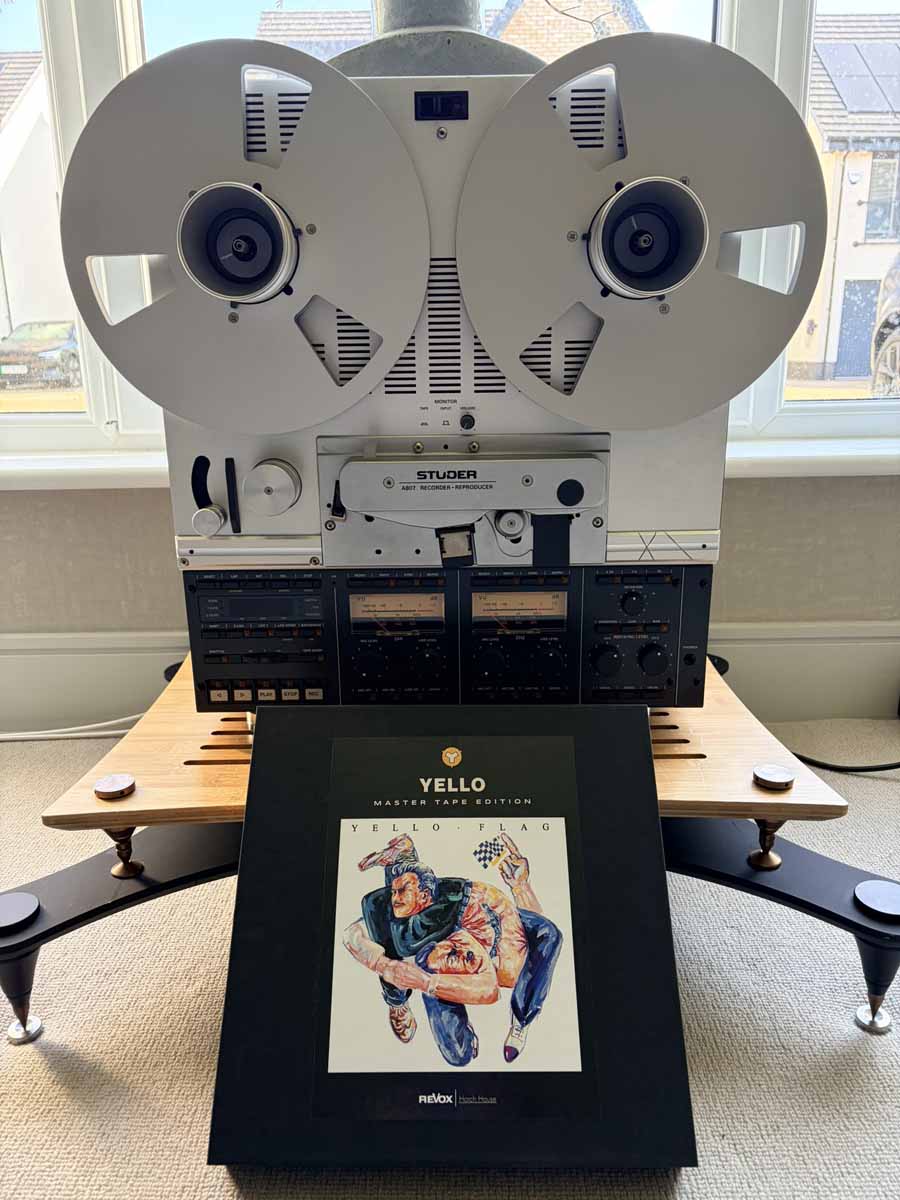
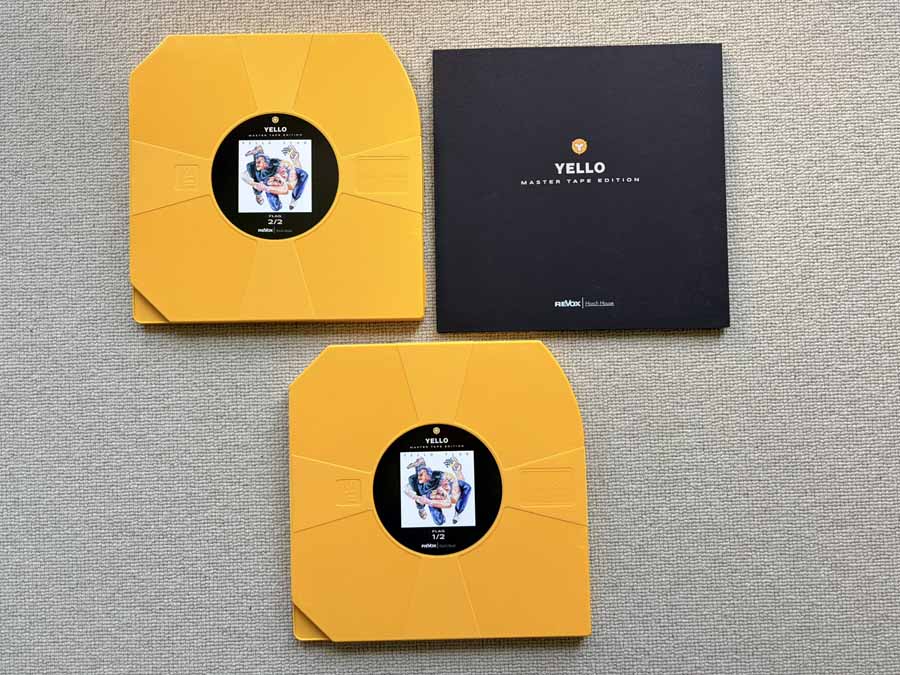
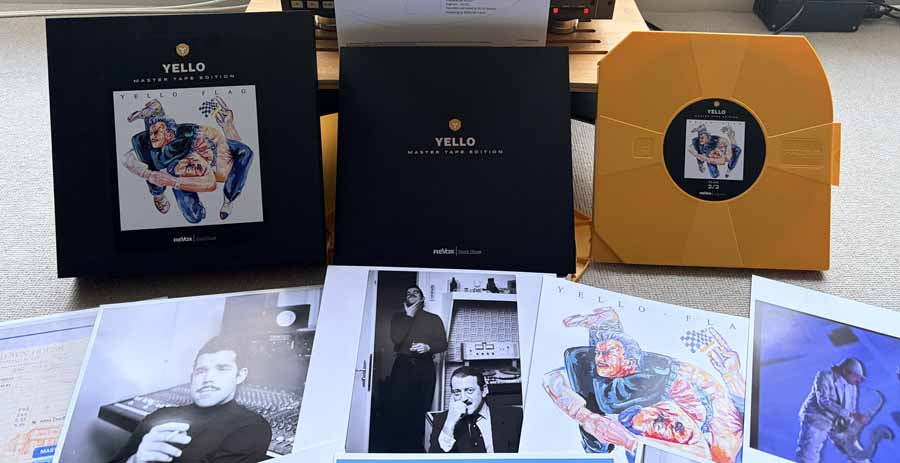
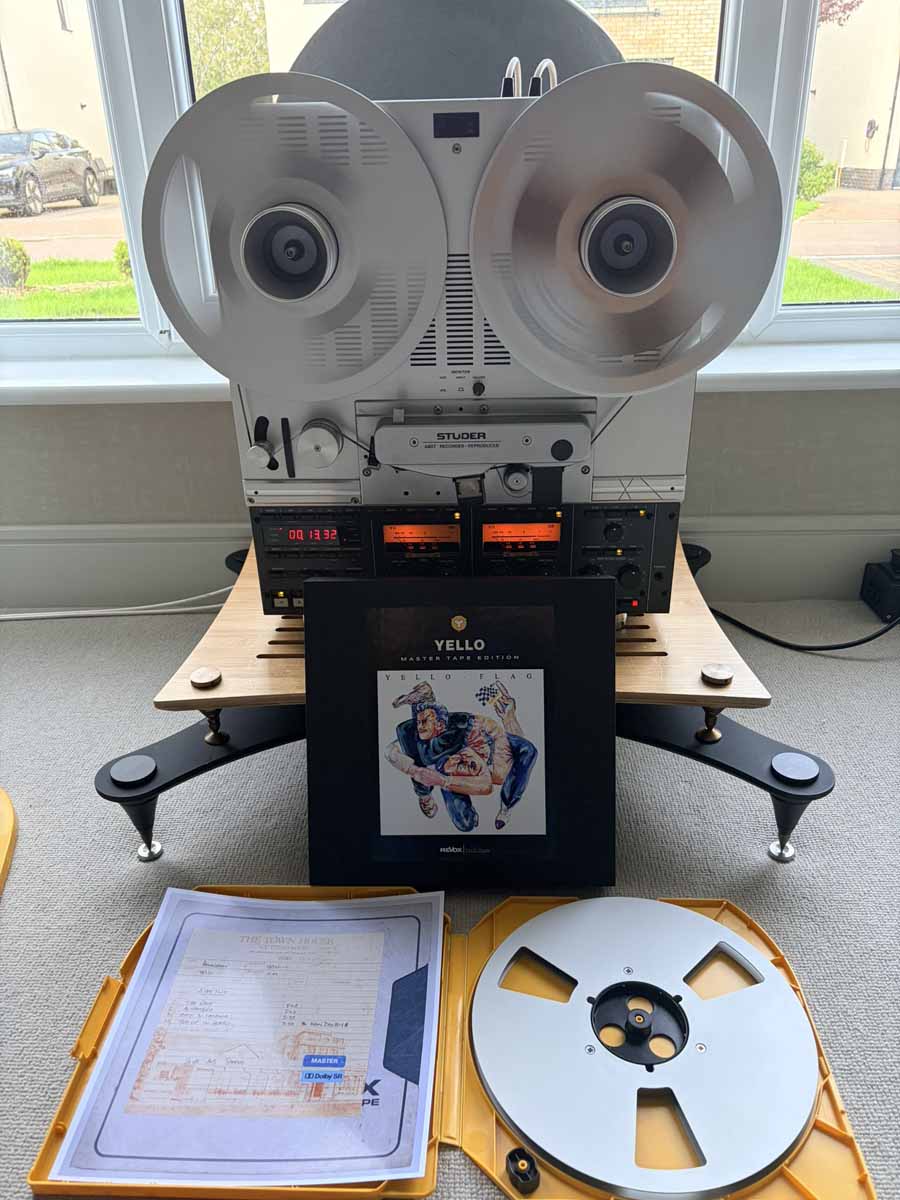
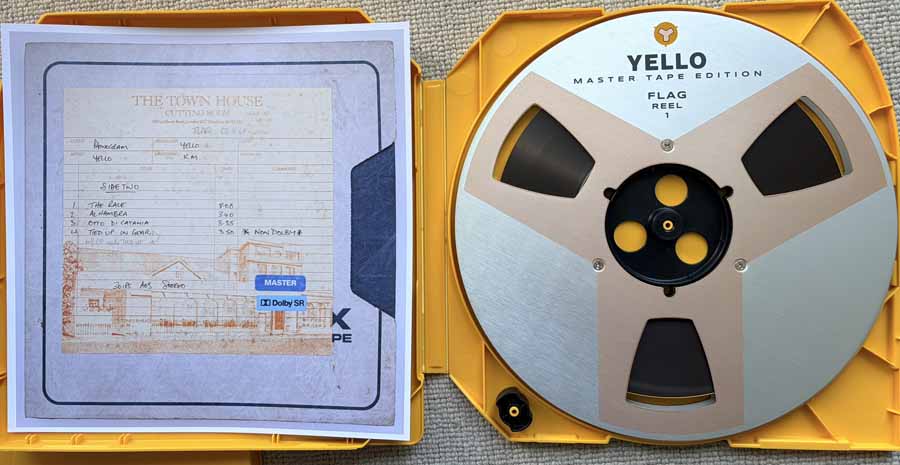
The tape itself is the officially licensed Yello Mastertape Edition, issued through Horch House in partnership with Revox — the same series that earlier gave us Stella and One Second. This is ¼-inch, two-track stereo tape running at 15 ips, cut with CCIR/IEC equalisation at 510 nWb/m flux, wound onto two reels of SM900 stock cocooned in yellow cases and supplied along with simply beautiful photo artwork, Gamper’s wonderful cover artwork and Revox’s usual certification of authenticity and recording data. For anyone who missed the recent-ish resurgence of open-reel tape offerings, this is not some flea-market survivor from 1988 but a modern, properly sanctioned edition with provenance you can trust, which for a release this important is no small reassurance. Unlike the CD, which came from a digital master copy of the tape, this is (wait for it) – All Analogue! More about the CD and vinyl later. There does seem to be some discussion about whether the vinyl was cut from tape or the digital master; that I’ll go into later – I wasn’t there, so answers on a postcard if you were!
The music
And what music it is. “Flag” opens with “Tied Up“, all elastic percussion and collage, Dieter muttering over the top like a man narrating a heist he only half approves of. It is the sound of a band flexing, and it sets the terms of engagement immediately when he says “pay attention, or be left behind.” The bongos have a life of their own. Then we have the moody “Of Course I’m Lying” with Meier at his most gleefully unreliable, a shrug set to music. Tape 1 closes with “3rd of June” and then “Blazing Saddles” where Boris takes the vocal lead for a change.
Come with me, we’re gonna win the race! Next, we load tape 2 and it’s the iconic “The Race”. It runs for eight brilliant minutes and was Yello’s biggest UK hit in its single form, reaching No. 7 in 1988 and No. 4 in Germany; it’s been remixed a good few times since – I first heard it at a club in the form of a remix (I forget which one… it was the ’90s after all). On tape, at full length, it is a marvel of controlled chaos: engines, orchestral stabs, vocal shrapnel and that relentless forward momentum, all edited together like cinema rather than pop, as I’ve mentioned in other reviews.
Elsewhere the album gets stranger (no surprise – it’s Yello!). “Alhambra” comes with its fusion of Latin and Middle Eastern space opera. “Otto Di Catania” is the one for me. It takes a little more chewing over, but you end up loving it: a wistful, characterful little vignette with clarinet, guitar from Chico Hablas and the late (great) Mackenzie lending his voice, the whole thing carrying the melancholy of a holiday that ended too soon. Each track is its own miniature world; “Tied Up in Gear” is the only one of the 2 usual LP inclusions, functioning as an encore for anyone who wasn’t quite ready to let go, which, by that stage, is all of us.
How does it sound though?
Still here? Goodness, you are patient, dear reader. Now – let’s talk turkey. If you have Flag on vinyl or CD, or managed to get your mitts on a digital copy (16-bit PCM in those days), you are never in a month of Sundays going to be disappointed. It’s superb! Boris made it that way and no one will convince me otherwise – this is what he does, and with “Flag” he did it with aplomb. So, “why then”, I hear someone at the back ask, “would I dig very deep into my not very deep pockets and procure it on tape? Surely it can’t get any better. Can it? Can it???”
Before playing the tape, I decided to refamiliarise myself with “Flag” via a 1988 German vinyl pressing I have. Sounds amazing. The next day, I decided to listen to it on CD from the same era – cut from a digital master. Sounds amazing! Actually, there is very little between them, given their origin from Yello, mastering by Kevin Metcalfe and the hybrid digital elements in their making, which is no bad thing – great digital makes for GREAT sound – so it’s not a massive surprise. Wait? Digital master? Let’s unpack that.
Boris was a pioneer of analogue-digital hybrid creation, using tape, synths and samplers – he has by now built up a sample library of more than 100,000 noises and samples. Sequencing was via Atari ST (remember them?) with samplers and synths like the Fairlight CMI, ARP, E-mu Emulator and Roland D-50 all employed to build the sonic scenescapes, but, crucially, recording, as with Stella and One Second, was multitrack to analogue tape. A digital master was then created from that tape and that was the source for the subsequent CD releases. The 1988 CD SPARS code of ADD is the tell. Doing some digging, I learned that the lathe process in vinyl at the time of release involved splitting the master analogue track into two – one being a digital preview delay (to gauge volume and send signals to the lathe computer to control groove spacing) and the other a parallel delayed analogue signal; it’s at least 50% likely that it was this delayed analogue signal that went to lacquer (not the digital one), with corrected groove spacing. Unlike many 1988 LPs that used early 16-bit PCM masters, this is why many feel “Flag” still has that depth of bass and soundstage and none of the brittle top end that others had. I’m sure this will be a hot debate for many!
I loaded up the tape on its Yello custom-designed RTM spool. Cue jaw drop. It wasn’t necessarily “Tied Up”, which sounds incredible, but I was still warming my engines. No. It was “Of Course I’m Lying”. Slam! The initial bass dropped and my jaw promptly followed. It was like a beautiful musical bomb going off. It’s not just the bass; the whole piece just has a power, impact and scale that is frankly mind-blowing. I sat through the remainder of Tape 1, head bobbing, foot tapping, loving it. Then tape 2. The Race at 8 mins and 8 seconds (808 anyone? Anyone?) has at times felt just a little too long for my taste – great, yes, but maybe a couple of minutes too long – there, I said it – not here. It’s so engaging, visceral and pumping; it’s like I’m sitting in the front row at Hockenheim (albeit a bonkers one) and watching those heroes of the racetrack doing their thing – I can still see those black JPS adverts around the track from the ’80s. I’ve also noticed the volume knob is creeping up – letting those engines roar! By the end of tape 2 I’m grinning like a fool. Then the next day I did it again. Twice.
Fun fact: two years prior to “Flag”’s release (1988), Alain Prost actually failed to finish at Hockenheim due to running out of fuel (falling foul of new reduced fuel rules as turbo came into play). Not something Boris Blank, I think, will ever do!
I think it’s the “fullness” and power of the tape version that gets me. With extended and layered decay, deeper texture and less dryness, the tape brings more individual gravity and separation of instruments – I am loath to say warmth, as I don’t want to confuse you, dear reader, into thinking it’s woolly. But it’s more alive, that I can say. Take the bongos on “Tied Up” – they are much more vivid, weighty, forward and have more stage presence, and I think this is a marker overall of the great separation of instruments on the tape. What about if I cued up the tape, the vinyl and the CD and hopped between them? Now… caveat… yes, each source chain is variable, but, as mentioned, none of the versions is anything but great and the source components, the Lab12 amp and Amphion Xenon Mk2s, give me plenty of information on which to determine my findings. Off we go to the races!
Running each pretty much in parallel and easily switching between sources, I found that the contrast was not small. Again, CD and vinyl are in many respects comparable – the CD is a little paler and more clinical; at times, the vinyl feels the richer of the two but now and then just a teeny wee bit more congested when things get very busy – this tape release opens up the life of the album fully, pushes textures deeper, expands that bass response; the cinematic experience of Boris’s work is more vivid and colourful; dynamics are bigger and bolder. Dieter’s eyebrow? It’s just a little bit bushier! Tape can saturate when pushed too “hot” and, while “Flag” does have the signature of tape around that lovely bass and dynamics, there is certainly no oversaturation; it’s wallop, bang, boom (vroom) and crash – not flump! Top-end melodies and stabs are crystal clear, vibrant, energetic but never sharp or brittle.
The verdict
What “Flag” on tape offers, and what this master-tape edition honours so well, is the sheer joy of a band operating entirely inside its own imagination. As always with Yello, there’s no chasing of trends here, no apology, no attempt to be anything other than gloriously Yello – and to create the very best sonic “cinema” possible. Blank’s obsessive sound-building and Meier’s arched-eyebrow theatre remain one of pop’s great conspiracies, and hearing it delivered on a format that so suits the album’s hand-built, spliced-together soul is a genuine pleasure. Is it for everyone? Of course not, and I suspect Meier would be faintly disappointed if it were. The sound quality is beyond compare for me, even if we have to accept this is a limited option for only some to enjoy. It certainly won’t stop people enjoying other formats; that’s the beauty of “Flag”: it’s simply an incredible piece of work.
But if you do have a suitable open-reel deck and a taste for music made by people who clearly had far too much fun making it, Flag on 15 ips is an unhesitating recommendation. So “Shut the door”, belt up in the back, and let two Swiss eccentrics remind you that pop music was once allowed to be this incredible (and odd). Long may the flag fly. And maybe we will hear it at HiFi shows again! One gripe folks may have is that the LP has extra tracks like “Wall Street Bongo” and “Tied Up in Red” which the tape couldn’t fit for time, but the best of the bunch are here.
Yello’s “Flag” 15 ips ¼-inch two-track tape is available in two versions: the one-reel Standard Master on LPR90 at €415 (plus ship + tax), recorded at 320 nWb/m, or the two-tape Studio Master on SM900 (reviewed here and recorded at 510nWb/m) at €567 (plus ship + tax). The Standard Master is available as both CCIR and NAB; the Studio Master is CCIR only.

Track Listing
Tape 1
Tied Up (6:05)
Of Course I’m Lying (5:56)
3rd of June (4:50)
Blazing Saddles (3:35)
Tape 2
The Race (8:08)
Alhambra (3:36)
Otto Di Catania (3:20)
Tied Up in Gear (3:58)
Associated review equipment: Studer A807 Mk1, Lab12 Integre Mk4 amplifier, Amphion Xenon Mk2 speakers. For format comparison – Origin Live Calypso/Illustrious Arm, Hana Umami Red, Gold Note PH10/PSU, Esoteric SA-60 SACD player. Quadraspire X-Reference racks. Power by Puritan and Titan Audio. Cabling by Atlas and Chord.