
Mola Mola Ossetra Monobloc Amplifier
MOLA MOLA OSSETRA MONOBLOC AMPLIFIER REVIEW
Mola Mola Ossetra monobloc amplifiers are Class-D amps based on the Hypex modules, though these amps are very much designed and built from the ground up. Having loved the Mola Mola Perca stereo power amplifier, Janine Elliot takes a listen to the £16K a pair monos.
So much great stuff is getting to my front door from the Benelux and Scandinavian shores for review these days. All looking gorgeous and sounding spectacular. I recently reviewed the Mola Mola Perca, and the Ossetra is largely the mono-block version of that power amplifier. So, the review should be easy then? I mean, it should sound exactly the same, shouldn’t it? Well, that might not actually be the case; with separate components, power supply and wiring per box, and greater output, that should actually mean there will be audible differences.
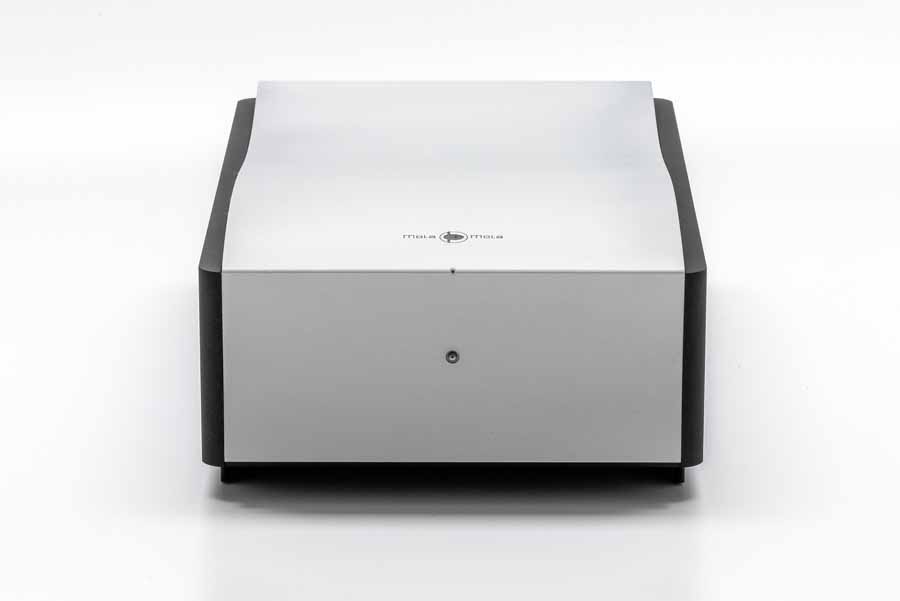
A Mola Mola is actually an ocean sunfish (the clue is in the company logo), a fish that likes to sunbathe on the surface of the water. The HiFi company produces ten ranges of different products in silver/black attire, including amps, preamps, DACs and phonostages, all with a wavy top and front, giving even more of a sense of the ocean. Even their premium remote is a curved work of art to match their electronic products. Their portfolio is massive, all named after fish and ready to ship across the world. I was awash with positivity with the Perca, scaling high on musicality, and so was eager to see if the Ossetra would equally catch my interest. An Ossetra is a sturgeon, famous for the expensive caviar that its eggs are sold as. The fish is also one of the very oldest on our planet; its origins harking back to the days of dinosaurs and no HiFi.










Mola Mola swam into the HiFi aquarium at the Munich High-End Show in 2012. Putting Hypex Class D technology into their high-end HiFi products, the first offering was the Makua preamp and Kaluga monobloc power amplifier, the latter a highly-tweaked Hypex NCORE® NC1200. Frank Veldman is the engineer behind the Trajectum technology used by Mola Mola. Jan-Peter van Amerongen, who set up Mola Mola, sadly passed away, and Jan-Willem Winters is now the CEO of the company.
BUILD AND FEATURES OF THE OSSETRA
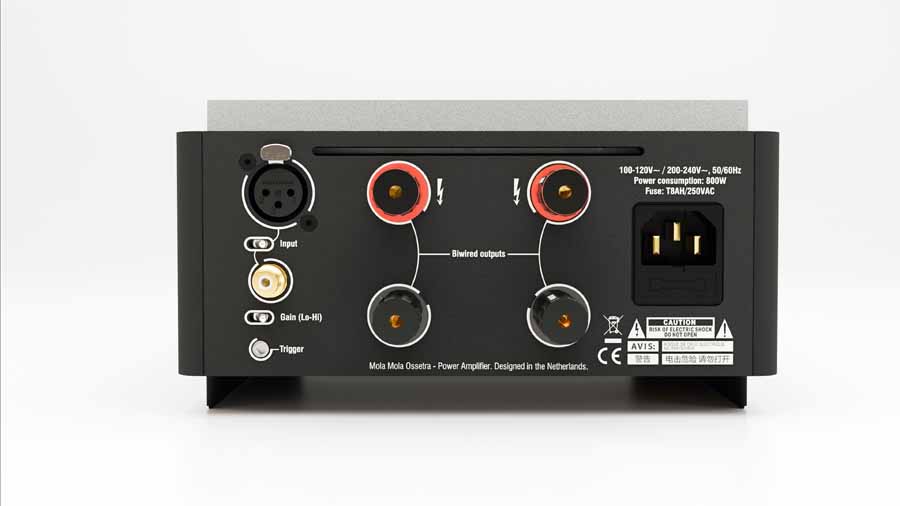
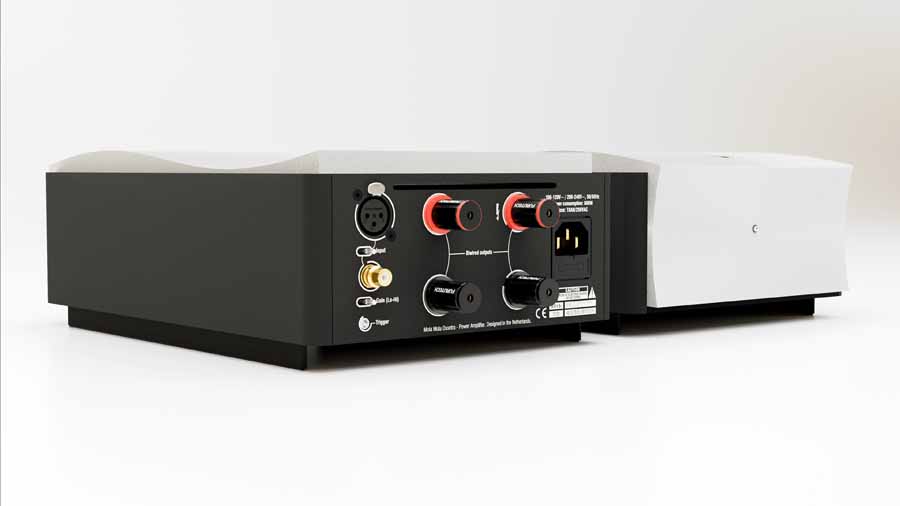
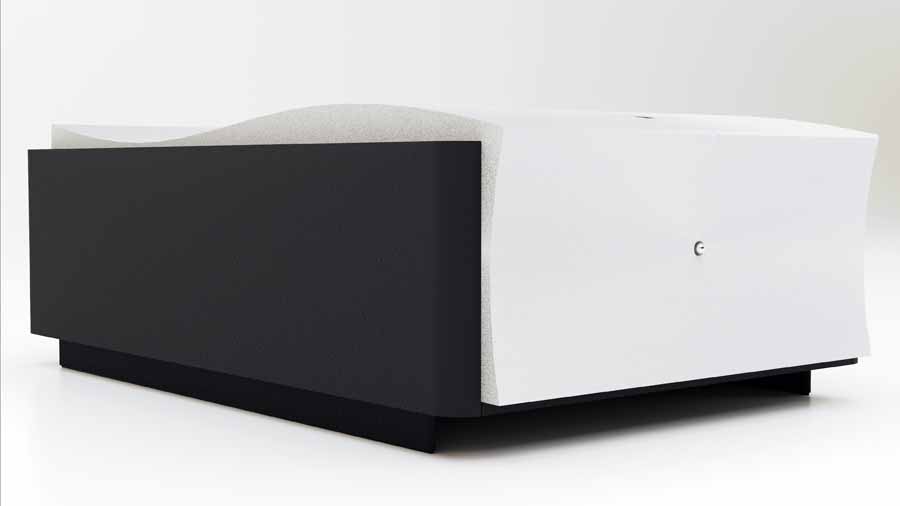
Slightly less wide than the £7.3k stereo Perca, at 200mm x 110 x 335mm, the half-width Ossetra has more than twice the power output and can be netted for almost twice the price at £15,998 for a pair. Looking great on either side of the Makua preamplifier, the duo (trio…) make exceptionally good-looking and well-featured products for your living room and musical world. Being Class D, the products don’t need fins or ventilation holes that would spoil the good looks. If you blink, you might even fail to see the tiny nipple off/on switch, central-front or the LED above it. Any bigger would totally spoil its good looks, though; this is no monster, but a fish of beauty, that wants to be stroked and fed good quality AC, and music, of course. The rear is only big enough for the necessary RCA and XLR inputs, two pairs of Furutech speaker terminals (should you wish to bi-wire your speakers), plus an IEC socket to power it up. Miniature toggle switches change input selection, plus there is a “lo-hi” +/-6dB gain switch, as in the Perca, so that I could compare XLR and RCA inputs without needing to touch a volume control. Finally, a 12V trigger socket saves pressing lots of buttons. It even comes supplied with a pair of 3.5mm cables for that purpose.
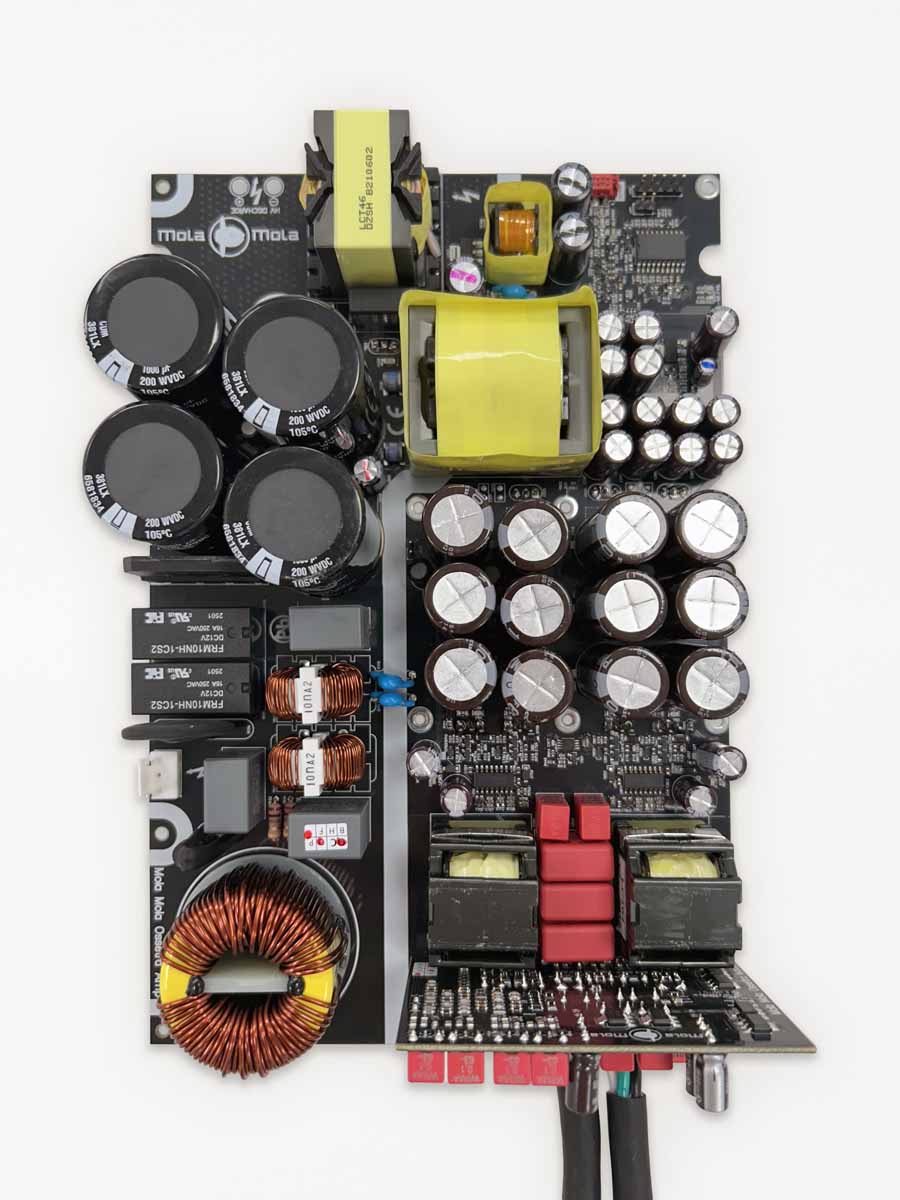
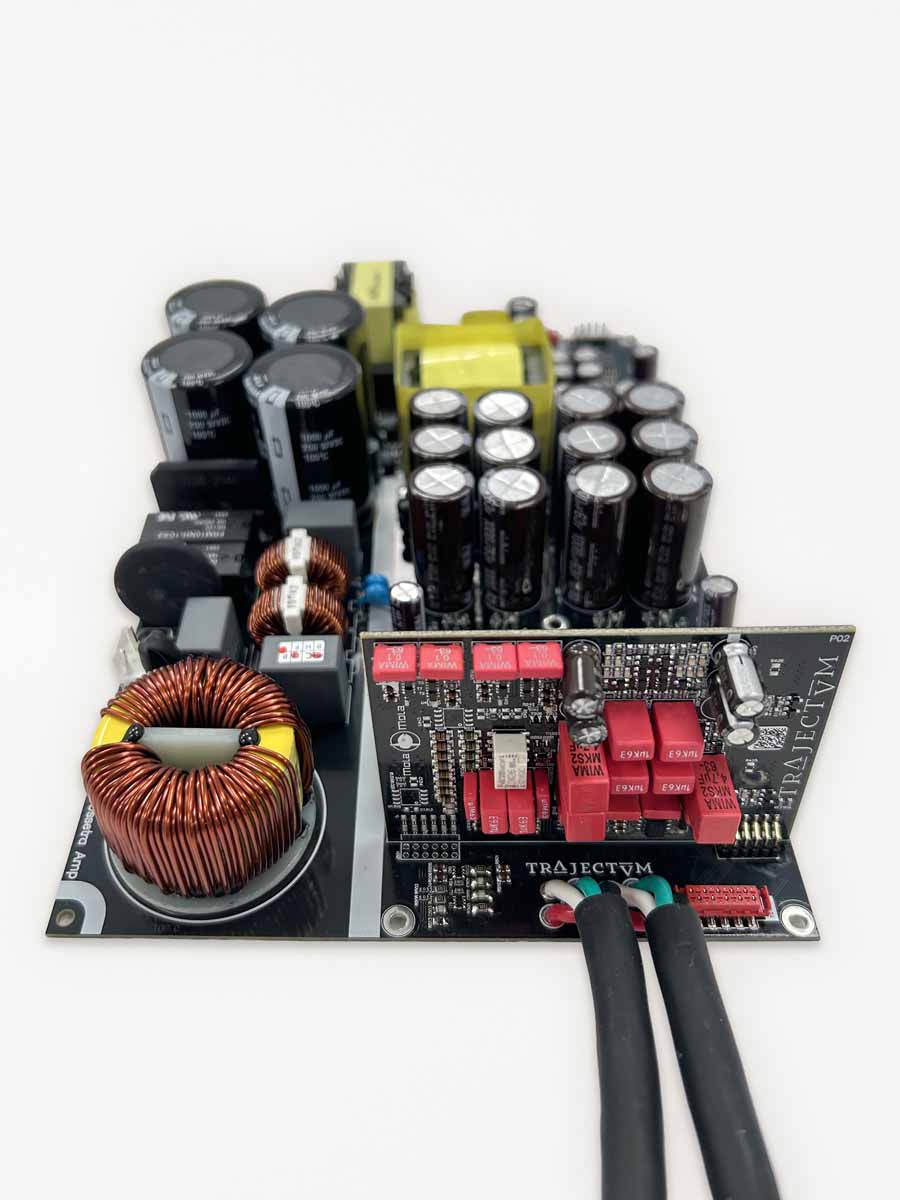
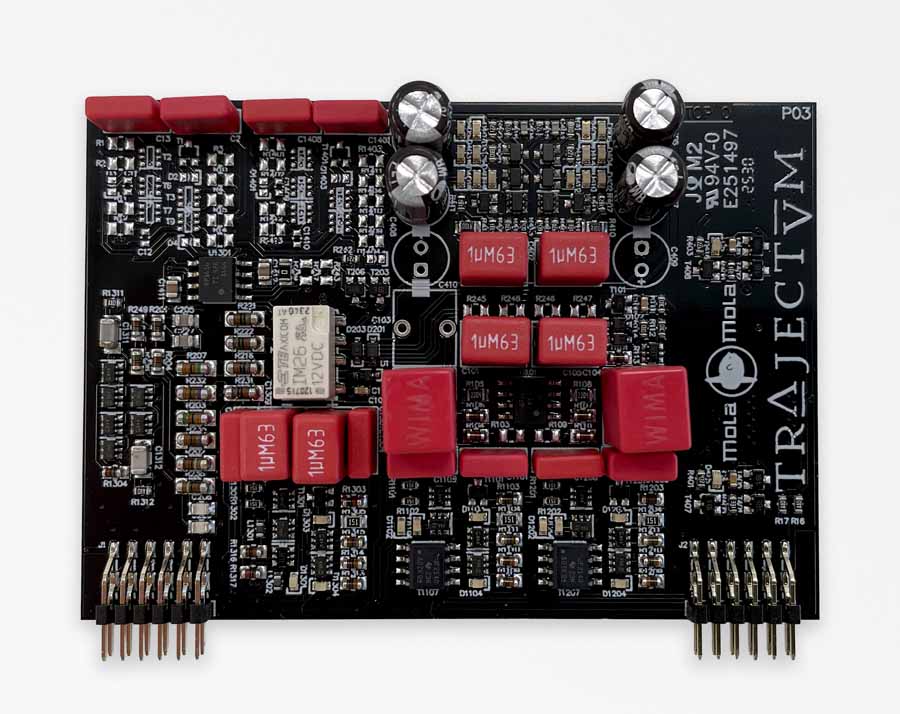
Inside the unit is not only the power supply, but also a 350W 8-ohm (700W 4-ohm) amplifier to more than cope with Schubert’s “Trout Quintet” or Led Zeppelin’s “The Ocean”. Indeed, it even supplies 900W into 2-ohm loads, if you have really hard-to-drive speakers. The Ossetra is a full-bridge power amplifier, the full-bridge output making the design fully balanced right from input to output. Starting from a blank canvas, the amplifier just pushes forward the design of previous Hypex modules. Both NCORE® and Trajectum use high-feedback and self-oscillating Class-D designs, but the Trajectum is better in many areas; it has a higher switching frequency, larger bandwidth, lower distortion and lower output impedance (comparisons of NCORE® and Trajectum can be read in my Perca review). The Ossetra deploys an all-new discrete Class A stage producing most of the gain. These gain stages have high open-loop bandwidth, each individually tailored to succeed in the specific task in the loop filter. This design strategy allows Mola Mola to optimise noise and distortion to very low levels. With a textbook flat frequency response to over 100kHz and distortion less than 0.0002%, this fish is no red herring. Indeed, the input-stage distortion is below current technical measurements at around -150dB (~0.000003%)! With an output impedance of around 0.002Ω, meaning an exceptionally high damping factor of over 5000, this amplifier will have very good bass detail. The higher the DF number, the more control there is of a speaker’s cone movement after the signal stops. This means the bass creates fewer unwanted resonances. Anything around 200 is actually fine, though valve amplifiers rarely quote a figure as it’s usually significantly lower, which gives it its more “cuddly” sound.









SETUP AND USE
Of course, measurements are one thing, but how it audibly performs is of more importance to the audiophile, and certainly me.
Setting up was a doddle; after connecting the XLR output from my MFA Baby Reference pre, I initially used Townshend Isolda speaker cables to the loudspeakers, though later tried some Ecosse bi-wired leads. Sources were Krell CD digits, and analogues from reel-to-reel and vinyl. Apart from putting on my glasses to find the on/off nipple on the front, operation was simple.
Coming in a gorgeous plastic flight case, the unit has a booklet showing all their current products, plus a 16-page user’s manual, just in case you can’t find that off/on switch.
The product relies on free convection of air along the sides and top for cooling, so not a good idea to put your HiFi magazines on the top. If you want to place the unit inside a cupboard out of view (why?), then Mola Mola suggests 12” of free air above and 4” to the sides. This amplifier, though, is too gorgeous to want to hide away. In operation, it does get warm, but nothing like the Class A Kraken I recently reviewed.
On connection to the mains, a tiny LED lights up red for standby at the top central edge, changing to a white flashing light for around five seconds as it sets itself up, and then a constant white LED once all is ready. I still prefer blue or red LEDs, but we’re all different, and it is perhaps good to see a company using a “nonstandard” colour. There is no main off/on switch, unfortunately, just the standby switch.
With the company’s background in Class D pre-made PCB designs, it is no surprise that the output stage is Class D. Similarly, the amplifier is not an off-the-shelf Hypex module. This amplifier has been designed from the ground up to get the very best sound it can. The amplifier is a hybrid design, combining the best of Class A in the input buffer using JFETs, and MOSFET Class D output stage with 22dB/28dB gain (depending on setting), meaning, whilst drawing only 0.45W in idle state, when this fish comes to life it can draw as much as a kilowatt! As in the Perca, the amplifier stage is their Trajectum feedback circuitry. The power supply is similarly detailed and clever in design. It can deliver 31A with great detail, and all noise-free. Believe me, distortion in Class D amplifiers is a lot more painful to the ear than Class A, so the DC-coupled input stages ensure that there is no DC or other noise or distortion to get as far as the Class D power stage with its clever feedback architecture. That power supply is a monster, and after unplugging, it takes around 10 minutes for the capacitors to discharge and the red light to vanish!
SOUND QUALITY
From my encounter with the Perca, I knew I was in for a very enjoyable review with this amplifier. Balanced from input to output, this amplifier provided me with such detail and transparency that I thought my ears had lost 40 years of ageing. Cymbals in Patricia Barber’s Café Blue album gave me a precision and pinpoint soundstage that made me stop everything I was doing just to listen to the music. The hand drums in track one were the cleanest I have heard them. That transparency made the cymbals pin-sharp, but at the end of track 3, I did, however, find those high frequencies just a little “brittle” for my taste. My KT88 tube Class A amplifier rounds those top frequencies to make it a lot more musical and enduring. The cymbals similarly got my attention in tracks 5 and 9, but here I felt they were spot on. Bass toms were also very exact and easy to pick out amongst all the instrumentation. Patricia’s smoky-jazz-room voice and her piano playing were similarly very clear and made for a very exacting and realistic performance. Playing this HDCD from my Krell CD player with Nordost Red Dawn XLRs would indeed give a great top-end. The Townshend Isolda cables, similarly, are very transparent and offer no sonic personality of their own, which is why I often use them for reviews. Changing my speaker cables to the bi-wired and very musical Ecosse SMS2.4 allowed the music a little more emotion and fluidity. The amplifier is highly detailed, but despite the Class A input stages, it is still slightly less musical to my ears and to my taste. However, the amount of detail it could get out of the music I played was simply astounding; this was the detail of an 8K Samsung TV screen. However, a 1080p screen is actually a lot easier on the eyes to watch a long film (probably why only a few manufacturers still make QLED 8k TVs)!
Jim Keltner’s solo drum “Improvisation” was impeccably clean from my CD player, a great track to test initial transients and whether your amplifier and speakers can cope with sudden dynamic flourishes. Musically, Gary Karr’s “O Holy Night” on cello with cathedral organ accompaniment was highly promising, and indicated brilliantly that control in the lower notes from my Wilson Benesch bass driver due to the excellent damping factor. The clarity was astounding, including the mechanical noises coming from the organ, or the cellist’s breathing as he got engrossed in the music. Even a “bang” at 5’12” from somewhere in the room allowed me to get amongst the performers. I was there in the hall! Jheena Lodwick’s “Emerald City” similarly put me there in the studio with her. Well, almost, as the OTT digital reverb and highly compressed piano accompaniment forced me to make a quick exit. Only the added double bass brought back some humanity into the proceedings.
This amplifier will hide nothing.
This amplifier also needs the right cabling to make it sound right, in my opinion, though I must stress this is for my taste and there is no escaping the transparency of this amplifier. Using the top-end Ecosse super-mono-crystal SMS2.4 (the 4 denotes it is biwired at one end) totally brought music back to life. Supertramp’s ‘Breakfast in America’ was as big as the continent, with lots more welly and emotion than I expected, especially in “Casual Conversation”. This brilliant album sounded as fresh as the first time I played it in my teens. Antonio Forcione and Cenk Erdogan’s ‘Storytellers’ guitar duet album is also more of a casual conversation than a collaboration. Antoine’s nylon-strung acoustic guitar and Cenk’s fretless guitar go so well together, and the Mola Mola really allowed me into these musical tales about their lives. Using the Ecosse cables gave more depth and humanity to the sound, and whilst this album is unadventurous in terms of stereo spread, the amplifier gives great depth to the music front to back, especially in the last track “Luna”. Antonio’s finger work is precisely picked out by the microphone, as are Cenk’s fretless glissandi. Indeed, the mechanics become a very integral part of the music, even if this album is a lot less jovial and entertaining than his solo albums.
With each track giving a tale about the performer’s younger lives, classical 19th-century composer Bedrich Smetana’s ‘Má Vlast’ (My Fatherland) is also an expressive symphonic poem about the Czech composer’s own Bohemian homeland. A 2-LP set of pieces, this work is all about the history, legends and landscape, carefully knitted into a large orchestral sound painting. With a harp introduction to the first of five sets of works, each with many sub-sections built in, the work layers up and starts on its travels. Only that the Ossetra is a little too critical and emotionless, spoilt the performance, though that improved with the Ecosse loudspeaker cables. What was important to learn from all this was just how accurate and detailed the amplifier is. It is totally transparent, and only by changing cables could I add a little colour.
Now, there is the old saying attributed variously, depending on where you look, to Stewart Hegeman or Peter Walker, that the perfect amplifier is a straight wire with gain. This essentially suggests that the ideal amplifier would add nothing of itself to the sound and would only amplify the signal that it is fed. However, as human beings, we all differ in our preferences and the sound we prefer from our system, with some of us liking a little colour added to the mix – seasoning, if you like. With this in mind, I would suggest that to get the sonic signature you prefer, careful matching of components is paramount.
To set about my own reconnoitre into my past, I finally set up the ‘Frampton Comes Alive!’ album on the platter, featuring guitarist and singer Peter Frampton with his band. Released in 1976, it is a set of live recordings from concerts he performed, one of the best-selling live albums of all time, an album that made the “Talkbox” famous. This clever device is a tube you put in your mouth to control the sound of the electric guitar to make it almost like a voice. Peter had seen it played by Peter Drake in 1970, so he spent time perfecting the sound, locked in a rehearsal room for over a week. The Ossetra ensured all the instruments were perfectly positioned, extrapolating all the instrumental lines and the atmosphere of the hall with infinite detail. “Baby I Love Your Way” allowed me to whisk back into my own past playing Fender Rhodes pianos (and also childhood relationships!), and the valve Manley Steelhead phonostage just helped make it all sound so organic. Ride cymbals from the drummer were precise and natural in “Show Me the Way”, and the almost vocal guitar via Talkbox made the music controlled, effortless, and meaningful.
QUIBBLES
I just wish that box also had a physical mains switch.
CONCLUSION
The Ossetra Trajectum/NCORE® amplifier really is a product that shows Class-D really does have a place in the audio top-end. This is such a transparent amplifier I am surprised they didn’t make the cabinet out of glass. You really can see clearly into the music that you play.
I didn’t think it could better the Perca, but keeping both sides of the equation totally separate, and upping power output, really does help produce an accuracy that is really good at this price. If you want the truth, the whole truth, and nothing but the truth, then this is your amplifier, but the jury’s still out on whether this is the most musical, and I refer you to my comment about “straight wire with gain…”.
AT A GLANCE

Build Quality And Features:
Impeccable construction and design
Sound Quality:
A highly detailed and fast sound
This amplifier will not hide any faults that are elsewhere in the system
Value For Money:
This is not cheap at £16k/pair, but the amount of detail and transparency will make you never want to switch it off
We Loved:
Lovely design
Transparency and conviction
Detail and speed
An amplifier that will work on any speakers from 2-ohms up
Accurate performance on all music
We Didn’t Love So Much:
That musicality just wasn’t quite as great as I would wish for
Elevator Pitch Review: Mola Mola is a company created to turn the excellent amplifier and power supply modules from parent company Hypex into top-end, ready-built boxes, ready to just ‘switch on’. These are, however, not Hypex modules just wired together, but products built from the ground up, intended to make Mola Mola the company for the discerning audiophile. My experience of Class-D with their Perca stereo power amplifier changed my opinion on “switching” amplifiers overnight, but at almost twice the cost of the Perca, would the Ossetra net me twice the sound?
Price: £15,998/pair
Janine Elliot

SUPPLIED BY SOUND DESIGN DISTRIBUTION
SUPPLIED SPECIFICATIONS
350W/8 ohm, 700W/4 ohm, 900W/2 ohm
Gain: 22dB or 28dB
Unweighted Signal/Noise Ratio: 130 dB
Distortion (THD, IMD): <0.0002 %
(all frequencies and power levels)
Input Impedance: 300kohm
Output Impedance: <0.0015 ohm (Damping Factor >5000), all frequencies
Bandwidth: >100kHz
I/O
Balanced and unbalanced input, selectable by switch
2 pairs of Furutech speaker binding posts.
Bi-wired directly to the amplifier PCB using Kubala·Sosna cable.
Trigger input (3.5mm jack)
DIMENSIONS AND WEIGHT
200mm (W) x 110mm (H) x 335mm (D) Depth includes speaker terminals.
Weight: 7kg