
MUSIC FIRST AUDIO LP 103 LCR PHONO-STAGE
MUSIC FIRST AUDIO LP 103 LCR PHONO-STAGE REVIEW
Music First Audio LP 103 LCR phonostage is the latest phonostage from this well-respected British brand. The price is £7300 plus VAT, and it is made in collaboration with Thorsten Loesch. Janine Elliot takes a listen for HiFi PiG.
Whenever Jonathan Billington, from Music First Audio, part of Stevens & Billington Ltd, announces a new product, you can be sure of a few things. Firstly, the company’s passive transformers would feature somewhere, it will sound bloody good, and it will also look equally professional and be designed to last. This new Class-A with LCR RIAA EQ phono-stage would not disappoint me. However, I did initially think I might need to gain a physics degree to be able to use it; this is a highly unusual product, but let me assure you, once I had connected it, I was very quickly in for a very musical journey.
This is not Jonathan’s first phono-stage. That was in collaboration with Long Dog Audio a decade ago and was a well-received hybrid valve MM phono-stage. For MC use all you needed to do was add the MC Step-Up unit. This new phono-stage, at £7,300+VAT, is for any type of cartridge and is designed in collaboration with Thorsten Loesch, famed for his work at iFi and AMR. His contribution here is the design of the active and loading stages within the LP 103. His background is in East Germany, where he initially worked in military and industrial electronics, and later got into professional audio. As a child, he had a great interest in playing with and modifying audio and TV equipment. After he – as he put it – “escaped to the West” as an adult, he came to the UK where he did a second degree at the North London Poly (Now University of North London) in Business Information Systems and Accounting, and after an enviable experience in HiFi (including writing for a few internet HiFi publications) he met Jonathan at the London Live HiFi Club, and a professional acquaintance began.










Music First Audio is a UK based company based in Rye Harbour in the southeast of England, born out of the skills and experience of Stevens & Billington Ltd, which is a small, specialist audio transformer winding business formed in 1963 by a certain Mr Stevens & Mr Billington, Jonathan’s father. Producing transformers and other wire-wound-wonders for professional and home audio with customers including the BBC, Soundcraft, The Royal Opera House, plus even trying to transform [sic] the House of commons, Jonathan took over the company in 1986 after graduating with a degree in Electronics and Communication Engineering. When Jonathan’s father died earlier in 1978, his mother took over the reins until their son became joint owner with Mr Stevens. With Jonathan’s high interest in high fidelity, he then spread into high-end audio, forming Music First Audio in 2002. I personally own a Baby Reference LCR passive preamplifier, using their the excellent TX102 transformer. Thus, it will not take long to realise that the LP 103 LCR is based on their newer TX103. LCR technology relates to the use of Inductors-Capacitors-Resistors in a passive RIAA EQ unit. The best components in audio are those that just disappear, and the design of this and other Music First Audio products are such that you really are just left with the music. With the LP 103 LCR you do, however, need to spend time in getting there.
BUILD AND FEATURES OF MFA LP 103 LCR
As expected, build quality is superlative, both inside and out.
At 412mm wide and 415mm deep, the LP 103 (available in black or silver) is basically a pure single-ended Class-A phono amplifier with a 600ohm constant impedance passive LCR RIAA EQ. The MC Step-up transformer is derived from the Stevens & Billington TX-103 that is used in their excellent newer passive preamplifiers, this time just 3 “taps” in the secondary coil.









Component choice is very good, with WIMA Foil & Film type plus Nichicon Muse Bipolar capacitors, both chosen for their low distortion and low microphony, so important in a phono amplifier where moving coil cartridges, particularly, have such a low output and therefore need considerable makeup of gain. LP 103 also uses Toshiba super low noise J-FETs, also chosen for their more tube-like presentation in the important audio areas, plus bipolar transistors elsewhere.
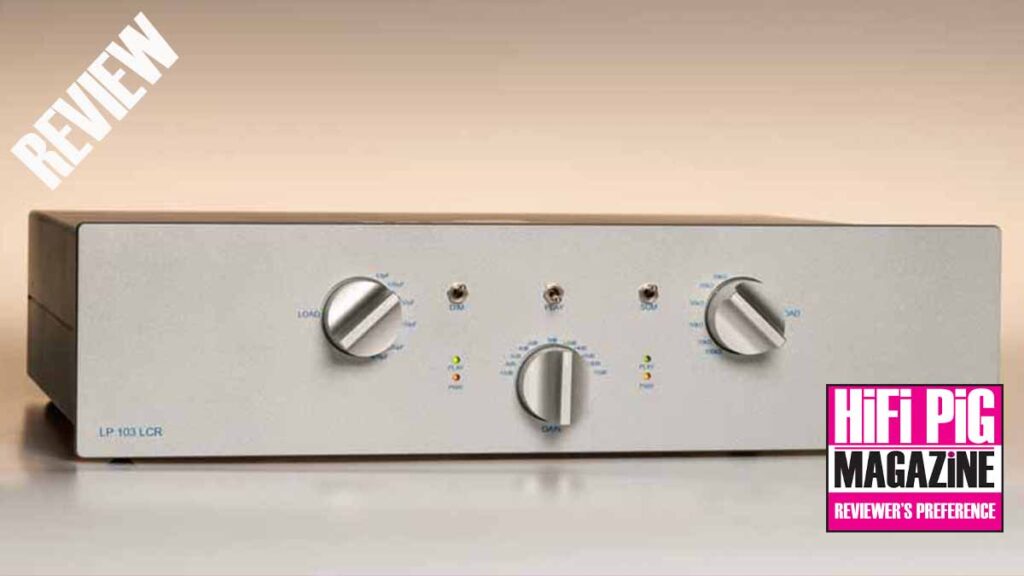
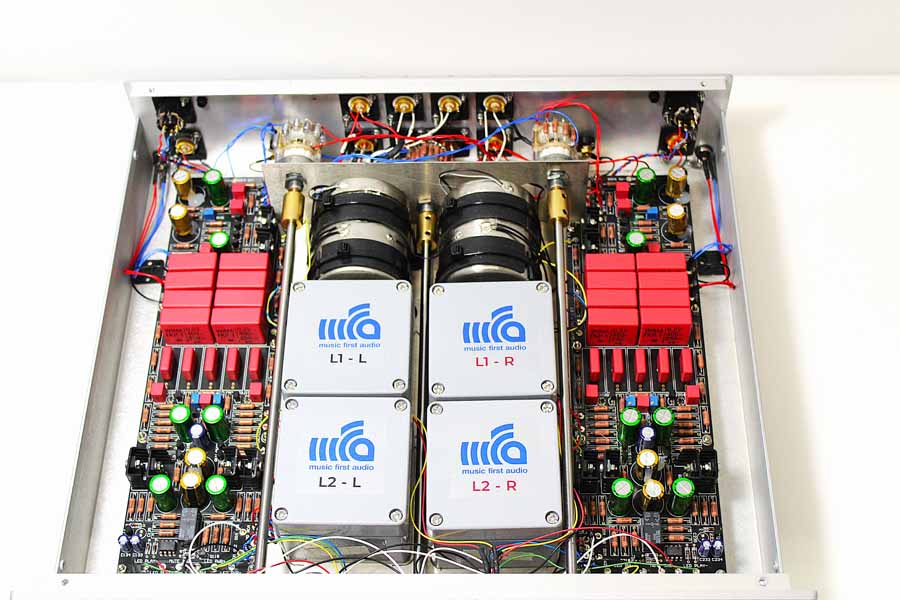
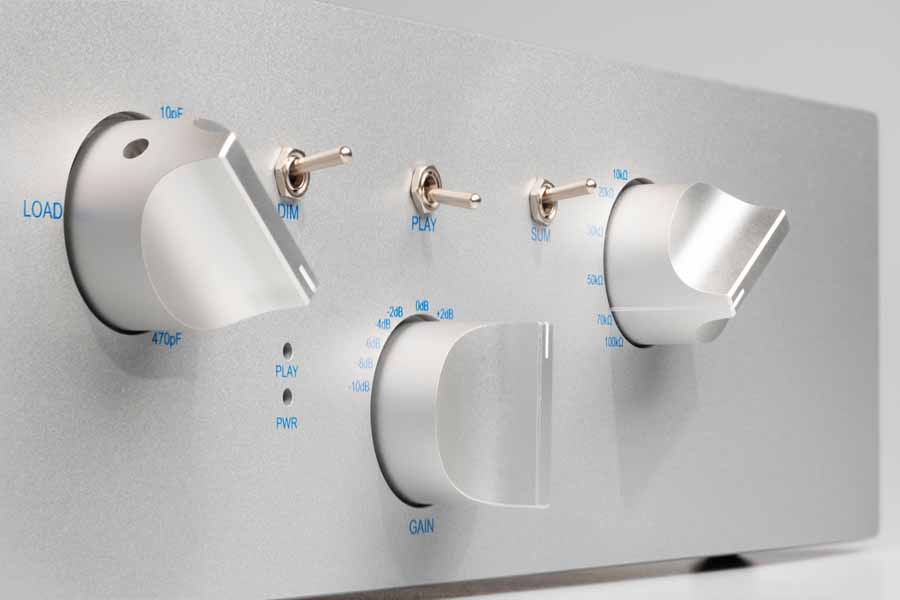
There is a total of 6 hand-wound transformers, which take a considerable time to make, so they have an effect on the price, and of course, add weight. Two are in the 3 MC input selectors, plus the other 4 being the “L” in the LCR EQ design. The front panel is symmetrically laid out to make operation easy as well as pleasing to the eye. With central gain control allowing a range of ±10dB, there are selectors for 6 load capacitance and load resistance settings to the left and right, respectively. These show 15k to 100k Ohms for MM load resistance, and from 10pF to 470pF for the MM capacitance load. Above the central volume adjustment are three switches to select “DIM” “PLAY”, and “SUM”.
The amplifier is basically two mono-blocks, so it requires 2 separate wall-wart 30V DC power supplies to operate. Once connected, the lower red “PWR” LED lights up, but then by pressing the central “PLAY” switch powers up the unit and after quite some seconds (around 30”), each blue “PLAY” LED will light up to let you know the unit is now ready to go. The “DIM” switch reduces the output by 12dB for when you are cuing or lifting the stylus, and the “SUM” button sums up the left and right channels for mono discs, a feature not found in the previous MFA phono-stage.
Inside, the unit is full of components brilliantly laid out and placed above an anti-vibration layer. A steel plate holds the transformers, the LR boards and earth points. Tolerance of components in the RIAA EQ is within 0.2dB, with all components checked and measured before connecting up. Indeed, it takes two days to test and measure before the unit is put up for sale, and a total of 10 days to build the unit with the team of Jonathan, Jayke (who’s now been working there for 20 years), and Anna, Jayke’s daughter.
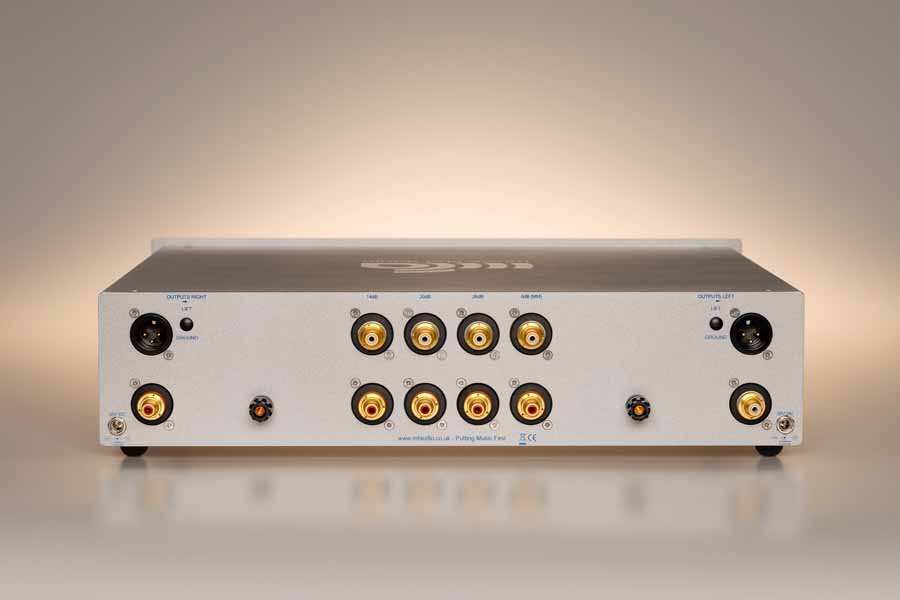
The rear of the unit may look complicated, but it is actually quite sensible once you understand the technology and maths; there are 4 RCA inputs for your choice of cartridge (XLR sockets are available if you can facilitate fully balanced operation, at no extra cost). The first socket is MM (at 0dB and 600ohm), with a further choice of 3 sockets at +14dB, +20dB and +26dB gain respectively for the MCs, going through the first transformer (effectively three secondary’s and 1 primary coils in reverse; my passive preamp has 24 2dB steps of attenuation, so therefore 1 primary (input) and 24 secondary (stepped o/p) ). All this will become clear soon. As well as the power supply sockets at either end, there are also ground connections positioned at the ends, so that you can connect to whichever is closest to the turntable. Outputs are a choice of both RCA and XLR (at 6dB of further gain). Initial thoughts on connecting the unit are possibly of confusion or, at worst, a headache! Things are actually a lot simpler than one might think, and a careful read of the instruction booklet makes things very clear, though just using your ears will be the best plan, and Jonathan suggests that, too. With MFA based close to where William the Conqueror won victory in the Battle of Hastings, I was eager now to conquer the battle of getting the best sound.
SETUP AND USE
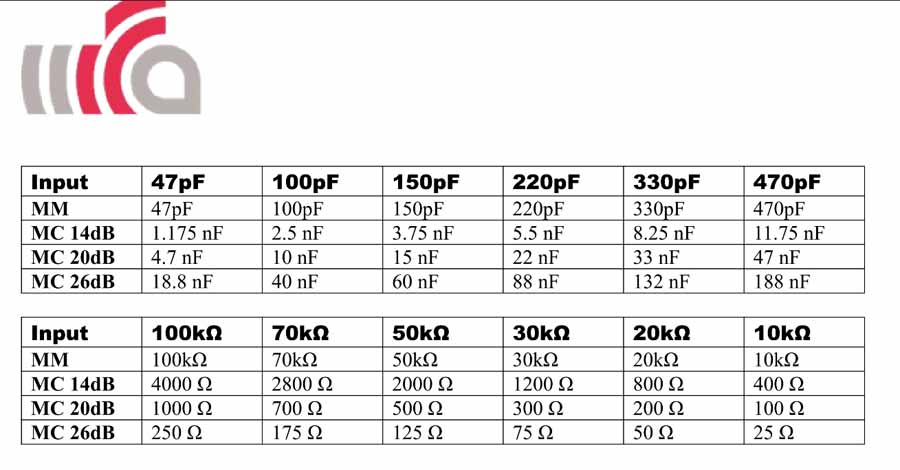
When I reviewed the Michell Apollo phono-stage recently, I was quite confused by the settings, as when I was following the cartridge manufacturer’s suggestion, the sound delivery wasn’t what I expected to hear until I altered the “gain” control on the Apollo. According to Google, the lower the load impedance, the better the top end and separation detail, but it really isn’t that simple. The sound actually changed dramatically depending on what the gain was set to, even when I was listening at equal sound pressure. I didn’t initially suss that the gain settings are before the audio gets anywhere near the RIAA stage, but using the MFA LP 103 LCR makes it a lot easier to understand this; there are 3 different MC gain input sockets at the rear, and the load capacitance and load resistance will consequently alter, depending on which socket you connect to. Just to complicate things further, those Load numbers at the front of the unit are displaying only the MM input settings. Writing four different rows of settings of impedance or capacitance around the switches would simply look too complicated, so initially, reading the manual would be advised, as it shows a table of conversion. Thus, if I connect an MC cartridge to the 20dB input and set the load resistance at “10kohm”, this is actually 100ohm, but if connecting to the +26dB input, that same load setting is now 25ohm! Similarly load capacitance also varies depending on input, and remember that you mustn’t wire up more than one cartridge at the same time (unlike on my Manley Steelhead phono-stage) as it will vastly affect the results of C and R! Just as in the Apollo review it also reminded me that other things come into play to determine the “best” setting to use; things like cabling, and even the tonearm itself, and the mat.
For the review, I initially set everything to the fully anti-clockwise setting, i.e. 10kohm and 10pF, before I then began to focus by ear on getting the best sound. Load capacitance in an MC cartridge is not quite so critical as it is on a moving magnet. My Manley phono-stage is set up as 50ohm and 220pF using my Ortofon Kontrapunkt b cartridge on a Pre-Audio tangential-arm turntable. For me to get a load impedance lower than 100 ohm I would need, therefore, to connect to the +26dB input. But, as I was about to find out, just following manufacture’s guidelines doesn’t always get you to the best sound. The sound at 50ohm on +26dB input was very cluttered and unreal, probably due to overload (see below). The motto of all this is perhaps be guided initially by the instruction book, but ultimately use your own ears! Just imagine if all this setting-up had to be done on DIP switches hidden underneath the unit! I used both an AVID Relveo/Hana ML and my Pre-Audio turntables, fed via XLR into an MFA Baby Reference passive preamp and via XLR then to my Synthesis KT88 tube monoblocks and Wilson Benesch Arc/Torus speakers.
SOUND QUALITY
The first thing I noted when I connected up my MC cartridge was just how quiet the amplifier is and how flat the frequency response at all frequencies was once I had set it to the ideal setting. Using both XLR output and RCA, I was subjected to a highly clever and musical product. I could hear why it has taken 3 years to get this all to production. With a total of 24 capacitance and 24 resistance load choices, this is one of the most versatile units out there. However, changing the input gain from +20dB to +26dB also affected the quality of the sound; the former is a 1:10 step-up, and so a cartridge with a 0.5mV output would end up as 5mV in to the phono-amplifier, so if it was now +26dB (1:20 step-up) the output would be 10mV which might saturate the components and hence change the sound, as it did for me. After much knob-twiddling and ear-twitching my listening culminated in setting the Hana and Ortofon cartridges to the 100kΩ and 70kΩ settings respectively, which meant I was actually feeding it 1000Ω and 700Ω! That wasn’t at all what I was expecting, but as Jonathan writes in the last sentence of the manual; “What matters is what you hear in your system, not some numbers on a piece of paper”.
“Moonroof” in the ‘Sky 3’ album has very prominent bright electric drums and cymbals that can make you grind your teeth if you don’t get the settings correct, so too much brightness isn’t always the best strategy. Good job I still have two good ears. That central volume control adjusts ±10dB in 2dB stages. I maintained it at +2dB and altered the overall gain from my MFA passive pre-amplifier. With the load impedance set to 700Ω it just gave me a bit more depth on the harpsichord introduction to “Dance of the Big Fairies”, a track which always amused me; with Herbie Flowers on deep tuba playing a melody that gives the illusion of a very overweight fairy. John Williams on an acoustic Ovation guitar just completes the soundstage, creating precision and fluidity but with solid punch and conviction. Similarly, the Steinway piano was tight and very detailed. “Sister Rose” has great dynamic range – even for LP – and the MFA enabled me to make the most of this. Interestingly, the sound was more akin to the valve musicality that I get from the Manley, showing good choice of JFET components in the Class-A side. Similarly, the last track in Dire Straits ‘Communique’ had an extremely musical and full-bodied sound. When using the +26dB setting it just didn’t sound right, even at the suggested 100-200Ω load. Everything was cluttered and very central. With 60dB gain (using the +20dB input plus +2dB on the trim and RCA output), everything opened up in terms of detail and positioning. In “Hello”, that bass was very full but no longer overpowering, as it was on the +26dB input. The electric guitar was similarly very precise and very coherent.
Being Christmas-time when I wrote this review, there were lots of war films on TV providing the usual Rachmaninov, Schostokovich and Addinsell piano concerto soundtracks. The Warsaw Concerto from Addinsell is one of my favourite orchestral pieces, featured in the films “Sea Wolves” and “Dangerous Moonlight”. Listening to an early stereo version of this music from RCA illustrated that the MFA certainly won’t hide any imperfections in a recording (one of the reasons I also use a MFA passive preamp). Whilst the orchestral soundstage is large in this recording, the piano sounds rather subdued and as if it is at the back of the hall. I have noticed this in a lot of piano concerto recordings from this period, despite the fact that the piano is usually actually sat in front of the first violins! The LP 103 is highly accurate in delivering the music. This album has lots of imperfections, and a good amplifier and speakers shouldn’t hide any of this!
For mono recordings I played, the SUM button enabled me to get a more accurate performance and even reduce scratches; nothing worse than mono music and stereo scratches! I have often found classical records from the 60’s-80’s lacking in detail and musicality, but Harmonia Mundi’s 1976 recording of the organ music from the 19th century French composer Lefebure-Wely really does show how good a system can sound in terms of frequency response, dynamics and soundstage, with the correct microphones and sound engineering. His “Satie en mi Bemol” really filled the room with dynamics and soundstage, as if I were indeed sitting in a large cathedral. In “Scene Pastorale”, the quiet beginning gives you a chance to hear the mechanics and wind-power from the organ. At 1000Ω load, the sustained D foot-pedal note was just too overpowering, but changing to 700Ω was now perfectly controlled. The middle section has some amazingly low reverberant sounds creating the effects of a windy day, and higher oboe melodies conveying that of birds flying around the room. The loud climax in the middle section sounds unlike anything I would expect from a 19th-century organist composer, and there are even hints of a fox hunt in Scotland at one point. Wely is considered by many to be a very non-standard composer, and by some as somewhat ‘vulgar’ in his unorthodox style of writing. However, the organ is brilliantly recorded by the engineer at L’Eglise de Nantua, and this performance not only tests your phono-stage but also the weight and bias settings of your turntable arm.
Whilst this album certainly sets your imagination ablaze, Kate Bush’s “And Dream of Sheep” (2018 180g remix) brings back a sense of reality, and it woke me up to a great sense of space and front-to-back detail. This is from my favourite Bush album, with a mixture of pop and art-rock, with side-2 labelled as “The Ninth Wave”; a conceptual album about a woman lost at sea. Playing “Watching You Without Me” at my pre-conceived settings according to Ortofon, the exceptionally fast spoken words had pin-sharp clarity and detail, plus an excellent soundstage – matching Kate’s imaginative mind – but the sound just didn’t sound right at the original 100Ω setting until I reset it to 700Ω. At my preferred EQ setting, this album had a clarity and musicality I had not hitherto heard. That detail was as clear as Thorsten’s own 24bit DAC designs, but with a musicality that only analogue and Class A can produce. If everything is right, I should be listening to music and not HiFi, and that is what I found with the LP 103 LCR. Indeed, I soon forgot about numbers of Farads or Ohms, and just got down to listening to music. Even connected to the MM input, my aged Shure V15iv gave such an honest and revealing performance that it confirmed to me why that cartridge is one of the best MMs of all time. Again, the proverbial 47kΩ loading was not found to be the best choice of setting. As Thorsten said to me, “I don’t want people to listen to the Bass’s, treble’s, the spit rattling of the singers teeth while she belts her heart out, but to simply listen to the music and enjoy the experience”. I certainly could do that with the LP 103.
QUIBBLES
This is an excellent phono-stage, only let down perhaps by the complexity of setup. If there were LEDs either side of the unit (as in their top-end Reference V2 preamplifier) that indicated the actual numbers for C and R, then it might perhaps be less daunting. But if you can be brave enough to read the accompanying manual and ultimately use your ears, then all should be well. Very well.
CONCLUSION
So many things need to be taken into consideration when setting up a turntable and phono-stage, and – as I have discovered over the last half century (and particularly recently) – following a manufacturer’s suggestion should only be the first point of call, as wiring can have an effect on the best settings and your own ears should be the definitive test. That was also confirmed in discussion with Thorsten, too. We get too bogged down by labels and numbers and sometimes that causes us to miss out on the music. What the MFA phono-stage does is allow you to get closer to attaining the perfect C and R setting than most RIAA amplifiers out there, and ultimately that means to the music itself.
My very first auxiliary phono-stage was the original NAD PP1 MM box. That was already better than the inbuilt phono-stages on my JVC or Sansui amplifiers, but how the technology has improved since then, like cabling. The LP 103 LCR surprised me by its musicality and at the same time a pin-sharp resolution that enabled me to get closer to the music than I have done before. For that reason, I give this phono-stage my first Reviewers’ Preference for 2026.
AT A GLANCE

Build Quality and Features:
Typical MFA perfection
Only getting past the load settings will be the daunting task
Sound Quality:
Very tidy and clear presentation, but with an almost tube-like musicality
Just make sure you spend the time setting it up properly!
Value For Money:
If you have a good turntable and record collection, you need to have it fed with something that will do it justice. £7300+VAT isn’t in NAD PP1 territory, but what it does to your music is well worth the big outlay
We Loved:
It lets the music speak for itself, unaltered if set correctly
Articulate and musical production
Very quiet
Passive LCR EQ
We Didn’t Love So Much:
Complexity of operation if you just like reading numbers
Elevator Pitch Review: There have been lots of high-end phono-stages to choose from since vinyl began its second life, and Jonathan, a true analogue-audiophile, would only want to create the very best you can buy. With his life taken up by winding toroidal cores, no phono-stage with his name on it would be complete without a passive LCR somewhere in the design. The LP 103 uses a form of his highly successful TX103 passive step-up transformer, as used in his Reference preamplifiers, and with miles of minute cabling wound up inside, this phono-stage really has musicality at its core.
Price: £7,300 + VAT

Janine Elliot
SUPPLIED BY MUSIC FIRST AUDIO
SUPPLIED SPECIFICATIONS
Outputs:
RCA L/R 100Ω XLR L/R 200Ω
Inputs:
XLR or RCA MM, MC +14dB, MC +20dB, MC +26dB
Gain at 1kHz
MM RCA: 28dB – 48dB adjustable in 2dB Steps
XLR: 34dB – 54dB adjustable in 2dB Steps
MC +14dB RCA: 42dB – 62dB adjustable in 2dB Steps
XLR: 48dB – 68dB adjustable in 2dB Steps
MC +20dB RCA: 48dB – 68dB adjustable in 2dB Steps
XLR: 54dB – 74dB adjustable in 2dB Steps
MC +26dB RCA: 54dB – 74dB adjustable in 2dB Steps
XLR: 60dB – 80dB adjustable in 2dB Steps
Impedance loading:
MM: Adjustable 10kΩ to 100kΩ (choice of 6); MC: Adjustable 25Ω – 4kΩ (choice of 18)
Capacitive loading:
MM: Adjustable 10, 100, 150, 220, 330, 470pF
MC: Adjustable 1.2nF to 188nF (total of 18 settings)
RIAA correction: ± 0.2dB
Power consumption: < 6VA
Dimensions: 412mm x 415mm x 104 mm (WxDxH) with knobs and connectors.
Weight: 8 kg
Colour: Silver or black