
Trilogy 921 Integrated Amplifier
TRILOGY 921 INTEGRATED AMPLIFIER REVIEW
Janine Elliot tries out the entry-level integrated amplifier, the 921, from British manufacturer Trilogy.
My eyes and ears always light up when I get to review certain products; names like Spendor, Harbeth, Leema, and PMC have BBC DNA somewhere in their origins, and as an ex-BBC bod myself, I love the link. So, to be sent an amplifier from Trilogy, owned by Nic Poulson, who joined the Beeb four years after I did and then left to set up his company in 1990, I was particularly keen to take on this review. Adding to this the fact that he founded the mains-conditioning company Iso Tek and Isol-8, and that I designed the mains tamer in my own home and helped design products for a few companies when I was a bit younger, I was now an even happier bunny, or should that be Piglet. His own history reads like that of a number of avid audiophiles; as a young teenager, he worked on Saturdays at a HiFi shop where he met Richard Bates (who, from 2026, now works with him as Sales Director). He created HiFi in his home, playing with kits at the age of 4 and building his first amplifier at 7. Living in a quiet village meant he didn’t have too many distractions, so music became a big part of his life. At 18 years of age, he was offered a job at Meridian. As his mum and dad had other ideas for his career, they had also set up an interview at the BBC, where he was successfully hired as a broadcast engineer. I may well have bumped into him at some point all those years ago! It was whilst at the corporation that he set up Trilogy Audio Systems. His work on studying the inherent weaknesses in most mains supplies led to him setting up Isotek, and then in 2000 Isol-8 Teknologies which, specialising in DC-blocking, he still runs. His designs, though, aren’t just limited to conditioners and amplifiers of all shapes and sizes including phono-stages and headphone amplifiers, for his fame even includes the design of runway lights, specifically the electronic transformers for running the lights, so that they were safe when it is raining and the lights all at the same brightness (remember that the further away, the lights aren’t so bright, so to get a pilot to see that he is actually approaching correctly, the runway lights need to be the correct equal intensity). His work is visible in over 10,000 lights in UK airports.
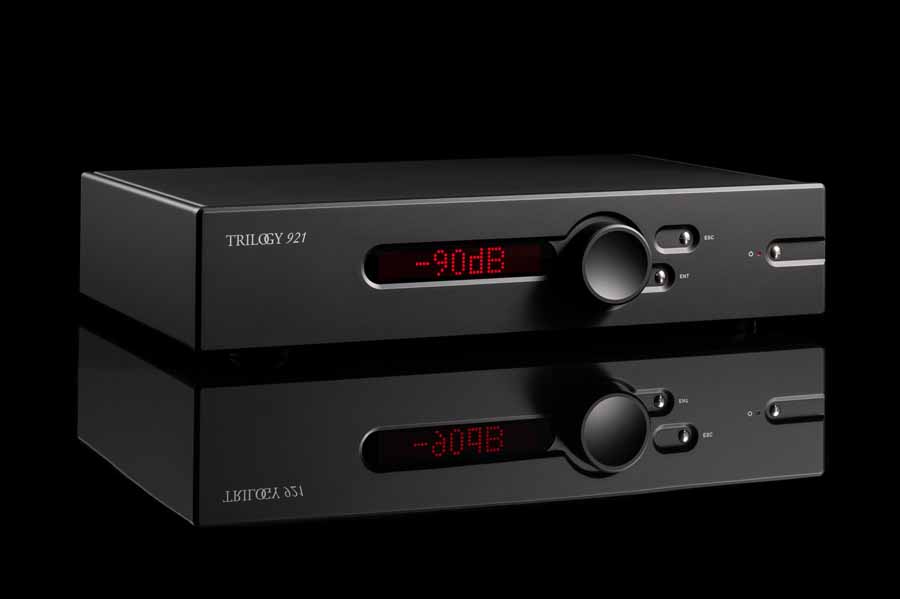
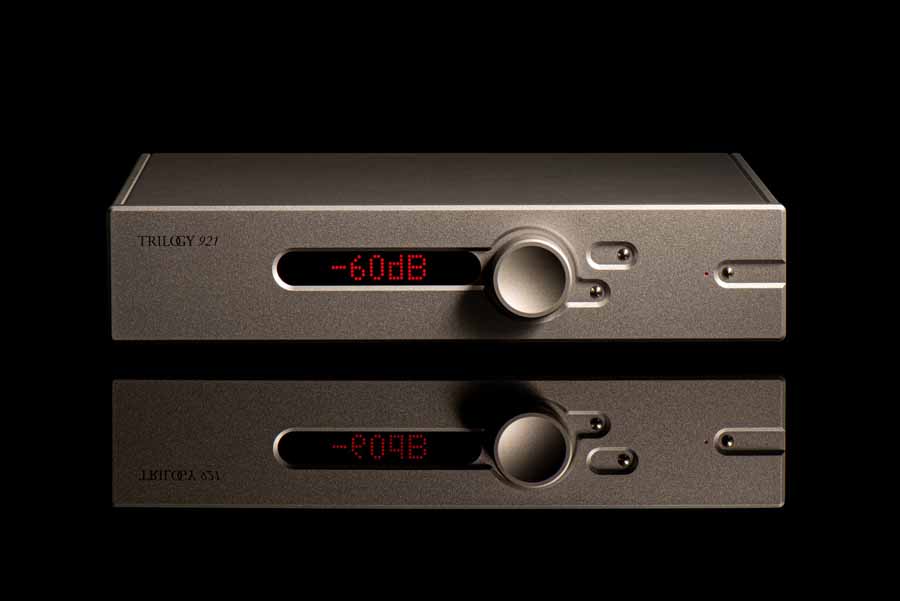
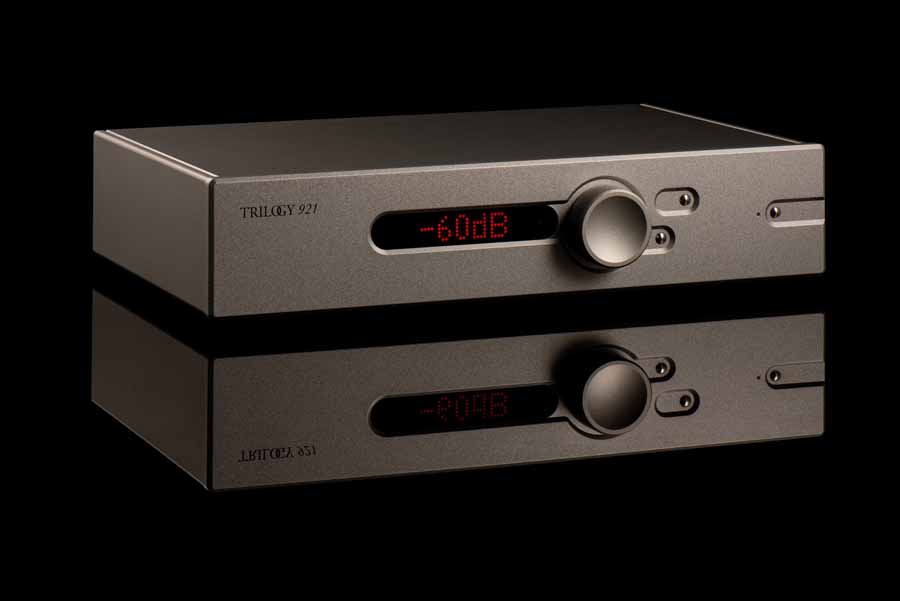
Rather than flying off at a tangent, this review will simply look straight ahead at the new Trilogy (note that the brand name isn’t “Trilogy Audio”) entry-level integrated amplifier, a gorgeous looking 75W solid-state affair with its gorgeous large red dot-matrix based screen on the front that sets it (and a few others) apart from the usual crowd who offer LED/LCD screens that are invisible from even a few inches away. Available at £6,200 for Natural Aluminium and £6,500 for the Stealth Black, this conventional aspect full-width amplifier with sculptured fascia is just one of a brilliantly designed and styled range of products built in the UK. The 921 is a great looker, especially with the red display, and comes with a super-looking matching remote control. Their previous entry product was some ten thousand pounds higher in price, so it is great to see something a little more “affordable” to make that entry into the Trilogy troupe. All are built at their gorgeous ivy-clad 16th-century Tudor house and factory in a leafy village between Evesham and Stratford-upon-Avon. I know Evesham well, a beautiful town with Wood Norton Hall where all BBC staff go for their intense training. Hey, another Beeb link.










BUILD AND FEATURES OF THE TRILOGY 921
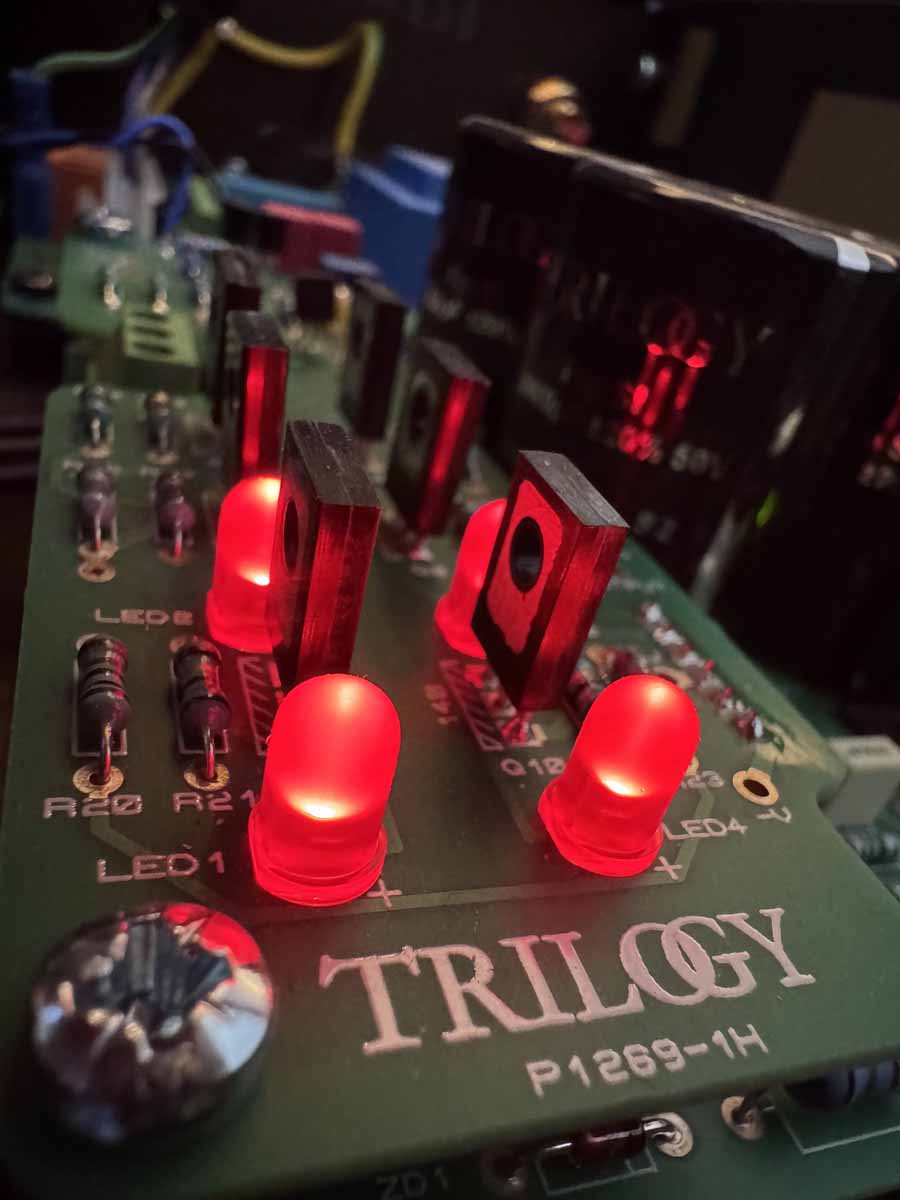
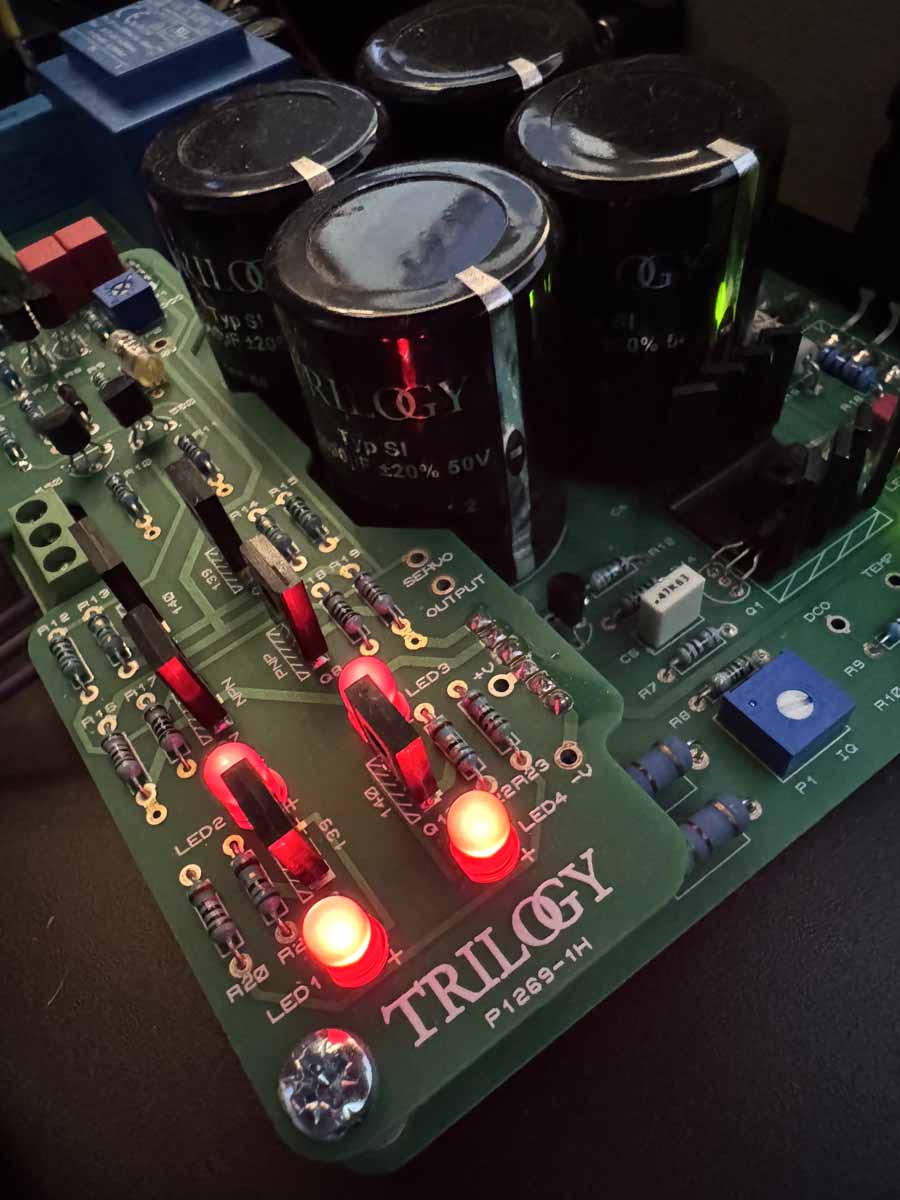
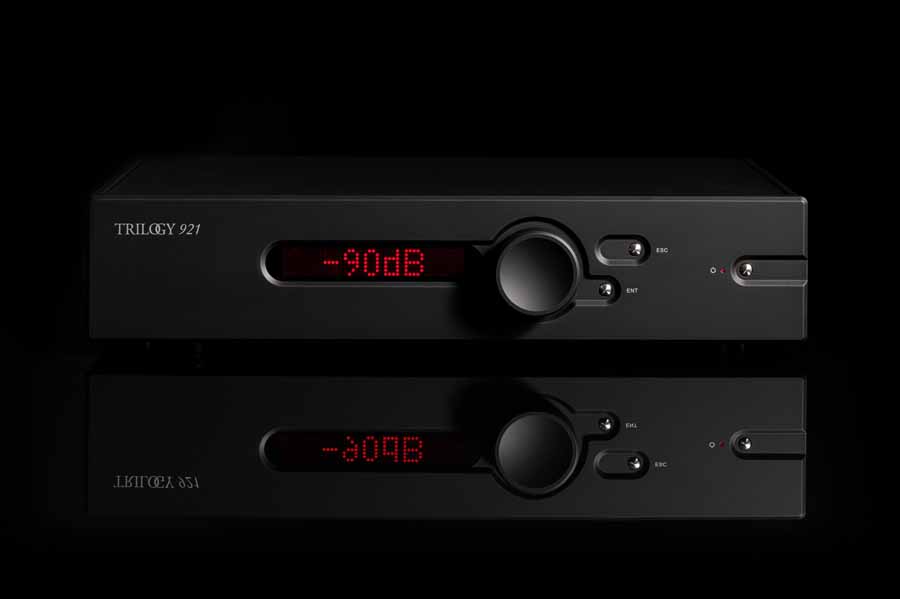
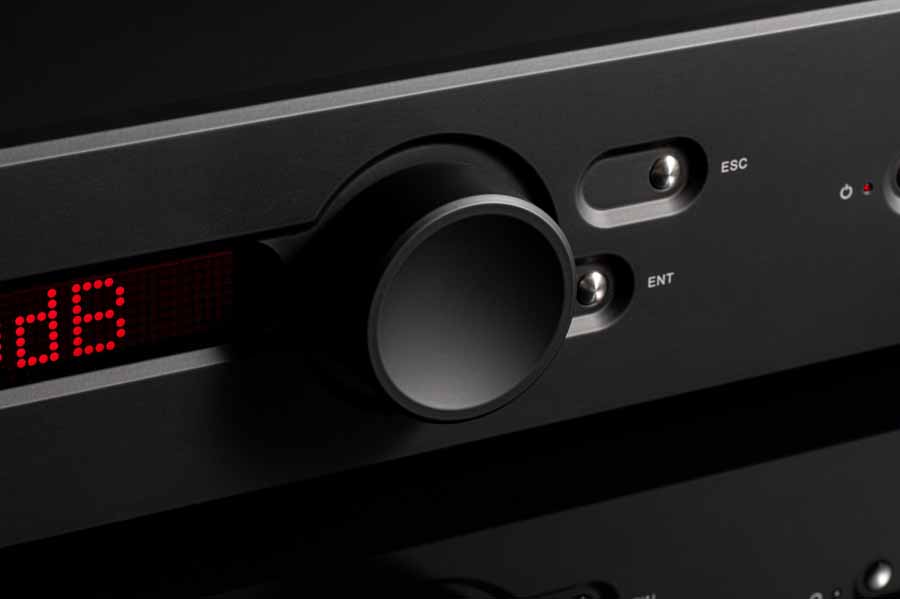
Unlike many integrateds at this price point, it was chosen not to make the 921 a preamp plus power-amp in one box. Nic and his team chose to have a single, ultra-linear gain stage to do all the amplification. This then connects to a compound output stage, similar to the design in their more expensive power amps. This allows for extremely high bandwidth (100kHz), low distortion and very small shunt feedback (9dB). Rectification and smoothing capacitors for the power supply are separate for each channel and fed from individual windings on the mains transformer. Each channel has 40,000uF reservoir capacitance, which is very respectable for a 75W amp. Signal and current paths are short, and to reduce any interference, they are laid out in a stacked formation so that the voltage gain stage is on the top and the output stage with Toshiba bipolar transistors and power supply (rectification and capacitors) is below. With a central toroidal transformer (I don’t like them at one end, which makes lifting heavy amplifiers less easy), this Class A/b amplifier is a surprisingly sophisticated design, and remarkably loud for 75W (8-ohm; 135W into 4-ohm) compared with some 75W Class D amplifiers I have reviewed. The digital control software is particularly clever with features including a clock and timers, the ability to set individual gain of the 5 RCA line inputs, setting the overall volume level at start-up (plus displaying it all in dB or just numbers), L/R balance, display brightness (automatically light-adjusting or a selection of 1-9), and also a “FILM” setting should you have desires to integrate it as part of an AV system, bypassing the 921’s volume control. The inbuilt timer allows you to set up start and end times every day of the week, so you can get the amplifier all “warmed up” before you sit down to listen, or perhaps to give burglars the illusion that you are still at home whilst you are out at the HiFi show. Even the channel inputs can be renamed if you desire, and you can check the firmware version or reset it all to factory settings. The remote control is a work of art (though you will need a Phillips screwdriver to insert the supplied AAA batteries), with its “one-piece” curved aluminium design. I love the fact that each labelled button lights up when you move the remote. The design is based on the Philips’ RC5 coding protocol, which allows you not only much adjustment but also to use other RC5 programmable devices. This complexity in design is met with a very simple and minimalistic amplifier fascia with the red dot matrix screen central and volume/function knob to the right, followed by enter/escape buttons for the functions, and the standby off/on button. There is no master off/on button.
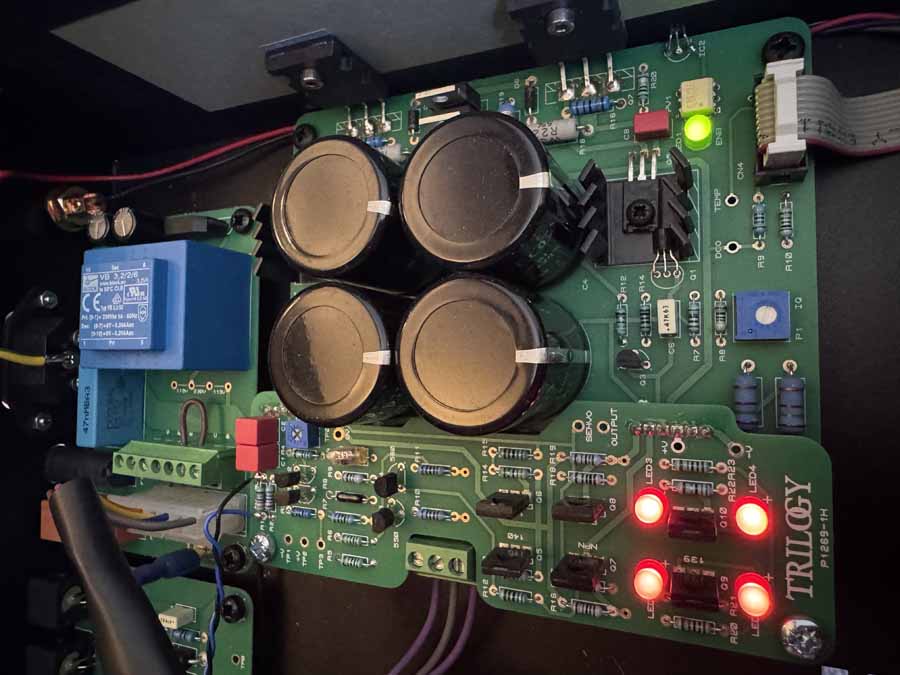
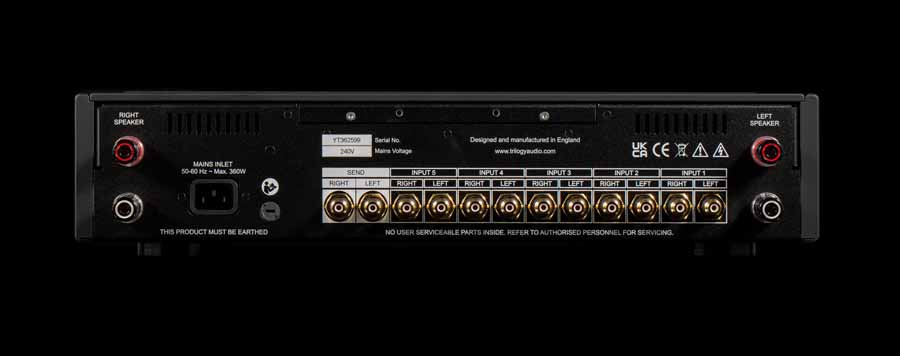
The rear is surprisingly simple, too, though each channel’s left and right input RCA socket adjacent, rather than one above the other as is standard. A little care might be needed whilst wiring up, then. There are no XLR inputs. Those remain in the more expensive 925.
Whilst the 921 amplifier is purely solid-state, Trilogy likes triode Class A, and their 925 and a number of other amps include the super 6H6П tube. I did wonder if that is the reason for the name Trilogy, but “Trilogy” was chosen simply because it sounded good. Despite the 921 being SS, I did hear tube-like musicality (see later).






Speaker connections are at either end of the rear, and there is also a left/right send RCA connection, should you wish to connect to a tape recorder or that AV system.
SETUP AND USE
I notice that Trilogy’s own listening room has Wilson Benesch Discovery stand-mount speakers, the bigger brother to my own Arc, so some of my listening had to be spent with these, but I also used my excellent Graham Audio BBC-based LS5/9s. Sources included Bluesound Node and Krell CD for digital and reel-to-reel for pure analogue. Nic admits his knowledge is analogue audio, candidly also admitting that “everything I’ve learned in life was from getting it wrong” (I think Thomas Edison, James Dyson, Henry Ford and Elon Musk have said similar things, too), and consequently, Trilogy only produce analogue products. So, no DACs in the Trilogy portfolio, and as he has little interest in digital circuitry, Chris Sims, another ex-BBC software guru, has been left to take care of that side of things. On switching on, the amplifier spends almost 20 seconds setting things up, with a “Warm Up” indication on the screen. Perhaps it wishes it were a valve amp. That setting up, though, is very important, as I was to find out.
SOUND QUALITY
Interestingly, with all this wonderful coding, when I first switched on the unit, it didn’t work, but the on-screen message gave me enough clues as to the fault, so with permission from Nic, I opened it up and reconnected a link to one of the channels that had simply got loose in transit. The “Status” button on the remote is preset to indicate the temperature of the two channels, so you know if it’s getting too hot. With “0C 22C” displayed, it was obvious there was no power in the left channel, the unit then cleverly shutting down immediately to protect the device, and indicating “DC”. I easily reconnected a loose connector and switched on. Next time, let’s hope the couriers are a lot more respectful of the boxes they throw about in the van. Luckily, the Trilogy is built like a tank.
Appropriately, the first piece of music on the listening test was Free’s “All Right Now” from their ‘Free Live!’ album. I have found Class A and AB amplifiers are generally great for Prog and Heavy Rock albums, and I wasn’t to be disappointed! With power where it was needed, the sound was surprisingly tight and controlled. Normally, the output from my streamer is very low level compared with that of my CD player, but -33dB indicated on the 921 was certainly loud enough for me to listen adequately.
Donald Fagen’s “The Nightfly” was similarly tight! His style always reminds me of a cross between Shakatak and Steely Dan, with a mix of jazz, funk and pop. Everything in the soundstage was carefully positioned with glistening precision and control. “I.G.Y” is one of my favourite tracks for reviewing loudspeakers, and here the amplifier gave such fast transients that the WB Arcs could work their magic without any holdback. Only that my own reference amplifier can give just slightly more bass power stopped me jumping off my seat thinking “eureka”. That drive that I hear from King Crimson, “In the Court of the Crimson King”, was well behaved and accurate, especially good for the baby of the Trilogy range and the fact that it is an integrated amplifier. “I Talk to the Wind” blew me away with the tightness and extension of the cymbals, wind and synth playing, as well as great vocals from ELP’s Greg Lake. I have said before just how brilliantly this 1969 album is recorded and played, and the amplifier really gave an excellent performance from my authentic reel-to-reel copy. The cymbals in “Moonchild” on the left and right, hand drums central and vocals on the right of this 12’13” track were carefully crafted into position by the amplifier; this track also includes an almost musique-concrète percussion section, which is great for testing any part of your HiFi’s anatomy. At 7’38”, it sounds like something drops on the studio floor mid recording it, something I hadn’t ever picked up before. The Trilogy gives it great power and detail, but also a humanity that still keeps it under control.
Dire Straits ‘Brothers in Arms’ was similarly highly precise and fast, but still offering that musicality and power you don’t normally expect in 75W SS integrated amps.
There was plenty of bite and control, and lots of excitement, but I did find that when I played my Karl Jenkins ‘Adiemus IV – The Eternal Knot’, that energy and detail were slightly restrained from what I am used to from my Krell. This is a vocal and instrumental work with ethereal, loud and even highly explosive sections, as used in the film “The Celts”. This album on my Krell is mind-bogglingly invigorating, but I did feel the 921 just left me slightly less spellbound. It was more careful, and for that reason, more precise and detailed in its positioning and playing of the instruments or voices. Being a British amp versus an American heavyweight, the performance made me think instantly of the comparisons between the respective current British Prime Minister and US President as I wrote the review. “King of the Sacred Grove” had great glockenspiel transients and punchy hand drums, and the next track “, Salm O Dewi Sant”, had brilliant depth and detail in this highly toe-tapping country dance. It didn’t want to be brash and unrealistic. It was just right. It was telling the truth.
The universal remote control has a “phase” button, which will reverse the phasing to both speakers on other Trilogy amps. Nic likes the idea of this feature, and it was very popular in the 1990’s. I did attempt to manually swap the red and black connectors on both speakers (you must do both speakers!), and on some music it resulted in a tighter bass grip and soundstage, but since getting perfect phasing between the different microphones picking up the same instrument at different distances in a big orchestral work is nigh on impossible, there are always phasing issues somewhere. Basically, try it and see if it improves the sound. It simply reverses the motion of the drivers. Having the 921 amp also do it at the press of a button would have been handy, though, as it is a great feature that sets Trilogy apart from most manufacturers. Firmware updates will hopefully rectify this soon.
Grip and control of sound continued in Nina Simone’s “Be My Husband”, even picking up a few microphone noises that just wouldn’t have been allowed when I was a BBC sound engineer many moons ago, but the performance from this aged jazz singer just sounded perfect, with great piano solos and an acoustic guitar to the left, a deep bass to the right and plenty of space for her vocal power in-between to breathe.
To assess that soundstage front to back, plus see just how good the bass extensions were, I chose Arvo Pärt’s “La Sindone” from ‘Credo’ with Paavo Järvi as conductor. This is a superb recording and really worth a listen if you like a mixture of space, relaxation and tension. Interestingly, this music was originally banned for its politically critical message, with Järvi’s family ending up emigrating, and Arvo going into a musical silence for a number of years. Great that he later returned with more minimalistic creations such as ‘Tintinnabuli’. With deep bass drive, heavenly strings and a haunting openness, this album has a brilliance of power and simplicity, equally replicated by this amplifier. The mighty bass drum surprised my cat as well as me with its authority and control.
QUIBBLES
It is hard to find fault in the design and sound, though I wish there were a ¼” headphone jack on the front so I could listen to cans without having to spend more money on their matching 931i headphone amplifier.
CONCLUSION
This was a very musical and engaging integrated amplifier to get you into the Trilogy fraternity. Trilogy doesn’t seem to shout out much about their products, a company I have not reviewed before, but there is a very good reason why they should do so; on whatever type of music I played, the 921 excelled with a refined realism and great focus on the music, allowing me to focus on the music itself, however loud, and also to shout out “Five Hearts”.
AT A GLANCE
Build Quality and Features:
Exceptionally well-constructed and with great features, including protection against careless delivery couriers
Sound Quality:
Very detailed and always in control
Value For Money:
At £10k cheaper than their previous “entry” integrated, it’s a cheap price to get on board the Trilogy train
We Loved:
Very detailed and controlled performance
Lovely remote control with back-light
Tight soundstage and timing
Good bass grip
We Didn’t Love So Much:
Certain music can sound just a little tame
Elevator Pitch Review: Trilogy Audio Systems is one of those companies that you just wish you had heard of a long time ago; run by Nic Poulson, an ex-BBC engineer from the days when the BBC was innovative and focused, and who continues that ethos in his analogue amplifiers. Now with Richard Bates as Sales Director to broadcast their excellence, hopefully even more audiophiles will be tuned into seeing just how good they sound.
Price:
£6,200 for Natural Aluminium
£6,500 for Stealth Black

Janine Elliot
SUPPLIED SPECIFICATIONS
Power output: 75W (8 ohm) 135W (4 ohm)
Distortion: <1% A-weighted at rated o/p 8 ohms
Inputs: 5 line-input single-ended 42k ohms
Outputs: Send line-out 0dB (no gain)
Frequency response: 5-100,000Hz +/-0.5dB
Recommended load: 3-16 ohms
Size: 465x312x106mm (465x350x106mm including connectors)
Weight: 11kg
Maximum power consumption: 300W (240V UK; 230V Euro; 120V US;100V Japan)