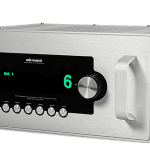
In 1973, the Audio Research SP3 was hailed as ‘the best preamplifier available’. The Reference Series from Audio Research was first introduced in 1995 and say Audio Research, ‘Has been the ultimate representation of performance, musicality and power.’ The Reference 6 is the latest preamplifier from the brand.Audi_Research-ref-6-news1

The Reference 6 is a solution to a need which arose after the creation of the Reference SE Series amplifiers. According to Warren Gehl, who is responsible for sonic development of all Audio Research products, the new series of Reference amplifiers offer ‘a level of musical and dynamic capability only made apparent when using the flagship, two-chassis Reference 10 preamplifier. Both preamplifiers of the Reference Series need the ability to provide the full benefit of this new sonic landscape. Increasing the tube count to six in the analogue section, and advancements in the power supply improved both macro- and micro-dynamics and lowered distortion. The Reference 6 also offers better bass control, relaxed purity and more dimensionality. Further improvements include a more grainless presentation, greater transparency, better speed, and more continuity across the musical spectrum. Quite simply, the Reference 6 improves upon its predecessor in every way for a more palpable and immediate musical performance.’Audio_research_ref_6_news2

Numerous elements – transformers, capacitors, wiring – are designs exclusive to Audio Research and the Reference 6. A completely new chassis has allowed a more beautiful aesthetic, but also provides more structural rigidity to assist in the dissipation of electrical and mechanical interferences. Six premium 6H30 tubes are now used in the audio circuit (increased from four tubes in the Reference 5SE) to provide an even quieter background and increased dynamic range. The tube-regulated power supply is also a new design. New circuit boards, circuit designs, and larger power transformer have been implemented to provide robustness and serviceability. A new volume control with finer step gradation and higher performance completes the system.
The first Reference 6 units, available in natural anodized aluminium with acrylic cover, will begin shipping in November.

 

Sponsorship button

sDP-1000EX from sOTM Audio is a high-end D/A converter and pre-amplifier with a USB audio function which supports DSD playback and has a battery power supply. 

USB audio uses an asynchronous mode to connect the digital audio source device such as a PC. It can playback a 32 bit/192KHz PCM signal (maximum) and DSD signal. In addition, the sound quality from the input source can be improved by the specially designed high performance clock and 32 bit up-sampler circuit.

All audio circuit parts including the DAC and preamplifier volume control are fully balanced circuits.  Not a single coupling capacitor is used in the audio signal path.sDP-1000_Front-e1418872157602

It has two battery packs installed, with one battery providing power whilst the other charges and switches between these functions automatically, so there is no additional work needed once it’s connected to a power supply for charging the battery. The sDP-1000EX will work continuously via battery power only.sDP-1000_Rear-e1418872178836

Features

SB input

USB specification 2.0 or higher

USB audio class 2.0

32bit/192KHz PCM & DSD playback

Native ASIO support

Optical, Coaxial, AES/EBU input

Max bit-depth : 24bit

Sampling rate : 32KHz, 44.1KHz, 48KHz, 88.2KHz, 96KHz, 176.4KHz, 192KHz

Impedance

Coaxial, BNC : 75Ω

AES/EBU : 110Ω

Balanced input

Max input voltage : 4 Vrms

Input impedance : > 10kΩ

Frequency range : 20~20KHz @ ±0.1dB

Unbalanced input

Max input voltage : 4 Vrms

Input impedance : > 10kΩ

Frequency range : 20~20KHz @ ±0.1dB

Balanced output

Output voltage at 0dB : 3.8 Vrms ±5%

Output impedance : 47Ω ±5%

Frequency range : 20~20KHz @ ±0.1dB

THD : < 0.003% @ 1KHz, 0dB

Unbalanced output

Output voltage at 0dB : 3.8 Vrms ±5%

Output impedance : 47Ω ±5%

Frequency range : 20~20KHz @ ±0.1dB

THD : < 0.003% @ 1KHz, 0dB

Volume control

Setting range : -75 ~ +10dB, 0.5dB step


Sponsorship button


The name of this French DAC/PRE derives from the word étalon, meaning standard, or measuring device. Dominic Marsh gets to grips with the 7530 unit and spills some blood for his art. More »

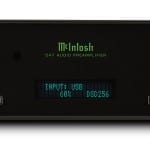
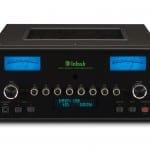
McIntosh Laboratory has launched the new C47, a flexible 12-input digital preamp that combines contemporary technology with the core values of the brand. The C47 has been designed to offer huge flexibility with both digital and analogue source components.

It offers a high-quality built-in phono stage for the direct connection of turntables, an advanced headphone stage with McIntosh’s proprietary Headphone Crossfeed Director (HXD®), plus four digital inputs.

The C47 is compatible with the latest high-resolution audio formats via its USB input, including DSD64, DSD128 and DSD256 along with DXD 352.8kHz; its twin optical and single coaxial inputs can decode at up to 24-bit/192kHz resolution. For optimum SACD playback, the C47 preamp can also connect digitally to McIntosh’s recently launched  MCT450  SACD/CD transport via its ‘MCT input’, creating a secure, custom DSD connection.

For analogue sources, the C47 includes two balanced and three unbalanced (fully assignable) inputs, plus Moving Coil and Moving Magnet phono inputs. All inputs are available all of the time – even those that have been assigned to individual devices, giving genuine flexibility of configuration.

With such a wide variety of source component connectivity, the C47 sensibly offers bass and treble tone controls for fine tuning. Further features include the aforementioned Headphone Crossfeed Director (HXD®), which brings an added dimension to headphone listening, while the C47’s Home Theatre Pass Through feature permits seamless integration into multichannel A/V systems.

The C47 incorporates classic McIntosh design cues, including a black glass front panel, an illuminated logo and brushed-aluminium end caps. It combines McIntosh’s contemporary solid-state preamplifier circuitry with a full complement of inputs and is perfectly suited to exploiting the full potential of today’s digital devices, while delivering the legendary McIntosh sound quality. Like all McIntosh products, the C47 is handcrafted in the Binghamton factory (New York) and boasts classic 1950s styling with contemporary features and technology.


Sponsorship button

At £129 this little passive pre has more inputs than its predecessor but costs less. What’s all that about then? Ian Ringstead finds out. More »

Another new preamplifier from McIntosh has been announced on the company’s website, hot on the heals of the C1100 that we broke news of yesterday.

“The C52 is the most advanced, single chassis solid state preamplifier we’ve ever made” the company say.
For connecting analogue devices, it includes 3 balanced and 4 unbalanced fully assignable inputs plus 1 each of Moving Coil and Moving Magnet phono inputs for connecting a turntable.XL_C52_Front_Top

On the digital side, it has 3 optical, 2 coaxial and 1 USB input. The optical and coax inputs will decode digital music at up to 24-bit/192kHz for high resolution audio playback. The C52 is also capable of decoding and playing back DSD files; the USB input accepts PCM signals up to 32-bit/384kHz and supports DSD64, DSD128 and DSD256 plus DXD 352.8kHz and DXD 384kHz. An MCT input offers a secure, custom DSD connection for playback of the high definition audio found on SACDs when paired with the company’s MCT450 SACD/CD Transport​ . The C52 features a 24-bit/192kHz, DSD digital-to-analogue-converter. XL_C52_Back

The outputs have also been updated to be easier to operate when bi-amping or tri-amping so that your highs and/or lows are not inadvertently turned off. An 8 band analogue equalizer is also included.XL_C52_High_Angle_right_close_up_background

For headphone listening there’s Headphone Crossfeed Director (HXD®) and the Home Theatre Pass Through feature allows for seamless integration into your multi-channel home theatre system.


Sponsorship button

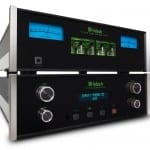
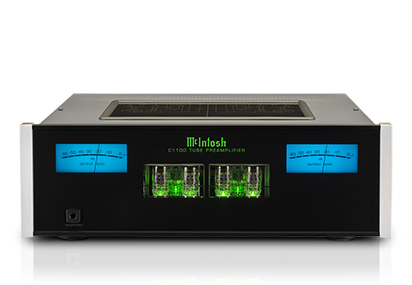
The C1100 preamplifier from McIntosh has, say the company, “high level inputs having the lowest noise of any McIntosh preamplifier ever produced”. It utilises a two-chassis design where the control and power sections are completely separate from the audio section. XL_C1100C_and_C1100T_Angle_Left

The C1100 is comprised of the C1100 controller and the C1100 vacuum tube preamplifier. Inside each, the left and right channels are electrically and mechanically isolated from each other to allow true dual mono operation. The two units are connected together via a pair of specially designed umbilical cables that are shielded. While they are two separate units, when connected they act as one and are easy to control and operate from the included remote control or the C1100 controller front panel.L_C1100T_Front_Top

All power control, data ports and external control connections are located in the C1100 controller; the introduction of a dual microprocessor allows for an improved robustness of the control system. The C1100 vacuum tube preamplifier houses the audio connections and circuitry, featuring a total of 12 analogue inputs: 6 balanced, 4 unbalanced, plus an adjustable loading Moving Magnet and a Moving Coil phono input.

For outputs, 2 sets of balanced and 2 sets of unbalanced connections provide flexibility in connecting to your amplifier. Twelve vacuum tubes (6 each of 12AX7a and 12AT7) power the tube preamplifier. Compared to the C1000 preamplifier which had 8 tubes, the additional 4 tubes in the C1100 lowers its dependency on any solid-state support. The amplifier circuit has much higher common mode rejection, so any noise introduced by interconnect cables is significantly reduced. For personal listening, the headphone jack features a higher output than any of their other preamplifiers and uses Headphone Crossfeed Director (HXD®).The Home Theatre Pass Through feature allows for integration into your existing multi-channel home theatre system. XL_C1100C_Front_Top


The C1100 preamplifier employs fully balanced circuitry and has the classic McIntosh black glass front panels, blue meters, knobs, stainless steel chassis, illuminated logos and custom machined brushed aluminium end caps.


Sponsorship button

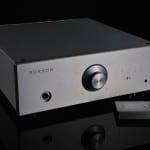
Burson Audio has announced the introduction of the new Conductor Virtuoso USB DAC, Headphone amplifier and Preamplifier Conductor-Virtuoso-2that can be used to drive headphones of desktop systems. The new Virtuoso supersedes all previous Conductor models.

Burson say that it has “significantly upgraded and refined previous generations of the Conductor. Besides big power, the Conductor Virtuoso includes a new, stunning 100-step volume control with a fresh and easy-to-read display. When the Virtuoso is turned on the volume indicators appear on the face of the thick, antiresonant aluminum front plate”.

Consumers can choose from two interchangeable DAC boards with different sonic characteristics, and the modular design should make for no-fuss upgrades. Another important consideration say Burson is that the Conductor Virtuoso doesn’t use densely-packed opamps, but instead all discrete circuitry which they say offers superior tonality, clarity and a lower noise floor.

The remote control is carved from solid aluminum with no visible screws.

The Conductor Virtuoso is shipping now with the ESS9018 Sabre DAC at $1,995USD / €1,850 Euros. The Burr Brown PCM1793 version is priced at $1,495USD / €1,451 Euros.

Sponsorship button

Densen have introduced an updated version of their B-250 preamplifier called the B-250 XS.densenbx

Improvements include a volume control using an attenuator made of Vishay metal film resistors switched by relays controlled by the microprocessor which Densen say has virtually no self-induced noise and extremely low distortion. The attenuator has 200 steps for precise control of the volume.

The new preamplifier also has sockets on board for the SA Board for surround and the DP-03 MM phonostage. The SA boards (Surround Audio Boards) are an add on for the B-250XS and will give 5.1/7.1 line input and line preout meaning you can connect a surround processor, DVD player, or SACD player.

On the back panel of the B-250XS there is a socket for use with internal DAC which Densen will soon be introducing. It will have USB, Toslink and coaxial digital inputs which you will be able to control from the Gizmo remote and from the pre’s front panel.


Sponsorship button


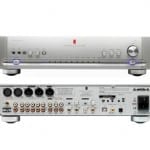
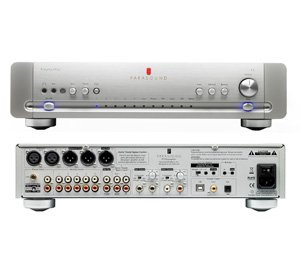
Parasound has announced the addition of a new 2.1 channel preamplifier to its Halo product line( Jerry reviewed the Parasound_p5_preamplifier_front_backHalo A21 amp some time ago giving it a Recommended award). The new Halo P 5 replaces the Halo P 3 preamplifier adding a DAC with coaxial, optical and USB inputs. Also included is a subwoofer output, home theatre bypass, phonostage and a motorised volume pot.

Inputs include one pair of balanced XLRs, phono, five stereo RCA inputs and a 3.5mm mini jack on the front panel so you can plug in your iPod or mobile phone.  Outputs are balanced XLR, unbalanced RCA and a choice of balanced/unbalanced subwoofer outputs.

The onboard phonostage will cope with moving magnet cartridges and pretty much all moving coil cartridges with a 100ohm/47 ohm switch for impedance matching.

Available in September the price will be $950 which would appear to be a good price for such a well loaded product.

Sponsorship button

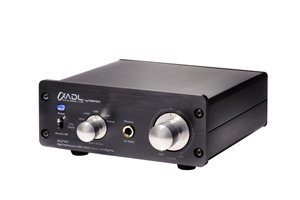
An increasing number of music lovers use their computers to store and play music, yet still want better sound and more flexibility. The new Alpha Design Labs Esprit, aimed at audiophiles who wants “higher performance and increased flexibility”  offering as it does 24 bit/192 kHz, a digital preamplifier and a headphone amplifier.

The Esprit is designed around the 24 bit/192 kHz Wolfson WM8716 DAC and the CIRRUS LOGIC CS5361 24/192 analogue to digital converter.  It features optical, coaxial, USB and 2 analogue inputs.  The USB output can be used for recording to hard disk and the S/PDIF output will support digital surround sound formats from allowing surround material stored on a hard drive to be played through a suitable digital surround decoder. More »