
Reel to Reel Review – Piano Recital Arturo Benedetti Michelangeli – 15 ips Master Tape
As De La Soul said – “3 is the magic number”. 3 is everywhere in human culture – think religion (pagan and Christian), acts in plays, beginning, middle and end in books, film trilogies, ghosts in Dickens… 3 is the key. This album (and this review) is also a story of 3 parts – or 3 acts, if you will – a phenomenal musical talent, a benchmark recording-engineering team and a class-leading tape and vinyl production house. Before we get to the latter 2 aspects, we should always start at the beginning – in this case, the artist.
How many 9-year-olds do you know who are already proficient, if not excellent, on the violin, start writing but then decide to try a bit of piano, audition and get accepted for private tutelage under a renowned piano teacher and examiner at one of Italy’s finest conservatories of music, enter the Milan Conservatory at 10 and then graduate at 14? Think hard – none? Yeah, that’s what I thought.
You, then, like me, didn’t know Arturo Benedetti Michelangeli (1920–1995), hailed as one of the finest pianists of the 20th century, the son of a count (and lawyer by trade), and well known enough to the then Queen of Italy that she attempted to intervene when he was drafted into WWII. At 18 (I was discovering clubs and raves), he began to appear in competitive piano events. At the inaugural Ysaÿe International Festival (Brussels), Arturo came in 7th due to a “flawed performance”, despite showing his “impeccable technique” (according to Arthur Rubinstein). He returned to take 1st place only a year later!










He made his US Carnegie Hall debut in 1949, and his career, which included teaching and many major performances, spanned many years until his death in 1995, at the age of 75. His final public performance in Hamburg was at the age of 73. Turning the clock back to 1972, however, Benedetti Michelangeli performed 2 sold-out nights for Radio Bern – it is these performances that the tape I’m now listening to captured.
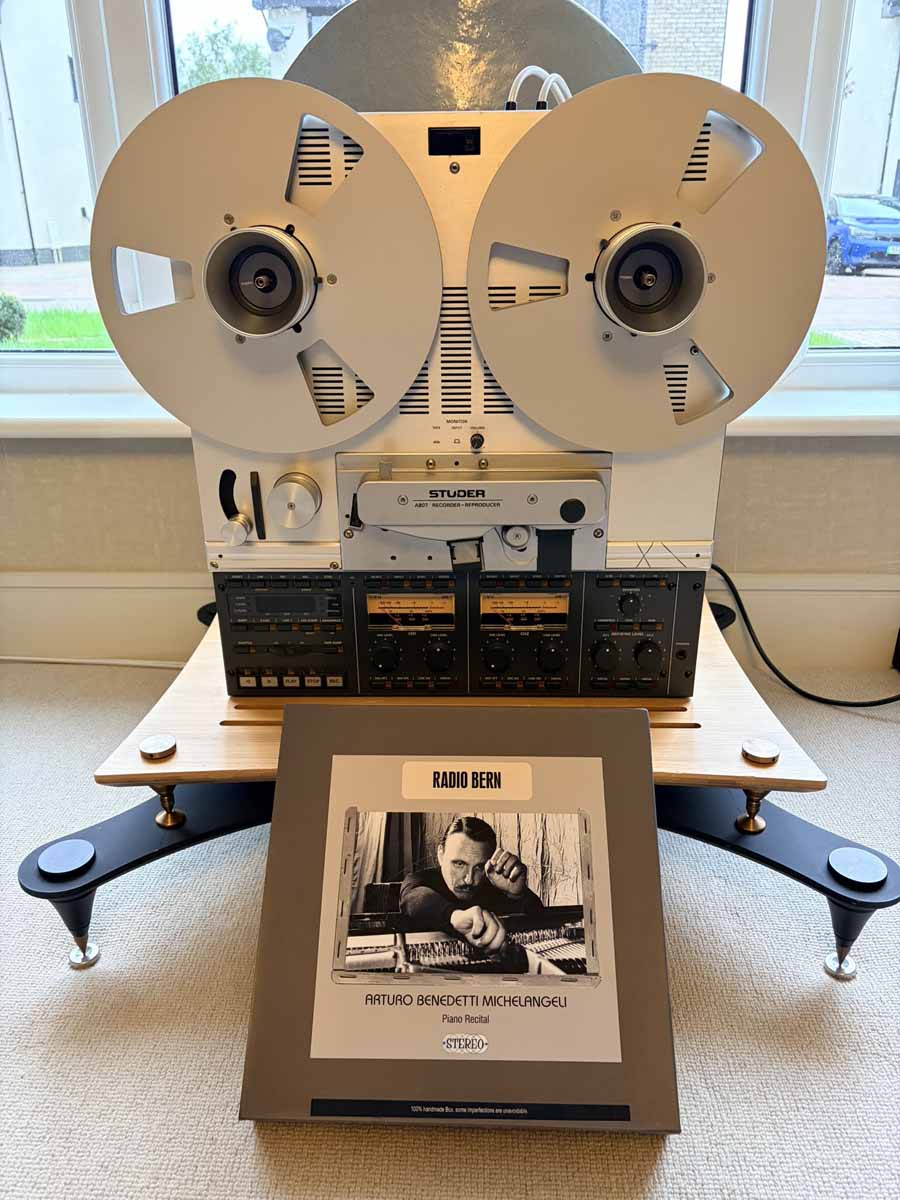
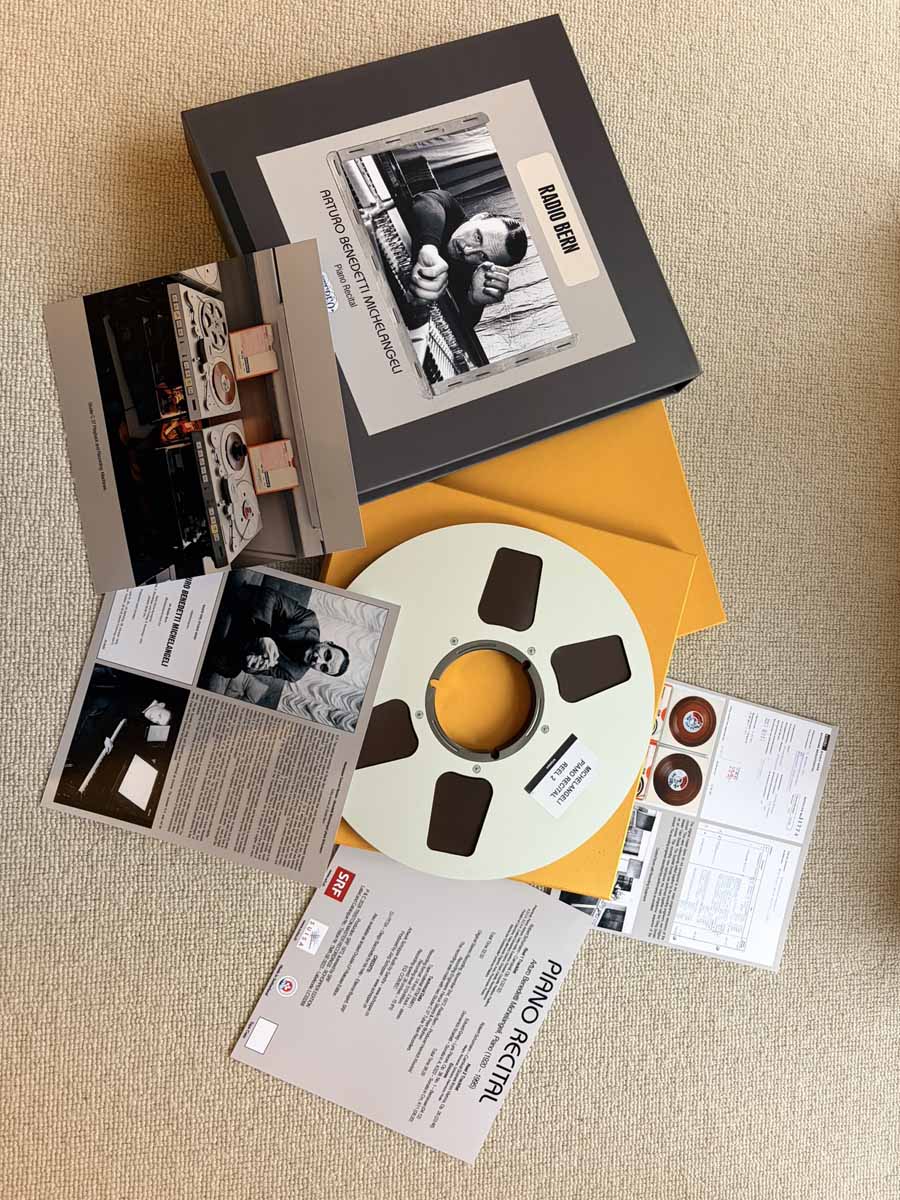
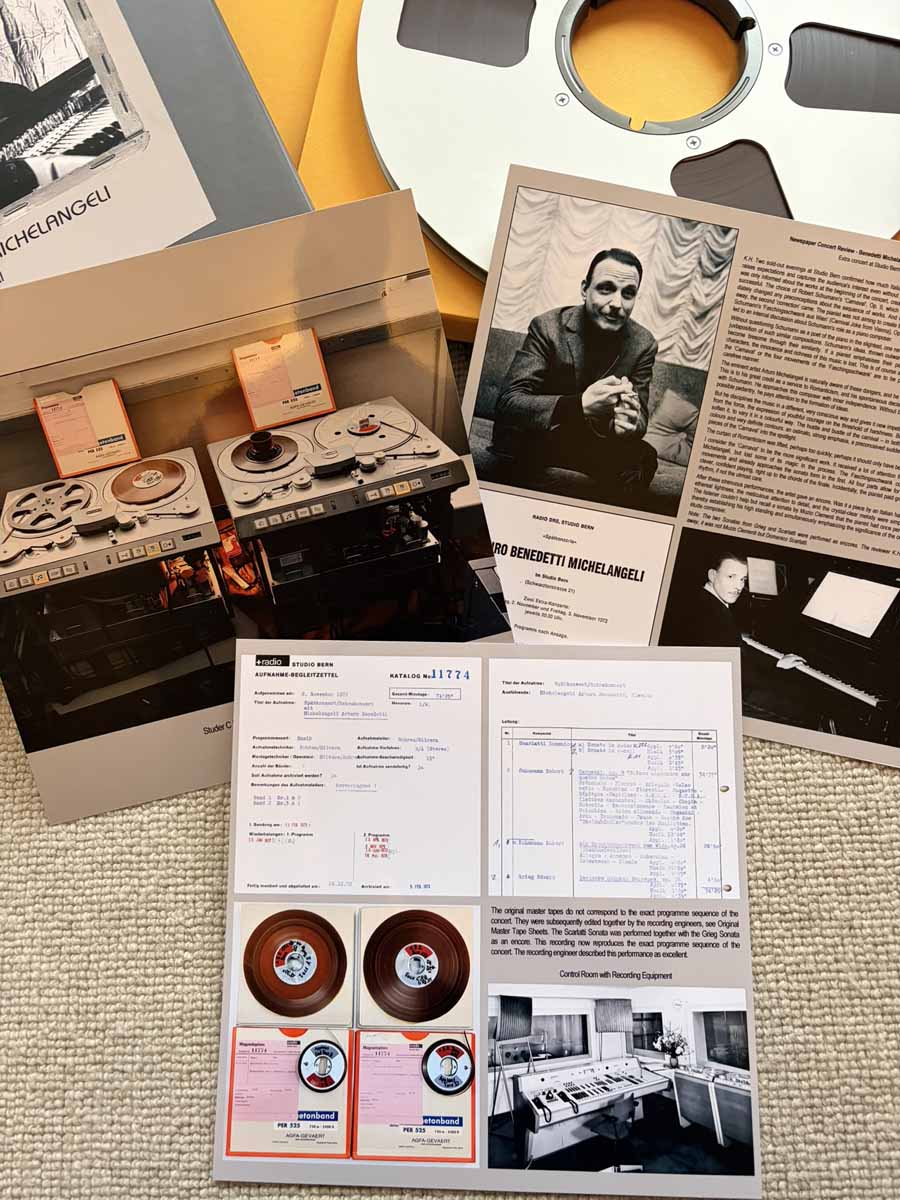
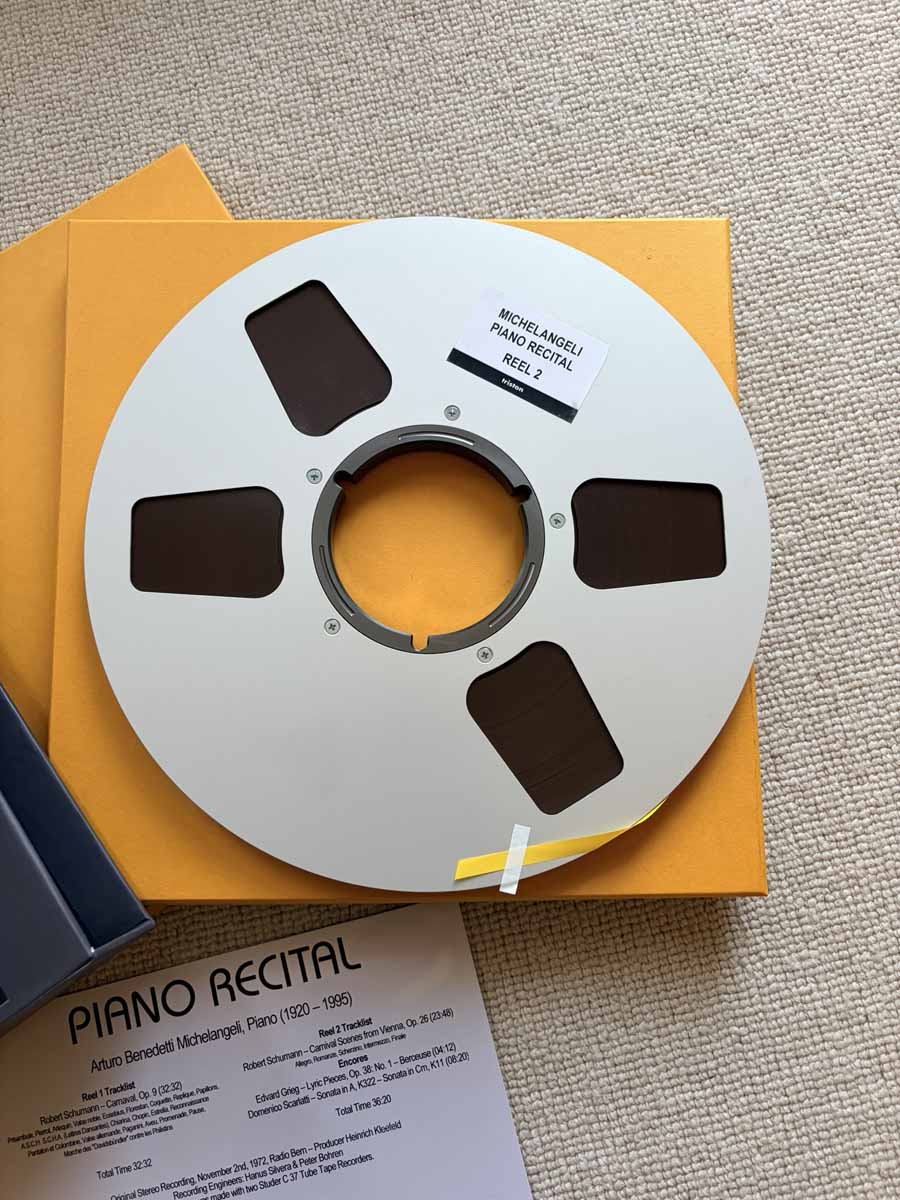
Piano Recital arrived extremely well packaged, with each tape in its own deep-yellow box with spine details. These are snugly housed in a very sturdy black cardboard outer slipcase, with the album-cover artwork on one side and Triston Masters label graphics on the rear – very smart all round! A plastic envelope is also nestled in the slipcase, containing super-high-quality photographs of the Studer C37s used in reproduction, the original master-tape boxes and notes, the recording booth at the event, Arturo at the piano and more. The 2-track ¼-inch tapes themselves are supplied on custom aluminium reels and are high-quality RTM SM911 stock with IEC/CCIR EQ.
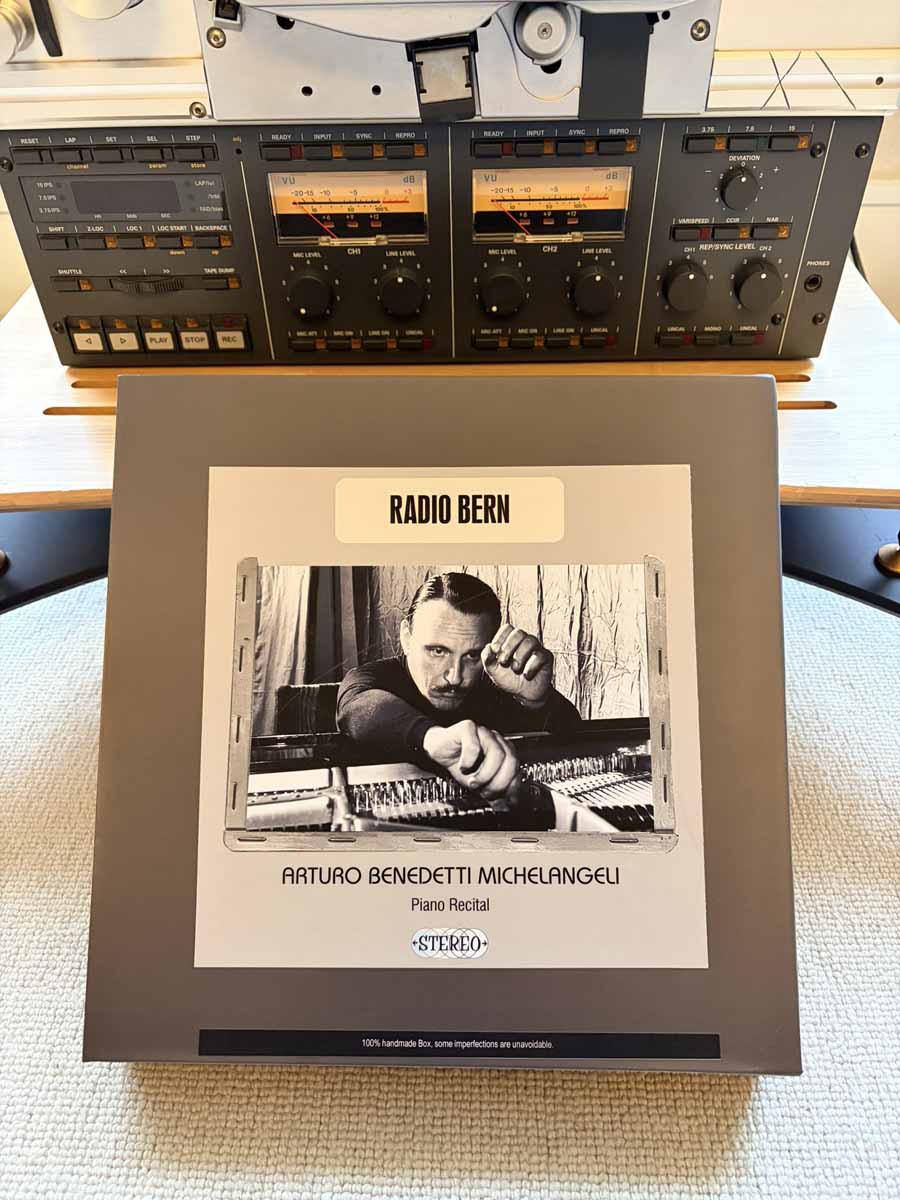
It’s at this point that I will clarify that I’m no “aficionado” of classical or piano recitals; however, I have been loving many more of them in the last year, in part due to the label we are discussing here. To counter this deficit, I have been researching studiously and speaking to Jürg Schopper directly to gather what I can about this work – if I am erroneous or miss some nuance of the pieces, please forgive me – but I do aim to provide a good background to its creation, as well as its sonic chops!








To give some sense of how well-renowned Michelangeli was, the actual pieces to be played at the Radio Bern event were not even specified in the advertising, meaning they were, to all intents and purposes, a surprise for the audience – they simply knew it would be great! The recital focused on Schumann’s portrayals of the European carnival, penned between 1834 and 1835: Carnaval: Scènes mignonnes sur quatre notes, Op. 9 and Faschingsschwank aus Wien: Fantasiebilder (Carnival Scenes of Vienna), Op. 26. The former focuses on indoor scenes of a carnival ball and includes portraits of many of the traditional characters, such as the Harlequin (Arlequin here), alter egos such as Florestan (Schumann’s fiery side), and also friends and people he admired, such as Chopin and Paganini (and his fiancée at the time, Ernestine von Fricken). Schumann also cleverly buries a secret coded message for his betrothed and a sneaky nod to the (banned at the time) French national anthem within the music – I’ll let you explore those aspects at your leisure! The final pieces paint for us the settings, scenery and dances – we arrive at the ball with Préambule, move through secretive whispers in Aveu, and dance waltzes such as Valse allemande before we conclude dramatically with Marche des “Davidsbündler” contre les Philistins (Schumann here imagining himself leading the League of David against the Philistine “old musical establishment”).
The whole work eminently captures the vibe and colour of an exciting and no doubt romantically charged masked ball, with colourful costumes, flirtation, dancing and whimsical characters – showing off his romantic flair and impressive technical playing with his own flourishes. The latter performance is a 5-movement expression of the outdoor festivities and atmosphere of the Viennese carnival, blending dance rhythms with romance and playfulness, and, if pushed, is my favourite of the 2 main performances due to its gravity and power. Where the first tape is light-hearted and flighty, the second, to my ears, has more depth – angst, drama and passion – while remaining full of fun, but never lacking in precision and technical excellence on Arturo’s part. Joy, fun, romance, love, drama, flirtation and coquettish glances are what I hear, and it’s a wonderful experience to listen to. The piece begins with Allegro, as we enter the bustling festival, before we briefly steal a glimpse into a lone window where someone sits quietly contemplating the loss of love in a room removed from and above the hustle and bustle (in Romanze), before the mood is quickly transformed with the bright and fun Scherzino (The Playful Prankster). Before we come to the triumphant, breathless sonata of Finale, we arrive at my favourite piece – the powerful, dramatic and quite breathtaking Raging Storm of Intermezzo – as it conveys the pure, unbridled, all-consuming joy and yearning of love – urgent and desperate. It is here that the staggering depth of dynamic and timbral richness of both the work and this tape reproduction reaches its peak. Truly superb.
Sonically, it’s incredible. When we think “tape”, we, of course, think unadulterated, close-to-the-original and highly dynamic reproduction. With Piano Recital, that is exactly what we get! Rather than choke the music, Triston have left it open and free, so some original recording air is audible at volume, but my God, it’s worth it for the presence, humanity, immediacy, emotion and sheer range of dynamics. At my listening volumes, I measured the softest key strike at around 46 dB, while heavier hands hit over 80 dB – the power, gravity, timbre and texture are wonderful.
Rewind a bit, though: what about the other 2 acts of our journey? Who or what is Radio Bern? Part of Switzerland’s SRG SSR network, it’s a regional station and has maintained a distinguished tradition of classical music broadcasting since the 50s, I believe. Radio Bern’s recordings from the 1970s are particularly prized by collectors, both for documenting performances by artists like Michelangeli, Horowitz and Rubinstein in intimate Swiss venues, and for their technical (sonic) excellence, achieved using professional Studer equipment (and, on reviewing the photos of the recording booth, Quad ESLs as monitor speakers!). These broadcasts preserved spontaneous, unrepeatable moments of musical history, often featuring programmes not commercially recorded elsewhere.
The man in charge was Heinrich Kleefeld, a distinguished Swiss radio producer and music director who worked extensively with Radio Bern (SRG SSR) during the 1960s and 1970s. He specialised in classical music programming and was known for his meticulous approach to recording live performances. My research indicates that he was characterised by “minimal intervention” (another thing we audiophiles love!), preferring to capture the authentic atmosphere of live concerts rather than heavily editing or processing the recordings, resulting in recordings that preserved both the musical brilliance and the intimate concert-hall ambience. Kleefeld’s collaborations with engineers like Hannes Silvera and Peter Boren produced some of Radio Bern’s most treasured archival recordings, including this 1972 Michelangeli recital. I’m starting to understand just why this sounds so good.
Now for our 3rd and final act… It’s this incredibly skilful recording that has allowed Triston Masters to reproduce this album. Led by the frankly lovely Jürg Schopper (if you know him, you will agree, I’m sure!), Triston Masters is a Swiss specialist reissue label focusing on historical classical recordings, particularly rare radio broadcasts and archival performances, and on preserving authentic sound quality. The broader family group of which Triston is a part – Schopper Audio – also specialises in Thorens turntables and has a superb collection of SPU cartridges, showing its passion for a bygone golden era. His father opened the first HiFi store in their region in the 50s, so there is some great heritage to build on here! Jürg himself was (among other roles) an EMI recording engineer and a real-life rock star (check out Shotgun Eddie and the Ravers), but his real love is open-reel tape and open-reel recorders – particularly the Studer C37 valve recorders. Outside of Triston Masters, Jürg has previously been responsible for the preparation of master-tape reproductions for the likes of Yello and others. His own personal collection runs to over a thousand tapes, and he tells me there are some very rare and interesting tape reissues coming after the summer from Triston – you heard it here first!
Using the valve-based Studer C37s he has in his studio (the same ones used to bring Yello Stella to life for Revox), Triston have taken the Michelangeli recording and reproduced it onto this 15 ips 2-track tape edition. What a job he has done. Triston Masters’ vinyl is, in my opinion, second to none for classical recordings, often from Radio Bern and Radio Zurich et al., and I am always simply stupefied at how incredible they sound – including this Radio Bern Michelangeli recital. This tape recording, however, takes it up to another level, being as close to the master tape as you or I will get. As I’m lucky enough to have this recording on both the tape and the limited vinyl release (both from Triston, using a C37 chain), I was able to compare both side by side by simply playing both and switching inputs on the Lab12 amp. The double vinyl LP, as I’ve mentioned, is simply superb – an all-analogue chain, and the C37 seems to breathe life back into old recordings. You are there at the event, among the audience, feeling as much as hearing the key strikes being played. The playback on vinyl is wonderfully open, light-hearted, dynamic and crisp.
Then we move to the tape and, quite suddenly, we are rewarded with an entirely new dimension in richness and texture, multi-tonal decay, multi-note bass and deeper registers, where keystrokes and chords (especially left-hand ones) sound alive on vinyl; now they are living their best life – grabbing your ears and shaking them to wake them up! This is not to say the vinyl version is in any way lacking – it is lovely – but, instead, we are now being offered first class as an upgrade from business; more seasoning has been added to my already unctuous amuse-bouche. Schumann’s Carnival gains new vibrancy and deeper romanticism – in a sonic context, the emotional connection is much more vivid – the power, dynamics and timbral realism of the piano are extended, viscerally and wonderfully so.
If you have read this far, dear reader, then you have reached the end of this 3-act review and we have neatly sewn up our piece – take the easy next step and, if you can play 15 ips tape, get a copy now!
Piano Recital, Arturo Benedetti Michelangeli, on 15 ips 2-track format with IEC/CCIR, is available on the Schopper Audio website now for €440 (+ any local taxes/shipping). It is also available as a limited-edition double LP.

Alan McIntosh
Track List:
Reel 1: Robert Schumann’s Carnaval, Opus 9 (32:32): Préambule, Pierrot, Arlequin, Valse noble, Eusebius, Florestan, Coquette, Réplique, Papillons,
A.S.C.H. S.C.H.A. (Lettres dansantes), Chiarina, Chopin, Estrella, Reconnaissance
Pantalon et Colombine, Valse allemande, Paganini, Aveu, Promenade, Pause,
Marche des “Davidsbündler” contre les Philistins
Reel 2: Robert Schumann’s Carnival Scenes from Vienna, Opus 26 (23:48): Allegro, Romanze, Scherzino, Intermezzo, Finale
Encores: Edvard Grieg – Lyric Pieces, Opus 38, No. 1 (Berceuse); Domenico Scarlatti – Sonata in A, K. 322; Domenico Scarlatti – Sonata in C minor, K. 11. Tape 2 totals 36:20.
Associated review equipment – Studer A807, Atlas Element Interconnects, Lab12 Integre 4 Mk2 Toroid Edition Amplifier, Amphion Xenon Mk2 speakers, Origin Live Calypso Mk4, Illustrious Arm and Hana Umami Red with Gold Note PH10/PSU10 & Chord Epic XLR Interconnects (for vinyl comparison), Tellurium Q Black II speaker cabling. Titan Audio power cabling and power conditioning by Puritan Audio. Quadraspire X Reference racking.