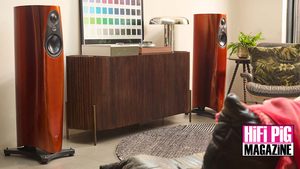

Pylon Audio Jade 20 Loudspeakers
PYLON AUDIO JADE 20 LOUDSPEAKERS REVIEW
Pylon Audio is a Polish loudspeaker manufacturer, and in this review, Janine Elliot takes a listen to their Jade 20 model costing £3745.
INTRODUCTION
If value for money was based on litres per pound, then the Jade 20 loudspeaker from Pylon would certainly come up trumps; a massive floor-standing 386 x 640 x 420 mm, 35 kg loudspeaker with 12” bass/mid and BMS compression driver at the top. Of course, I’m not swayed just on looks and size, but this Polish brand does make exceedingly good value products. I recently reviewed the similar-sized 3-way Indiana Utah 5, also Polish-owned, that came in even cheaper, again able to sit on the floor and angled up so that the tweeter hopes to point somewhere toward your ears. The £3,745 Jade 20, for review here, was supplied with their £695 screw-in wooden stand, taking it up another 217mm and raked at an angle of 4 degrees to get that tweeter a lot closer into ear-level.
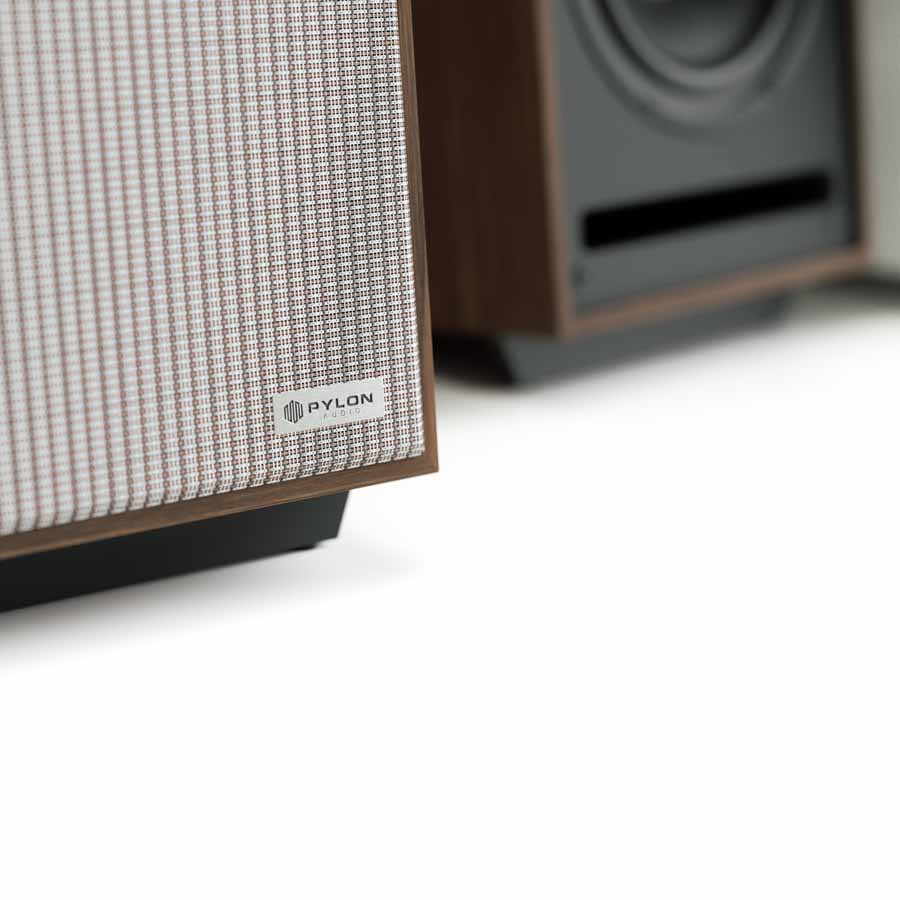
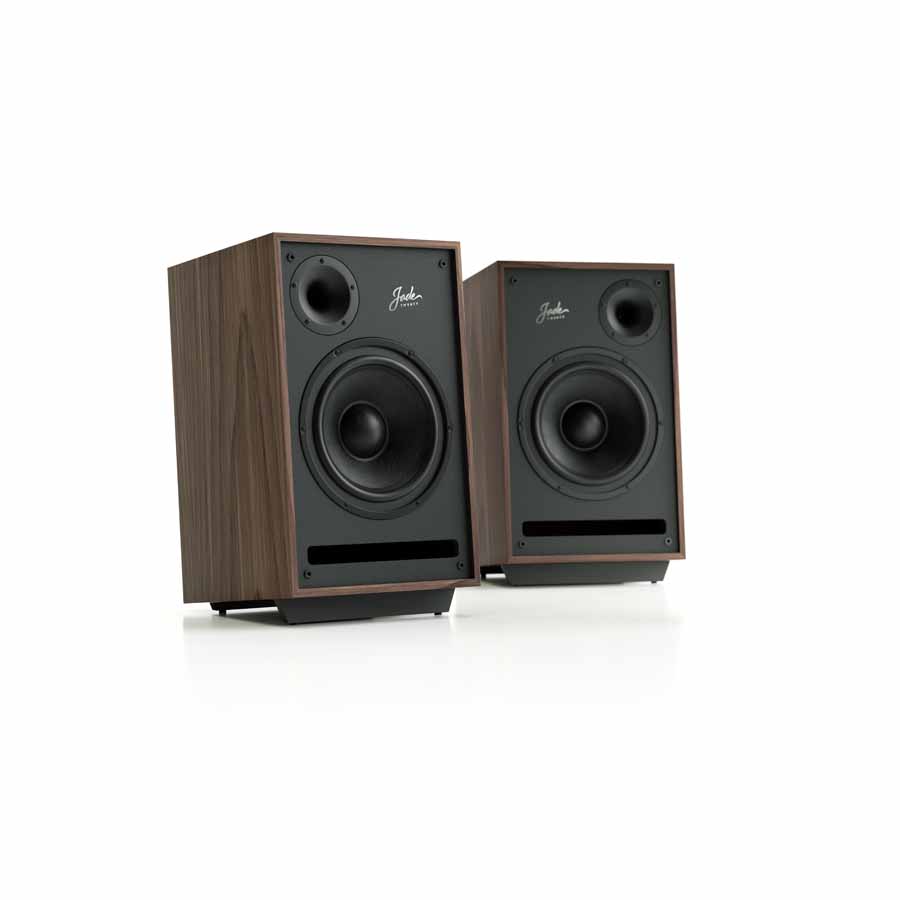
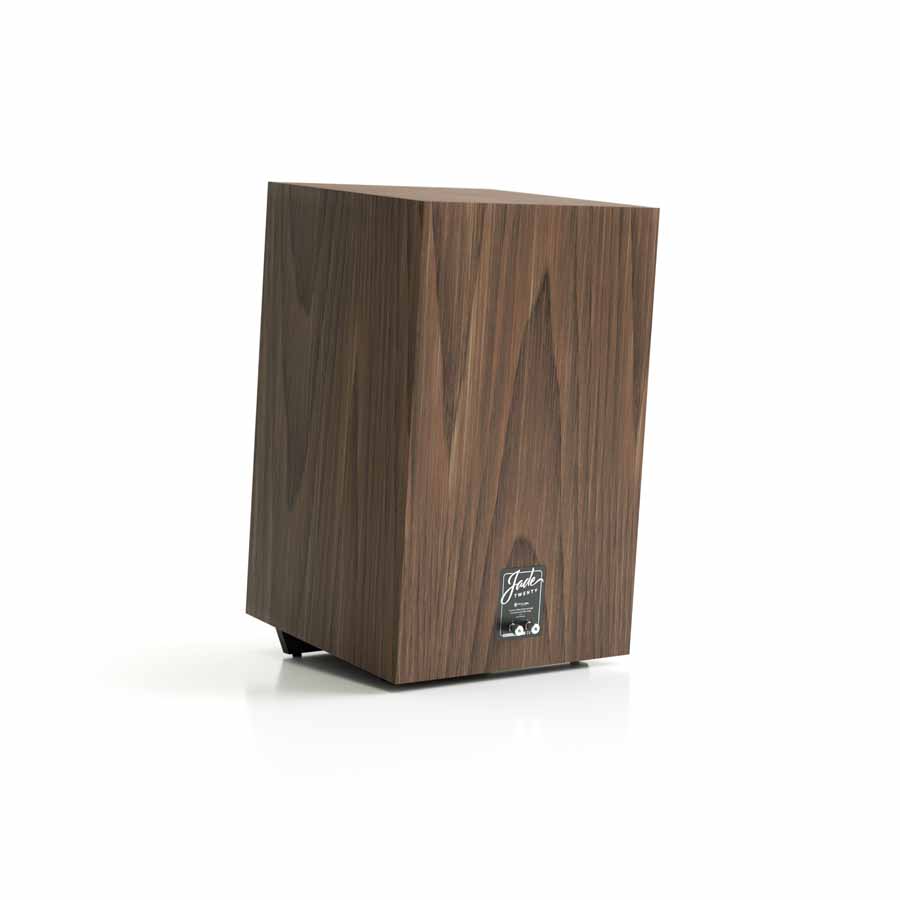
This is a really traditional-looking loudspeaker and certainly a statement, available in oil-wax-coated American Walnut, or Black American Walnut veneer. It also has a choice of two grilles, further adding to that 1970’s look that seems so popular these days. It all reminds me of the retro JBL, Wharfedale and Klipsch models. With the Jade 30 and 10 at either side – a 3-way floorstander and 2-way bookshelf respectively – they form an excellent value threesome, coming 3rd from the hierarchical top Jasper range. As well as speakers, they also make an “S” shaped (viewed from the sides) Obsidian t.3 HiFi stand.










Pylon was set up in May 2011 by two childhood friends, Mateusz and Mikołaj, who both had a great interest in music and technology from their youth. Plus, with Mateusz’s mother and Mikołaj’s father in the furniture industry, they would have the know-how to initially design good quality loudspeaker cabinets for other manufacturers, which they did, and which led them onto building their own-branded speaker systems later on. Indeed, the Jade 20 uses their own drivers (the tweeter a revision of a BMS unit), unlike, for example, the Jasper which uses Scan Speak units. Pylon is the largest Central European manufacturer of speakers and cabinets, selling particularly well in Asia.
BUILD AND FEATURES OF THE JADE 20
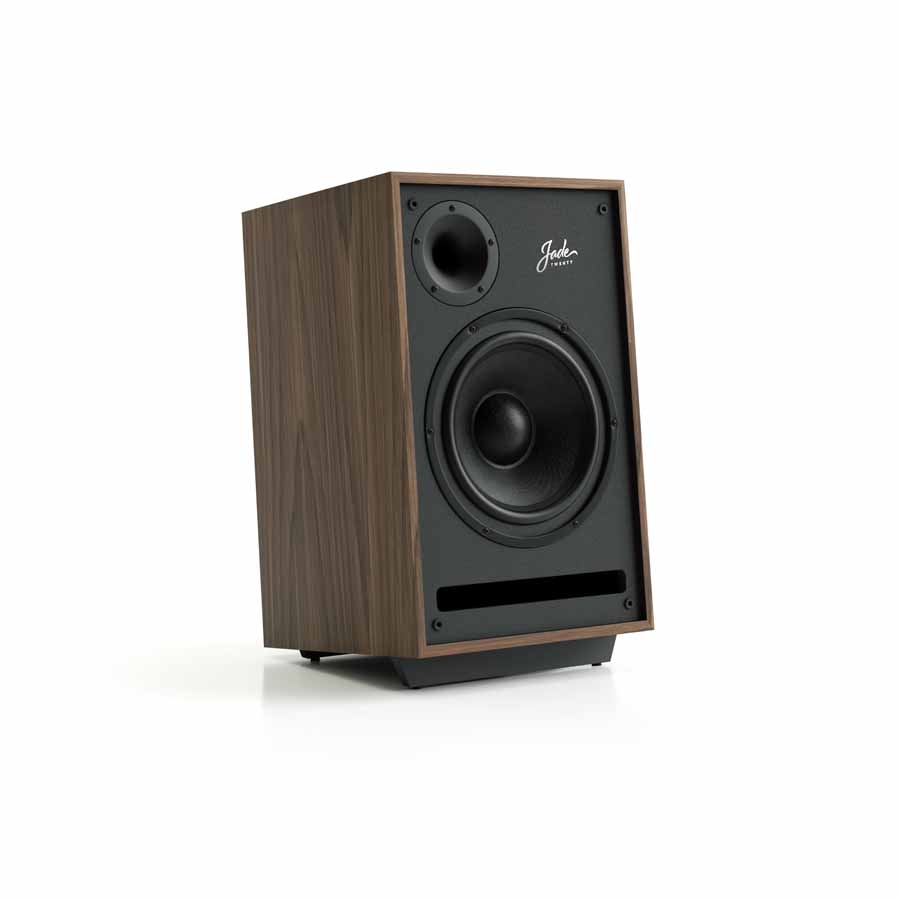
This is a very traditionally looking and designed loudspeaker constructed from durable MDF boards with additional bracing in all the critical areas to make it really rigid, and heavy, too. Weighing more than ½ my own weight, it is not the easiest speaker to move, but luckily I had a burly Nintronics staff member to deliver it to me. Its weight means, though, that it doesn’t move or add in any way to the sound from the drivers. Internal damping is natural sheep wool. Both the 12” bass/mid and tweeter are their own development; the former very retro with its cone made of paper, and the tweeter, a Pylon Audio PST 25PO.8, as used in the cheaper Jade 10, is a BMS 4550/8 compression driver set back in line with the woofer’s voice coil, via a short tube with a specially designed Tractix horn profile. The crossover point is very low at 1200Hz, with a 12dB/octave filter for the bass/mid exit and 18dB/oct for the tweeter entry. Whilst 1,200Hz might seem a low point for the crossover, it really works well, and bearing in mind the size of the driver, that chosen point is not a surprise. Being so big also means that it is very efficient at 91dB/1m (the more air you can shift, the louder it goes!) The loudspeaker has a long rectangular port at the front bottom of the speaker. This worked really well, with no frequency bumps in output pressure. Where the Jade 30 has a massive 15” bass driver, it also has a midrange, which I feel the Jade 20 should have possibly had, too.
SETUP AND USE
With an 8-ohm impedance and being high efficiency, this loudspeaker was very easy to drive by low-output valve amplifiers like my even-more retro-looking Leak Stereo 20, plus I could equally power it to annoy my neighbours from my 250W Krell solid-state power amp. Coming in matching pairs, setting the left and right speaker the correct way round so that the tweeter is at the extreme of the soundstage, I was able to get a good listening position and with them toed out slightly. These speakers, like the Utah 5, are designed to sit on the floor and angled up with the supplied front “foot”, but doing so would mean that the tweeter would not be getting to my ear-level unless placed at considerable distance from me. I was pleased, therefore, that the UK importers supplied it with the wood/aluminium frame unit, big enough for you to place small mono-block amps or your 1970’s HiFi magazines under each speaker, so I could get the correct height for the tweeters at 6ft away on my settee. The speaker is screwed into the stand. Surprisingly, the speaker is also classed as “bookshelf”. They must have big houses in Poland!









For the review I mostly used my Krell amplifier with vinyl via Manley Steelhead and reel-to-reel from my Ferrograph Logic 7.
The front fabric grilles are held in place by pegs. I found it very hard to move them on or off, mainly because the grilles are so heavy. I guess magnetically held grilles probably wouldn’t work due to the weight. For the review, the grilles were removed.
SOUND QUALITY
With such a large cabinet and 12” driver, the first music on the turntable was the excellent 5LP set of J. S. Bach’s 6 Cello Suites from Chasing the Dragon. These are solo works, but Schumann wrote piano accompaniments for them all later, though his wife Clara surprisingly destroyed them when he died. Luckily, the piano accompaniment for number 3 was rediscovered in 1986 and is here presented by Justin Pearson on cello, with Katherine Rockhill on an upright piano. Justin’s career has included being the cellist in some of Andrew Lloyd Webber’s shows, and his playing here really does convey command of the instrument. The bass extension from the speakers is as I would expect, and even the upright piano, whilst coming from behind the speakers, helps convey the mood of the music, supporting his playing. The mechanics of the cello bow and even Justin’s finger-work are very clear for all to hear, brilliantly mastered by Mike Valentine and his team. Whilst my smaller reference LS5/9’s gave more space and bite, the Jade 20’s gave more conviction from this bigger and much deeper brother of the violin.
Of course, bass would be easy to tick off in this review as satisfactory, but I really wanted to study the soundstage, that crossover-point, and the top end detail, especially with such a low crossover point. For that I chose Side 1 of Pink Floyd’s excellent ‘Division Bell’ double-LP. This album has a slow start and low piano notes plus atmosphere that the Jade performed with authority plus sensitivity. The bass and cymbal entry was also excellent, including a sensitive rhythm adding to the theatre. Indeed, the soundstage and depth from the speaker are very good, and “Cluster One” is a brilliant ambient track that sets the album off to a good start. Track 2, “What Do You Want from Me”, a Chicago Blues-type song, has an accurate and timely bass, but I felt the top-end just a little confused. The vocals from David Gilmour showed an excellent mid from the loudspeaker. Indeed, all vocals during my review were honest and gave a full sound. The guitars fully left and right in the next movement are similarly well mastered by the speaker. Only from high mids (3kHz and higher) did I feel just a little confusion at times.
Next on was a disc I used to check my turntable as a child, the Ortofon “Pickup Test Record of Signals and Music”. “Moppin and Boppin” (Pearia Jazzband) has great performance, including power from the double bass low down and clarity from the flutes and a piercing muted trumpet at the top and percussion that show off the loudspeaker at its best. Again, that top end lets it down just a tad, but this is quite a powerful performer for the price. That bass can be slightly too forward in a lot of the music, though playing the speaker at really low-level can conversely bring in a “hole” in lower frequencies. Shostakovich’s “Polka” from ‘The Bolt’ at good listening levels gives a great soundstage, and the high-pitched piccolo at the start certainly pulls its weight with the trombones and percussion, with the middle-section off-beat rhythms showing intently what Shostakovich wanted to put across in terms of intensity. All sections of this very short movement are given great authority by the speakers. Generally, louder music worked best, rather than in the quieter sections.
Initial transients are certainly very fast from the Jade, with the castanets in “The Hunters Purse” a case in point. Dire Straits “So Far Away” similarly showed off the initial waveforms from the percussion with great authority, matched by the guitar plucking. Mark Knopfler’s vocals are very clear and precise, and the trumpets announcing the start of “Your Latest Trick” similarly show the care Pylon have given into creating a loudspeaker that pulls its weight even more than its, err…. weight. This track is exceptionally clear and very musical. Only the ride cymbals seemed just a little recessed, unusually so due to the horn-loading. Detail just wasn’t quite as careful as I have heard with smaller drivers. That soundstage similarly didn’t quite cut the mustard in Kate Bush’s “Prelude” and “Prologue”. I normally sense great depth of soundstage with Kate’s voice separate from the piano, the child’s spoken voice and sound effects. The famous tom-tom entrance at 4’34” just wasn’t as authoritative as I have expected. Again, at very low level the bass is rather sucked out, but at sensibly good levels the speaker is a winner; it never sounded like a PA system as I expected when I first saw it. The bass is very controlled considering the size, and I can hear why the speaker needs to be this big. Surprisingly, it also fitted well into my pas très grand living room, too.
Sky’s “Hotta” track, with John Williams on guitar, plus his four band members, showed great strength, power and detail, something a really small bookshelf couldn’t do with as much authority. That percussion detail and strength was equally strong in Quentin Collins’ “Paxos/Antipaxos” on reel-to-reel.
Rimsky-Korsakov’s “Scheherazade – Final” (Chasing the Dragon, reel-to-reel) gave a larger sense of the soundstage and the depth of authority in the music than I normally expect, with an excellent positioning of all the instruments plus top frequency precision from the percussion.
The control on the balance of instrumentalists and vocal solo in Bizet’s “Carmen Habanera” was equally inspiring. Only the slight quandary over the top end slightly veiled the Beethoven “Moonlight Sonata” on a Bösendorfer piano recorded at Air Studios. It might perhaps have been more successful if it had been a brighter-sounding Steinway Model D, and during the review I did find the slight lack of top-end bite restricted my listening at times; however, the punch and attack of the music gave a really commanding listening experience.
QUIBBLES
Apart from a slight confusion in the mid frequencies on some of the complex music I played, and of course that the grille was a little tough putting on and off, it was a very enjoyable review to do.
CONCLUSION
If you want a loudspeaker system that gives you a concert-hall atmosphere and dynamism, then the Jade 20 will certainly get you engrossed in your music. It does, however, need sensible positioning in a fairly large room to pull it across, especially to get the clever tweeter to your eye-level. It certainly enabled me to listen to music and speech for serious lengths of time without any fatigue, even with its gripping bass extension. If you want something big in size and sound, but more petite in price, then these speakers would be well worth a listen. It also works well with amplifiers with smaller output power. Worth spending extra, though, on the stand to help get the best listening position.
I award the Jade 20 Five Hearts.
AT A GLANCE

Build Quality and Features:
Well braced and reinforced MDF frame with well-designed 12” bass/mid and 1” horn-loaded BMS tweeter
Internally damped with sheep’s wool
Sound Quality:
Excellent coverage in the important bass area, and with a carefully precise top end to hear those cymbals, too
Working best on louder music, it is trying to do what the 3-way Jade 30 offers, but with just two drivers
Value For Money:
This is an extremely good value loudspeaker if you want to show your neighbours that size really does matter
We Loved:
Dynamic and authoritative performance when the music needs to be
A full-on sound with tight top end
Excellent value for money
Great retro looks!
We Didn’t Love So Much:
That front grille might be an issue if you actually need to keep taking it off
Would like a little more top-end bite
Elevator Pitch Review: With twelve-inch bass/mid and horn tweeter, this pair of speakers is even heavier than me, and I expected to need a roadie and playing rock and disco music for a few weeks, but I was surprised just how well-mannered and fully-fledged the speakers were, on whatever genre of music I played. My only problem was just where I would put them.
Price: £3,745 (plus £695 for the stand)

Janine Elliot
SUPPLIED BY Nintronics <nintronics.co.uk>
SUPPLIED SPECIFICATIONS
Impedance: 8 Ohm
Frequency Response: 35-20,000Hz
Nominal power: 140W (max: 220W)
Efficiency: 91dB/m
Woofer: 12” Pylon Audio PSW 32.8 CS
Tweeter: 1” Pylon Audio PST 25PO.8
Dimensions (W/H/D): 386 / 640 / 420 mm
Weight: 35kg each
Suggested room size: 18 – 45 m2
Finishes: American Walnut/Black American Walnut