Pro-Ject Debut Reference 10 Turntable


























































PRO-JECT DEBUT REFERENCE 10 TURNTABLE
The Pro-Ject Debut Reference 10 turntable costs a single pound under a thousand, but comes with a ten-inch tonearm and a cartridge. Clearly aimed at vinyl lovers who want to get the best out of their liquorice pizzas without upsetting their bank balance too much, Janine Elliot gives this vinyl spinner a whirl.
I have always been impressed by Pro-Ject Audio. They began creating a range of cheaper-priced and great-looking turntables at a time when the world was focusing on CD players and the renaissance of vinyl hadn’t yet begun. They were so right, and their mountainous range of turntables has expanded more quickly than I can keep up with. Formed by Heinz Lichtenegger, this is an Austrian manufacturer that builds its products in the Czech Republic.
Starting with turntables in 1991, they added electrical products, such as phono-stages, headphone amplifiers and amplifiers from 2000, all made in Slovakia. Heinz’s wife Jozefina also began creating high-quality turntables herself at the same factory in Litovel under her own company EAT (European Audio Team), a company famous for 300B and KT88 vacuum tubes. Whilst those products are very high-end and many with massive 12” arms, Pro-Ject has similarly morphed into making better-looking and more sophisticated turntables in recent years, including the Signature 12.2 at £10,599, and coming up with special limited-edition turntables such as AC/DC and Pink Floyd inspired products in unusual shapes and with LEDs to attract appropriate vinyl lovers.
Their popular Debut range, introduced in the late 1990s, brings affordability and high performance together. The new Debut Reference 10 (a reference to the 10” arm) utilises a lot of technology from their top turntables, whilst keeping the price under control at £999, where less affluent audiophiles can still get a bite at the high-end.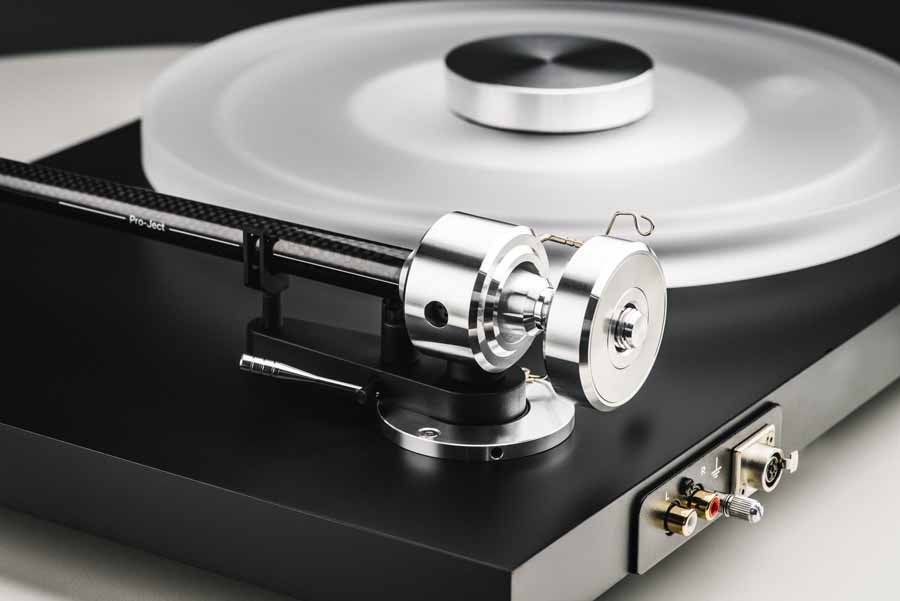
BUILD AND FEATURES OF THE PRO-JECT REFERENCE 10 TURNTABLE
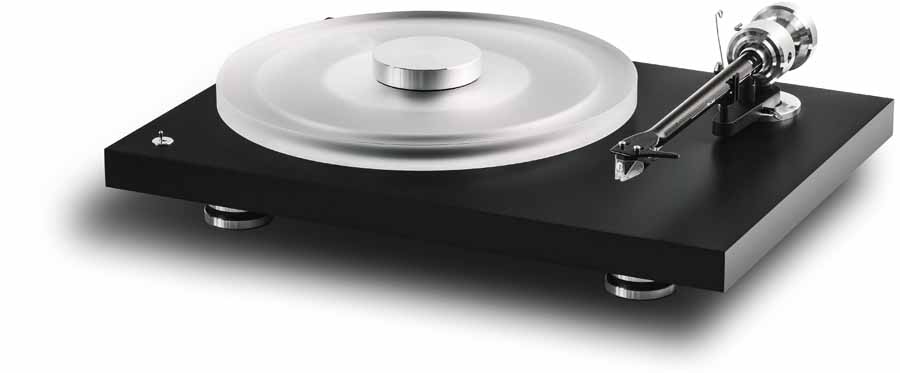
This turntable continues Pro-Ject’s trend of MDF plinths. Whilst I prefer the marble/slate base on my own turntable, it is considerably more expensive and heavier! MDF, if constructed correctly, though, is actually quite an adequate wood composite to use on a turntable, especially in terms of damping resonance, and certainly helps to keep that price down.
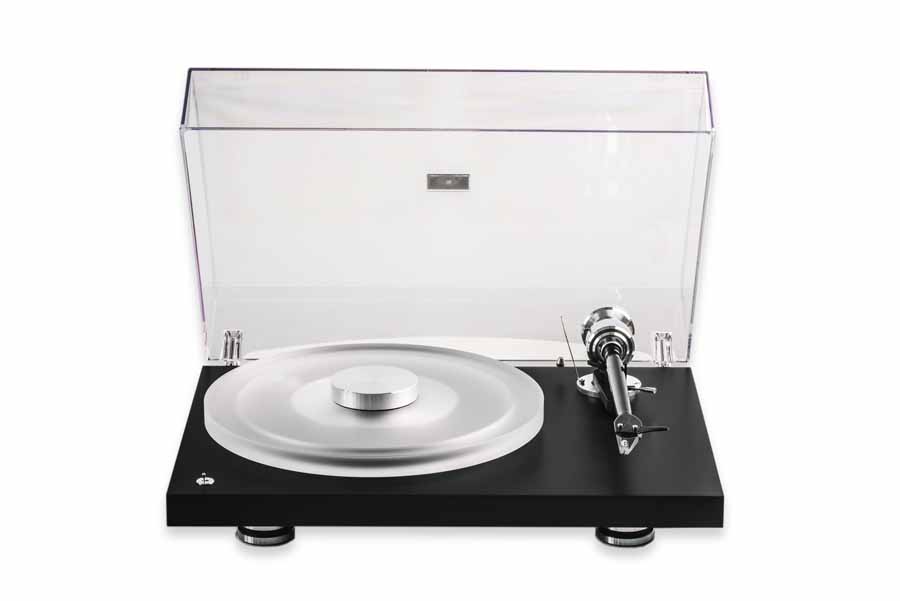
This example is hand-painted in black MDF and looks very smart. That is where the simplicity ends, though. This is quite a turntable for the price. It has an aluminium sub platter, made with diamond-cut precision to which the belt is fixed. Most lower-priced turntables tend to have plastic sub platters, including Pro-Ject and other respectable turntable manufacturers, and hence not so accurately rounded as this metal design. Above this is the lovely 300mm satin-finished acrylic resonance-free main platter that simply sits on top. Being quite weighty, there is no worry of movement out of sync with the sub platter below. For the review, the icing on this cake the review sample included a black felt disc to put your record on, but as this turntable features on websites (including their own) without it, I refrained from using it for most of the review. An aluminium puck goes on top of the record, it having a felt under-layer so that it doesn’t hurt your prized vinyl.
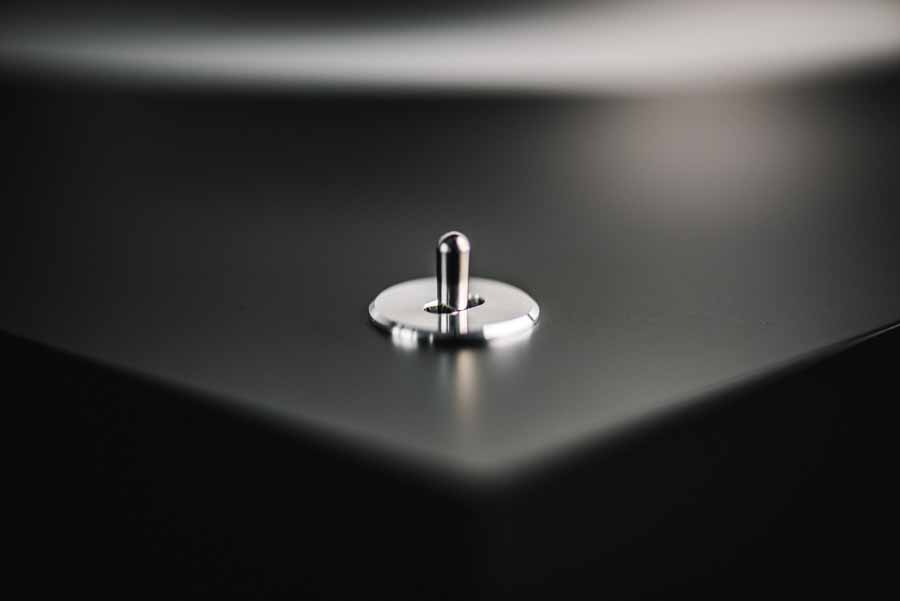
To turn on the record player, there is a 3-way toggle switch to the left of the platter, working 33/off/45. This is a minimalistic-looking deck, so there are no labels (including the name of the manufacturer) to help you operate it, but logically, slower is to the left and faster to the right. The electronic speed switching is very quick, getting the platter up to speed very quickly and the same stopping.
As well as the flat belt for 33/45, the unit comes with a round belt for 78rpm, though if you really want to play shellac discs, you will need a special stylus. The round belt fits around the lower and larger diameter pulley, and you switch the turntable to 45rpm. I didn’t bother with that for the review, but it might be a useful feature for some.
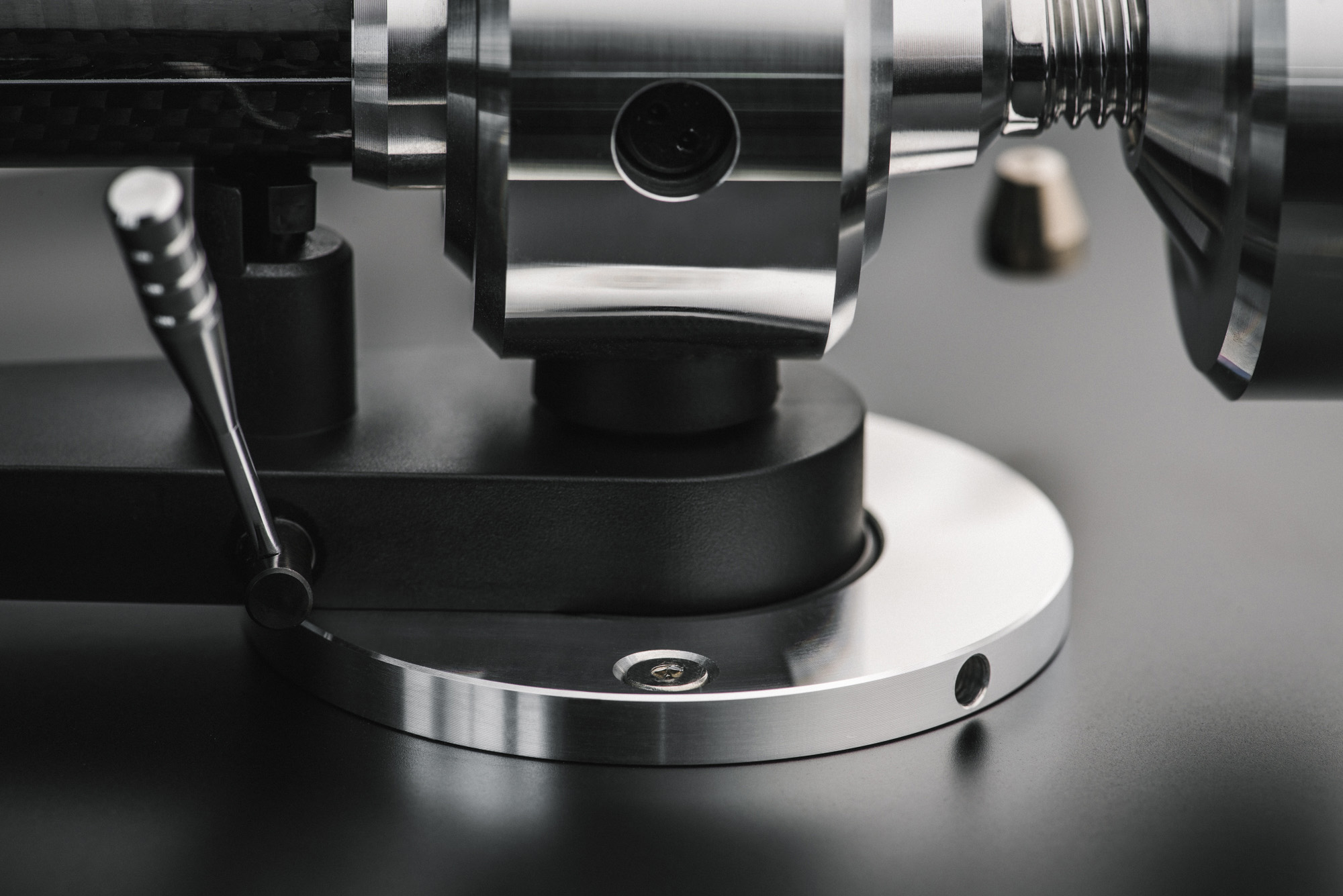
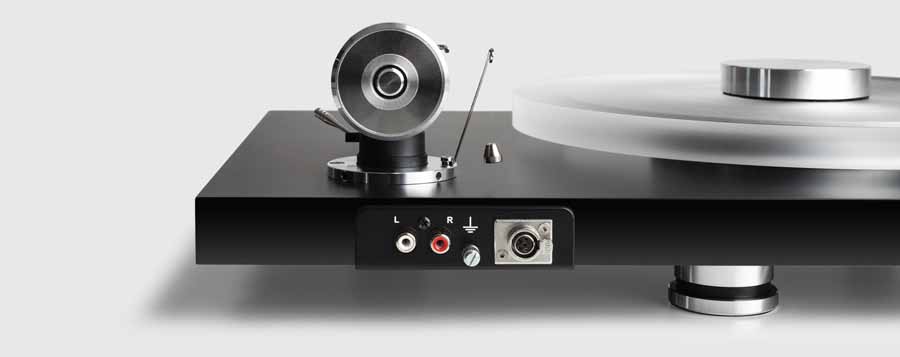
The arm is a significant part of the turntable’s design; a hybrid carbon/aluminium 10” beast that looks and works really well. Being longer than average means there is reduced inner-groove distortion due to the angle of the stylus to the groove changing at different positions on a record. Who says size doesn’t matter? It is a sandwich construction with carbon strength on the outside and aluminium inside to dissipate resonances before they get as far as the cartridge. With fishing-line type anti-skate and a new bearing block design plus a TPE-damped aluminium counterweight, setting up your cartridge is a doddle via the enclosed set-up manual.
The supplied (and readily installed) cartridge is their own (well, Ortofon really) “Pick It Pro Balanced” MM cartridge. Based on the Pro, the Balanced version is, yes, balanced. Output from the deck is balanced if you buy the appropriate mini XLR lead and connect it to one of their, or other, balanced phono-stages. Next to that connecting point at the rear are 2 RCA sockets plus a grounding link, and they even supply a nice-looking cable for you to use in case you haven’t spent lots of Korunas on your own. I am really glad that they didn’t just connect the cartridge output straight to an attached lead to connect to your phono-stage input. This deck really is made for the audiophile.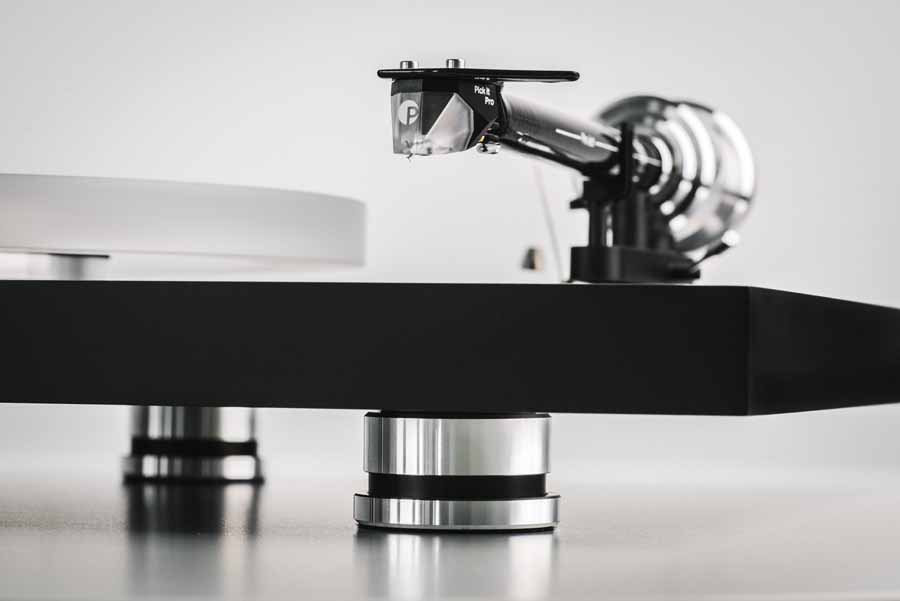
SETUP AND USE
If you need to adjust tonearm VTA (Vertical Tracking Angle) or azimuth (the angle of the arm and thus the stylus onto the record), you can. Adjusting VTA is very useful if you, like I, add special mats onto the platter to improve the sound, and it is done via two small grub screws at the base of the arm. The arm needs to be parallel to the platter. 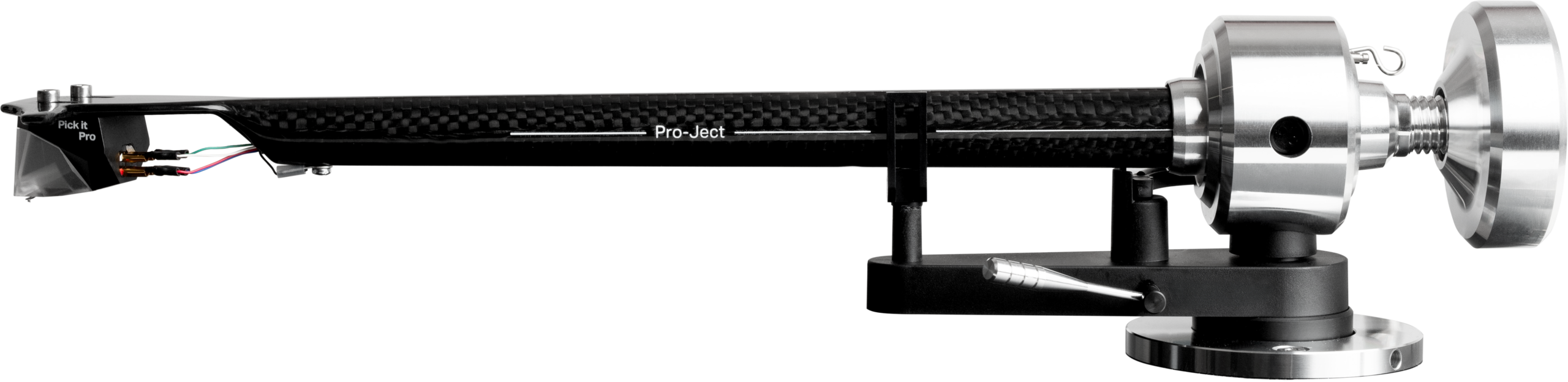
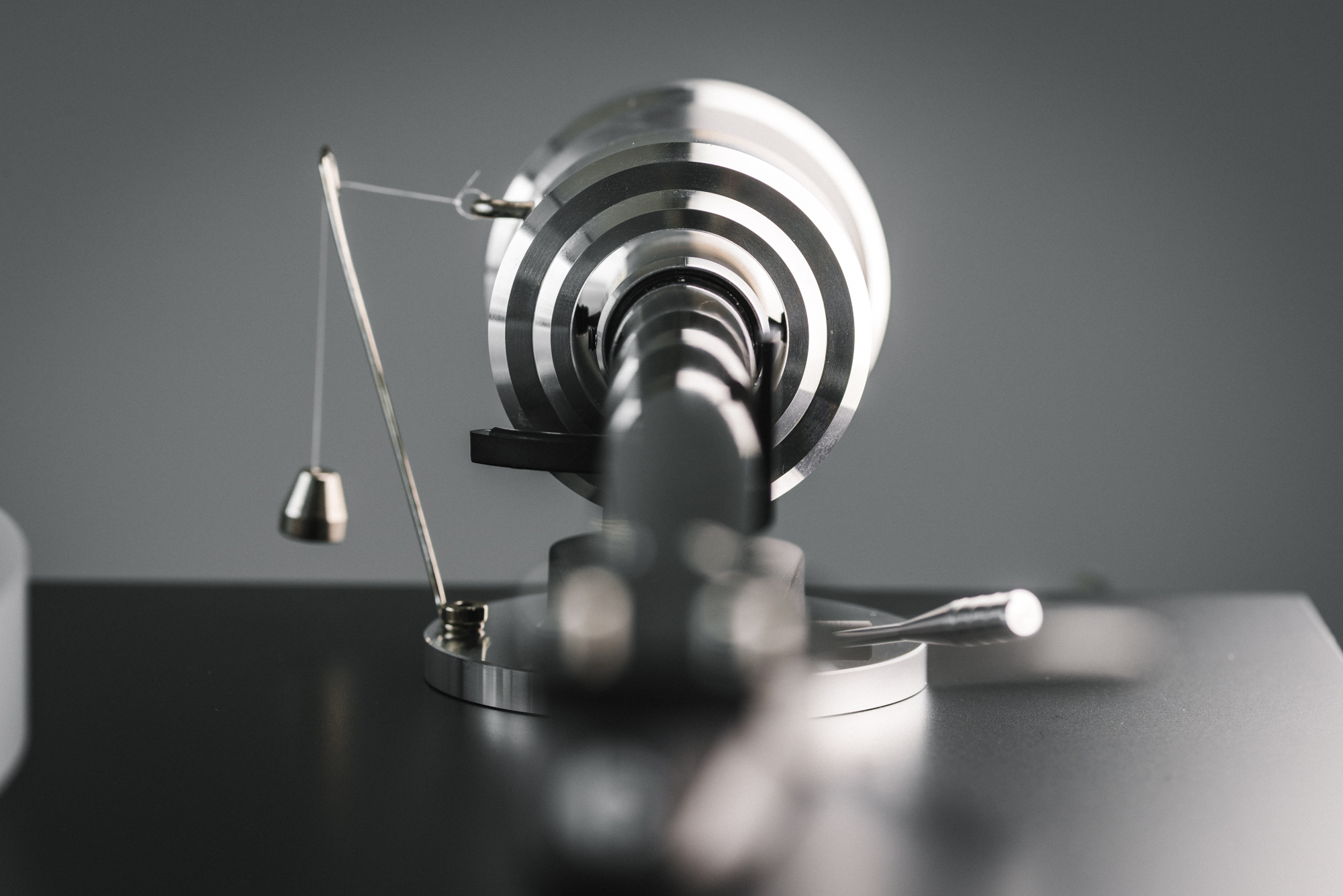
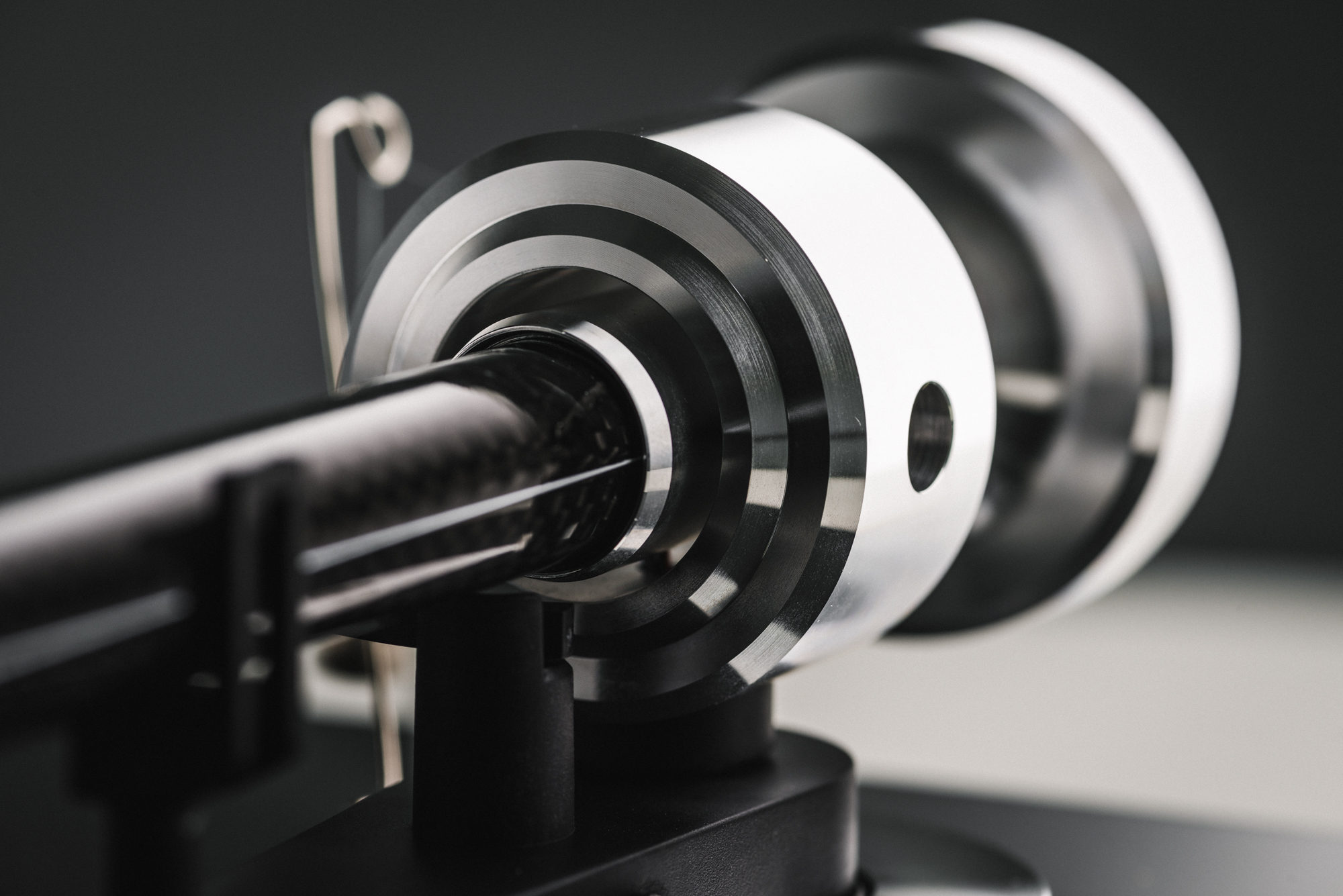
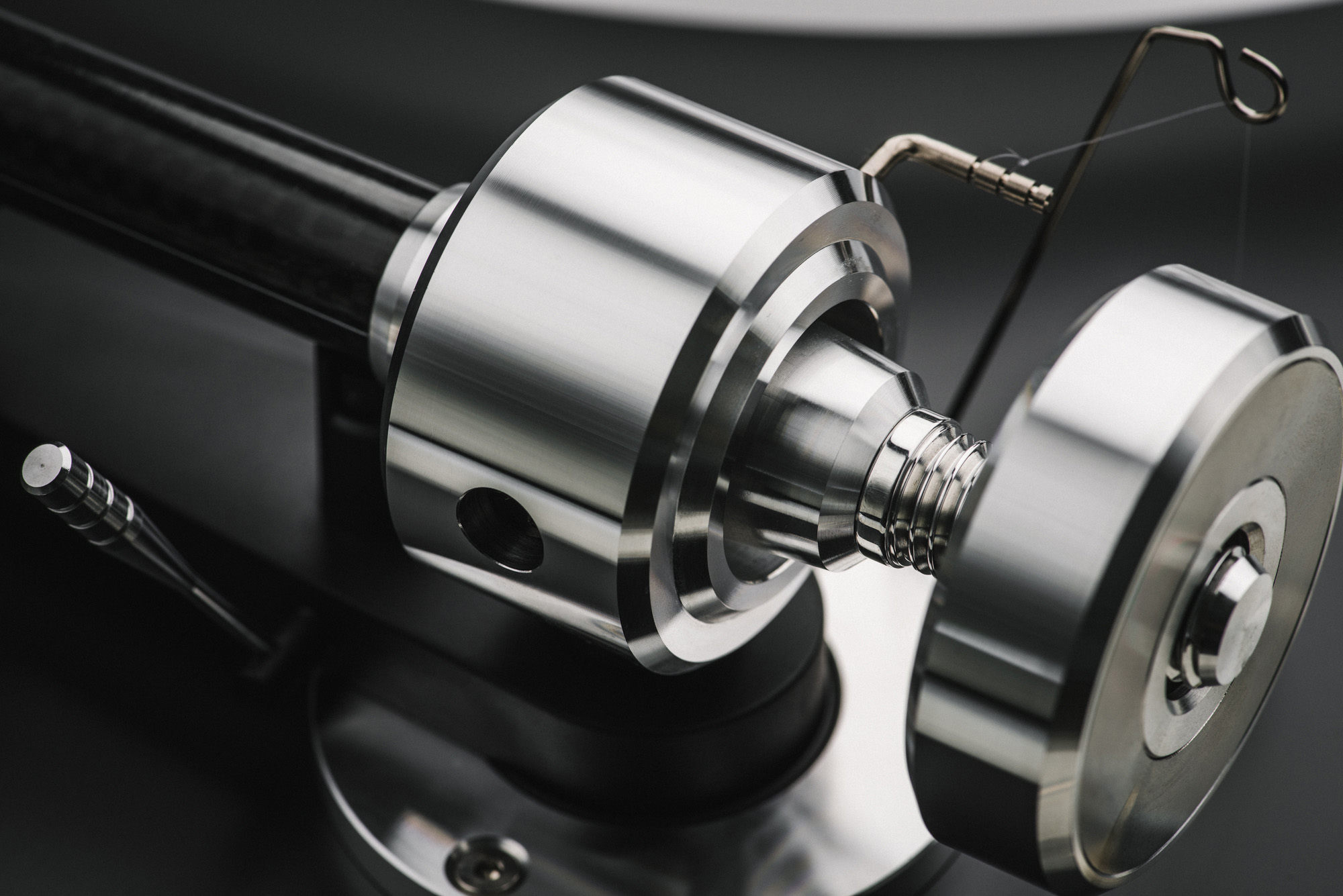
For setting up the cartridge tracking weight, the turntable comes complete with a plastic weighing gauge; this is basically a length of plastic with legs underneath, not quite at the centre point, that, with its inbuilt weight at one end, requires you to lower the stylus onto an indented marking and change the counterweight until it balances level. Very clever device, but I still went to my old 1970’s BIB weighing machine as that was a little less fiddly. The accompanying instructions don’t tell you if the cartridge is a Moving Magnet, let alone the correct weight for it (1.8-2.2g). I set it up at the recommended tracking force of 2g. The cartridge has an elliptical diamond stylus, and needs the usual 47kohm resistance loading and recommended load capacitance of 150-300pF. The supplied illustrative instruction pamphlet for setting up the turntable is actually very good, though it lacks the details that I would like to have seen; luckily, there is a link to the complete manual that you can download if you so wish. Interestingly, the supplied manual and photos do not refer to the supplied felt slip mat, and setting up the weight of the arm does so without the mat in place, which would slightly affect the numbers if you used it, let alone change the stylus angle slightly (though you can of course adjust VTA).
Whatever, the turntable, complete with tidy acrylic dust cover, looks absolutely gorgeous set up in my music room, and the supplied Connect It Phono E RCA cable is of very good quality. 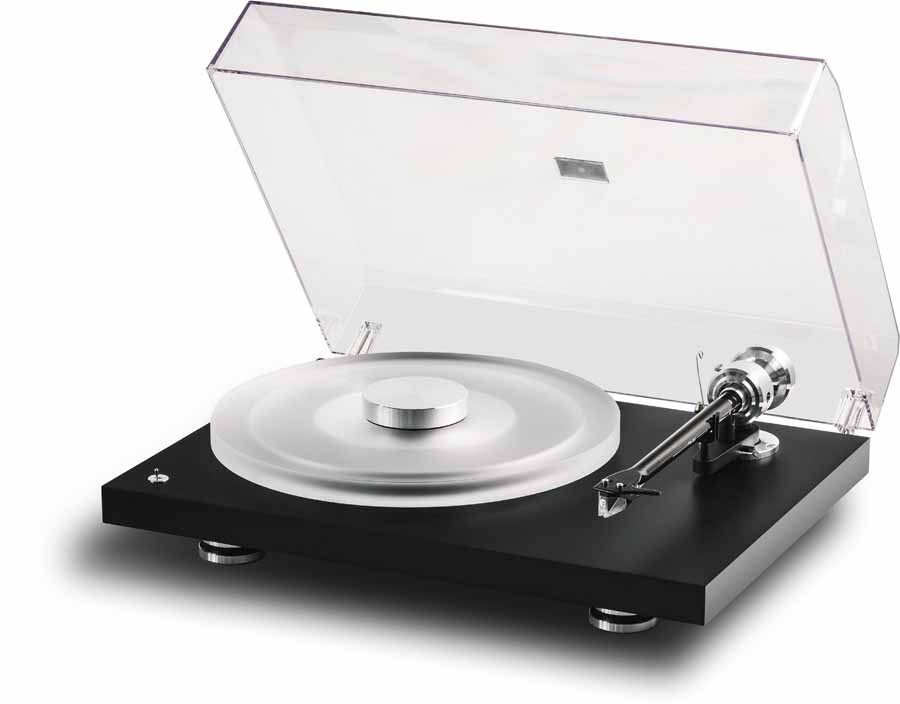
The turntable sits on 3 adjustable damped aluminium feet, which allowed me to balance the deck perfectly with my spirit level (pity there isn’t a spirit level sunk into the turntable plinth). The turntable arrives with a 15V DC wall-wart power connector and several plug options for different countries. Pro-Ject offers better power supplies if you wish to go up a gear in performance. Setting up the turntable is really simple, and probably took me just 10 minutes, including the arm balancing, and that was with a bad back!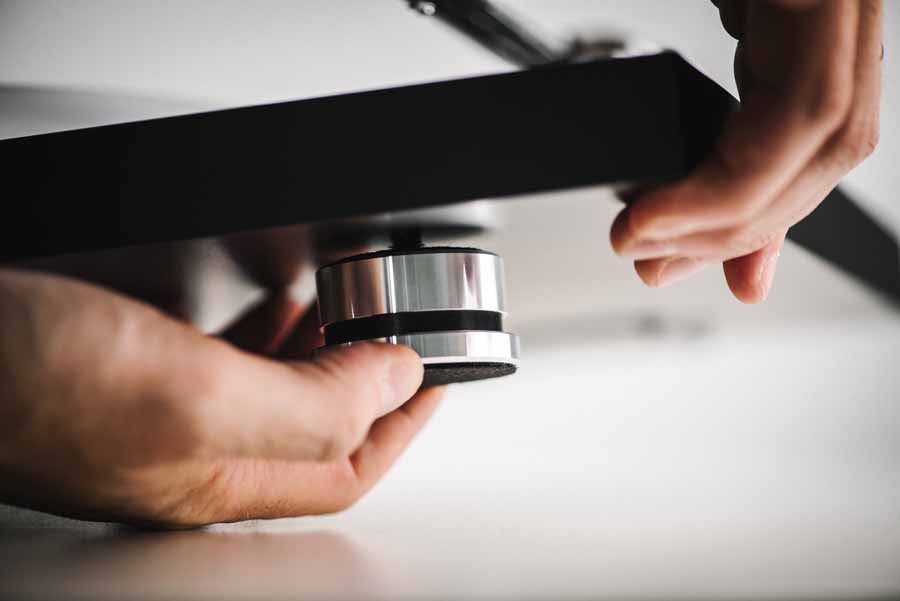
I was immediately impressed with the performance of the Reference 10 from my first playing; this is a very quiet turntable, and the metal toggle start control gets the turntable up to speed very quickly. The arm is a pleasure to use, kept in its rest position with magnetic attraction, like much of Pro-Ject and EAT turntables. I still, however, prefer the mechanical arm clips found in Rega tonearms.
SOUND QUALITY
The first track placed on the turntable was Katie Melua’s “Golden Record”, which has plenty of energy and both great bass and high frequencies from cymbals. This opening track from the album ‘Love and Money’ begins with unusual and intentional rhythmical scratching noises right from the start, which could be confused with scratches on a bad record, and many turntables and cartridges fail to understand this sound design. The Reference 10 and MM cartridge actually gave quite a good account, making it sound part of the music rather than interference. In this review, I did comparisons of the same music with my expensive Pre-Audio/Ortofon set-up to use as a reference and for my own personal interest. This album sounded less urgent and edgy from my own reference deck, but the Reference 10 gave a clear account of “14 Windows”, with tight cymbals and realistic acoustic guitars. The detail in “Lie in the Heat” is not only very precise and well placed, but it also contrasts well with the laid-back voice of Katie. Only the extreme bass in “Darling Star” wasn’t as well controlled as from my own turntable.
The excellent vocals were also apparent in Clare Teal’s ‘A Tribute to Ella Fitzgerald”, an album that also brings in powerful brass, woodwind, piano and drums into the foray. This brilliantly engineered recording (and I was there when it was produced) made me able to play around with capacitive load, ending up setting my phono-stage to 300pF, to get the best sound. “Night and Day” has some loud, deep drum rhythms which the turntable performed much better and tighter, than I expected at this price point. “Anything Goes” gave a credible performance in the lower frequencies, and with the piano playing, I totally forgot about any hints of wow or flutter (piano music on my cheap cassette portables as a child was excruciatingly painful; a great instrument to check out wow and flutter). This is a very solid performer, with wow and flutter at a reasonable 0.16% for 33rpm records. Only “That Old Black Magic” didn’t sound quite tight enough.
Art Blakey and the Jazz Messengers’ 1959 album ‘Moanin’” is a brilliantly performed and energetic album from the great percussionist. This album really is full-on, and turntables need to be good to make the album really come to life in a realistic and musical way. Recorded in the old-fashioned technique of piano left and drums right, the turntable was able to position these, plus the trumpet, sax and bass precisely, though much more forward and slightly recessed than my own turntable does. The title track has a clever trumpet line on the left plus sax and drums on the right, all with energetic playing that some turntables just can’t make human enough. Whilst the Reference 10 gave an admirable performance here, I (as a sound engineer) was rather disappointed at the mic’ing of the instrument. As the sound was more forward than my own turntable/arm, it made the music more tense than I expected. Don’t get me wrong, this has an excellent £199 MM cartridge on board, so it gives a very able performance with the arm, but the trumpet here can get rather excited and would alarm any stylus travelling alone in the grooves. The saxophone is set behind the other instruments on the right, giving a very good 3D soundstage, and the double bass is well captured, though the precision of the finger-work isn’t quite so apparent as on my own turntable. The precision walking bass-line on “Are You Real” is carefully directed by the turntable so that you can hear the beauty of the improvisation of these brilliant performers.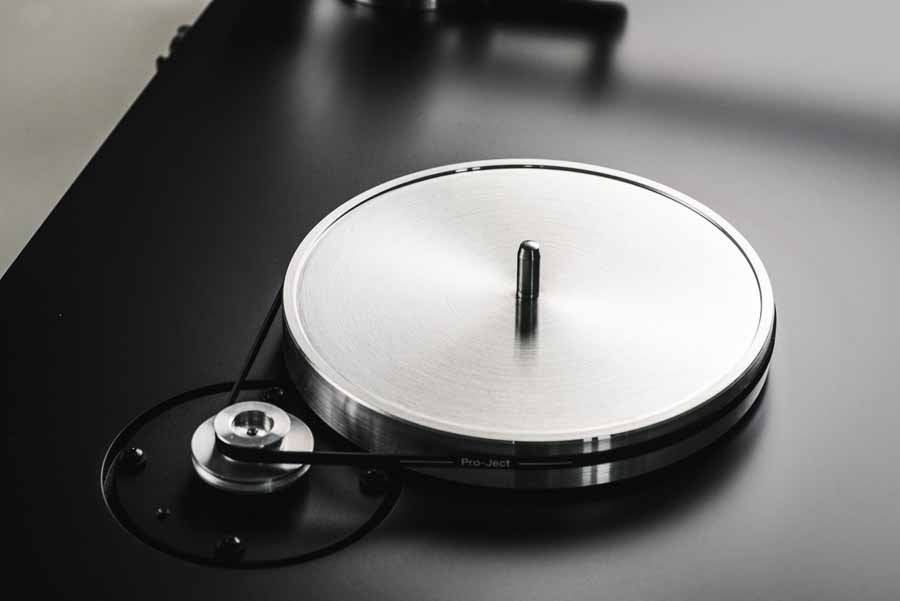
QUIBBLES
This is a superbly engineered turntable, and so it is not easy to find fault with anything. I just think they should shout out its excellent statistics on the setup pamphlet.
CONCLUSION
Choosing a Pro-Ject turntable is never easy, as there are so many ranges and models within those ranges, but the Debut range is always a good point to debut high-end performance at low-end prices.
A belt-driven turntable with a carbon 10” arm and built-in cartridge for under a £1000 is a great feat of finance, let alone engineering. This is a solid performer that really does give its best, and worthily deserves five hearts.
Complete with a balanced cartridge made with the help of Ortofon, plus a balanced output if you can accommodate that, this is a great turntable for the burgeoning audiophile whose pocket isn’t quite as deep as their audio expectations.
AT A GLANCE

Build Quality and Features:
Solidly built with great looks (especially the carbon/aluminium arm) and easy to set up
Clever arm balancing widget
Sound Quality:
A solid performer across all music genres
Tidy and controlled
Value For Money:
A down-to-earth turntable for the serious vinyl lover who doesn’t want to spend the earth. With a carbon arm and balanced MM cartridge, this is a great value ensemble
We Loved:
Rhythmically secure performance
Excellent arm
Balanced output
Great looks
Good value for money
Very quiet in operation for the price
We Didn’t Love So Much:
Nothing at this price
Elevator Pitch Review:
Pro-Ject were clever enough to think of creating great value turntables when everyone else was preoccupied with CDs. They foresaw the renaissance of records and have delivered to the world a vast offering of turntables (and now electronics) over the years. Choosing a Pro-Ject turntable takes time, with there being so many, but luckily, the Debut range is a great collection of spinners worth starting your search. Designed for the audiophile on a budget, and all featuring carbon fibre tonearms that are both light and strong, the Reference 10 is at the pinnacle of this range with a massive 10” arm and balanced MM cartridge and mini XLR output if you want a balanced life. For £999, this is great value for money, but was the sound as equally impressive? It sure was.
Price: £999
Janine Elliot
SUPPLIED SPECIFICATIONS
TurntableSpeed: 33, 45/(78) (electronic speed change) Drive principle: belt drive with electronic speed control Platter: 300mm acrylic Platter bearing: high precision stainless steel axle in bronze bushing Wow & flutter: 33: +/-0.16%; 45: +/-0.14% Speed drift: 33: +/-0.4%; 45: +/-0.5% Signal to noise: 68dB Tonearm: 10” one-piece carbon-aluminium tonearm Effective arm length/mass: 254 mm / 16,6 g Overhang: 16mm Included accessories: 15V DC / 0,8A power supply, dust cover, 78 RPM round belt, 7‘‘ single adapter Power consumption: 4W / 0W standby Dimensions: 462 x 145 x 345mm (WxHxD) Weight: 6 kg net
CartridgeCartridge Principle: MM (Moving-Magnet) Output Voltage at 1 kHz: 4 mV Channel Separation at 1 kHz: 22 dB Tracking Ability at 315Hz: 70 μm Frequency Response: 20 – 20 000 Hz +/- 2dB Stylus Type: Elliptical Stylus Tip Radius: r/R 8/18 μm Tracking Force, Range: 1,8 – 2,2 g (mN) Tracking Force, Recommended: 2,0 g (mN) Tracking Angle: 20° Internal Impedance, DC Resistance: 750 Ohm Internal Inductance: 450mH Recommended Load Resistance: 47kOhm Recommended Load Capacitance: 150-300pF Cartridge Weight: 7,2 g