
Orchard Audio Starkrimson Mono Ultro-Premium LPS GaN Power Amplifier
ORCHARD AUDIO STARKRIMSON MONO ULTRA-PREMIUM LPS GaN POWER AMPLIFIER REVIEW
I recently reviewed a gallium nitride (GaN) amplifier from ArgentPur, also originating from the USA. This is a relatively new technology. Just as valve and now silicon transistor technology is getting a bit long in the tooth, new technology is always welcome, as we have seen over the last few decades with EV cars. The benefits of GaN-FET amplifiers will please any eco-fan: low power consumption, low heat, smaller boxes, and audiophiles will love the faster speed, the greater transparency and the incredibly low noise. However, things are never quite that simple, as musicality should ultimately be the biggest target for any designer or purchaser. Leonid (Leo) Ayzenshtat created Orchard Audio in 2017, having had a lifelong passion for electronics and all things audio. Before founding the company, he trained and worked as an electrical engineer, earning a BS and MS in Electrical and Computer Engineering from New York Institute of Technology and applying that knowledge in various industry roles. After designing an audio system for his home, visitors’ approval of the sound pushed him to turn his hobby into a business. “When I started Orchard Audio in 2017, it was a side project that grew steadily alongside my day job. I continued working a full-time 9-to-5 while building the business until the company reached the point where it required my full attention; I transitioned to running Orchard Audio full time in February 2024”. The names “Orchard Audio” and “Starkrimson” are derived from his love of apples and orchards, as he told me; “All Orchard Audio products are named after things that grow in orchards to reflect that inspiration and a simple, organic naming theme.” The Starkrimson name has a clever double-meaning, as it is named after a variety of pear with a dark-crimson red skin, and you will need a “pair” of them to make up your stereo! Clever! With faith in new design techniques, and in keeping with da Vinci’s philosophy of simplicity being the ultimate sophistication, his products explore new avenues in audio design on the road to the future. Whilst the sound is pivotal, Leo says, “I believe that all aspects of sound quality can be measured. Hence, R&D efforts are focused on getting the best possible objective measurements. This will yield great subjective results”. Those results are evident in the specification pages on the company website.
Going, going, GaN…










With GaN-FET amplifiers, a streamer, an RCA to XLR add-on (more on that later) and cables, Orchard Audio is certainly growing big shoots in creating clever designs at small prices. The Starkrimson Mono Ultra-Premium LPS is a limited-production version of the standard model, finished in silver, with just 100 pairs being produced. Where the normal monoblock is $2,774.95 each (UK £4,599/pair), the LPS version is $900 greater at $3,674.95.
THE TECHNOLOGY
A growing number of companies are now introducing GaN semiconductor designs, seeing that small boxes and low power consumption are desirable qualities. Working at around 94% efficiency, unlike my power-thirsty Class-A amps, GaN-FET switching amplifiers operate at much higher PWM (Pulse-Width Modulation) frequency (switching speeds) than conventional Class-D amplifiers do, and have short dead time. In basic terms, this means that the square waves at the switching node are actually even squarer, hence giving a purer, more accurate sound. With the switching speed of GaN at 10-20 times higher than silicon (the Starkrimson is 0.8 MHz; standard silicon MOSFETs can be as low as 200 kHz), one can have a much more benign low-pass filter and much lower EMI. GaN-FETs have incredibly low Qrr (reverse recovery charge); in Class-D amplifiers, the switch between an “on” and “off” of the transistor pair (and why some incorrectly refer to Class D as Digital!) means the associated diode pair needs to discharge quickly before the other half switches on, and this can cause noise. GaN-FETs have zero or almost zero Qrr, and hence much lower noise. It is no wonder, therefore, that the advantages of GaN-FET technology are now being taken up by companies such as AGD, ArgentPur, Filtronic, iBasso, Peachtree and Texas Instruments. The use of GaN-FETs ultimately leads to smaller components, improved efficiency, reduced switching losses, and higher power density. Some even sense GaN amplifiers sound more like valve and Class-A amplifiers. As Orchard Audio’s website states, “Class A sound with no heat”. Finally, with GaN designs the circuitry requires less feedback, so the open-loop performance is increased.
BUILD AND FEATURES OF STARKRIMSON MONO ULTRA PREMIUM LPS POWER AMP
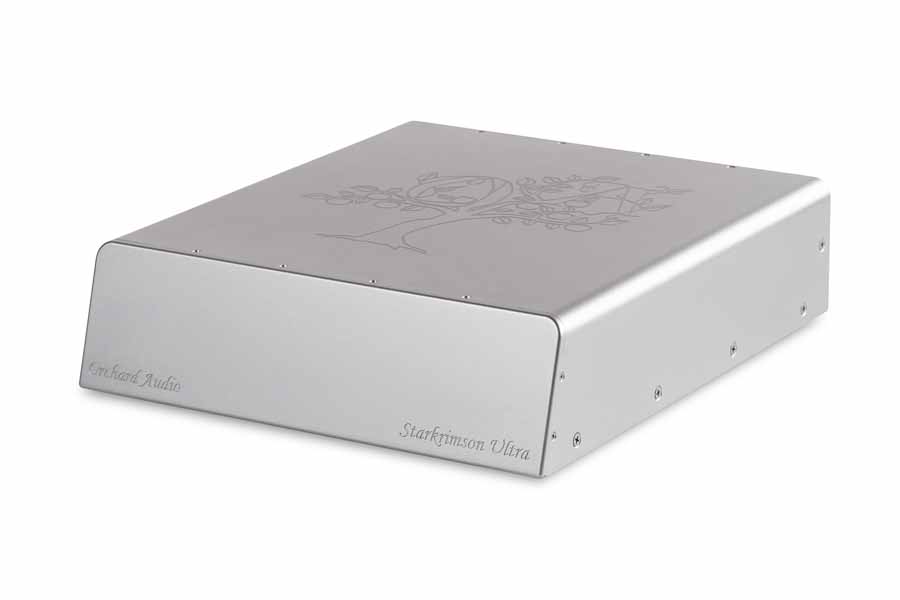
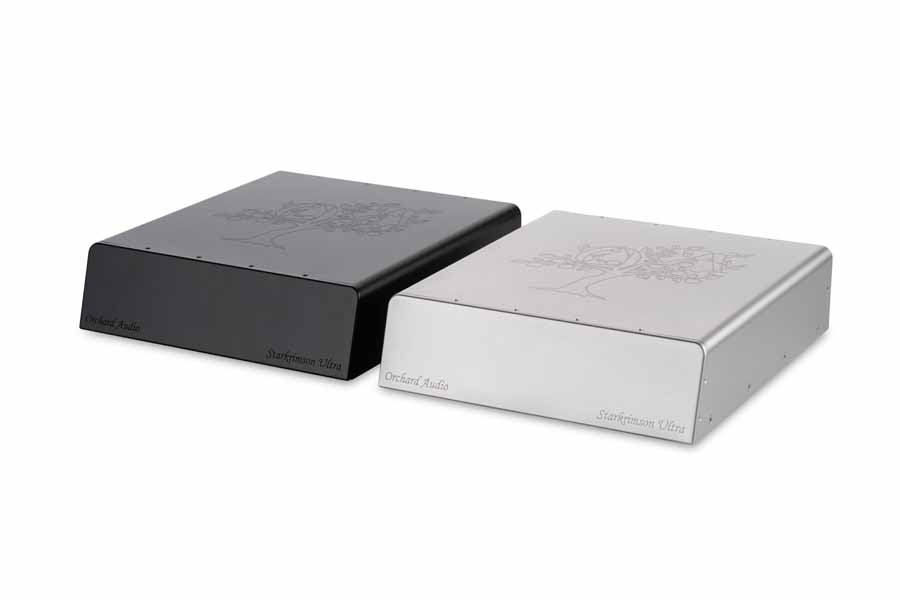
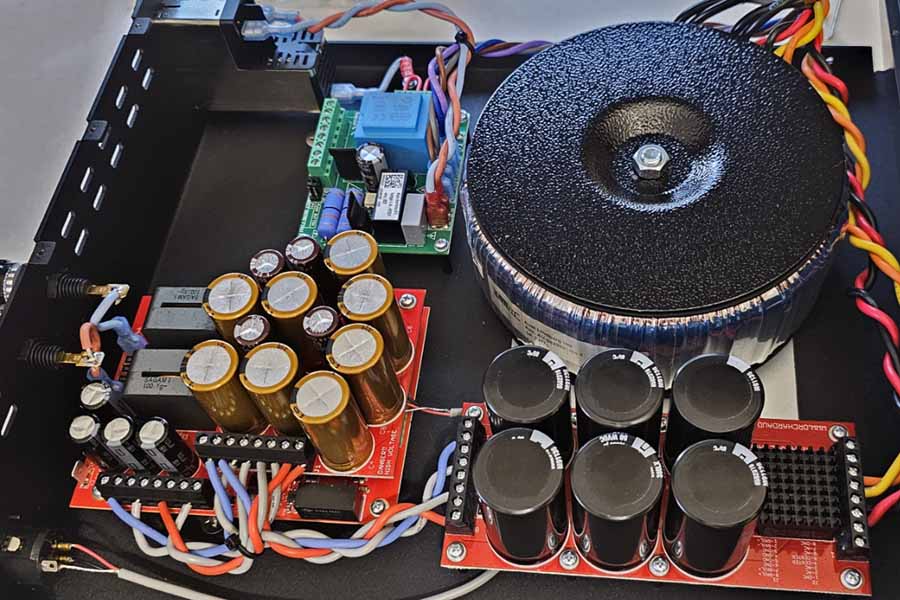
My instant thoughts on picking up the amplifier were not just how big it was, but also how heavy, largely due to the toroidal power supply (the LPS version is 25 lb; the standard SMPS version 13 lb). Whilst the Starkrimson dual feedback architecture monoblocks are low in power consumption, they are certainly not small. Unlike the 25 monoblocks or the Stereo Ultra DMC 2.5, which can fit on a single HiFi stack, the Ultra-Premium will need two shelves with its dimensions set at 12.2ʺ × 13.9ʺ × 4.75ʺ. This is a very sturdy minimalist design with a sloping-fronted brushed aluminium fascia. Where the normal UP is in black (or silver on request) the LPS version is only available in silver. Inside is a set of modules, that can be purchased separately, like products from Hypex (also famed for Class-D) should you wish to build your own. The 500 W (4-ohm) unit is so minimalist that there isn’t even a light on the front to let you know when you have switched it on. Indeed, it is so efficient that it only uses trickles of electricity compared with my greedy Krell. Leo suggests just leaving it on all the time, though I would recommend turning down your preamp volume control when not listening! Where the (lighter weight) non-LPS Ultra uses a 1,200 W switch-mode power supply (SMPS) and has 43,600 µF capacitor reservoir, the LPS version employs a linear power supply built around a toroidal transformer and is rated at 1,000 VA. It does have a much larger capacitor reservoir at 133,600 µF and so will easily drive any loudspeaker even below 2 ohms. There is a known issue with SMPS capacitance, whereby the supply can become unstable or behave poorly if the reserves are low, but the LPS version having over three times the reservoir will negate those concerns. This can also significantly improve the bass end and transient response. Indeed, the LPS has a massive damping factor of over 700. In basic terms, under heavy bass transients a small reservoir will deplete quickly meaning the output stage struggles to keep a tight control. Larger reserves hold more charge, so the voltage won’t sag. Be warned, though, the loudspeaker terminals can offer up to 80V and due to the bridged-amplifier design they consequently can get hot. Also, don’t unplug these terminals whilst switched on. Not that you ever should.








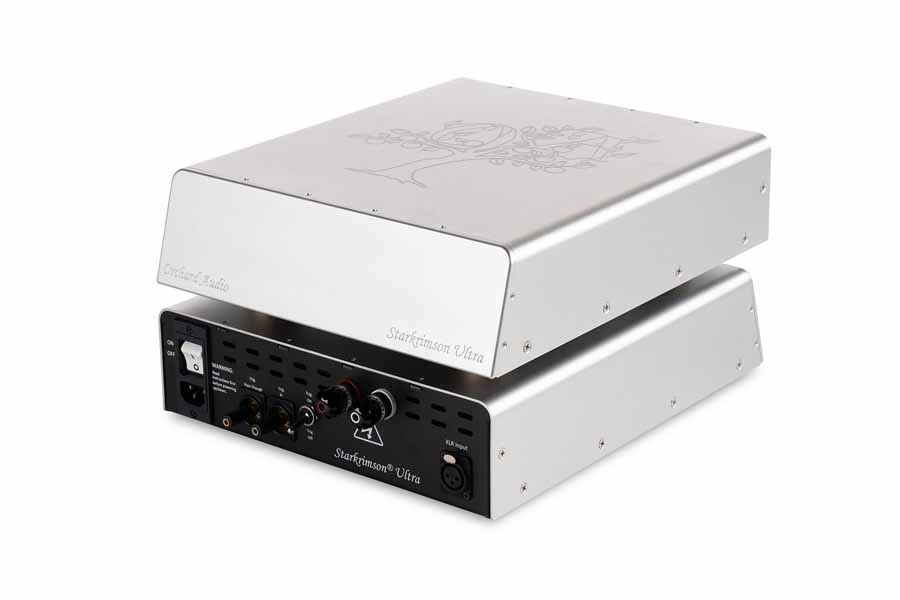
The rear of the Starkrimson is where all the important bits are. There is a single pair (pear?) of good quality speaker terminals and only a single balanced XLR input. The amplifier is balanced from from input to output, so if you want to connect unbalanced RCA from your preamp, then you can add the Orchard Audio RCA to XLR converter, available for $349.95 to be placed between both. There are also a pair of 12V trigger sockets (RCA, though my sample comes with RCA-to-3.5mm adaptors) and the associated deployment on/off switch should you dare to want to turn off both the amplifiers simultaneously between use.
SETUP AND USE
Setup was very easy; I connected Nordost XLRs between my passive MFA preamp and connected Esprit Celesta cables to my Wilson Benesch Arc or Graham Audio LS5/9 speakers. Sources were Qobuz digital via Bluesound streamer, vinyl and reel-to-reel using Tellurium Q cables.
SOUND QUALITY
I did expect lower bass to be slightly recessed with GaN-FETs, but actually the frequency response was very flat from bottom to top, though the 250 W (8-ohm) output wasn’t quite as grand as my power-thirsty Class-A Krell. Hardly unexpected, even with both using toroidals. With the name Starkrimson of course my first listening choice was King Crimson and “21st Century Schizoid Man” from *In the Court of the Crimson King*. Their music always has plenty of power and intensity somewhere in the music, and the Starkrimson not only performed the music with intensity but also allowed the music to have space and depth to give a 3D performance of the music. The intentional distortion on the vocals and guitars was reproduced with pinpoint accuracy. My favourite 10-minute track “The Court of the Crimson King” on reel-to-reel is full of musical and experimental excellence, with pin-sharp acoustic guitars on the left, drums across the whole stage and thick modulations from the vocals and instruments in the centre. The Starkrimson is excellent at pinpointing positions and details. The highlight for me on this track is the use of the Mellotron keyboard played by Ian McDonald and the tight and very fast cymbal rhythms. The solo flute melody, also from this multi-musician, is so open and undeterred on top of the busy guitar and cymbal rhythms. The amplifier really does give an accurate rendition opening up all the detail with no distortion or colouration. This 1969 debut album is for me the very best from the band, showing their unique sound painting philosophy. At 7 minutes you think it is all over, but there are several more silences and cymbal, flute and organ solos before it all comes back in earnest; the speed of the amplifier even surprising me when it does, and I have been playing it so many times before! After another silence it ends with weird wheezes from the organ sounding like the King is taking his last breaths.
Crimson Glory is an American progressive metal band whose self-titled 1986 debut album includes “Valhalla” which I have always liked, perhaps due to the modulations from strings and choirs that I also hear in albums from Dream Theater. Like the switching technique on this Class-D amp, this band have similarly been producing sounds on and off since 1979, beginning as Pierced Arrow and then Beowulf before finally as Crimson Glory in 1983. The amplifier, however, gives an unfettered performance with unwavering energy and detail. Similarly, my favourite Dream Theater track, “Repentance”, also makes light of all the dramatics; the extended progressive ideas, the tight percussion, the spoken-word passages, unusual time signatures, classical modulations and timing on the *Systematic Chaos* album are performed with an accuracy and control that makes it so enjoyable. The Chaos is certainly lessened, but maybe sounds too controlled. The openness and space do mean that I need to turn up the coils on my passive TVC Music First Audio pre to 50% to really get enough welly. It’s not inefficiency, it’s just different to the fuller Class A sound on my Krell or Synthesis KT88 monoblocks. However, I still marvel that a 0.2 W idling GaN amplifier can also give out a massive 500 W into the speakers. It’s just so much more efficient than my house-heating Class-A, rather than redefining Newton’s 3 laws or the law of Conservation of Energy. Nothing is wasted in the music, either; that tightness and detail certainly works with “Infernal Dance of King Kashchei” from Isao Tomita’s electronic arrangement of Stravinsky’s *The Firebird*, on Tomita’s album *Firebird*. If precision and speed is your main purchase objective then this amplifier will be an excellent choice. It is also a surprisingly musical and fluid GaN amp.
Keeping on the theme of crimson, Sir Arthur Bliss’s “Red” from his *A Colour Symphony* is surprisingly….colourful. This BBC National Orchestra of Wales version is actually my favourite, probably the composer’s first well-known work. With beautiful British countryside atmosphere from this essentially film-music composer, there is great openness and depth with brass back right and violins front left making an almost 3D performance in my living room. Sir Arthur became BBC Director of Music during the Second World War, having written this four-colour tone poem between 1921 and 1922. The Red movement represents rubies, wine, revelry and magic with the later blue movement, for example, painting sapphires, deep water and being melancholy. Whatever the colour, the Starkrimson really brings out the detail you need to capture the emotions and see red or conversely feel blue with a very transparent amplifier. Jimi Hendrix’s “Red House” has his voice hard left and his guitar hard right as if he were a contortionist, with the distorted 12-bar blues guitar not doing any HiFi any favours. This amplifier doesn’t cover up old-school thinking. This is a very honest amplifier. Goldfrapp’s “Thea” from *Tales of Us*, however, is not quite as sibilant in Alison’s voice as I heard in a previous review, making this vinyl disc sound more human, and even the deep double-bass chords in the final track, “Clay”, had more depth and detail than I have heard before, making it stand out without making it too loud, the excellent soundstage front-to-rear assisting in the precise presentation. Bass is still all there, just very controlled.
QUIBBLES
This is a really good amplifier, but I really just wish there was an ‘on’ indicator at the front (perhaps in krimson).
CONCLUSION
In a world telling us we need to go EV to save the planet, a GaN amplifier does the same for HiFi. Where an ICE car with gears is more fun for me than a silent automatic electric motor, I might need to stick to my polluting amplifier just a little longer, but this amplifier is getting pretty close to showing that GaN technology is truly a Formula One contender. Add the speed, transparency, low noise level and low power consumption, and this amplifier is truly a winner!
AT A GLANCE

Build Quality and Features:
Excellently constructed with very tidy inside layout, this XLR input amplifier is a truly balanced box.
Sound Quality:
Very transparent, very quiet, very fast and very good soundstaging.
Value For Money:
For a truly balanced amplifier from from input to output with specification that most would die for, this is an exceptionally good value pair of monoblocks.
We Loved:
Speed of transients
Excellent soundstaging
Very fast and detailed sound
Excellent on all types of music
We Didn’t Love So Much:
Wish it could just be a little more adventurous in its musicality, but the toroidal PS and massive storage capacity give this special version of the Starkrimson a lot of muscle.
Elevator Pitch Review: When I read the words “How do you like them apples” “rev 1.3” on the instruction sheet, I thought perhaps I should look up Revelations chapter 1 v3, but there was no reference to trees or even HiFi there. Not even Isaac Newton’s apple tree, though I did think of the law of conservation of energy when trying to understand why a pair of Gallium Nitride FET monoblocks barely moved my electricity meter though could still deliver 500 W into 4-ohms. Magic or not, GaN semiconductors are now the latest marvel in audio, far faster and quieter than valve or silicon transistors, and able at 94% efficiency (Class A is ~25%, A/B ~50%) to keep even the most eco-friendly tree-hugging fan content, and very entertained at the same time. This is as close as I have heard Class-D get to the Class A. And luckily, founder Leo Ayzenshtat loves trees and apples, too.
Price: LPS version at $3,674.95 (each).
Standard version $2,774.95 each (UK ~£4,599/pair)

Janine Elliot
SUPPLIED SPECIFICATIONS
Power Supply: Linear P/S with custom 1,000 VA toroidal transformer (the basic version is 1,200 W); 133,600µF power rail capacitance (basic version is 43,600µF)
Balanced Input Gain: 19.05dB
Signal-to-Noise Ratio (SNR): 120dB (A-weighted, 22 kHz BW)
THD @ 250 W: <0.016% for 20 Hz – 20kHz into 8Ω
THD @ 10W: <0.0004% for 1 kHz into 8Ω
THD @ 500 W: <0.08% for 20 Hz – 20kHz into 4Ω
THD @ 10W: <0.0007% for 20 Hz – 20kHz into 4Ω
Frequency Response: DC – 80 kHz+
Balanced Input Sensitivity: 5 V in for 250 W into 8Ω
Balanced Input Sensitivity: 5 V in for 500 W into 4Ω
Balanced Input Impedance: 44 kΩ
Output Power (16Ω): 125 W RMS (250 W peak)
Output Power (8Ω): 250 W RMS (500 W peak)
Output Power (4Ω): 500 W RMS (1000 W peak)
Output Power (2Ω): 250 W RMS (500 W peak)
Damping Factor: >700 @ 1 kHz
Power Supply Input Voltage (stereo/mono amp): 95 to 265 V AC
Dimensions: 12.2ʺ × 13.9ʺ × 4.75ʺ