Musical Fidelity B1xi Integrated Amplifier


























































MUSICAL FIDELITY B1xi INTEGRATED AMPLIFIER REVIEW
Musical Fidelity B1xi Integrated Amplifier is a £700 integrated amplifier with onboard phonostage and Bluetooth. The price, specs, and heritage of this amplifier put it very much in the affordable but desirable sector of the home-audio market. Janine Elliot takes a listen for HiFi PiG.
Seems Groundhog Day is here to stay, with retro Integrated amplifiers now updated with BT and MM phono integration to improve upon the original models of yonks ago. Retro HiFi is big business. However, the original B1, launched in September 1989, looks absolutely nothing like this new model. That £199.99 offering was an exceptionally good amplifier, and beautiful it was, too. It showed off the company’s sound-DNA to the world: a fully class-A 32W amplifier with both MM and MC input, built like a brick, and designed in collaboration with the great Tim de Paravicini. In today’s retro-world, there are quite a lot of ‘integrateds’ to choose from, all offering around the same features and technical prowess.
Where the original B1 left its mark was in its uncomplicated looks and controls, unlike the Japanese opposition at that time. Today’s B1xi is equally simple in looks and with equally clever design from England, but now they are built in China. So good to have an easy-to-use amplifier without the complication of screens and pointless buttons. The name B1xi, however, is far from simple, sounding more like a retro Citroen car, but this name might be well worth trying to remember if you are in the market for a low-priced amplifier. This isn’t the 11th incarnation of the model, which might add to the confusion, though. Let me explain; just before the Austrian independent audio specialist Audio Tuning took over the Musical Fidelity brand in 2018, whenever the company updated the M-series amplifiers, they added the extension “si” to indicate the new model (so the M6 became M6si). Once Audio Tuning took over, “xi” was added to the name. Thus, the M8 became M8xi, and the nomenclature has now extended to the B1 update. Audio Tuning is best known as the parent company of turntable manufacturer Pro-Ject.
Of course, Musical Fidelity has been a major part of the UK HiFi empire since 1982, when professional musician Antony Michaelson set up the company. The first product was the ‘Preamp’ (indeed, Stu’s first proper preamplifier), followed by a power-amp. I own an original pure-class-A A1 integrated from 1985 and its matching P150 power amplifier. Their first high-end power amp was in 1986 with the A370, which got me interested in the company. The following year saw the world’s first high-end DAC, the Digilog, and then in 1997 began the Nu Vista series of products using the diminutive metallic Nuvistor valves hidden somewhere inside, and which continues to this day. This all demonstrates their attention to producing top-quality audio engineering. I was therefore put at ease before I even switched on the B1xi when it arrived at my front door.
At £699, the amplifier is soon to be joined by a CD player, the B1xCD, at £599.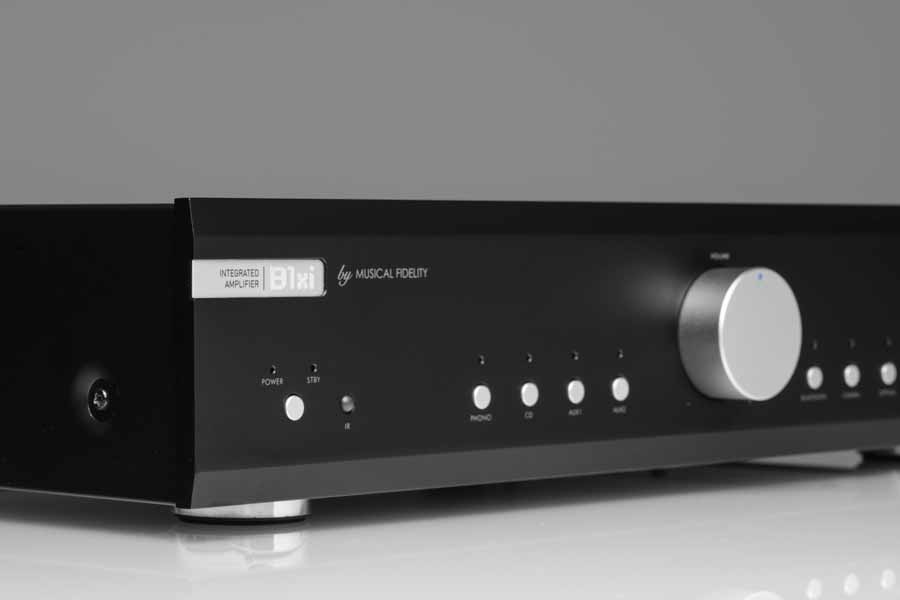
BUILD AND FEATURES OF MUSICAL FIDELITY B1xi
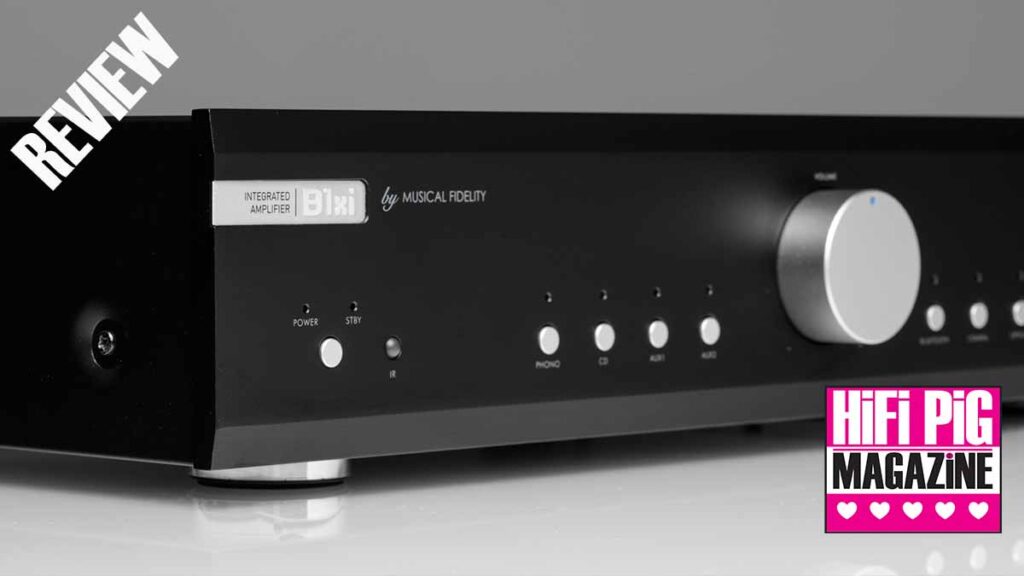
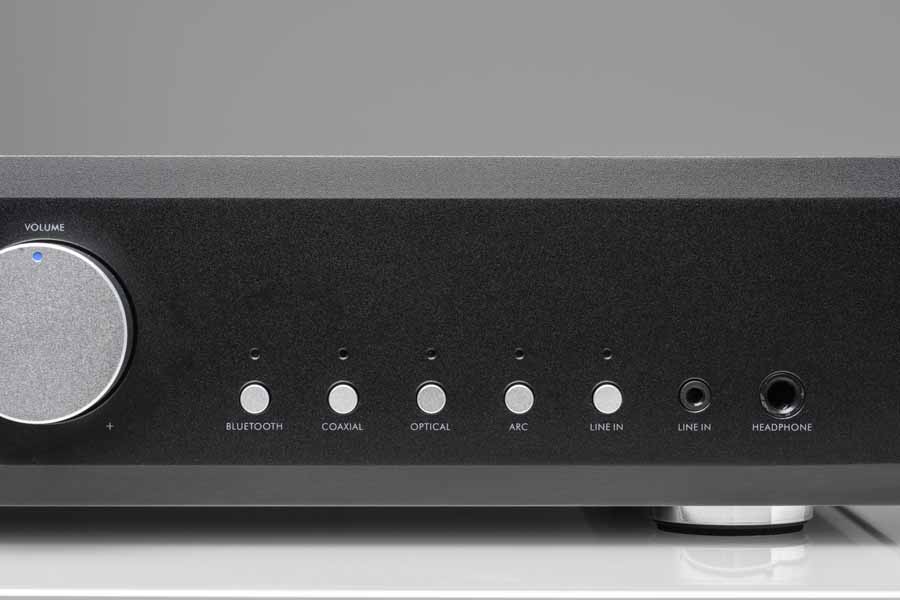
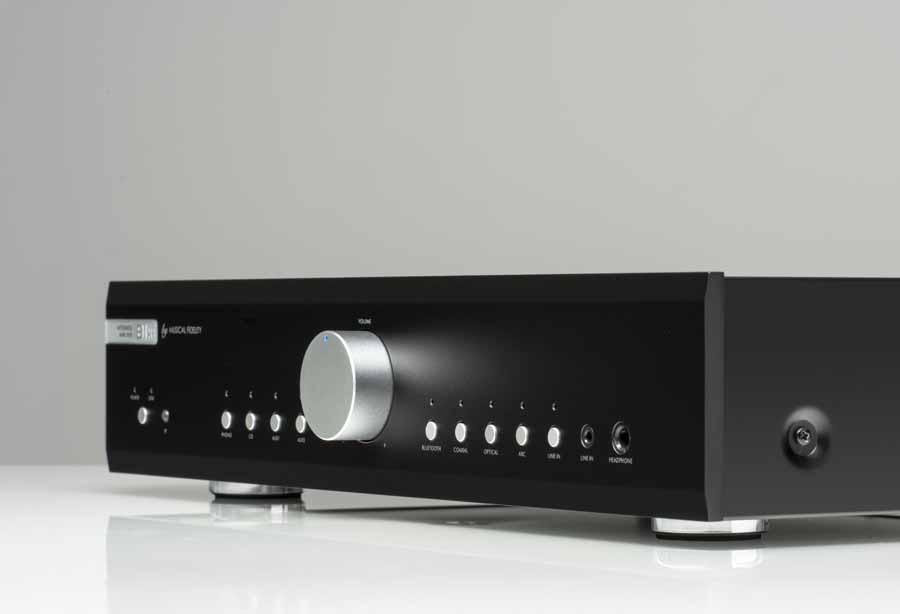
The original B1 had only three knobs: volume, source and recording input selection. Very clever and useful in the days of making illegal cassette recordings, and almost as simple to use as my aged minimalist Meridian 101B preamp. I loved the look of that model, but not everyone agreed at the time. The B1xi maintains the looks of their current M6-series components, and this time only has one central volume knob, but is flanked either side by a series of small buttons with LEDs above to indicate their selection. After turning on the amplifier at the rear, a red standby LED lights up above the front, far left on/off switch; this swaps to a blue LED next to it when you press the button, matching the blue LEDs above all the function buttons on the faceplate, and even the flashing light on the remote when it is pressed. The simplicity of looks and detail is actually so refreshing. The 5 buttons on either side are sensibly laid out to help the least able audiophile. Next to the on/off switch (with a sensible gap) are four main analogue input switches: phono, CD, Aux1, and Aux2. The phono input also has an earth linkage at the rear, should you need it, and is set up for Moving Magnet cartridges with the ubiquitous 47k-ohm resistive load. The original B1 catered for both MM and MC inputs. To the right of the central volume knob are the digital inputs: BT, coax., optical and HDMI Arc, plus finally a line-in analogue button with a 3.5mm socket to its right. To the far right is a ¼” headphone socket to complete the setup. The B1xi uses a carefully trimmed DAC design using the much-used ESS Sabre ESS9018 chip. The digital coaxial and optical inputs accept high-resolution sample rates up to 24bit and 192kHz (but no DSD), and the HDMI ARC input is there if you want to liven up your visual home theatre. I believe this to be the first MF amplifier with ARC provision.
The rear is equally sensibly laid out with good quality RCA input sockets and good loudspeaker terminals. It also includes preamp output RCAs, so you can connect to your subwoofer, cassette deck (please), or to bi-amp your speakers, plus there is also a 5V USB socket if you have a suitable music drive or streamer that needs powering (or charging).
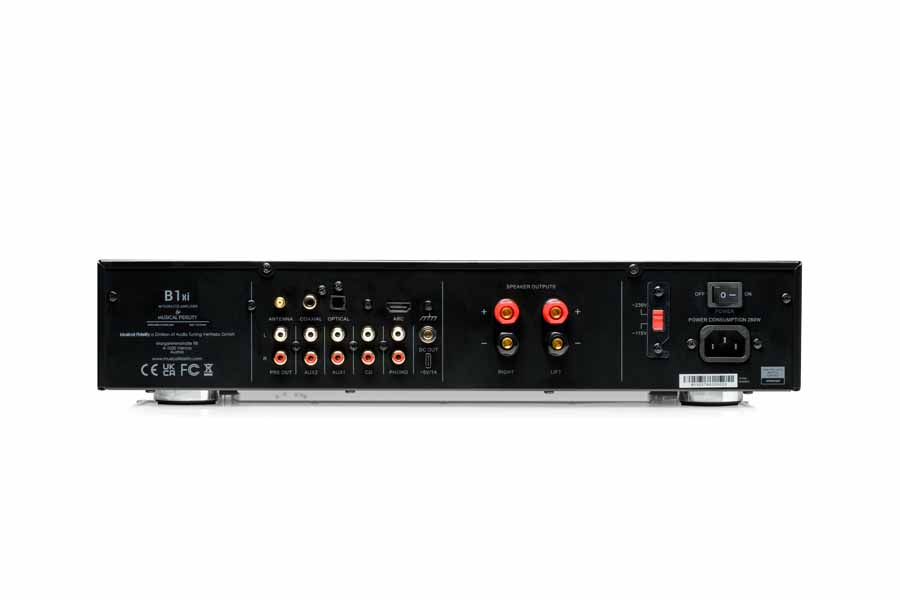
Inside is where the work is. With separate PCBs for power, digital and amplification, this is a well-thought-out design. Even the digital board has its own linear power supply. MF realised that any RF signals would decay the performance of any amplifier, so it took them a year to improve the layout of the circuitry and match each of the boards in relation to the transformer, using carefully selected components, using discrete transistors just like the original B1 did. However, the new model owes much to the design of their present-day expensive Nu Vista products, trickling gallons of research and development philosophy into the B1xi’s thimble-sized price. Similarly, the exclusion of WiFi, screen and app. is intentional, as sound quality is of foremost importance here, and adding these gimmicks would remove the amount of money that could be spent on the important bit…. the sound. Now with twice the power, the new £699 B1xi offers Class A/B with a large and generously rated toroidal transformer easily visible from the vents above, just to tempt you even more. Rated at 60W (8ohm) and 100W (4ohm), the output apparently gets up to 140W for less-easy-to-drive 2-ohm loudspeakers, so this amplifier should work well with whatever speaker you plug in. The box itself, tastefully available in just the black haute couture as was the original B1, is typically MF metalwork at its best; an extruded aluminium frontage and thick metalwork to keep those electromagnetic infiltrations out. With all their great metalwork, I was disappointed by the plastic remote control, though its buttons are sensibly laid out and easy to use.
SETUP AND USE
Setting up this amplifier cannot be simpler; no need to get a degree in WiFi and touch screen interaction. All I needed to do was plug in my speakers and sources, plus remember to screw in the BT aerial. For this review I used two turntables (Technics and Philips), connected BT from my phone, plus line-level sources from a Bluesound Node streamer and Krell CD player. Operation couldn’t be simpler; the remote is clear to use, though rather slow in certain operations such as volume up/down. Source change and track forward/back was very quick and easy to follow.
SOUND QUALITY
When the then MD of MF in 1989, Antony Michaelson, offered the “new” B1 to UK reviewers to assess its performance, they came up with the view that it was easily worth several times the selling price. Would the xi version get the same thumbs up by me? To start the review I played vinyl, using turntables from before and after the original B1 had set the scene for great British sound quality. I had at the time of doing the review been renovating the famous 1970’s Philips 212 belt-driven turntable with MM 401 cartridge, that form part of my collection. Nothing special, but I always wanted one as a child as it had 3 illuminated touch-buttons; something quite unique at the time, and it also had a good sprung sub chassis and looked good. Despite its “nothing special sound” I was quite impressed how the B1xi picked up all the details from the cartridge without hiding any of its shortfalls, as some cheap and mid-priced amplifiers can do. At £699, the B1xi is exceptionally good quality and sounds far better than its asking price.
Turning quickly to my Technics direct-drive SL-Q2, and suddenly the music came to life. Simon and Garfunkel’s “Homeward Bound” directed me to a musicality I could easily associate with the original B1; plenty of guts and punch, with a great bass extension.
Jethro Tull’s ‘Bursting Out’ live album has plenty of atmosphere and dynamism to inspire a good listening session. Brilliantly engineered, the B1xi allowed for great distance between the instrumentalists and audience, and a tight, clear and purposeful performance. With electric guitars on the right, a wide drum soundstage and central fluid flute forays, this was a very capable phono-stage section. ‘Bursting Out’ is a highly complex album which the amplifier unpacks into its separate pieces with musical finesse that surpasses its price point. If I had to find faults in it, it would be that the midrange can sound a little too bright, something that was compounded by my lively Wilson Benesch Arc speakers, but connecting my Graham LS5/9’s toned down that excitement, producing a sound that was more controlled and musical.
With nine complete and one incomplete symphony to his name, Mahler’s 2nd (The Resurrection) is my favourite and a great work to check out the dynamic range of any HiFi. With its frightful start with shimmering violins and very loud cello and double-bass octave melodies, this funeral music is all about life and death. Mahler had himself experienced lots of deaths in his family as a child, so he wanted to express the importance of appreciating in full what the world has to offer. Similarly, the B1xi gave me a chance to appreciate just what Musical Fidelity can offer at well under a thousand pounds, and despite this work totalling around one and a half hours with its massive orchestra, choir and two vocal soloists, I felt able to listen to it all with no fatigue or boredom. Mahler suggested the conductor sit down for 5 minutes at the end of the work before the audience should applaud, so that they could really take in the depth of the music. I guess a chair would actually have been of better use for the conductor to recover from standing so long! Whilst this amplifier couldn’t compete with my own thirsty Krell power amp, I never felt disappointed with the MF. There was lots of force and anger, but equally a good sense of peace and space, particularly in the second movement. With the double-bass section showing good extension, the amplifier’s ability to deliver down to 2 ohms presented a confident performance on the severest of music, and the overrated toroidal power engine could give fast peaks when peaks were needed, just as the toroidal supply in the original B1 could do.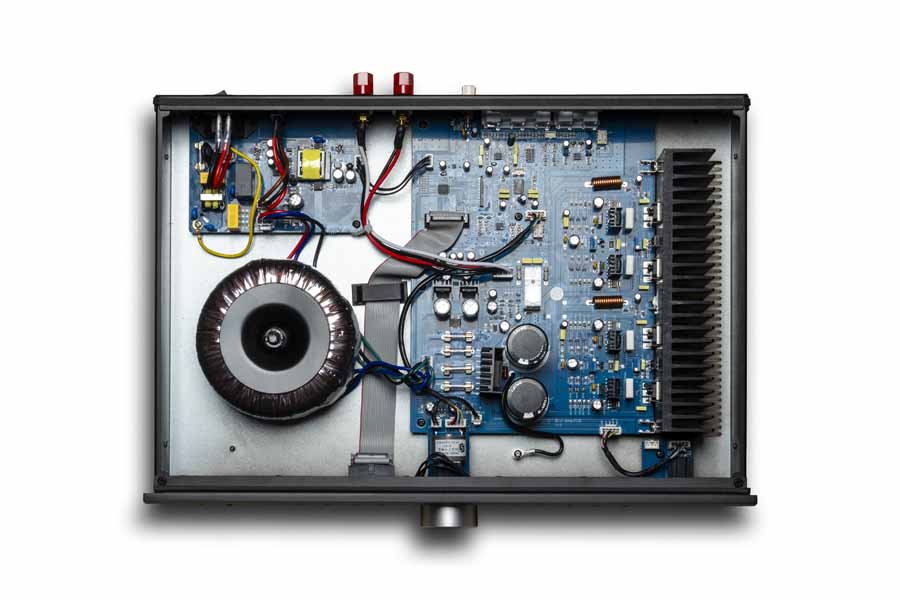
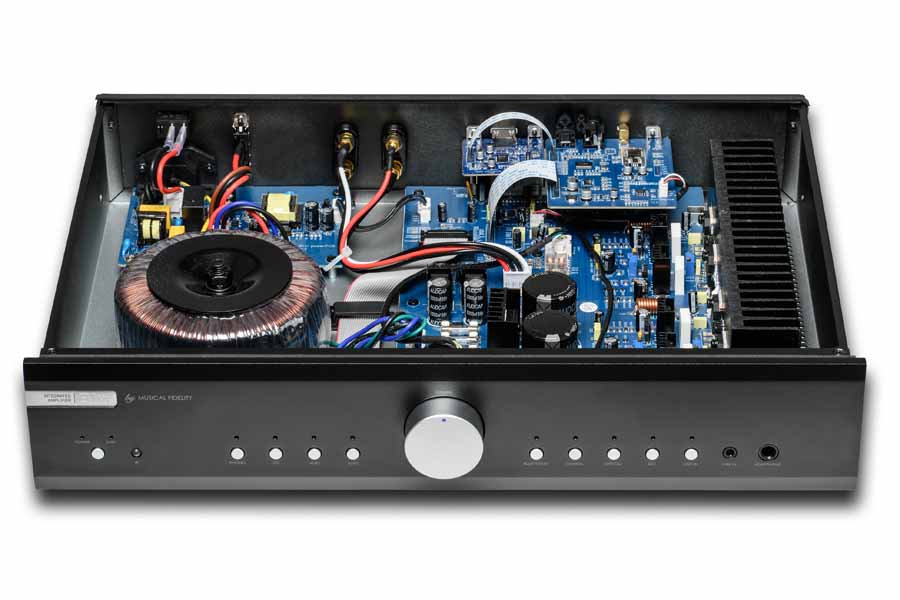
That bass was equally clear from the double bass in “Volare” from the Francesca Tandoi Trio. With tight brush strokes on the snare drum and pin-sharp finger-work from the piano and Francesca’s own distinctive vocals, the performance was very tidy and, despite just being a trio, was very holistic. Whether large or small music, the amplifier gave a very crisp and exact performance, with musicality at its core, on any genre.
Setting up and using the BT input was also a doddle. Using my phone to play Qobuz files I found the MF worked well. At the start I hadn’t even connected the screw-in aerial at the back of the amplifier and it still worked a treat!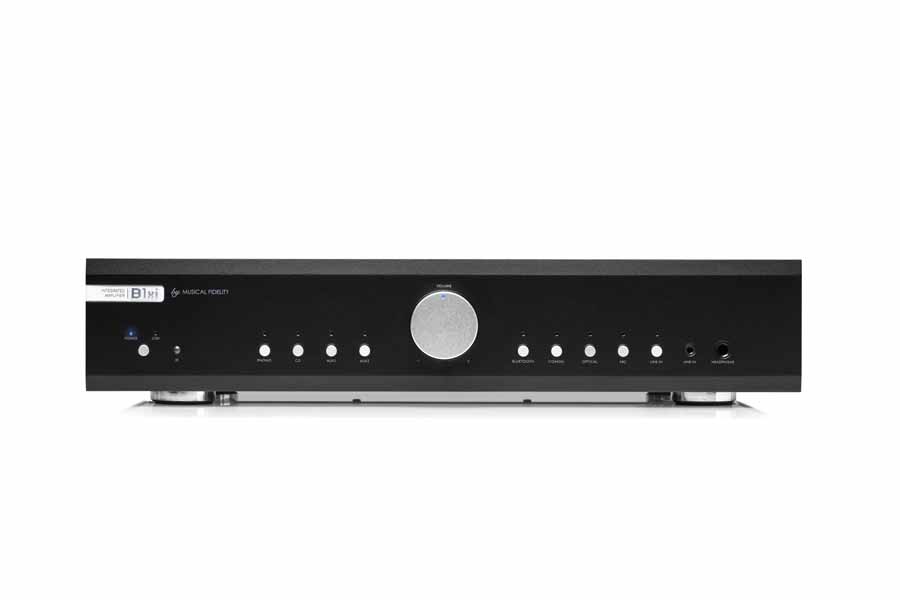
Oscar Peterson’s “I Won’t Dance” got my feet busily tapping away, with a bassline from the double bass player and precision playing from Oscar on his preferred Bosendorfer grand piano. In all I played, I was conscious of the detail in the lower regions. In Stevie Ray Vaughan’s “Voodoo Child” that bass guitar, kick drum and tom-toms all had an urgency and rhythmic drive. I did, however, find the volume control on the remote operating the mechanics of the resistive potentiometer on the amplifier just a little slow and imprecise at times. I also needed to up the level past 12 o’clock to get enough power to excite me. The toroidal might well have plenty of “reserves”, but it didn’t have the energy that my own Krell power-amp has in spades. All the frequencies are catered for, but I could have perhaps done with a bit more top-end “tightness”. The mids again were a little imprecise, but what I did find, however, was a very good 3D-soundstage from the amplifier. Instruments were expertly positioned and timed, and reverbs were allowed to decay in their allotted time. For example, Patricia Barber’s “The Thrill has Gone” (Café Blue) is a live performance with a great sense of atmosphere and space, and the amplifier handled this with great respect. Only the Spanish guitar in “Romanesque” didn’t sound quite so precise and musical as I would have liked to hear. However, in the French band Air’s “La Femme d’argent”, the synthesisers and percussion were well controlled, and again with lots of stage information, including front to back. That sense of musical direction and sensitivity was displayed further in their track “Run” with its distinctive vocal synth “humming” chords, reminding me of the bands Enigma or Clannad. I generally preferred the analogue sources to the Coaxial and BT digits that I supplied.
The ESS DAC is getting quite old now. For £699, though, I found this to be a stonker of a product for the price, with looks matching their M6-range, and only slightly let down by the remote.
QUIBBLES
Apart from the slow responding remote volume, I was very impressed with this amplifier. Analogue and digital sources were good, though in the latter there was no DSD compatibility. I so loved the design of the original B1 I was slightly disappointed that the xi version wasn’t a retro version, though it still looks good.
CONCLUSION
One can’t expect an earth moving performance at such a cheap price, but the B1xi is audibly clearly from the same family as Musical Fidelity’s best offerings.
A very confident performer that gave great bass and soundstage with an excellent dynamic range.
Where the HiFi reviews of the original B1 felt that model was worth much more than its asking price, I can concur that I believe their B1xi to be even better value. Interestingly, allowing for inflation, the B1 in 2026 would be almost the same price as the B1xi! This new amplifier is all about sound-per-pound as opposed to features, and if this is of importance to you, too, then you’ll happily forfeit screens and WiFi.
The original A1 and B1 amplifiers left a big impact in the ‘80’s, and Musical Fidelity’s new B1xi will surely get people talking today as well. For that reason, the B1xi deservedly gets 5 stars.
AT A GLANCE

Build Quality and Features of the B1xi:
Very solidly built, as are all MF products, with ease of operation at its heart
This isn’t a feature-packed product; it gives attention to the sound quality, which should always be the most important attribute
Sound Quality:
A very good soundstage and controlled and extended bass
Very musical for the asking price
Value For Money:
At£699 there are a number of amplifiers on the shelves around this price point, but very few offer such engaging and controlled performance. Indeed, when you listen to it, you simply forget just how cheap it is.
We Loved:
Lots of muscle for such a lightweight price
Excellent soundstage
Extended and controlled bass
A very good MM phono-stage with good S/N
Exceptionally good value
We Didn’t Love So Much:
Lack of DSD
Just wish it looked like the original B1, as they did with their recent retro A1.
Elevator Pitch Review: So much great HiFi originated in Britain in the 70’s and 80’s, and it’s refreshing to see so many retro versions of these products appearing half a century later. We’ve seen it, too, with cars; the Mini, Fiat 500, VW Beetle and the new Renault 5 are obvious examples. The new B1xi from Musical Fidelity, however, other than sounding like a new Citroen is more like the new Ford Mustang or Capri, showing very little visual likeness to the original. However, where the similarity lies is in the all-important sound DNA; that 1989 B1 was distinctive in its solid performance, warmth and engaging sound, and particularly its exceptional value for money. Would the B1xi be its worthy and bettered offspring? Time to play.
Price: £699
Janine Elliot
SUPPLIED SPECIFICATIONS
Power, both channels driven @ 1% THD: 60 Watts per channel into 8 Ohms; 100W into 4 ohms; 140W peaks into 2 ohms
Power, both channels driven @ 0.09% THD, 20Hz to 20 kHz: 50 Watts per channel into 8 Ohms; 80W into 4 ohms
Damping factor 30
Line input
THD+N < 0.02 % typical, 20Hz to 20 kHz
Signal / noise ratio > 100dB ‘A’-weighted
Input impedance 47k Ohms
Frequency response +0, –3dB, 10Hz to 30 kHz
Phono input
Sensitivity (nominal): 5mV (suitable for cartridges giving 1.5mV or more including high output MC types)
Signal / noise ratio: >70dB ‘A’-weighted
Input impedance: 47k Ohms
Input capacitance: <100pF
Gain: 42dB
Frequency response: RIAA/IEC ±1dB, 20Hz to 20 kHz
Connections
Line level inputs 3 pairs line level RCA connectors
MM phono input
Optical, coaxial, ARC digital inputs (up to 24bit/192kHz stereo PCM)
Bluetooth 5.1 input
1 pair line level RCA connectors, preamp outputs for e.g. bi-amping
Speaker outputs 1 pair 4mm banana plug/binding posts
Power requirement: Mains voltages 115/230VAC 50/60Hz (factory pre-set) or 100VAC 50/60Hz (alternative)
Consumption: 280 Watts maximum
Weight: Unit only, unboxed 7.2 kg. In shipping carton 8.9 kg
Dimensions: 430 x 324 x 90mm
The original 1980’s B1 specification;
Power output: 32 watts per channel into 8Ω (stereo)
Total harmonic distortion: 0.5%
Input sensitivity: 0.25mV (MC), 3.5mV (MM), 220mV (line)
Signal to noise ratio: 55dB (MC), 60dB (MM), 80dB (line)
Consumption: 200 Watts maximum
Weight: 7 kg
Dimensions: 440 x 340 x 70mm