Lector Strumenti Diginet Streamer Transport
LECTOR STRUMENTI DIGINET STREAMER TRANSPORT REVIEW
Lector Strumenti Diginet is a streamer transport from this well-respected Italian brand. It’s devoid of frills and frippery, and costs £2587+VAT. Stuart Smith takes a listen.
For those that aren’t in the know, Lector Strumenti Audio is an Italian brand that has been in the HiFi business since 1982 and introduced their first tube-based, Audio CD player and DAC back in 1989. The current product range includes tube and hybrid amps, CD players, and DACs. Interestingly, the Diginet Streaming Transport is not listed on their website.
BUILD AND FEATURES OF THE LECTOR STRUMENTI DIGINET
The DIGINET is a streamer transport, designed as a digital output control unit rather than a unit with analogue outputs – it needs a DAC to function in a HiFi system. It can connect to a network via LAN cable or WiFi, and it also supports Bluetooth, including Bluetooth Classic, A2DP, and aptX.


















It supports playback of a wide range of file formats, including MP3, MP4, MKV, AAC, APE, AIFF, ASF, Vorbis, Opus, PCM, WMA, WAV, AC3, FLAC, ALAC, APER, and WavPack. The unit is specified to handle audio up to 24-bit and 192 kHz.
For multi-room use, the DIGINET supports the Songcast protocol, allowing multiple devices to be grouped so that the same audio content can be streamed to them in synchronised playback. Streaming services Qobuz and Tidal are supported via direct login access using a username and password. I’ll not be using the DIGINET in a multiroom setup, and the whole of this review will be based on my experiences with it placed in our usual reference system. For the duration of the review, it was used to feed a Lampizator DAC, which then fed a Music First preamplifier into a pair of Electrocompaniet AW800 M monobloc amplifiers. Speakers were the O Audio Icon 12s.
Construction is described as a fully extruded aluminium chassis made from non-magnetic aeronautic materials. Power is handled by a linear power supply specified with more than 25,000 uF of capacitance and a low noise toroidal transformer, alongside seven independent power supply regulators.












On the digital side, the DIGINET includes a high-speed digital transmitter and an internal high-precision word clock generator. Storage connectivity is provided by three USB ports intended for HDD or SSD, plus a further USB port intended for software updates.
Digital outputs include S/PDIF, Toslink, AES EBU (AES 3), and I2S via HDMI. The unit is specified for 230 Vac, 110 Vac, or 100 Vac, at 50 or 60 Hz, with a stated power figure of 70 VA. 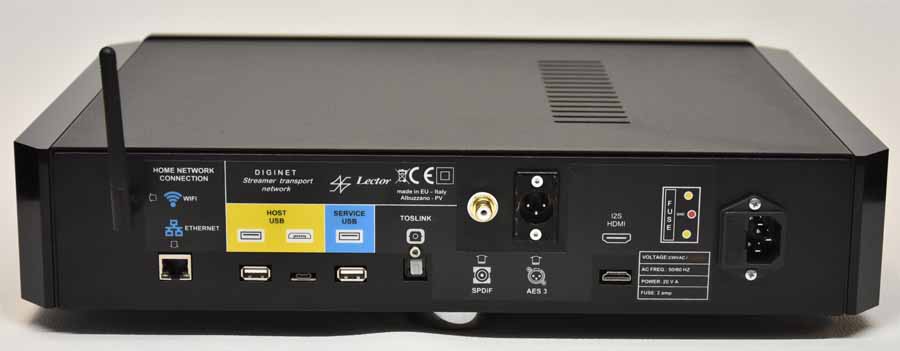
Optional extras include side panels in cherry wood or black solid plexiglas, which add 2 cm per side, plus spike feet in aluminium. Ours came with Plexiglass sides and standard feet.









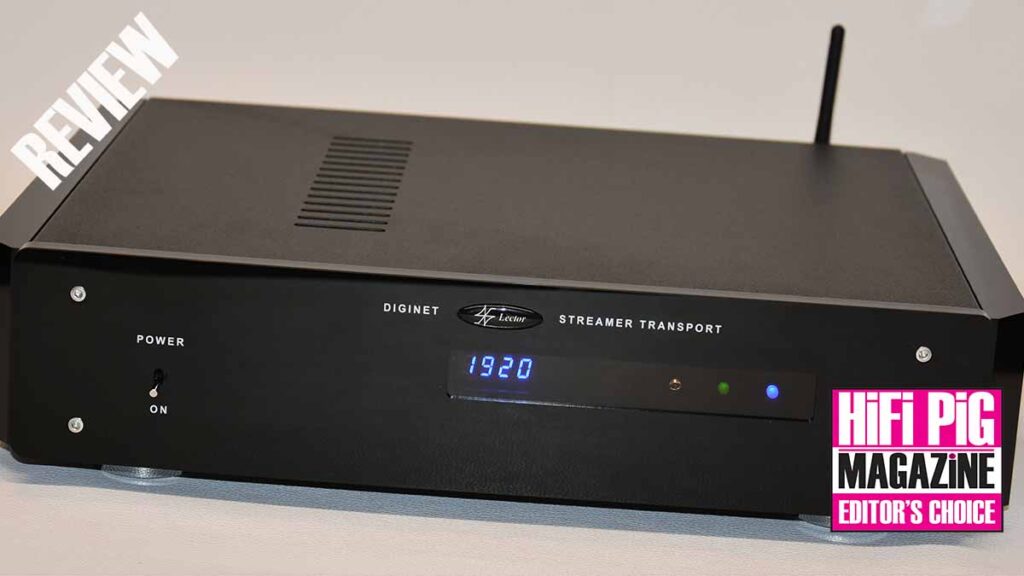
Build quality is good, and the unit has a nice look to it – I’d certainly be happy to have it on the main rack permanently based on looks alone. The front panel has a cool on/off toggle switch, and that’s pretty much it, other than a blue digital display to show the bitrate of the files you are playing, and a blue LED to show the unit is powered on. Some may moan that there is no screen on the front of this unit to show the artwork and whatnot, but it’s very likely that you are going to be controlling the DIGINET with a phone or a tablet, and so that point is somewhat moot; I actually think that nowadays, a fancy screen on the front of a streamer is serving little purpose but to add to the overall cost.
Around the back are the aforementioned outputs, though there is no USB output. I spoke to Claudio, the head of Lector, and he explained that a converter is available for USB (it uses the I2S output and converts that signal to USB), but overall, he believes that USB is inherently a noisier signal. However, at the same time, he recognises that some buyers would prefer the option – hence the converter module they have available. 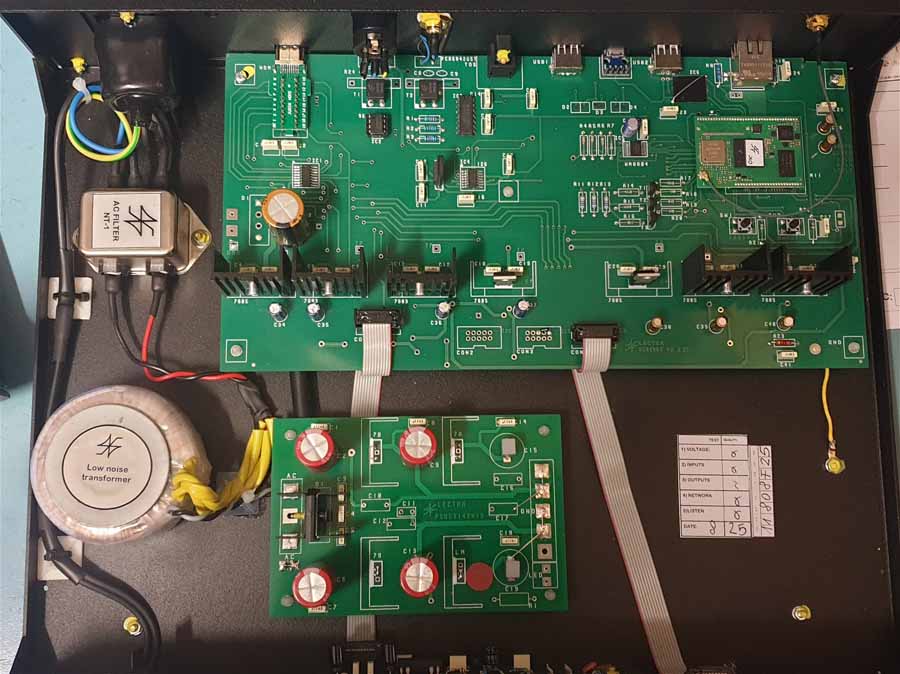
SET UP
At one time, not that many years ago, the whole setup of digital streaming units filled me with horror, but time has moved on, and I don’t know if it’s just me being more “au fait” with the whole “format” or whether the units are indeed easier to set up. Anyway, the DIGINET was easy enough to set up in the system, with me connecting it to the local network via a LAN cable and then connecting it to the DAC via SPDIF. You can connect by wireless, and you get a small antenna for this purpose, but I’ve now used a wired connection for some years, and for this review, I will be doing likewise; I prefer to compare like with like. The only anomaly in the “like-for-like” scenario is the fact that I’ll be using SPDIF cable and connectors rather than USB. You can download an app for Android and Apple, but for my purposes, the DIGINET is pretty much plug and play: wire it up, set it up on ROON (it shows a HBM11-78XX (Shairport Sync)), find a tune, and hey-presto, you have music. As I say, pretty much plug and play for my needs. Those worried about set up should have no fear with this unit. 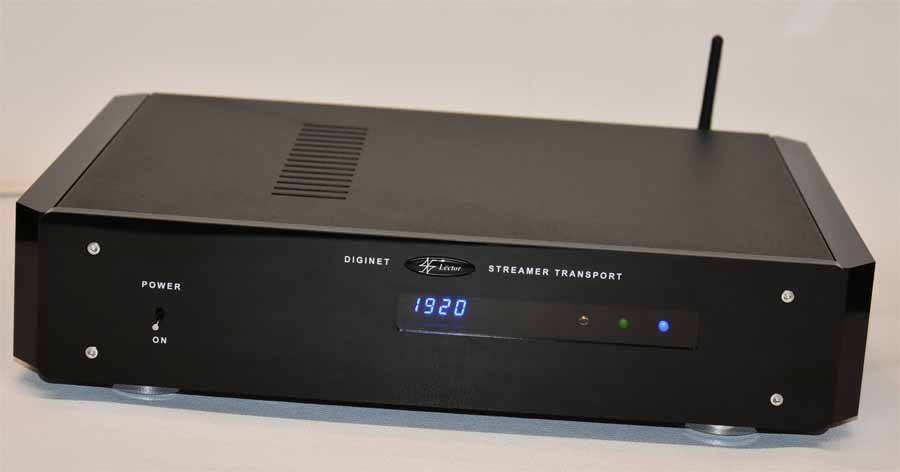







SOUND QUALITY
I’ve had a whole load of streamers through the doors in the last few years, some I’ve reviewed, and others have been for my own personal entertainment, or trying to find something better than I already own for the reference system. What I can say with confidence is that not all streamers (or digital transports) are built equally or sound the same. The whole “It’s digital and zeros and ones, so it all sounds the same” is patently not correct in my experience. I was chatting with Ricardo and Kasia from Absolute Sounds a few months ago and they were telling me how good a particular streaming source was. I’ll not go into the whole conversation, as it’s not relevant to this review, but one thing that Ricardo did say was along the lines of “One thing Ivor from Linn got right is that source matters and that’s true of both digital and analogue sources.” I’m paraphrasing, of course, but over the last few years, this has become increasingly obvious concerning digital sources. However, I do think the differences between digital sources are less pronounced than, for example, a new amp, speakers, or cartridge.
The first thing I noticed that was different, and perhaps a little better than the Auralic unit I’ve chosen as being our reference for a few years, was that the separation of instruments in the mix was marginally better with the DIGINET. We aren’t talking night and day here, but the difference was there and was repeatable.
I had thought when listening to some punk compilation that the bass was a little light on the DIGINET, but putting on A Raver’s Diary by Dusty Kid expelled this fear within the first few bars. The rolling bassline of the opening track (Here Comes The Techno) was all there, and so was that feeling that the noises that fly about the soundstage were somehow a little enhanced; more separated and with more space around them. This latter point sounds a bit woolly, I know, but that’s what I took from my listening. The soundstage was definitely a smidge more open and more three-dimensional than with the Auralic in the system. This album, using this streamer, really drew me into the recording and all the psychoacoustic effects more than I usually would be. The dying notes of this track disappeared into complete silence.

With what I said above about the soundstage, I wanted to listen to something in an acoustic space and with acoustic instruments, and so pulled Le Pas du Chat Noir by Anouar Brahem off the virtual shelf. From the opening piano of the title track, it was clear that this streamer was doing something. The tone of the piano was very lifelike and “in the room”, as was the oud. Again, there was a purity to the sound and (reviewer cliche alert) a distinct feeling that I wasn’t listening to digital files. This might be contentious, I know, but there is definitely something going on with the DIGINET that takes away the “sense” of digital and connects you in an analogue way with the music you are listening to. This is not my normal listening fodder, though I do listen to this recording fairly often, but I ended up being really drawn into the small details of the playing and sounds. Decays and reverbs on the top end of the piano decayed beautifully, and there was a sense of space, airiness, and the room that was very apparent. Musical is a word bandied about by some reviewers when they want to say that some product is a bit crap, but don’t actually want to say it, but the DIGINET with this recording and this DAC sounded gloriously musical in the sense that it was as “live” a sound as I’ve got from this recording. I really got drawn into the decays, the reverbs, and the micro-detail of the instruments playing in front of me; I kind of completely relaxed into the music. And I do think this is the DIGINET at play here, rather than me listening more intently or whatever else I might have attributed it to. There was a real sense of the players playing in the room in front of me that I just didn’t experience with the Auralic. There’s a series of small noises (kind of taps) at around three minutes on the track Pique-nique a Nagpur that I have just not heard before. Whatever the DIGINET is feeding the DAC, I get the feeling that it’s feeding it all in some “organic” kind of way…yes, I’m well aware how ridiculous that sounds, given it’s all apparently just zeros and ones.
As I was writing this up, I sent a message to Claudio at Lector asking for prices, fully expecting something close to £10K, but was very pleasantly surprised when he responded with £2597+VAT as being the UK price. 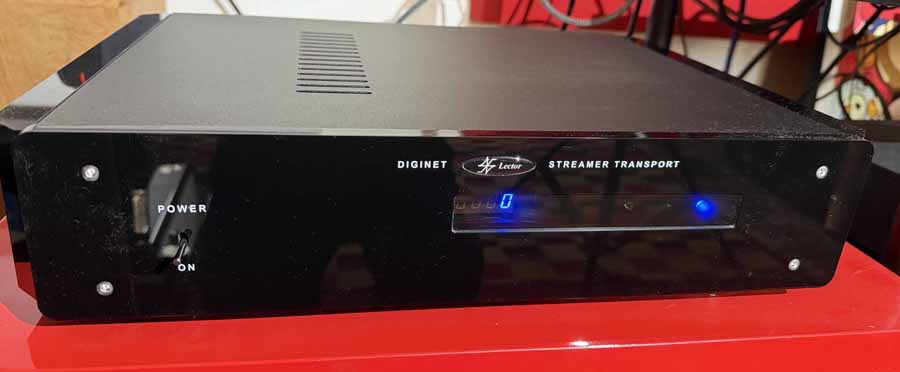
I’d been really drawn into the whole sense of “liveness” of the files I’d been playing and wanted to hear Jazz at the Pawn Shop, and whilst I’m not a huge fan of the music (it’s not terrible, it’s just not to my taste), the recording is famous for the way the recording has been made with regards to the acoustic of the room and the sounds you hear other than the music – kind of as if you are sat in the audience. The DIGINET got this across very well, but one track was all I could cope with.


So, techno sounded cool and analogue instruments sounded like real instruments, but what about more raucous tracks? I specifically don’t like products that have been voiced to push that upper-mid presence band to the fore; it’s an important band for vocals and spatial cues, but it’s not the be-all and end-all in the way a product presents itself.
Anyway, with the above in mind, I popped on Smoke on the Water off the Made in Japan album. I needn’t have worried about the DIGINET being a one or two-trick pony, as Blackmore’s opening guitar riff has a feeling of it being recorded off the desk, but mixed with microphone recordings in the hall. Again, it had a “live (yes, I know it’s a live recording) feel to it.) The bass on this track has been a test track for ages, and I wasn’t disappointed here; there was that growl that I’d expect.
I’d forgotten to talk about vocals in this review, but as I was writing up my notes I was sat listening to the Yoshiesque Two files (Deep Dish) and the track Marscarter (BLH II Original) and was totally drawn into the female vocal to the point I stopped typing and just listened. There was a purity of tone, and I could visualise the singer looking up to the microphone and moving to and fro from it. 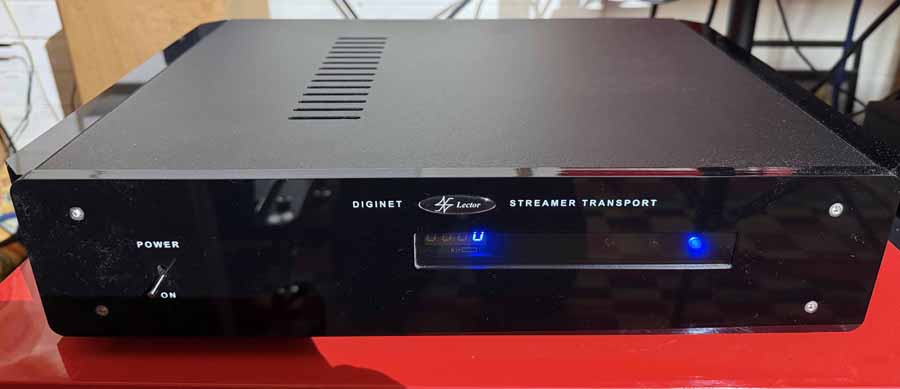


QUIBBLES
No USB output. Bit boring looking but you can tart this up with wooden side panels should that be your want.
CONCLUSION
The DIGINET from Lector Strumenti is an unassuming unit that clearly focuses on delivering as clean a set of digits to the DAC as possible. It doesn’t have many frills and doesn’t have a USB output, which disappointed me a little. However, once I got over myself with regard to the USB and just sat and listened, the DIGINET really appealed to me.
There is a real sense that you are listening to a product that seeks to strip the digital away and present music in an analogue way. And I did find myself enjoying some acoustic recordings more than I remember previously.
Soundstaging is somehow enhanced with the DIGINET in place, and I have no idea how to explain that other than it perhaps reduces the overall noisefloor presented to the DAC.
I’m giving this an Editor’s Choice award for the simple reason that it sounds better and more organic than our current reference.
AT A GLANCE

Build Quality and Features:
A bit boring looking – it’s a black box with some blue LEDs on the front
Build is good
Has WiFi, Bluetooth, and multi-room capability
Connects to ROON
Sound Quality:
Open, airy, and organic are the words that I’ll use to describe the sound
There’s a feeling of effortless naturalness to the sound
Spatial cues become really evident
Value For Money:

I was genuinely shocked (in a good way) at the price of this unit
We Loved:
Ease of set-up
Sonically clean and non-digital sounding
Unassuming looks
We Didn’t Love So Much:


No USB out, which is my usual go-to
Elevator Pitch Review: TheDIGINET from Italian brand Lector is an unassuming-looking £2587 (plus taxes) digital transport. It’s easy to set up with loads of outputs and USB inputs for external drives, but no USB output. What it lacks in bells, whistles and fancy frippery, it more than makes up for in sound quality. Sonically, it is as organic a digital transport as I’ve had in our reference system. Spatial cues and soundstaging are excellent, with them coming from a silent background so that you can hear details and nuances that you might not have been as aware of before. At the asking price, I’d say it’s a bit of a bargain if you set it up as I have. I bought the review sample.
Price:
Euro 2270 + local vat tax
Sterling 2587 + local vat tax
USA/dollar 1932 + local vat tax
Stuart Smith
SUPPLIED BY LECTOR AUDIO STRUMENTI