
ISOL-8 Substation Axis F5 Mains Conditioner
ISOL-8 SUBSTATION AXIS F5 MAINS CONDITIONER REVIEW
I have been building and using mains conditioners and balanced mains units for many years now. Mains taming is very important. Not only does the mains supply reach our house in a less-than-perfect state, but different pieces of kit in our house can interfere with other devices, especially if linked on the same mains block. Even using your supply at different times of the day and night can affect the sound you hear, and this is not just influenced by products in just your own home. Mains conditioners generally get rid of certain frequencies, like a tone control, leaving the 50 or 60Hz as pure as possible. They come in different flavours and prices, and I have particularly been keen to follow ISOL-8 since its beginnings.
Nic Poulson has had a life working in broadcasting and HiFi. As a young teenager, he worked on Saturdays at a HiFi shop in London where he met Richard Bates (who, from 2026, now works with him as Sales Director). He created HiFi in his home, playing with kits at the age of 4 and building his first amplifier at 7. In the 1980s, he worked as a broadcast engineer at the BBC.










His passion for HiFi continued when he left in the early 90s, designing electronic circuits for amplifier manufacturer Trilogy Audio Systems, which he created in 1990. His fame also included designing the runway lighting systems at major airports in the UK. His work encompassed the electronic transformers for running the lights, so that they were safe when it was raining and the lights were all at the same brightness (remember that the further away the lights are, the less bright they appear, so to get a pilot to see that he is actually approaching correctly, the runway lights need to be the correct equal intensity). His work is visible in over 10,000 lights in UK airports.
Studying the inherent weaknesses in most mains supplies led him, after starting Trilogy, to set up IsoTek with Keith Martin and Peter Dolding, with Nic doing the designing and the other partners involved in the management. After 3 years, he took his designs into ISOL-8 Teknologies, which specialises in DC-blocking and which he still runs now. Both IsoTek and ISOL-8 are now two of the main names in mains taming, though numerous others are coming onto the scene as our mains gets even more infected.
Nic’s pioneering work in the use of multi-section filters, designed to eliminate the problem of noise transmitted between audio elements, will become a central part of this review, and he is well known for his interest in valve and SS analogue technology, not wanting to get involved too far in the digital side of things. The Trilogy amplifier I reviewed last year had gone through enormous R&D to get to the point of sale, and Nic and his team really do concentrate on getting things right before delivering them to the audiophile. His products are always meticulously engineered both inside and out, and the Substation F5 is no exception.










This year, the work in creating new products in the ISOL-8 portfolio dealing with mains taming and distribution has amped up, with no fewer than 7 coming to market: 2 mains blocks (the P3 and P5), two DC-blocking devices (AXIS 10 and 20), the Substation F3 and F5, plus the soon-to-appear F7.
BUILD AND FEATURES OF THE SUBSTATION AXIS F5
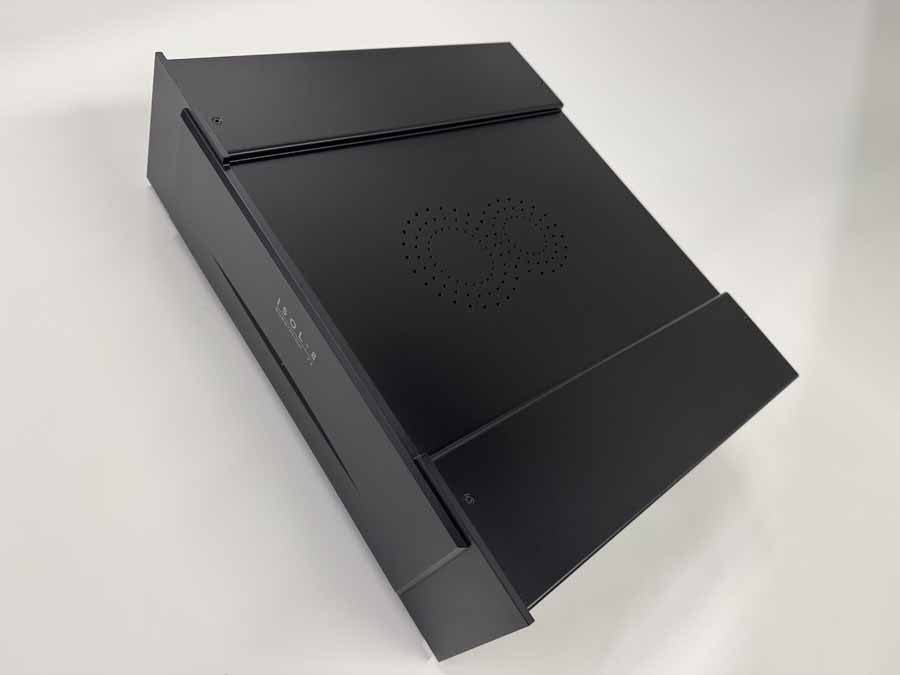
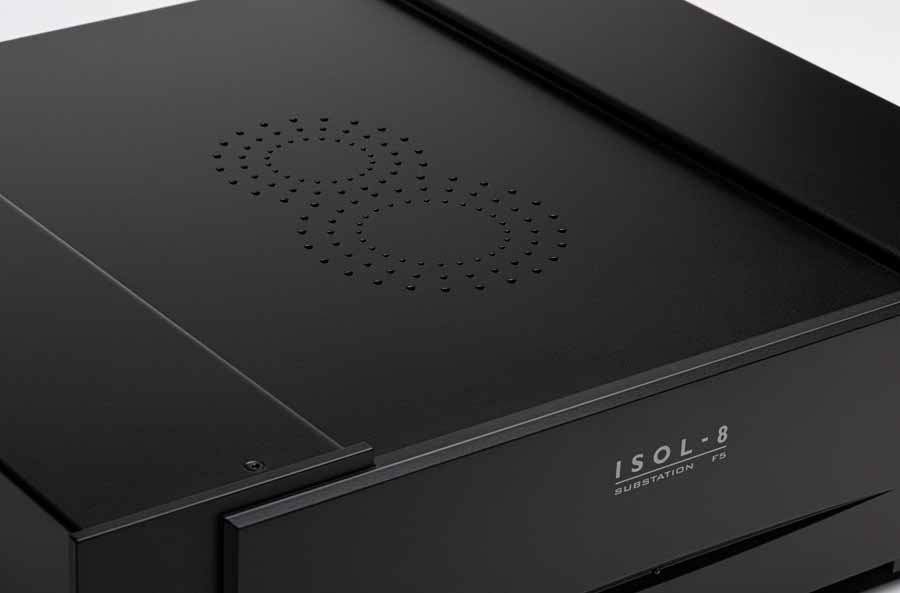
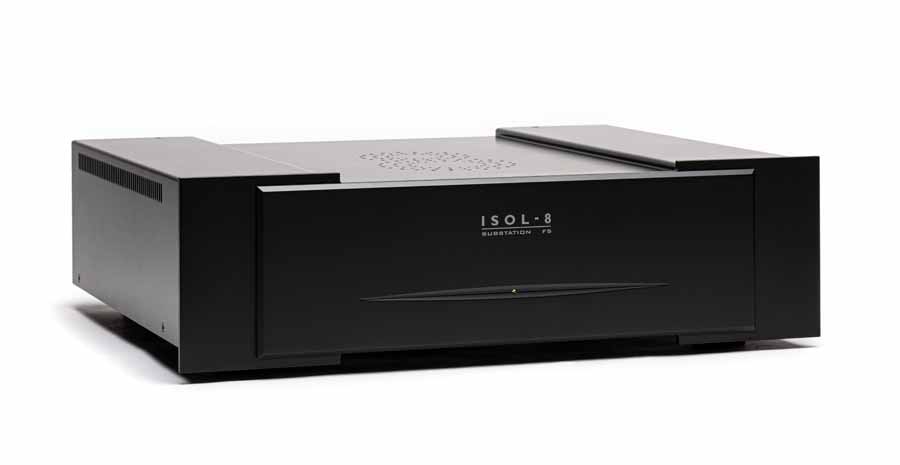
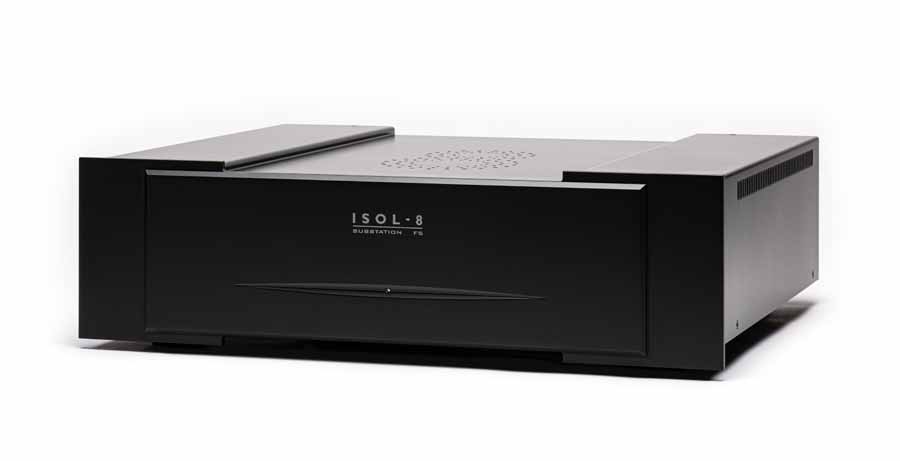
ISOL-8 products appear in three groups of high-performance, audiophile and custom install, created to cover everything from the low end of the market to the very top audiophile separates. The Substation series is at the higher end and encompasses the F3 – a 6-way unit – and the F5 – a 7-way unit, both offering up to 15A with a C20 IEC inlet (10 Amps with a type C14 inlet). An even higher-spec F7 will appear later this year. For systems where DC offset on the mains supply is a concern, such as the Orchard Audio Starkrimson GaN-FET monoblocks I recently reviewed, DC blocking is available as an additional option across the entire F Series for £400 extra, and is fitted to the review sample.
Indeed, there are numerous features in these £3,995 (£4,395 with DC blocking option) units, sounding like they come from a Doctor Who episode: AXIS DC Blocking, multi-stage Transmodal Filtration, X-Contamination Control and Surge Protection. The transmodal filter technology reduces both common-mode and differential-mode noise, filtering those high frequencies out of the system, basically LC filters aimed at reducing the high-megahertz interference and without limiting the dynamics in the music. In some manufacturers’ designs I have listened to, EQ’ing out these megahertz can result in some dynamic reductions, sounding like music compression whereby you lose some of the music’s power, intensity and character.
The Cross-Contamination circuitry reduces contamination between different components in the ‘adjoining’ mains sockets caused by power supplies and diode rectifiers; each component you add to a multiway mains adaptor creates its own electrical noise which can make its way onto others and affect their sound, so each socket on the F5 is effectively a separate mains source.
Finally, the importance of DC-blocking cannot be underestimated. With the crests and troughs in the AC, there are bound to be offsets which, being in a “straight line”, are thus DC. It can often be caused by apparatus such as switch-mode power supplies, cheap hairdryers and even some light dimmers. Even a small amount of DC will change the performance of the equipment, causing effects such as audible mechanical hum or buzzing from partially saturated toroidal transformers, reduced power supply efficiency and lowered headroom. The F5, as standard, also protects connected equipment from voltage spikes and surges. With custom-wound chokes, polypropylene capacitors and silver-plated copper wiring with PTFE insulation, this product has gone through much R&D to get onto my HiFi rack.
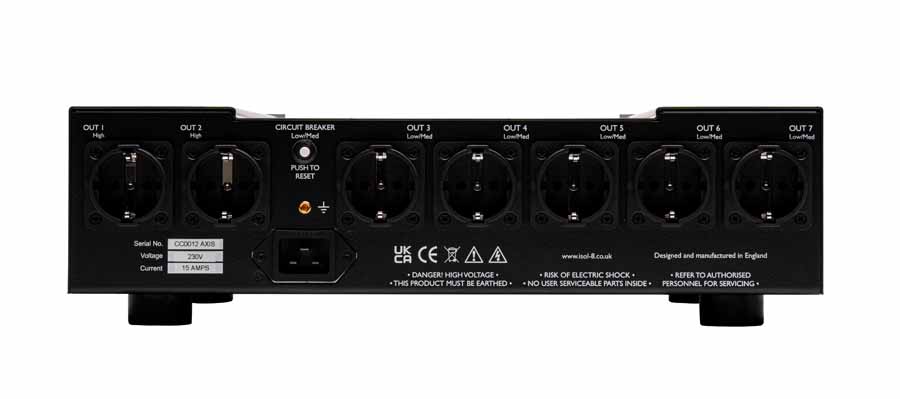
Mains conditioners across different manufacturers will sound different, just as different prices, designs and manufacturers of cables create varied sonic signatures. With the name ISOL-8, there is much thought on reducing the electrical influence between different pieces of equipment, hence the F5, the culmination of 27 years of research into tackling mains problems, has 5 low-medium 13A sockets for equipment like turntables, streamers, preamps, CD players, etc., and two high-level sockets for the more powerful kit like your amplification.
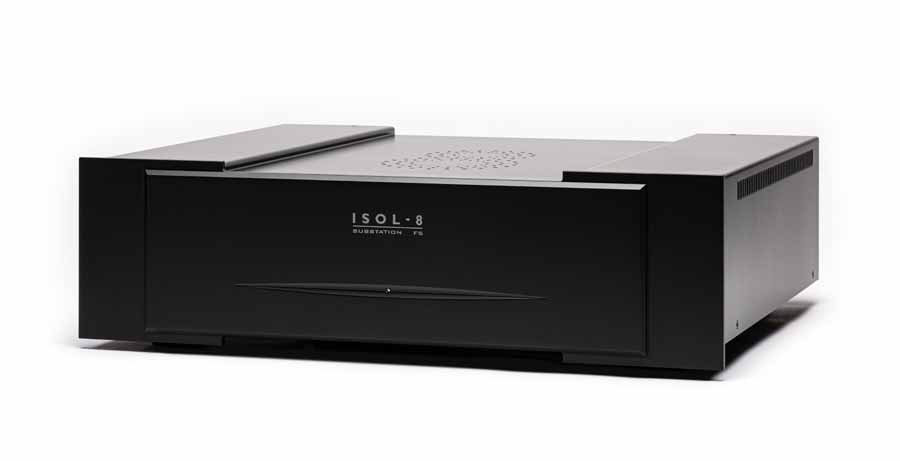
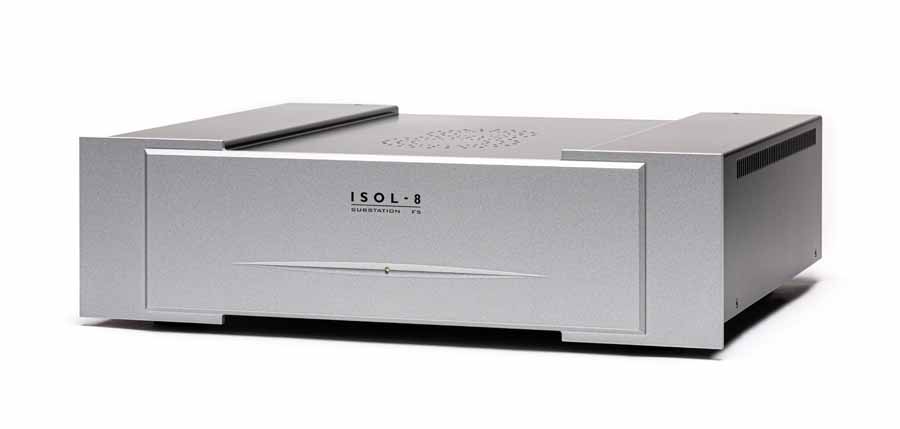
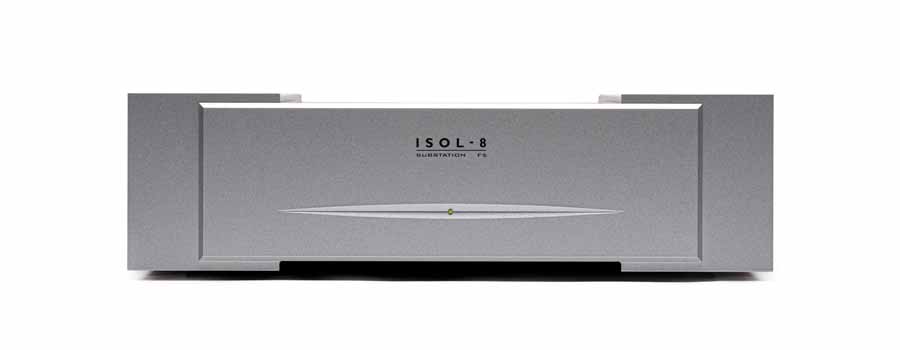
The F5 allows a maximum of 15A (6A total across the low/med outputs), and the main on-off rocker switch under the front middle also operates as an overall circuit breaker, should anything untoward happen. There is an additional breaker at the rear for the five low/medium sockets, plus a 4mm earthing socket for items requiring grounding, such as your turntable. All is put together very professionally, and to connect the C20 IEC input socket at the rear to my mains supply, the unit was supplied for review with their purple Vector mains lead, which has excellent Viborg connectors. The unit comes in black or silver and measures 450 x 375 x 132mm (w x d x h) and is hand-built at their factory in Worcestershire, England.
SETUP AND USE
As well as testing directly from my HiFi mains wall socket, I intentionally made the mains supply to the Substation F5 as awful as I could to enable me to really test its ability, so I included a daisy-chained array of connections and devices (don’t try this at home)! If my mains wasn’t dirty before, it certainly would be now! The unit is so self-explanatory that it didn’t cause any issues, though I would prefer the 13A sockets to be upside down so that mains cables rose directly to the separates sitting above on my rack rather than firstly curving below onto the floor. I’m sure that can be requested, as can the type of sockets (UK, Schuko, NEMA) that you require.
Sources included Krell CD, Pre-Audio/Ortofon Kontrapunkt b/Manley Steelhead phono and Akai reel-to-reel, with the light-dimming-on-switch-on Krell KAV250a power amp connected to the high-output sockets. My preamp is passive.
SOUND QUALITY
First to be listened to was the Eagles’ title track “Long Road Out of Eden” from their October 2007 double album. It was clear from the start that this mains conditioner worked brilliantly with deep-bass sources, and was also amazingly quiet in operation, allowing the eerie atmospheric opening to this track to have a chance to give a good account of itself in terms of dynamics and spread. The middle instrumental section of this 10’17” track, with its great drum rolls, was very full-on, and the cymbal crashes at the end were very detailed. The brilliantly simple 1’38” “I Dreamed There Was No War” was similarly eerie and airy, allowing me to cast my thoughts on today’s world of anguish, hoping for world peace 19 years later.
In “Somebody”, the organ, guitars, drums and vocals were tightly placed in the soundstage, and the distinctive rhythms in “Frail Grasp on the Big Picture” were equally big across the sound painting, with tight transients and a greater grasp of the bass than my own resident mains conditioner, though the top end was slightly less prominent (could be just that the bass on the ISOL-8 is fuller).
Dynamics were not limited on this conditioner. King Crimson’s “The Court of the Crimson King” had a bigger soundstage, richer bass detail and timing, and a more relaxed flute in the quieter middle section. That extra detail in the bass was also apparent in Goldfrapp’s “Jo”, with a tighter double bass performance, allowing me to really grasp the mood of the music. Indeed, the music became more “real” in my music room, and equally so in Chasing the Dragon’s “Concerto for 2 Mandolins” (Vivaldi, RV 532), where there was an intense humanity in the music.
Liszt’s Piano Concerto No. 1 (Alfred Brendel, 1969) might be a really old vinyl recording, but the Steinway piano always sounds so good in this performance, and even more so now with the F5. There is a particularly meaty and natural bass, plenty of analogue reverb, and much space from the ‘forward’ violins and ‘distant’ piano (on the stage the piano is actually placed in front!) As a musician, I might find this somewhat strange, but this full-on recording was made really compelling and powerful on the ISOL-8. This was great listening!
QUIBBLES
My only question on the AXIS F5 was that I would prefer the UK mains sockets to be set upside down.
CONCLUSION
Mains conditioners are often considered a Marmite technology on social networks, and I feel this could simply be because some of them are so badly designed, meaning that they can cause degradation of the music when connected. I have often heard differences in sound just between different basic mains blocks, even with no filtering, so the importance of the best components, materials and design really can be the difference between excellent and excruciating. The folk at ISOL-8 are too experienced to offer anything that won’t improve your listening, and the AXIS F5 really did control my mains supply, giving me a more focused and musical performance on all that I played, with more tightly controlled bass and clearly positioned sound-staging.
AT A GLANCE

Build Quality And Features:
Excellently constructed using good components
With isolation and mains taming, this product will really police your power purity
Sound Quality:
This unit really does improve the detail and accuracy of your music, as well as reducing noise
Value For Money:
£4,395, including DC blocking, is a small price to pay for upgrading high-end components so that they can behave at their very best
We Loved:
Bass tightness
Improved detail
Improved speed, especially bass/mids
Better sound-staging accuracy
We Didn’t Love So Much:
Slightly less forward top end than my own mains conditioner, but just an observation.
Elevator Pitch Review: Like Marmite, escargot, anchovies and sardines, mains conditioners are favoured by many and avoided by many others. A lot of the worry is the after-effects to your sound, as some are so badly designed or overdesigned that they reduce your music to an EQ’d and compressed musical performance that makes the HiFi sound even worse. Luckily, Nic Poulson and his team at ISOL-8 have much experience, technical knowledge and good ears to know how to just get rid of the mains noise and leave you with a purer 50 or 60Hz supply that will allow your kit to simply just play at its best. Our mains is dirty with noise from other users on the grid and contamination between components in your own highly prized system.
The Substation F5 is a new member of the company’s portfolio, with 5 low/medium sockets and two high-power sockets for your amplification. With the name ISOL-8, there is much focus on isolating each component connected to the full-width box, plus the review sample includes Nic’s speciality, DC blocking. DC in your AC mains supply? Yes, you’d be surprised.
Price: F5 £3,995; F5 with DC blocking £4,395

Janine Elliot
SUPPLIED AXIS F5 SPECIFICATIONS
Number of outlets: 7 (the F3 has 6)
Dimensions (width x depth x height): 450 x 375 (excluding connectors) x 132mm
Packaged dimensions: 555 x 500 x 300mm
Weight: 11.7kg
Packaged weight: 15kg
Power inlet choice: 10 Amp IEC Type C14 Inlet (for C13 connector); 20 Amp IEC Type C20 Inlet (for C19 connector)
Neutrik powerCON® type NAC3MPXXA (for NAC3FXXA connector)
Input voltage: 230VAC version; 220–240VAC (120VAC version; 100–127VAC)
Input frequency: 50Hz or 60Hz nominal
Maximum total continuous current (shared across all outlets): 15 Amps (10 Amps with type C14 inlet)
Maximum continuous current across all Low/Med outlets: 6 Amps
Protection: Switchable circuit breaker