Eversolo PLAY CD Edition










EVERSOLO PLAY CD EDITION REVIEW
Eversolo PLAY CD Edition is a £699 all-in-one (just add speakers) streaming amplifier with phonostage that is clearly aimed at those looking to get more music into their lives without spending a packet and without taking up much real estate. Seasoned audiophile Janine Elliot takes a look and listen to this music centre for the 21st Century.
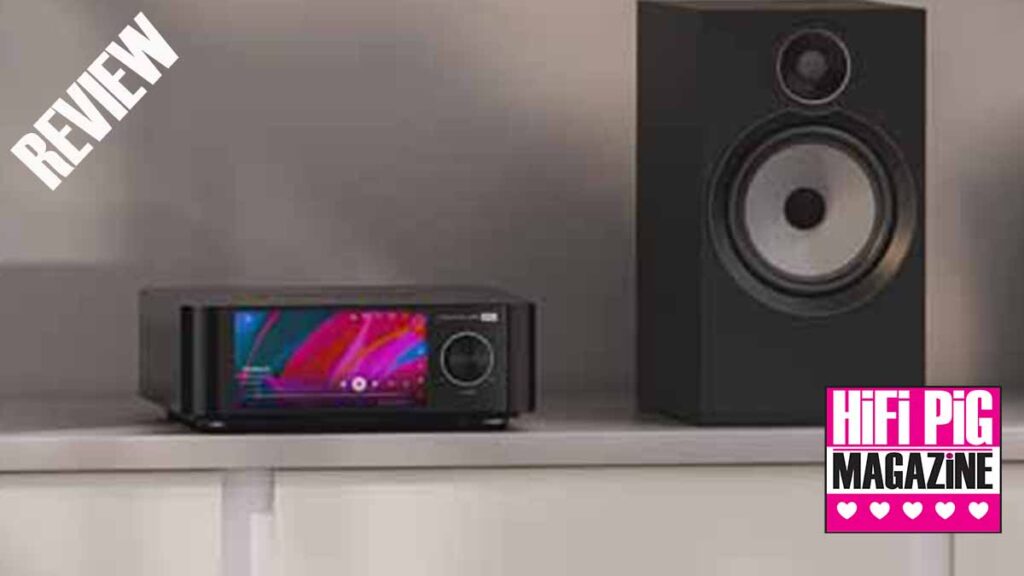
Alan Sugar’s Amstrad made the idea of Tower Systems popular in the very late 1970’s; looking like lots of separates – amp, tuner, cassette, turntable – but all conjoined so you didn’t need a spaghetti junction of wiring at the back and tons of electrical components, including multiple power supplies. It also saved money by not buying the same Amstrad ‘separates’. Of course, audiophiles weren’t fooled by the join (and inferior audio), so separates became King again, and we needed big racks to put our expensive gear in. Times have changed. The idea of onesies and smart speakers have changed the audio world, and some manufacturers are trying to fit as much technology into the smallest space they can, perhaps for the University student or those with a small space and small cash. Indeed, I don’t know how Eversolo (who always amaze me) can get so much electronics and functions into such small spaces. I mean, how can you fit a CD player, amplifier, phono-stage, streamer, BT and wired digital input with full touch-sensitivity 14cm colour-screen in just 7.5 x 23 x 23cm, and the whole caboodle weighing in at under 3kg. Eversolo seem to know how, and to offer it all for just £699, and if you don’t want the side-opening CD player, then that reduces the price by a further £100. That is why I wanted to test it; features are one very important factor, but sound quality is also (obviously) very important.
Eversolo is a Chinese brand from Shenzhen, started in 2014 by a team of HiFi enthusiasts working for Zidoo Technology. Zidoo is a Chinese technology company formed in 2014 that is a leading manufacturer of ARM multi-core architecture for the industrial and consumer community. 80% of what they make is exported to Europe, America and Southeast Asia. The “Eversolo” division concentrates on the audio side of things.Their DMP-A6 streamer received excellent acclaim in 2023, and which I reviewed earlier. The Play CD Edition continues all that technical wizardry, so I will not spend too much time talking about the functions this time.











BUILD AND FEATURES OF THE EVERSOLO PLAY CD EDITION
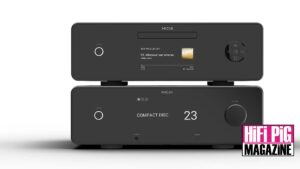
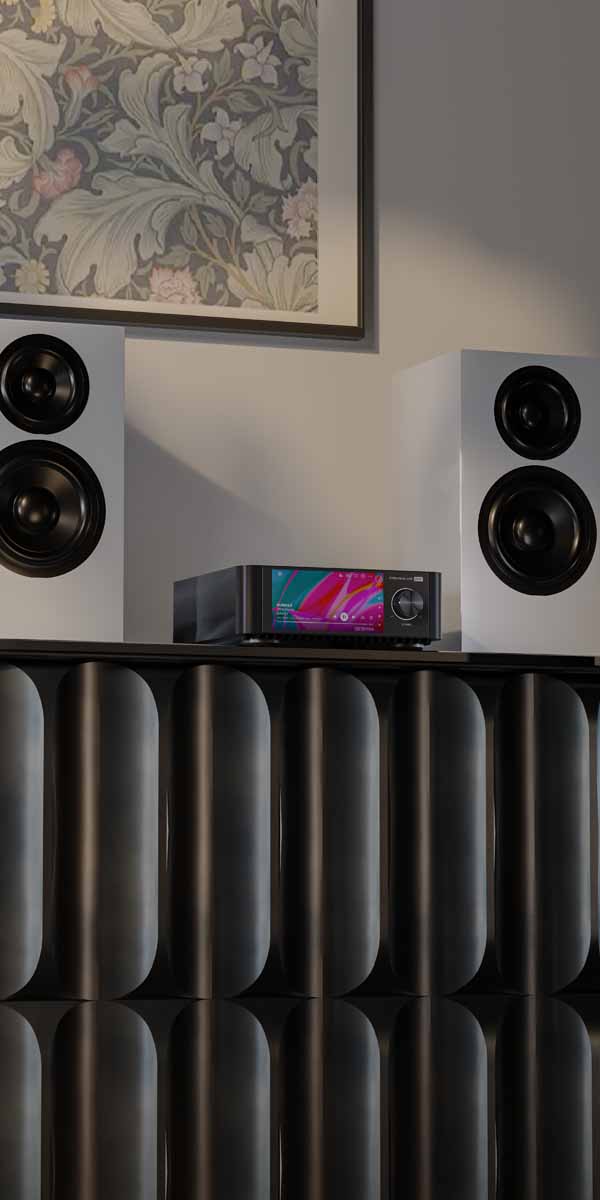
The first thing I noted when I got the unit out of the box is that it isn’t actually very easy to tell what it is, apart from “Eversolo” etched on the solid top of this well-built unit. To the very right, with my magnifying glass, I finally could see that it was indeed the Play CD Edition. Phew. It doesn’t even tell you when the screen “comes on”.
Underneath is a full-length heatsink to take away any heat from the unit in this 60W Class-D amplifier. It doesn’t get hot or even very warm, apart from the CDs when you take them out of the unit after playing them. This is a really lovely unit to look at, though it only comes in black. Perhaps pink, green, blue, etc, might attract more of the market I assume it is designed for.
In terms of technology, this, like the DMP-A6 streamer, is a highly technical and brilliantly functional machine. Analogue inputs include an RCA line and an MM/MC phono-stage. The turntable earth linkage is positioned a distance from the audio RCAs, which could be confusing, though I didn’t actually need it with my turntable. A subwoofer RCA output (mono) is provided, and also a coax digital output. Digital inputs include coax and optical, HDMI ARC, USB-A input, and a USB-A output if you want to store music tracks greater than the internal 32GB memory. An RJ45 allows network connection, plus Wi-Fi is also provided. A 3.5mm trigger-in and a set of loudspeaker binding posts complete the rear, plus an IEC socket and toggle switch to turn it all on.
Streaming provision is expansive, plus uPnP to allow you to connect all streaming services you should ever need (see the specification below), and a cute feature called “Listen at Will” will randomly play music from all your logged-in services and libraries, just in case you can’t be bothered to select what you want to hear – just like the “shuffle” button on my aged iPOD!








Digits are handled up to 32-bit/768 PCM and DSD 512, all thanks to an AK4493SEQ DAC with “VELVETSOUND™ technology”, rather than the ubiquitous ESS Sabre DAC found in the DMP-A6. The front is very bare, with just a back-lit volume control/function knob on the right and a large touch-screen coloured display for you to do all your wizardry and which is also replicated on your smart-phone using the Eversolo App (obviously both Android and iOS). There is no headphone socket, unfortunately.
Like the Streamer I reviewed, there are tons of things you can do to alter the sound quality and visual display. Yes, there are 7 VU meter selections if you want to pretend it’s a Nagra or Akai reel-to-reel, and 4 parametric EQ display choices if you want disco lights. I have to say I do like these features! Even the back-lit volume/function knob can change to a different colour. My favourite was the “passion” option. There are also 23 EQ presets if you want to make the sound work best with your speakers, or you can create your own. There are also FIR (Finite Impulse Response) digital filter design options you can import, if you really want to go high-tech to gain a linear phase response. You can even use the Eversolo EM-01 omnidirectional microphone (or any other) to – like with DIRAC – adjust the audio to fit best with your room in the “Room Correction” app. There is a multi-room facility, and music service usage allows access to all the network services you will ever want to use; TIDAL, Qobuz, Apple Music, Deezer and Amazon Music are integrated into the player. Any other apps you would like can be downloaded from the appropriate APK file onto a USB stick and uploaded onto the Play. The unit also supports multiple streaming protocols, so you can stream music directly to it from your phone. It also supports cloud-storage services. I could go on…


Amplification is handled by a Class-D 60W (8-ohm) design. That might seem like quite a lot of power, but my 87dB sensitivity Graham LS5/9 speakers needed to have the volume set at 85% to give me any sense of power and excitement in my reasonably small room. Had that been Class-A/B with toroidal power, it would be louder! Much more about the sound later, of course.
The internal CD player is a great idea. I still use my silver discs regularly, and this player will work with both CD-ROMs and home-recorded CDR’s. The transport is, however, rather flimsy in use (It’s the sort you get on a laptop), so you should take care (and remember it opens on the left side of the box). CDs can be ripped onto the internal 32Gb storage.
Unless you sit next to the Eversolo, you will need to use the Eversolo App when you play the Play. I loved the app when I used the A6 streamer. However, if I suddenly need to alter volume or anything, I will have to keep logging back in to my phone each time. I would therefore have also liked a simple remote control available for basic operation. I loved the fact that my phone could copy everything on the Eversolo screen, so I could change sounds, VU meters, look at album covers, and a plethora of other functions, too. For my review, I logged in to Qobuz on the Eversolo, played Wi-Fi sources, plus used network-based services, such as Spotify, BBC, etc.
The internal phono-stage suggests it is MM/MC compatible, and if using Moving Coil, I would recommend using the highest-output cartridges. Analogue sounds from my (much) better Krell CD player tested out the analogue RCA, and its higher output consequently increased sound pressure in my living room a bit.
SOUND QUALITY
I must start this section by saying this is by some margin the cheapest fully-featured onesie I have reviewed, and who could have thought when Amstrad issued their unique TS40 Tower System in a wooden rack in 1979 that so much more technology could be put into such a smaller space 46 years later. Indeed, that successful £150 unit in 1979 would, in today’s money, also cost about £46 more than the Eversolo. But which would sound better? Well, unsurprisingly (phew…) the Eversolo is far, far better, and just like the TS40 did, it will allow new music listeners into the world of “HiFi”, who might otherwise have to save up a few more years’ pocket money. I was blown away by the features and the great screen and app.
Sound wasn’t quite as good, unfortunately, though. Playing the French group Air’s famous “La Femme d’argent” instrumental track from their 1998 debut album ‘Moon Safari’ set me in the wilds of electronica and downtempo music style, with a very detailed and fast rendition of the talented duo’s music world. Everything was very accurate, but it just sounded too much like the Class-D of old. Soundstage, both sideways and front-to-back, was reasonably good for such a cheap and sophisticated unit, and signal to noise would be very good if I could get the music loud enough to test. This seven-minute track really shows off the duo’s fondness for Burt Bacharach, plus it has a great piano solo that the Play just made sound just a little too technical. This is a warm-sounding album that just played a little too hot for me on the Eversolo. Those great aged synthesiser sounds were detailed and took me back to my own early synths, with the sounds of Moog, Korg MS-20, ARP String-Ensemble, and probably many more. Such a simple track with constantly repeated chord modulations, but I couldn’t get into the music as much as I wanted. Taking the Coax digital output and processing it into another of my amplifiers did improve things. Similarly, the vocoder in “Remember” was just a little harsh, as was the synth drum. The “ELO” influences from the cello sliding notes did humour me, though. 


Graham Fitkin’s ‘Piano Circus’ CD contains 3 works for 6 piano players. This is a highly detailed and very bright-sounding recording. Six Steinway grand pianos being hammered will certainly test your ear’s handling of frequency response, let alone your HiFi components, and is very much in the Steve Reich “minimalist” style with repeated ideas and changes in accents and rhythms. The Play made great attempts at displaying the pianos in different areas of the soundstage, though I am not sure I could identify all 6. Though very dynamic, the amplifier still needed to be around 85% to give me any sense of power and energy, but the detail and passion of the performers were still evident. The six pianists who created the ‘Piano Circus’ ensemble obviously didn’t have access to many works for six pianos, so Fitkin came to the rescue with ‘Log, Line, Loud’; three very long and tiring pieces for the musicians. The chunkiness of the music and the interplay between the musicians are very clear. With busy note playing in “Log” and power chords in “Loud”, the performance gave me heightened belief in the Eversolo.
One of the pianists in the performance above was the composer Max Richter, and playing his “On the Nature of Daylight” from the album ‘The Blue Notebooks’ was really expressive with all the long string ensemble chords. The double bass was extended, and all the instruments in the recording played an equal part in the soundstage. Everything was well controlled and reminded me of Arvo Pärt or Berio. The Eversolo was surprisingly organic in sound and highly addictive.
Turning to Phil Collins’ 2025 mix, Sussudio had all instruments very precise, but that electronica really doesn’t help with the Play’s amplifier. All instruments are very precise and detailed, from acoustic guitars in “Crying in the Night” (Buckingham Nicks) and percussion in “Logical Song” (Supertramp) were clear, but again a little too “tizzy” for my audiophile-centric liking.
Nirvana’s “Smells Like Teen Spirit” had plenty of guts, and would certainly be a distraction from writing that last-minute dissertation, forcing me to turn down the volume to -21dB.
I did find that a few times my Qobuz playing glitched depending on which page was open on the app; all was fine on 24-bit music on the Qobuz page, but as soon as I went back to the Eversolo page with the grey parametric EQ in the background and the track detail and timeline at the front, things weren’t quite so succinct. I also hoped the VELVETSOUND™ technology on the AKM DAC would do as it says on the tin, but there was little that was velvety, even through my LS5/9s.
Plugging in my MC Ortofon cartridge did, however, give me something to smile about. Switching between MM and MC in the settings changes the load impedance, but there is nothing you can do to “tailor” the sound of your cartridge. However, I was to be entertained by some very musical performances using the Play. The Rachmaninov Piano Concerto No. 2 (Martino Tirimo, Philharmonia Orchestra) did need to have the volume almost on full to take advantage of the gorgeous chords and modulations, and the VU meters hardly registered anything at all, but the sound was still quite engaging. There was great depth of field and good detail, though top frequencies were not quite as fluent as I hear from my vastly more expensive Manley. There was an excellent bass-end and a very quiet and musical RIAA curve. The iconic album “A Kind of Blue” sounded just a little too mellow, but the occasionally distorted saxophone was just as I expected to hear it. The raspy saxophone, plus the beautiful trumpet playing from Miles Davis, was clear and as velvety as I hoped the VELVETSOUND™ AKM DAC would be. This album is often regarded as the best jazz album of all time and is brilliantly recorded, though I could perhaps name a few others, too. For an onboard MM/MC phono-stage sounding this good in a feature-filled streaming amplifier is something Eversolo should be proud of.
QUIBBLES
For £699 there is little I should complain about. However, that 60W amplifier just wasn’t quite enough for me in terms of power or musicality. Remember NAD’s original class A/B 3020 was just 20W, but much more powerful. I also missed the lack of any wired headphone provision.
CONCLUSION
There is no way that £699 with all this tech could possibly compare musically with a seriously expensive contender. As someone once said, nothing in life is free, but as Churchill almost said, “Never before in the acoustic field of human listening has so much been put into such a small space for so few pounds”. What Eversolo does do is allow you to get physically closer to more of your music source options, and whilst the sound might not be as good as a traditional bare £699 amplifier, with all the functions and changeable settings at your disposal, you can at least tailor it to the sound and appearance of your own satisfaction. If you want to get emotionally closer to the music, that is not going to happen, but this amplifier is fast and doesn’t hide anything, and most importantly, you will have great fun. It is a great achievement, and I really enjoyed having it to review, and perhaps had I been new to the audio world (the target audience for this product), I might indeed be tempted.
AT A GLANCE

Build Quality:
Excellently built and internally designed
It has great looks, especially the curves
Sound Quality:
Very detailed sound from the Class-D amplifier, with lots of user control over how it sounds
Value For Money:
£699 for all this technology and 5½” touch-screen is a bargain
It even has a CD player and MM/MC phono-stage
We Loved:
Festooned with functions and features
Tight and fast sound
Excellent MM/MC stage
Excellent App
Great visual displays to take your mind off the music.
We Didn’t Love So Much:
The amplifier is just not 60W-enough for me
Lacks dynamic punch
No headphone socket
Elevator Pitch Review: Eversolo never fails to leave me speechless with respect to features and functions for the price. They look great, are well made and always come in small physical and financial packages. For £699 you get here a fully-featured analogue and streaming DAC amplifier package including both MC and MM phono-stage plus a CD player that you can even rip music to the built-in hard-drive. With all the features, including VU meters on the 5½” touch-screen, would I be distracted into actually forgetting to find out just how it sounded? Of course I wouldn’t.
Price:
£699, available in black (£599 without the CD player)
Janine Elliot
System Used:
Qobuz, Spotify, BBC (digital streaming) and BT via Samsung phone; Krell KPS20i (CD); Pre-Audio/Ortofon Kontrapunkt b (turntable); Graham Audio LS5/9 plus Townshend Supertweeter (loudspeakers); Tellurium Q and Townshend XLR/LS cables plus standard mains leads, Coppice Audio stand and Townshend rack.
SUPPLIED SPECIFICATIONS
Power 60W per channel (into 8 ohms)
Streaming features Bluetooth 5.0, AirPlay, Spotify Connect, Tidal Connect, Qobuz Connect, Amazon Music, Deezer, BBC Sounds, UPnP, Roon Ready, TuneIn internet radio
Sources CD, Bluetooth
Network Wi-fi, ethernet
Inputs HDMI ARC, Optical, Coaxial, MM/MC phono, RCA line level, USB type A x 2
Outputs Coaxial, Sub out
Headphone output? No
Max file resolution 32-bit/768kHz PCM, DSD512
Dimensions (hwd) 7.5 x 23 x 23cm
Weight 2.9kg
Finishes black