Ancient Audio Studio Oslo Monitors










Love at first sight
I’m a sucker for the cute and pretty ones. I’ve always been the same. So as soon as I unpacked Ancient Audio’s 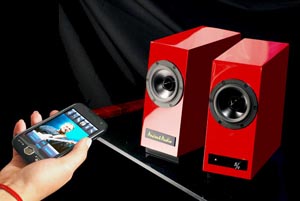 dinkyStudio Oslo active loudspeakers, I knew I was in trouble. Beautifully finished in deep gloss lipstick red and measuring just 100 x 239 x 210mm (WxHxD) they adopt the ‘narrow frontage/extended depth’ format. For those who would consider the review pair too, errr… ‘tarty’ they are also available in white or black gloss as well as ebony and rosewood veneers.
Hailing from Poland (despite the Norwegian moniker) the Studio Oslo is described as a ‘nearfield powered monitor speaker’. Given the connectivity on offer, it’s hard to argue. With balanced XLR inputs, in addition to 2 pairs of RCA phono sockets (for high and low level signals) along with volume and – wait for it, tone controls, they certainly tick the studio monitor checklist.








With an eye toward their likely placement on desks, from the side they have a parallelogram profile, ensuring that the single full-range driver, sourced from Dayton and featuring an anodised aluminium cone, fires slightly upward, toward the listener.
Connections and power amplification reside in one of the speakers, along with an analogue sound processor, precisely set to optimise the performance of the drivers by compensating for phase shift and amplitude variations across the driver’s frequency range. An umbilical provides signal to the left speaker. Onboard amplification is based around the Philips TDA8566Q IC, providing 30 watts of power. Ancient Audio state that they have biased it well into class AB, but in use, the rear-mounted heatsink barely rose above room temperature.
The units come complete with a simple laptop type power supply, though Ancient Audio state that any laptop power supply with an output of 17 – 19 volts DC will do the job. Ancient can also supply an adaptor that allows the speakers to be used with car or leisure type batteries.
Listening




The Studio Oslos are marketed as being ideal for computer-based audio, TV, mobile phones and MP3 players. Fine. In line with the ‘everything was better in the old days’ phase I’ve been enjoying lately, out came a Philips ‘Discman’ type portable CD player (‘jogproof’, no less) circa 1995. Well, with a name like ‘Ancient Audio’, they asked for it…
Kicking off with Liane La Havas’ ‘Au Cinema’ from her debut album, ‘Is Your Love Big Enough’, there was nothing ancient about the sound. Right off the bat, the first thing that strikes you is the incredible midrange coherence and clarity. Strings and vocals are incredibly immediate, palpable and – dare I say it, natural. Struck percussion – woodblocks, congas and bongos for example, enjoyed the same startling clarity. This particular track features assorted subtle percussive effects throughout, including guiro shaker and drum kit rim shots. Not all systems lay these effects bare. These mini monitors did. Surprised? Intrigued? I was astonished.
On ‘Elusive’, from the same album, compression effects are used to produce the familiar ‘squashed bass’ sound, contrasting with the rest of the mix which seems almost compression free. In particular, Liane’s breathing, phrasing and wonderful vibrato were as clear as day, while plucked strings on her Gibson guitar sounded just as they should, with real harmonic richness. Even handclaps further back in the mix actually sounded like handclaps.
Typical of a single-driver design, midrange-to-treble coherence was outstanding. However, the treble itself was initially hard to get a handle on. While some loudspeakers try to imitate treble detail by having a rising response at high frequencies, these beauties were detailed with good separation, with triangles easily discernable from amongst cymbals and bells for example, yet the extreme treble seemed oh-so-slightly rolled off. This lead to an odd effect, where high frequency resolution was so good, it genuinely revealed new details, but sometimes further back in the mix than they should have been.
I presumed this apparent extreme treble roll off was an inherent characteristic of the Dayton full-range driver employed in this design, but having investigated the drive unit’s specifications, that isn’t the case. I was flummoxed.
It’s the cable, stupid…
Perplexed by the wonderful/frustrating treble, I experimented with bright, strident all-digital, recordings (cue just about every track from Prefabs Sprout’s ‘Jordan – The Comeback’) I tried adjusting the height of my computer chair to ensure that my ears were at the right height, I tried pretty much everything. I was falling in love, but something wasn’t quite right. Finally, it hit me – with the Studio Oslo arriving as a complete kit, I’d simply used the bundled power supply and signal cable to lash the whole rig together. How cheap is the supplied signal cable? Well, I suspect you would be able to buy near identical examples in a pound shop or dollar store – but only in multiples of ten. You get the picture…
Hopeful that I’d identified the problem, but still determined to continue my self-indulgent ‘time warp’ existence, 10 minutes of rummaging around saw me find a 20 year-old pair of Kimber PBJ interconnects. With the Ancient Audio supplied cable replaced (and given to the dog to use as a chew toy) I proceeded to be completely blown away by the clarity, coherence and poise of these incredible little speakers. ‘Cinderella Ballin’’, from Angie Stone’s ‘Stone Love’ album is a multi-layered affair, yet wind chimes, cymbals, bells and vocal sibilance were distinct and natural.
Stevie Wonder’s harmonica playing on ‘Little More Time With You’, from James Taylor’s ‘Hourglass’ album had real bite, but none of the phasey effects so common when listening to speakers with multiple drivers. Branford Marsalis’ soprano sax playing on ‘Gaia’, from the same album, was wonderfully spot lit, soaring independently of the layers and layers of instrumentation and massed voices. No edge, just beautifully resolved, wonderfully delineated music. I was infatuated.
The plucked guitar on ‘I’m Getting Ready’, from Michael Kiwanuka’s ‘Home Again’ album sounded so vital and immediate, that I found myself doing the whole gormless grinning/head nodding thing. In fact, the Studio Oslo was so revealing that it reminded me that we all discriminate. You know exactly what I’m talking about. We all have those albums that we definitely don’t listen to from start to finish, instead choosing to go through the same ritual of starting with our favourite tracks and using the opening bars of those tracks we don’t like as nothing more than a cue to reach for the ‘next track’ button. Over time, it becomes almost automatic. These dinky things helped me to discover tracks that I’d long since condemned to my subconscious ‘skip list’. In particular ‘Rest’ from the same album – a track I’d long since written off as far too twee and saccharine for me was utterly captivating, showcasing Kiwanuka’s easy-going, effortless, soulful delivery.
As far as imaging is concerned, they really do exploit the abilities of both miniatures and point sources. Simply put, at times, they threw virtual holograms. My teenage son, who, in passing, has heard more high end kit than he cares for down the years, for once passed comment, repeatedly exclaiming, “it’s like they’re in the room!”
Quality vs Quantity
Listening to the Studio Oslo, I’m convinced that their designer, Jarek Waszczyszyn, must have the body of an Adonis. He is so obviously the kind of guy that always politely refuses second helpings, no matter how delicious the dish, preferring instead to eat exactly the correct amount required to maintain a perfectly proportioned body. At least that’s the approach he’s adopted to the design of these beauties. While other designers start mini monitor design projects not with a blank sheet of paper, but with a sheet headed ‘Super miniature design sheet/bass augmentation project’ he’s gone for an even frequency response and clearly expects purchasers to be grown up enough to realise that the very deepest bass isn’t on the menu here. That said, in normal use, I never felt short-changed as far as low frequencies were concerned.
What is available is finely judged, free of obvious bass reflex foibles and surprisingly deep – in part due to the long port and downward firing arrangement. In fact, Gbenga Adelekan’s simple, loose bass playing, on Metronomy’s ‘The Look’, from their most recent album, ‘The English Riviera’ shows just how low these babies will go. Though it is possible to produce the familiar bass reflex ‘one note thud’ effect by turning the bass control up to ‘11’, at its standard setting, bass is firmer, tauter and more realistic than you’ve any right to expect. Listen to a pair and you’ll agree that the design falls on the right side of the quality vs quantity bass equation.
Infatuation
I fell head over heels in love with these loudspeakers. In fact, to put too fine a point on it, my time with the Studio Oslos severely tested my partner’s patience. I found myself making excuses to leave the room and spend time with them. Not always to play music, sometimes just to look at them and give them a knowing smile. I got butterflies in my stomach whenever I thought of another album that would sound great through them. I started missing meals. On more than one occasion, she took me aside and asked me outright, “Is something going on?” I lied, of course, and told her that there was no-one else. The dirty, filthy truth was that all I could think about was spending more time with these beautiful, sexy, addictive things. All the while, the return date for the review pair was looming. What was I going to do? I was completely smitten…
My complete infatuation couldn’t disguise a handful of tiny faults however. The only really significant one being Ancient Audio’s decision not to source and provide a high quality minijack to phono cable – the throwaway affair included as part of the package is the aural equivalent of throwing mud on a Leica lens. Even using the supplied cable, the astonishing midrange coherence is evident, but with a decent cable, the speakers are utterly transformed. Ancient Audio must supply a better cable as standard. Maybe they just don’t realise how good this product is – who knows?
My review sample was from the very first production batch, with a serial number heavy on the zeros – 0009, in fact. As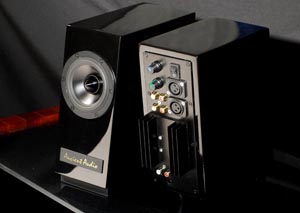 a consequence, the junction at the exit of the port and the base of the speaker didn’t share the Porshe quality finish of the rest of the speaker – but Ancient Audio tell me that this has been addressed on the current production batch – and in any case, it is so minor that only an anally retentive nerd would even notice, let alone mention such a thing. Err, moving on…
While I can understand that the flexibility the bass and treble controls provide might be useful to studio engineers, the team at Ancient Audio have done such a wonderful job with the voicing of this speaker that no matter how much I fiddled around with the tone controls (and with speaker placement) I always came back to the ‘default’ centre position on both dials. I can’t help but think that bass and treble potentiometers with a centre detent would make the most of the excellent voicing job that the Ancient Audio team have done. Better still, a stripped down version, shorn of tone controls would be a good idea. Maybe they could spend the money they save on that decent minijack cable…
Conclusion
Don’t be fooled. Don’t think of these as good or even great by multimedia loudspeaker standards. They are truly wonderful loudspeakers, period. They just happen to be truly portable, with near endless connectivity options.
I’ve heard endless studio monitors, over almost 25 years. I own a couple of well regarded, UK designed pairs. Most provide a very dry and bright balance. A select few have actually provided enough transparency to do the job they claim to. Even fewer have proved listenable in the long term. The Studio Oslo are transparent and not just listenable, but utterly addictive, with bass that is perfectly proportioned and seamlessly augmented, though if you’re expecting the mythical quart of bass to emanate from this gorgeous, glossy pint pot, you’ll be disappointed. Ancient Audio tell me that a subwoofer is in development. If it’s offers performance on a par with its £650 siblings, a giant killing full range system is on the cards.
Author – Rod
Want to read more hifi reviews?