
VoiceVictory POP Speakers
VOICEVICTORY POP SPEAKERS REVIEW
Janine Elliot takes a listen to the cylindrical VoiceVictory POP speakers.
I love being surprised by something that doesn’t look like the “normal”, like Ford’s “curvy” Sierra back in 1982 or Jaguar’s upcoming Type 00 car that similarly breaks convention. Love it or hate it, the latter is certainly a conversation starter. When I opened up the box on the latest speaker from VoiceVictory, my initial thoughts were of the JR149 round speakers minus the foam surround that tried to improve on JR’s iconic LS3/5a shelf speakers in the 70s, or even a DIY version I remember appearing at some point after. The Type 00 car is different for many reasons, and the speaker here for review is similarly different to avoid the less-than-desirable and sometimes ugly square-box philosophy of speaker cabinets that have daubed our living rooms for the past century. It does it for very good reasons. The traditional wooden box is an old philosophy that acoustically is less than desirable, a bit like the air-cooled Porsche 911 engine being behind the back wheels. Porsche worked around that imperfection, just as speaker manufacturers add bracing, walls and damping to make their speakers sound better. VoiceVictory try a different approach, using a thick-walled, high-density PVC cylinder cabinet with no unhelpful straight walls to muddy the sound. All four speakers in designer Ferdinand Verbeek’s range are cylindrical. The idea for the shape actually began when a sewer was being repaired near Ferdinand’s accommodation whilst he was studying law at university. Inquisitively, he “borrowed” a piece of the pipework and started making a speaker cabinet from it, which turned out to sound surprisingly good. Not only did the round shape reduce the impact of standing waves, but it was also strong and resonance-free. His speakers now use high-quality PVC capable of 30 bar of pressure, originally designed to carry torrents of drinking water to homes or supply water in Olympic-size swimming pools. Don’t worry, you don’t have to just play Handel’s Water Music or Bridge over Troubled Water. I hasten to add that Ferdinand never completed his law degree; indeed, he really wanted to do medicine, but, having always had an interest in music and audio (and even running a discotheque at college), he finds working with HiFi just what the doctor ordered.










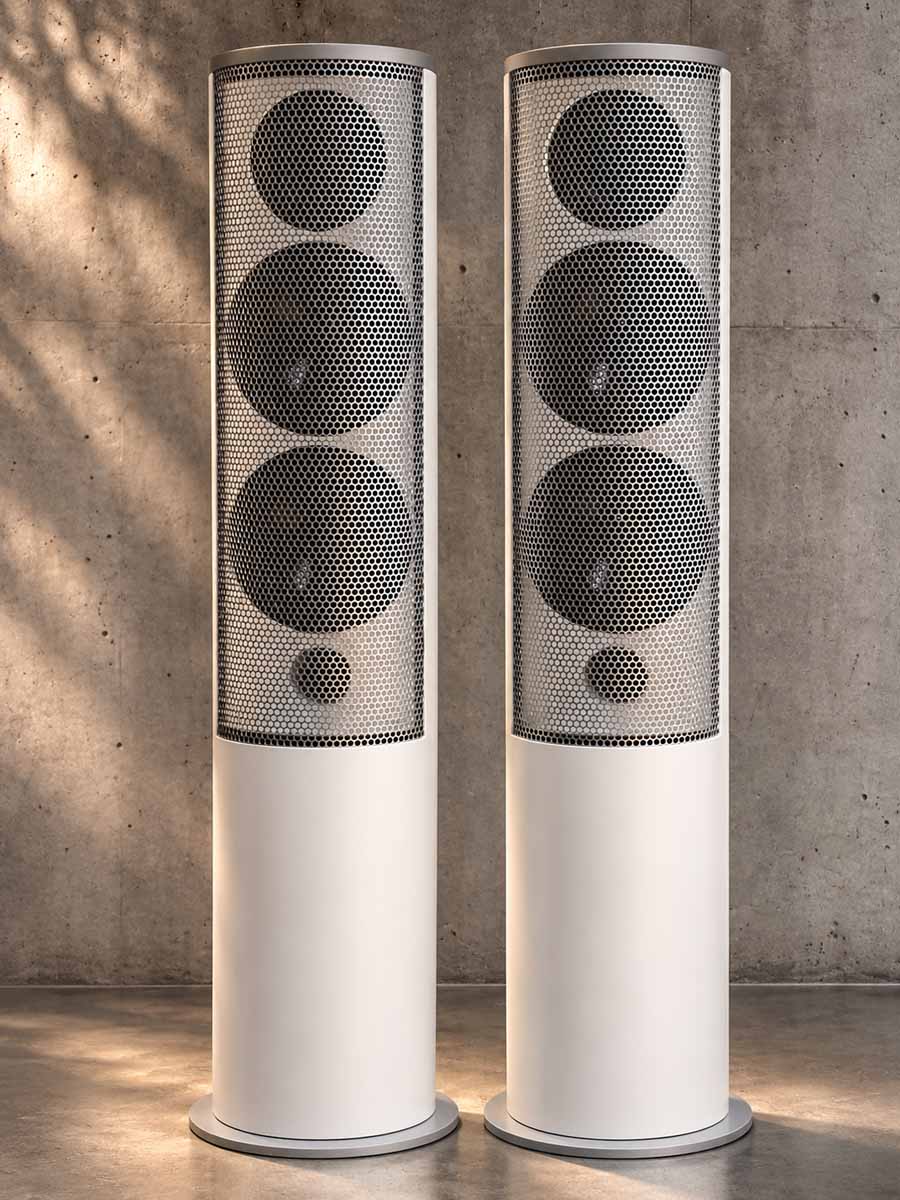
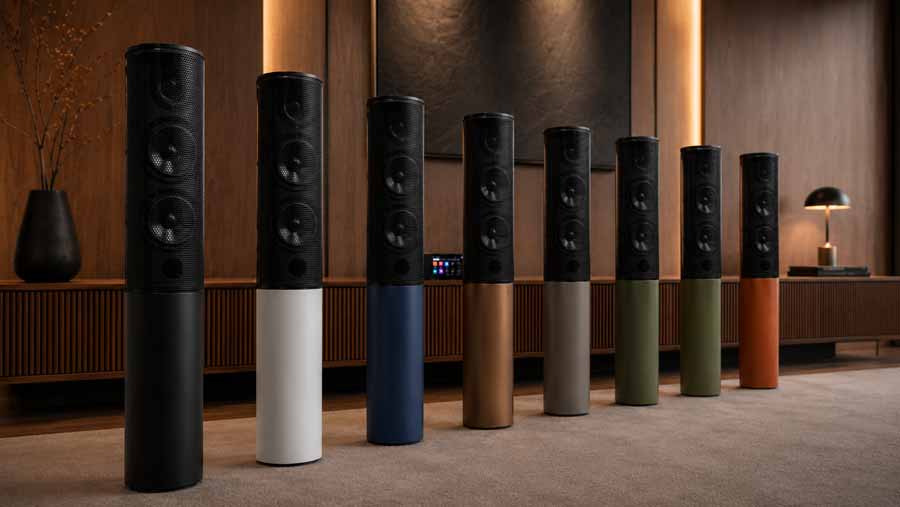
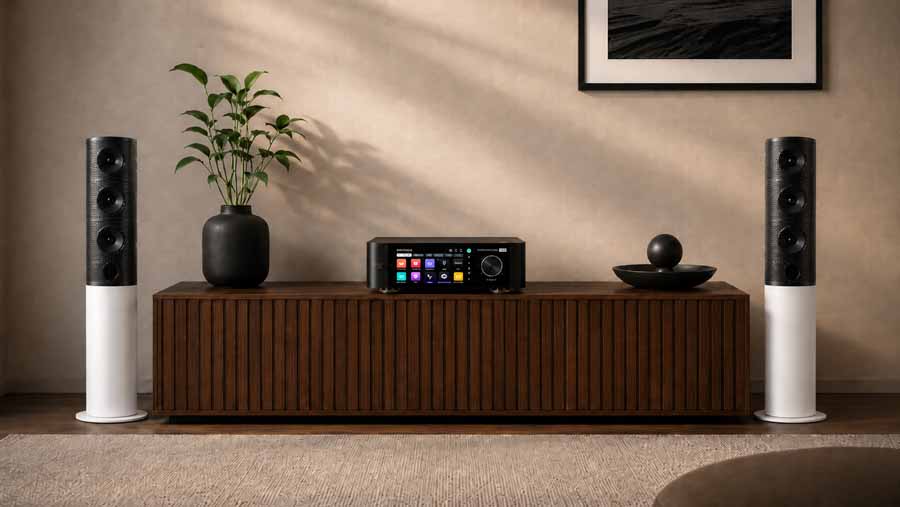
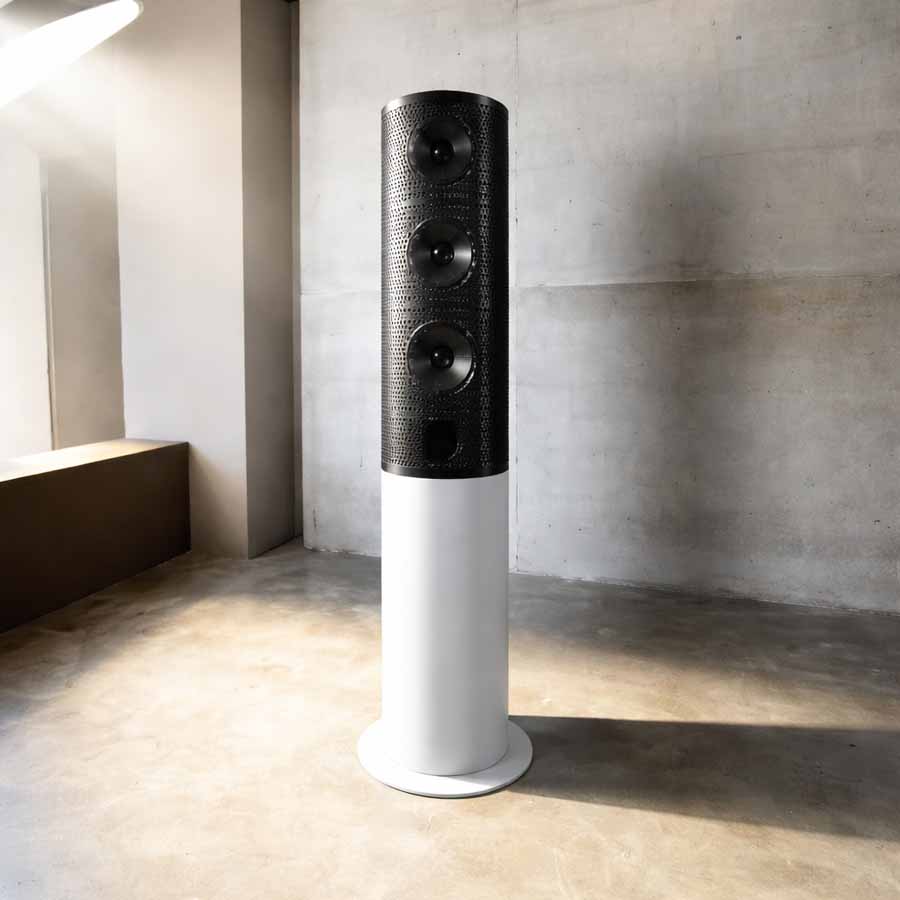
The POP (Power of Possibility) is a unique and compact floor-standing speaker available in a selection of finishes to fit in with your room décor. With a height of 82 cm and a diameter of 16 cm, it is the latest and smallest member of the speaker range. Although the POP is designed to work with their promoted Eversolo products or their own Hypex-based (Nilai) Class-D amplifiers, I reviewed the POP with both Krell KAV250A monoblocks and the petite Proprius amplifiers from Graham Slee, having myself not yet progressed beyond the letters -A and -B. Ferdinand believes in suggesting the ideal amplifiers to work with his speakers, and even the cabling, as he really wants the audiophile to get the best performance, and particularly wants to encourage the younger generation who perhaps have the least collateral. The VoiceVictory speakers are designed with the philosophy of “Less is more”, and whilst very simple and somewhat industrial-looking, are available in a variety of colours to brighten your listening room. Their approach is to merge precision engineering with minimalist design. Indeed, Ferdinand told me that the target is not so much to make them look beautiful but rather to make the musical experience beautiful and powerful. Ferdinand also founded a lighting company called FerroLight that focuses on bold, detailed architectural forms that are crafted in metal. Ferdinand’s background in loudspeaker manufacturing actually dates back to the late 1980s with V-Vox, and this is where his idea of cylindrical speakers first came to light. After hundreds of hours of experimenting, listening and refining, Ferdinand created VoiceVictory five years ago. Interestingly, the name “VoiceVictory” came from his wish to keep the two “V”s used in the name V-Vox.
BUILD AND FEATURES OF VOICEVICTORY POP SPEAKERS
Issued in March 2026, the POP is a 2-way bass-reflex system featuring two 135 mm woofers from Dayton Audio and a 25 mm silk-dome Morel tweeter with wave-shaper. The POP comes as standard in a choice of black or white with either a silver or black aluminium grille for €4,950. Any other RAL colour option for the main cylindrical body is available at an additional price, as is a real leather finish if you wish to match with your handbag. Whilst the POP has three drivers, their top-of-the-range Labyrinth has no less than six drivers, including four bass drivers. With the double letter “V” firmly visible on the circular anodised aluminium top plate, these made-in-Netherlands speakers look particularly well assembled for the price. The epoxy-covered crossover uses the excellent Jantzen and Mundorf components, silver solder with WBC cable (another product that he likes to promote), and has a 6 dB filter at 3,750 Hz. Interestingly, there are no feet on the speaker; rather, it sits on a slightly larger-diameter aluminium base, adding to its industrial look. Despite its small diameter, it sits very firmly on the floor, and, very importantly, the cabinet does not vibrate to the music or resonate when you tap it. With 3 mm wall damping using bitumen plus additional wool damping, there is still plenty of “air space” inside plus a front-tuned port below the two bass units. The speaker is very efficient at around 92 dB/W/m. A single pair of very good-quality multiway binding-post loudspeaker sockets is at the back almost at the base of the unit.
SETUP AND USE
I set up the loudspeakers slightly toed-in, using the Krell Class AB amp that I regularly use, and also listened with Slee Proprius monoblocks. Wiring was TQ, and sources were vinyl, reel-to-reel and 24/192 from Qobuz via a Bluesound Node.









SOUND QUALITY
First to be played was Pink Floyd’s The Final Cut (1983, remastered in 2011) on reel-to-reel. This lesser-known album is actually my favourite, though it includes many ideas that didn’t quite make it on to The Wall and other albums. “The Post War Dream”, with its punchy bass drum and bass guitar, gave the POP a chance to show how extended the dual 5” drivers could go, and, with such small diaphragms, how quick the initial transients could be. It reminds me of my Meridian M2 powered speakers, which similarly have a two-bass-driver and one-tweeter configuration (though those upward-angled speakers have the tweeter between the woofers). That speaker is mightily fast for its age and similarly has an excellent 3D soundstage. The M2’s dual bass configuration means it can get down to 38 Hz and replicate a 12” × 5” single driver. The bass from the POP is more realistic, and the top-end output for acoustic guitar, cymbals and vocal detail was similarly transparent and very fluid. This created a very good soundstage. The mysterious-sounding deep bass drum beat in “When the Tigers Broke Free” gives detail of the mist and uncertainty of front-line battles in the Battle of Anzio in 1944, creating an excellent sound-painting. The track is about the death of Floyd’s bass guitarist Roger Waters’ father in action in Anzio during the pointless Second World War. You cannot help but be affected by the power of the music.
There is similarly excellent bass extension, power and speed in the track “The Gunner’s Dream”, though I did find later in Asia’s “Without You” that the really deep bass wasn’t as natural as would be from a bigger loudspeaker, though not as “synthesised” or “constructed” as in the M2. With Geoff Downes on keyboards, Carl Palmer drumming and Steve Howe on guitar, you would have expected this group to make big waves in the ocean of music. Whilst Asia’s more commercial sound was perhaps a departure from the progressive rock these musicians were best known for, their self-titled 1982 debut album was a huge commercial success, going multi-platinum and becoming the best-selling album in the US that year. The sound quality on the album is very good, with excellent, dated 80s synth sounds and tight drumming, but the POP speakers didn’t quite deliver enough oomph for me to get really involved in the music.
Similarly, the piano from Aimi Kobayashi in her performance of Chopin’s Prelude in C minor (Op. 28, No. 20) just lacked the power in this short, funeral-sounding piece. The piano sounded more Blüthner than Steinway, despite the latter being her preferred choice. Like designs of speakers and cars, Barry Manilow totally stole the musical idea for his own “Could It Be Magic” song, and the piano on that recording really did not sound convincing in the bass, sounding more like a Yamaha. Every piano will sound different and feel different when you play it; even different Steinway Model D grand pianos will sound different, and the weighted keys will feel different, just as every Stradivari violin will have its own sonic signature. Playing piano on a pair of loudspeakers really shows off the ability of a box, especially in the bass and top harmonics. Marcin’s acoustic guitar performance of “Kashmir” (Led Zeppelin) features great playing with pin-sharp melodies, rhythms and percussive effects from the woodwork, plus the addition of synthesiser accompaniment. The POP gave a very tight performance, making it highly enjoyable, especially in the mids and highs. Only a slight peak on the lowest B-flat prevented my total amazement at the speakers, and the detail, bite and depth of sound in his “Toccata” (Bach, BWV 565) were equally engrossing, showing off not just the excellent playing but also the sound engineering.
For detail, the POPs are tops. On Stan Getz and Charlie Byrd’s “Desafinado” from the first-ever bossa nova album recorded by American jazz musicians (Jazz Samba, 1962), the guitar from Charlie Byrd on the right speaker almost “comes out” of the box with its 3D detail, with the rhythm central behind the speakers and Stan’s brilliant tenor saxophone playing slightly further back. The musicians were in the room with me on this brilliantly recorded vinyl.
ELO’s “Midnight Blue” is typical Jeff Lynne in its chords and modulations, a style that no one could get away with copying – although Roy Orbison worked in collaboration with him, and Jeff also wrote for The Move, the Traveling Wilburys and several other groups. Perhaps the regular use of cellos has Beatles DNA, I suppose, but the original design and looks of the POP enabled all these different instruments, vocals, melodic lines and accompaniments, plus the recognisable ELO drumming style, to take their own space brilliantly within the architecture of the music.
QUIBBLES
If sound is your priority, then these small-footprint floor-standers will meet your needs, but I would perhaps like to see some inlay architecture on the PVC cylinders just to make them look a little more visually inviting.
CONCLUSION
Whilst the 1960s Austin Cambridge, Morris Oxford, Peugeot 404 and Fiat 1800 might all look the same, they were distinctly different cars, and in this world of similar-looking or designed speakers, it’s good to see that someone is thinking outside of the (square) box. With its lack of internal reflections and cabinet noises, and its very clear and transparent soundstage, the POP from VoiceVictory could well be your choice for well-rounded music. It’s interesting that, with all the bad press on Jaguar’s unique new Type 00 car, Audi have just released a look-alike prototype. Perhaps all speakers will be cylindrical one day, then. 5 hearts
AT A GLANCE

Build Quality and Features:
A bit industrial in looks, but build quality and detail are superb, and the speakers feature a flat bass response that worked well in my room.
Sound Quality:
Very transparent with excellent soundstaging, including depth.
Value For Money:
€4,950 isn’t cheap, but the sound certainly satisfies my purse. Adding your own colour for €500 will make it really fit into your living room.
We Loved:
Transparency
Soundstaging
Speed
We Didn’t Love So Much:
Bass, whilst going very low (~40 Hz), just lacked the deep power available from bigger air spaces. Pure physics.
Elevator Pitch Review:
I love things that are different, such as Jaguar’s new Type 00 car. It is too early to know whether that makes it better than other cars, but Ferdinand Verbeek’s round, cylindrical loudspeakers are equally individual. Whilst many toy with the idea of rounded corners to reduce internal reflections and improve the looks over boxy speakers, VoiceVictory has decided to go the whole hog. Will it mean a rounded audio performance in my living room? These tiny floor-standers certainly make a big impression.
Price: €4,950 (+ €500 for additional colours)

Janine Elliot
SUPPLIED SPECIFICATIONS
Speaker Housing: Black or white; Cover/Front: Black or aluminium
Options (additional cost): Any colour available for the speaker housing
Weight: 12 kg
Impedance: 4 ohms
Design: 2-way crossover
Sensitivity: 92 dB/W/m, 125 W max.
Frequency Response: ±1 dB, 40–22,000 Hz
Comes with a 10-year warranty.