
EAT F-Dur Turntable
EAT F-DUR TURNTABLE REVIEW
The EAT F-DUR Turntable is a £7899 (plus £1300 for the LPS 2 linear power supply) vinyl spinner from the company headed up by Jozefina Lichtenegger. Janine Elliot takes a listen for HiFi PiG.
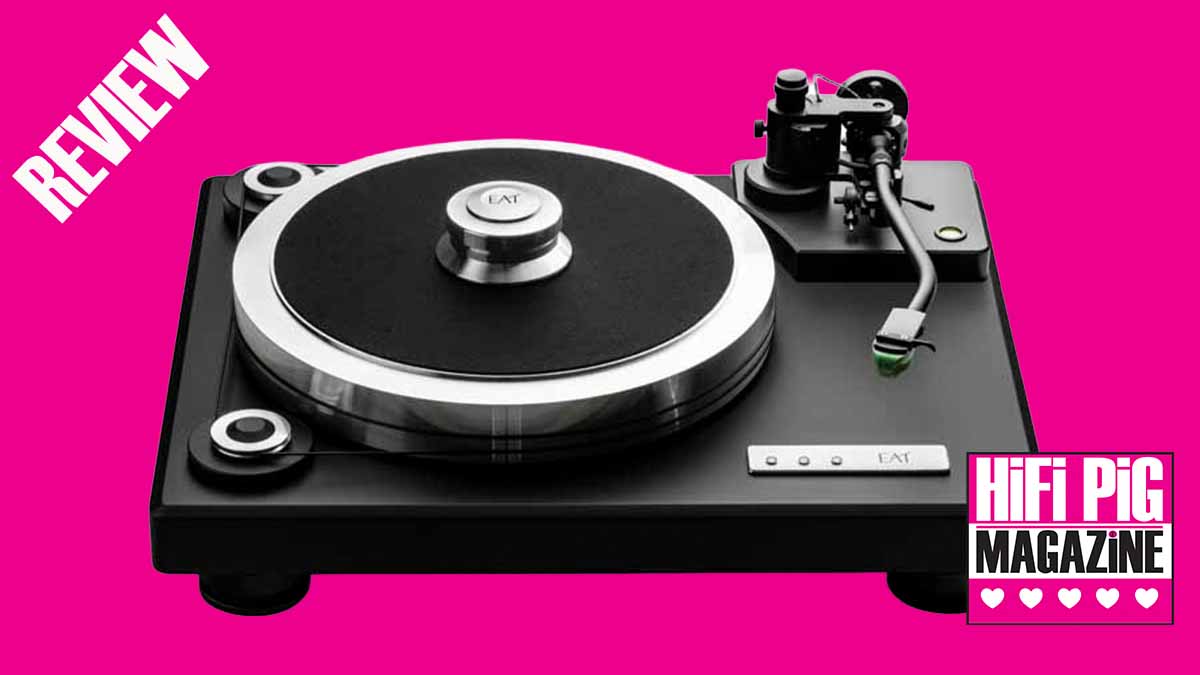
There are really only two types of turntable set-ups; multi-sprung or solid plinth. Whilst my very first turntables as a child were of the former variety (you know, the usual Trio KD 1033 and Thorens TD 160), once I got hold of a Garrard 301 and designed a massive plywood plinth using wood taken out of a British Aerospace airplane (there might still be a plane somewhere flying about with a hole in it…) I was hooked on solid plinths. That turntable was exceptionally heavy and beefy and made the idler-driven spinner as silent as any belted variety. I generally find a fuller and more musical bass end on solid-frame turntables. My present Pre-Audio player has a 50kg marble plinth to match my décor. So, to be given the 44 kg mass-loaded 50mm thick MDF F-Dur turntable from EAT, was indeed food for thought. F-Dur is German for F Major. This model fits within the midrange of EAT turntable prices and uses much from their similar-looking and slightly more expensive Forte S turntable (based on the Forte but smaller, hence the “S”).
I have been interested in EAT (European Audio Team) since its beginnings, not only because of the consistently musical note-names, but also because, like my phono-stage, it is owned by a woman and valve veteran, this time Jozefina Lichtenegger. This captivating woman began her journey in audio in 1998 whilst studying for an MBA at the University of Economics in Bratislava, Czech Republic. In her walk towards EAT, she has worked at VAIC, where she learned about valve production, later in 2003, selling 300Bs and KT88s. VAIC’s owner then sold the company to her, and she moved to Prague. EAT, whilst predominantly known for its turntables, starting with the Forte in 2009, still makes brilliant vacuum tubes in the Czech Republic using their own manufacturing techniques. Their mission is to make the very best 300B and KT88 tubes, and my Synthesis Roma 98DC mono-block power amps indeed use KT88s.










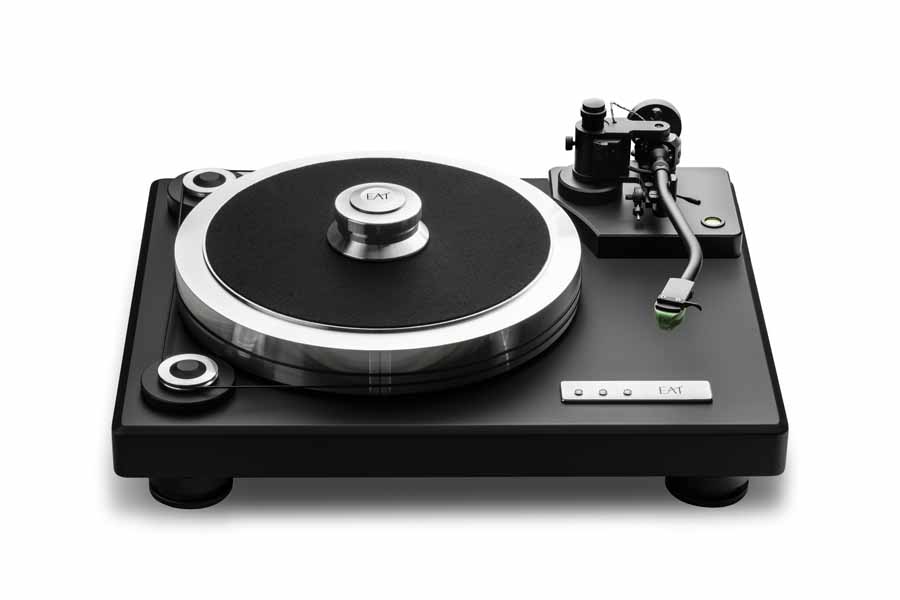
The final reason for my interest in the company is its link with Pro-Ject Audio, famed for their competitively priced predominantly MDF plinth’d turntables. It is essential to stress that EATs are not rebadged Pro-Jects! Whilst both companies reside at the same site, EAT occupy a separate area. The only inseparable link between the two companies is that the Pro-Ject CEO is her husband, Heinz Lichtenegger, and that they produce the turntables for them. The design, however, is totally at the specifications set by Jozefina. The F-Dur, at £7899 including the £4k F-Note 12” tonearm, is totally EAT in its philosophy and over-engineering. It is massive, too!
BUILD AND FEATURES OF EAT F-DUR
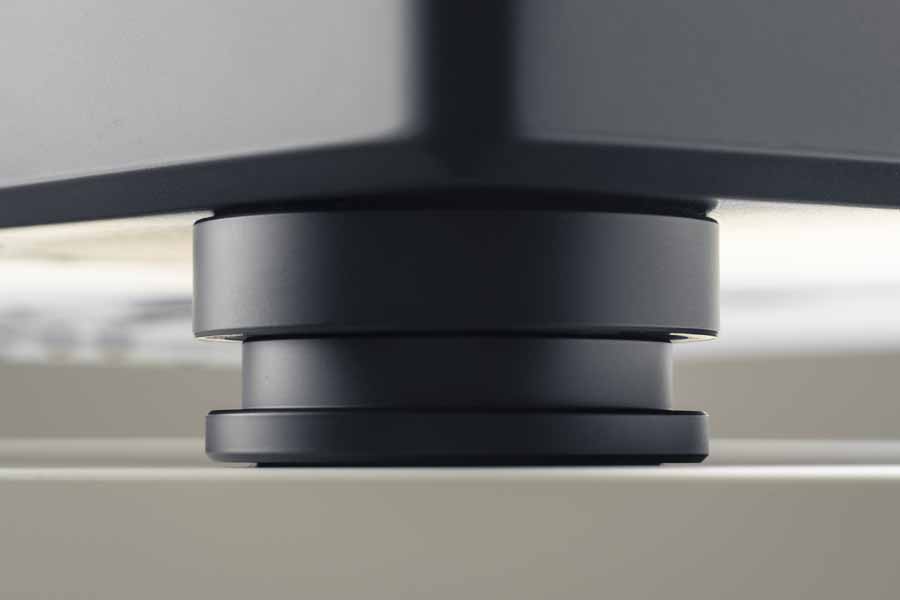
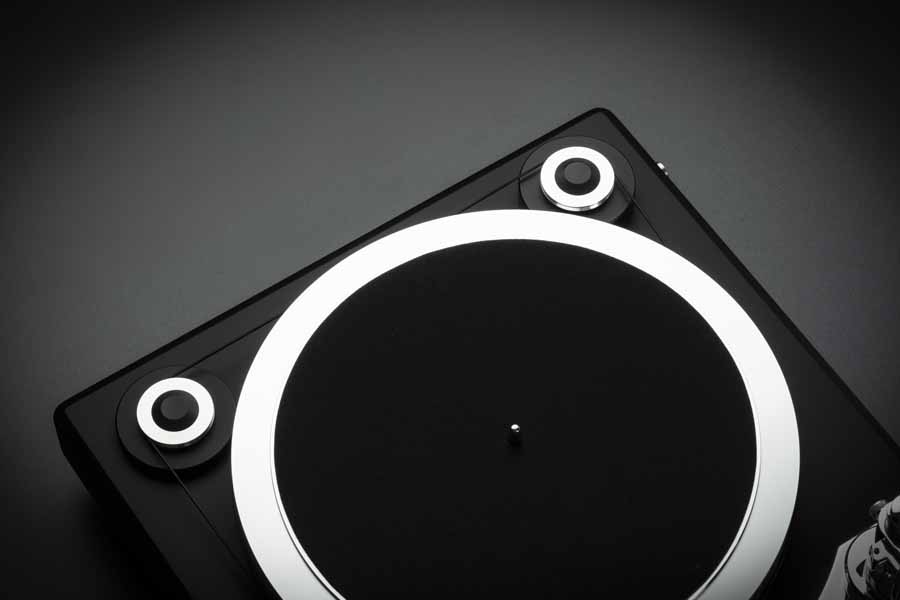
Apart from its footprint of 550x440mm, meaning that many stands won’t be able to fit it, the most notable features of this turntable are the oversize 13.5” platter and 2 AC motors and belts. These are not just for show; they are essential in making the music sound good. Just as in the original Forte, the platter is heavy, and the extra size and weight at the rim increases kinetic energy and reduces wow and flutter; Transcriptors and Michell were first to utilise this basic physics from the 1960’s, placing heavy weights around the platter. Having two motors is not just to help get the record get up to speed; that still takes 10 seconds for 33.3rpm to be accurately set (and longer for 45rpm), so you won’t find this turntable in a radio studio. More importantly, having two motors means that any minute change in speed due to a change in poles in the magnets as the motor revolves is reduced, as each motor is separately driven from the DC-driven AC power generator to supply a freshly created sine wave. Unless you want to pay the price of a house for Wilson Benesch’s GMT 21-poled engineering marvel, then this is at least getting a bit closer. Each motor is carefully selected before being worthy enough of installation, apparently from a collection of over 100,000 available units, with the precision DC-driven AC power generator making this all work accurately and silently. These motors are mass-isolated from the main plinth. The belts themselves contain carbon fibres, which makes the belt conductive and therefore eliminates any static buildup that might affect speed stability, as well as attracting dust to the record. This is also a seamless rubber ring, unlike most that are made by glueing two ends of a rubber length; this ensures that the revolution of the platter will have an accurate motion. The 50mm-thick solid MDF plinth will act like a sponge and absorb vibrations, but my old test of tapping the plinth or the table it’s sat on could be heard from the speakers. I don’t generally jump up and down as I listen to music, though, so the turntable was remarkably well behaved, as was I. Interestingly, the 4 feet of the turntable are right at the edges of the turntable, just like Austin famously put the wheels of the 1800 (motorcar) as far to the edges to create better stability and road-handling, but the problem with this on the F Dur is that whilst the top of your stand might allow an over-hanging turntable, at 21.654” it might not be quite so easy with the feet at the edges. These aluminium feet are all adjustable to get a perfectly flat turntable, using the spirit-level on the arm base as a reference. Integrated TPE damping inside the feet absorbs any vibration.
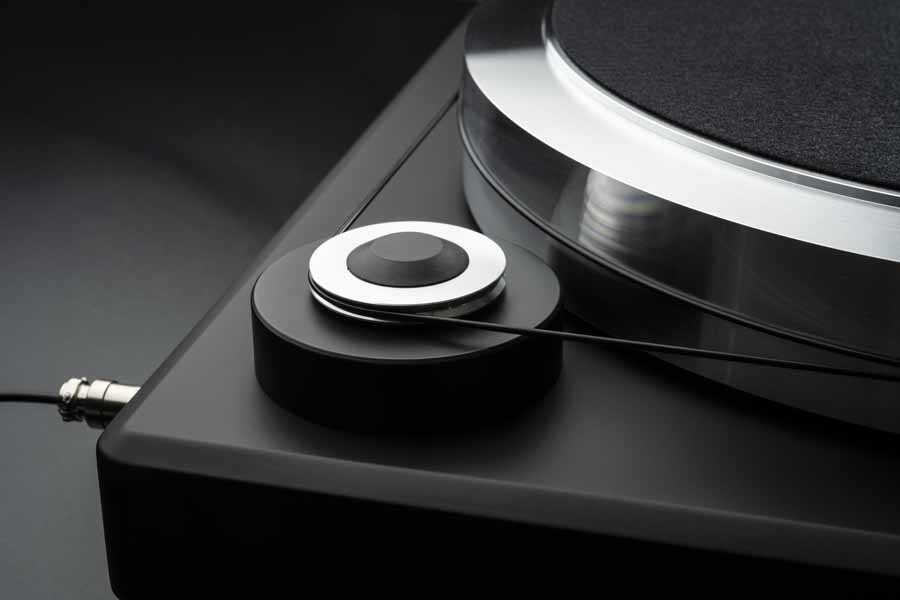
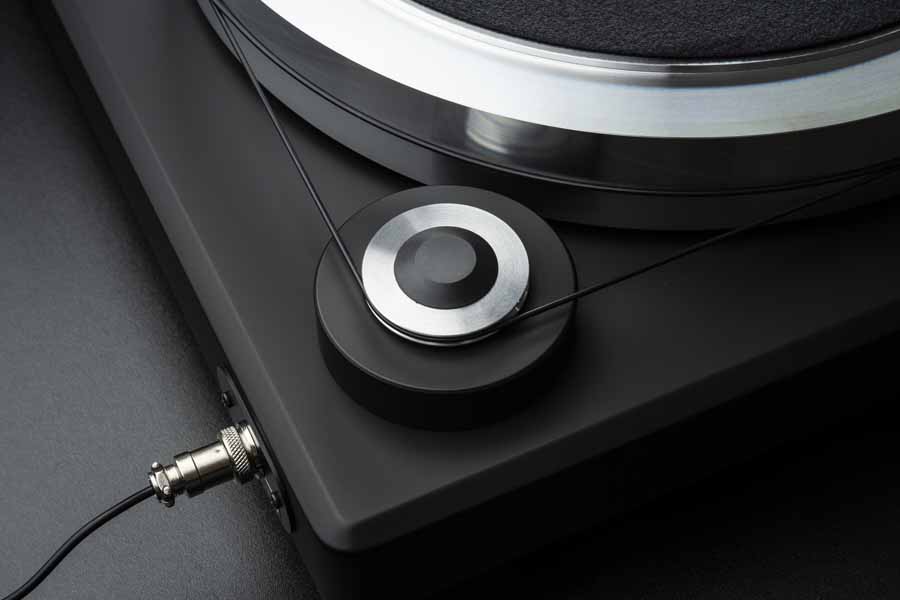
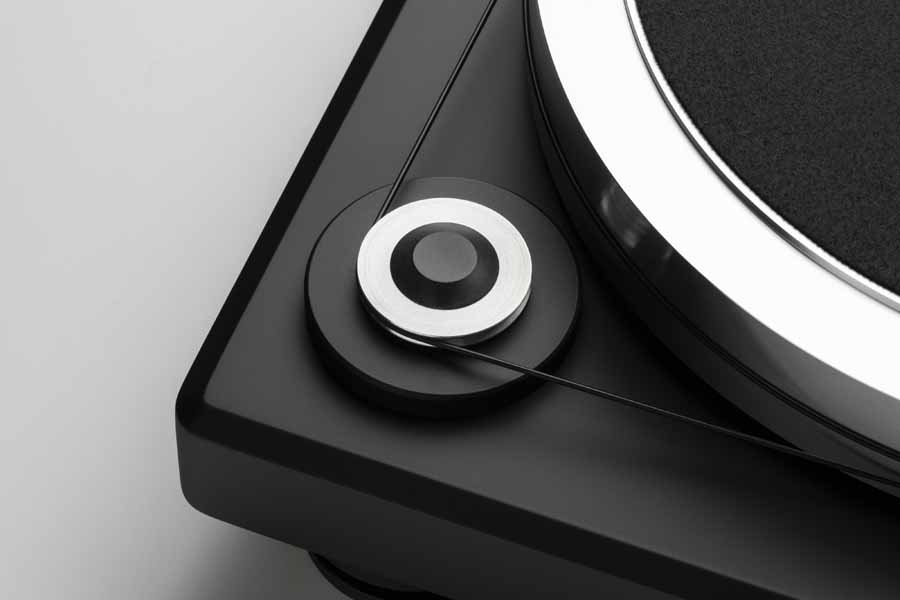
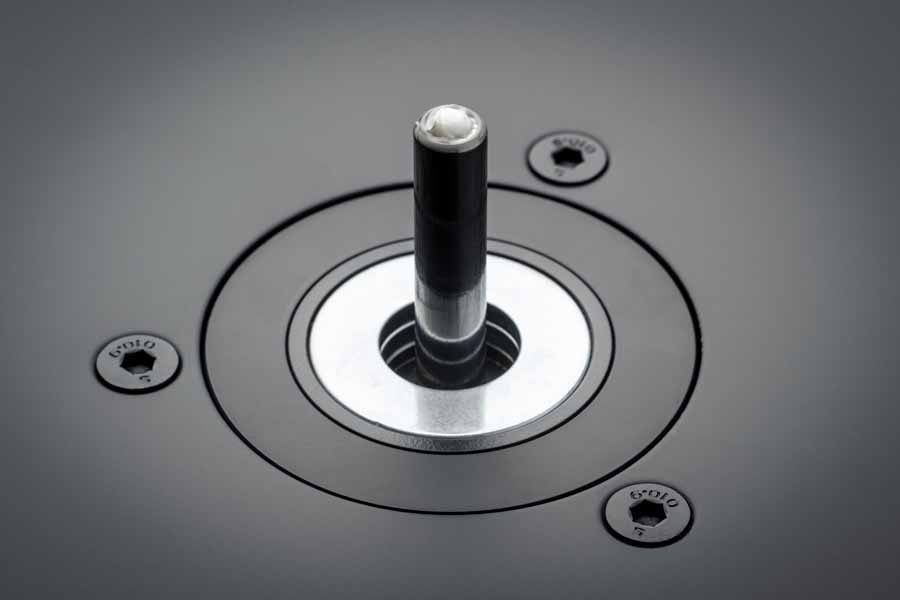
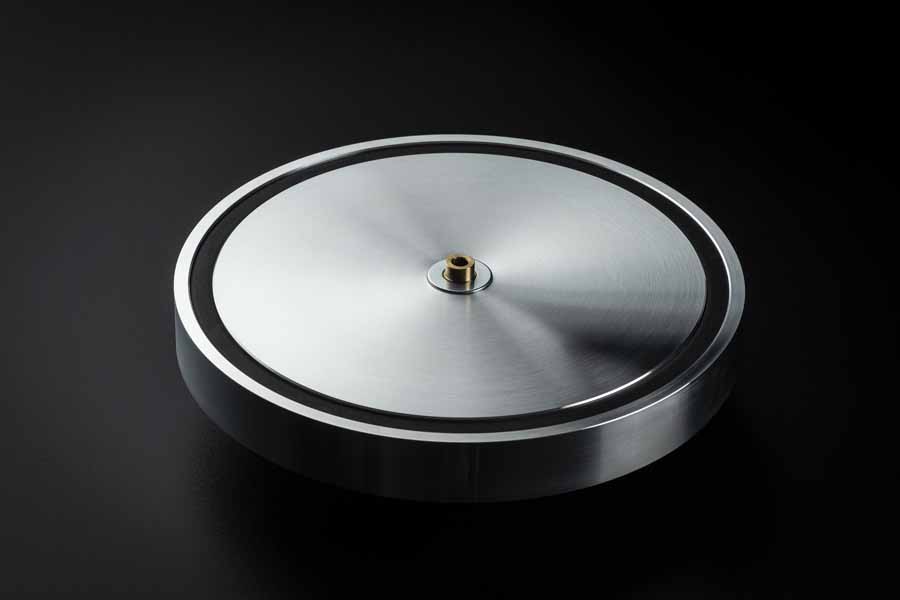
The 13.5” platter is heavy CNC machined aluminium, ensuring the rotational consistency as mentioned earlier plus has a ring of thermoplastic elastomer damping (TPE) to absorb any resonances. Having it wider rather than just weightier increases the flywheel effect and offers better horizontal stability. The turntable uses an inverted bearing system that, with the use of two opposing magnets, means that the platter is almost floating; reducing pressure and load on the contact point so that the platter revolves very smoothly, a method also applied in their very first turntable. EAT refers to this as “assisted magnetic repulsion”, and it reduces about 30% of the mass of the platter on the bearing. At the important point of rotation is a precision ceramic ball bearing, chosen because of its durability and low friction. The bearing block itself is heavy, acting as an energy sink to absorb and dissipate vibrations. The setup of the bearing, platter and belts is extremely easy, only requiring you to add a small amount of grease onto the bearing before adding the ball and then the platter.









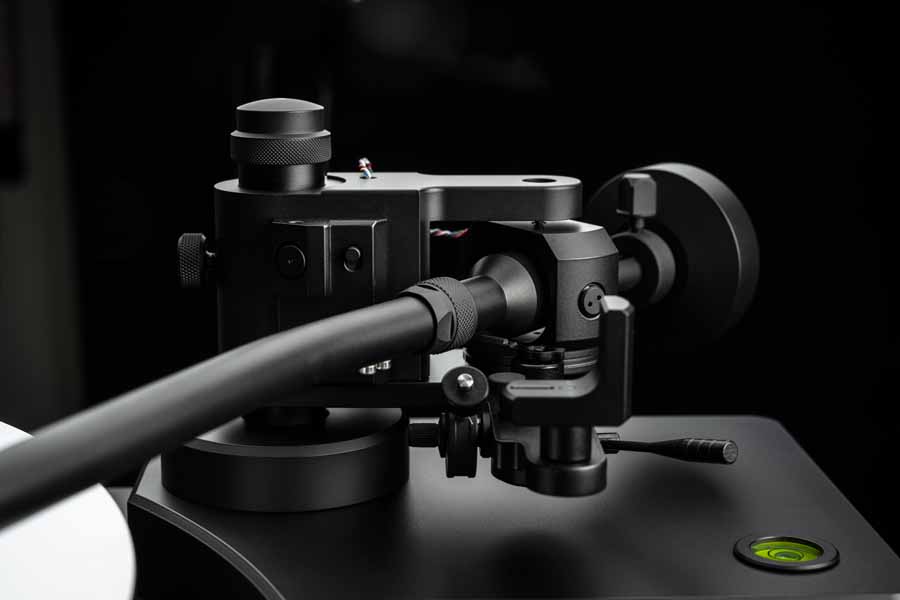
The F-Note arm, itself introduced in 2022, is an extremely clever unit, and at 12” (just as on that original Forte) gets closer to the perfect constant stylus position found in parallel-tracking arms such as my own Pre-Audio. EAT have always been known for their 12” arms. Whilst the stylus might be bang-on at the start of a disc, by the time it gets to the end, it has a slightly changed angle, which means the diamond is not hitting both left and right sides of the groove as exactly as the groove was cut from a Neumann VMS parallel-tracking disc cutter. For a conventional tonearm, it would need to be at least 3 feet long to be anywhere near as accurate! At 12 inches, though, we are getting much closer than the conventional 7” affair. This turntable does require either the 12” C-Note or, in the case of this review, the top-end F-Note J-shaped 12” high-mass aluminium tonearm. Days are gone of the lightweight arms for high-compliance MM cartridges like my aged SME 3! Whilst the turntable is available in black only, the top-of-the-range F Note tonearm is a choice of black or chrome. The black on black, as in the review sample, looks very professional. The F-Note tonearm is a cardanic (gimbal) design with four ultra-low friction pinpoint bearings, featuring a super-hard diamond mirror for the bearings. The large base isolates it from any vibrations produced by the turntable itself. The design not only allows you to adjust cartridge mass easily and precisely (I always think my SME3 arm was like a scientific weighing machine with its added weights and micro adjustments), but precise adjustment of VTA and azimuth is equally easily achievable. Adjustment of arm height is done from a dial on the top (there is a screw adjustment for very big changes, but generally never needed), and for adjusting the azimuth (angle of stylus to the groove) the turntable has a laser unit built in, so that with the stylus in a record groove you aim to get the perfectly level laser beam to precisely hit two indents at the back of the headshell one at a time; If it doesn’t hit them both perfectly central you can then adjust the angle of the arm to get it level. Of course, the old-fashioned way of doing this is to set the stylus on a mirror and check that the two images of the cartridge line up perfectly. I so remember spending hours doing this as a child! The only stipulation with this laser is that it relies on the cartridge sitting perfectly into the headshell (some cartridges have recesses, which will hinder gaining accurate height). Bias is adjustable in 3 weight positions at the end of a pulley system that changes height as the arm moves closer to the centre of the record. Not the usual fishing line anti-skate device or clever magnets as found in some arms. Works very well, though. The arm is very pleasant in setup and operation. It sits in place in its home position provided by a magnet arrangement, as in many Pro-Ject/EAT turntables. The magnet is weak, so not my preferred method of security. A stronger magnet might not be a good idea with the cables running along the arm, though.
The turntable is equipped with a standard 15V wall wart power supply, but this review sample had the £1300 (20% off if bought with the turntable) LPS 2 Linear Power Supply. This unassuming rectangular silver box has the provision of two outputs, 15V or 18V, depending on which turntable you need to plug in. In general terms, house mains enters the PSU where it is changed to 15V DC, then converted back to the more stable AC on a PCB in the turntable plinth.
SETUP AND USE
Setup is extremely quick (and for me it was done by Henley Audio, who supplied the turntable), though the unit, being so heavy, arrives in a big wooden box. An Ortofon MCX40 moving coil was supplied; one of the many successors to my excellent Kontrapunkt b cartridge. Set up with a 50-Ohm Load impedance on my valve EveAnne Manley Steelhead phono-stage, it worked brilliantly. This £875 cartridge has a 50μm/6μm profile nude Shibata diamond stylus and boron cantilever. As the turntable is so big, I needed to sit it at the side of my rack, meaning that the SME cabling from the arm needed to be extended to reach. Not ideal, but not an issue in terms of added load impedance. Adjusting my phono stage down to 25-ohm didn’t work, and trying 100-ohm just lost so much detail. The SME connection is at the rear of the arm, negating fiddling underneath the unit to connect it all up. This idea also stops tight cable curves or, much worse, accidentally moving the leads whilst playing a record, affecting the position of the arm as on my old SME!
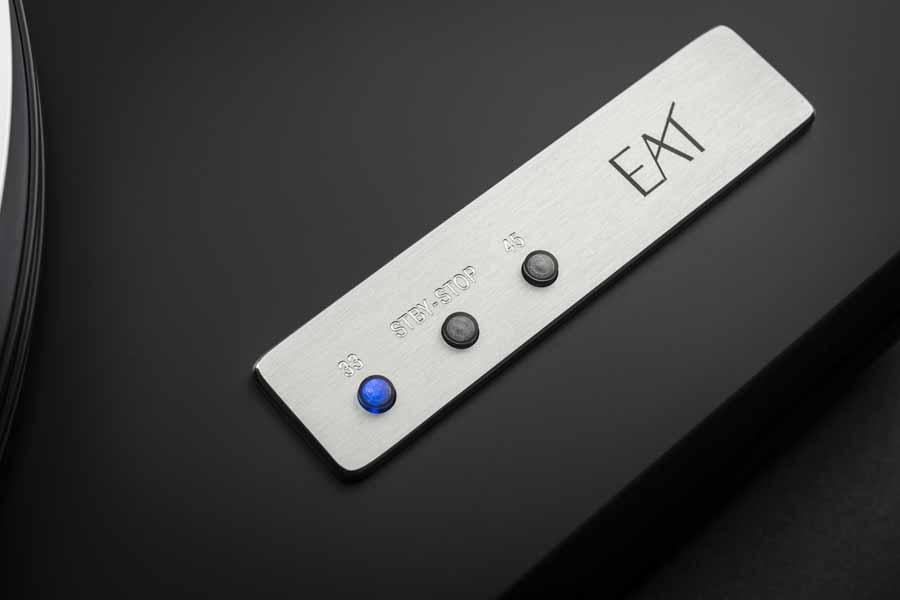
Amplification was an MFA LCR passive preamp and a Krell SS amplifier. The Manley and Krell work so well together. Loudspeakers were the fast and transparent Wilson Benesch ARC, complemented by the Torus Infrasonic 18” bass generator taking frequencies down to 10Hz and a pair of Townshend Super-tweeters holding up the other end to 100kHz. TQ and Townshend cabling. Controls for switch off and speed selection are on the top front right, with good physical LED buttons.
SOUND QUALITY
Immediately as I put diamond to plastic, I was aware of EAT’s distinctly musical prowess. The music was so well controlled and full-sounding with excellent speed stability. With a central green off switch and blue LED buttons on either side, the 33 and 45 buttons will flash rapidly for around 10 and 15 seconds, respectively, until the processor is happy with speed stability.
Katie Melua’s “Golden Record” (from ‘Love and Money’) instrumentation had great depth and punch, adding to her very individual, raspy vocals. I was immediately put at ease with the music. This is a very quiet turntable, and you forget there are actually two motors. The 12” arm and MCX40 cartridge could get intimately close to the music with great accuracy and musicality. “Quiet Moves” has incredible depth to the soundstage front-to-back, and instrument positioning and sense of ease of controlling the music enabled a surprisingly precise and masterful performance in all the tracks.
Similarly, that command of the performance was in David Bowie’s “Blackstar”. I normally find his last and timely album – issued just hours before his death – really hard to give a controlled and precise performance on any turntable. With all the complex rhythmical lines over-girding his laidback vocals, particularly from the accompanying jazz quartet, it quite often doesn’t work with turntables, amplifiers and speakers in reviews I do. An awful lot is going on in his and engineer Tony Visconti’s mind here. The laser-synth sounds cut across precisely and full-on, as does the saxophone. Moving into the more sedate middle section is a great exhibition in the art of contrast, though it can often sound confusing in a bad system. It flowed so musically here, and his iconic vocals vividly gave clues to the world of what was happening in the music as well as in his life. The whole track can sound fast and irritable, which is why I tend to play earlier albums, but the EAT just let it flow with greater control, timing and passion. Even the avant-garde jazz improvisations at the end from sax and drums just made more sense than ever before. His breaths leading into the next track, “Pity She Was a Woman,” finally sounded appropriate. The MXC40 has great dynamics and brings out changing textures better than my Kontrapunkt b does, and the breaths were indeed more emotional, as if it were his own last intake of air. The track also had more space between the instruments, and the voice just carried it through with intense power and conviction. The track doesn’t actually have much stereo-spread at the start, but as it gets more rock-jazz ’like (especially the section between the verses), the improvised instrumentation spreads its wings quite noticeably and accurately from the polyvinyl chloride source.
We were now into space.
Cue “Saturn” from Holst’s ‘Planet Suite’. This is a very mysterious movement, “Saturn, the bringer of old age”, and whilst this aged version from Sir Malcolm Sargent and the BBC Symphony Orchestra has plenty of scratches, the amount of musical detail extracted from the grooves of this great performance enabled me to concentrate solely on the music. The speed is well-paced and very clear in this EMI performance. It doesn’t run away uncontrolled but sedately holds the reins, especially the descending 4-note bass-line scales, then the toll from the bells makes the movement even more emotive. The EAR captures each instrument clearly and precisely; this work has lots of instruments from 16 wind, 15 brass, lots of strings, plus a battery of percussion instruments, plus celesta, harp and even an organ. The pseudo-F major opening of this movement on the F-Dur has great transparency and resolution and sounded grander in my listening room than I had heard for a while. How Holst could have created such textures, structures, characters, harmonies and imagination from the piano at the London Hammersmith School, in which he taught music, is a marvel. I was honoured many years ago to actually sit on the very chair he composed this great work. The performance here was as if I were at a concert hall. Even as the final movement, “Neptune”, descended into space, and the crackles from this aged LP from my youth didn’t matter. I was in orbit.
That brilliant control and detail from piano and bass in “Fly Me to the Moon” from the Amsterdam Jazz Trio, plus the brushed snare drum and cymbals kept my attention still further; indeed, I needed to play the complete LP, as the positioning and control of the instruments was indeed some of the best I had yet heard from this recording. Finally, “Mirror to the Sky”, YES’s 23rd album from 2023, might be played by old-timers, but that timing and fluidity was still there to hear. This album includes strings and horns precisely positioned in a slightly more relaxed YES style. It works so well on the EAT.
QUIBBLES
My only concerns were the magnet holding the arm at rest between playing. It just didn’t make me relax with a cat in the house!
CONCLUSION
I knew I wouldn’t be disappointed by the F-Dur and F-Note combination; just looking at its relative simplicity and then having it all confirmed to me when I started playing. This turntable has great control of all genres of music, with a very stable performance, particularly in the bass, and very quiet mechanics. Timing is so excellent, even in discs that normally are hard to sound musical. Well worth a listen, and so I have no qualms in delivering five hearts!
AT A GLANCE

Build Quality and Features:
Top-end construction and clever tonearm
High-quality cabling and connectors
Sound Quality:
Full-on musicality, with brilliant control and depth to the music
Value For Money:
Lots of technology and thought has produced an excellent turntable competing excellently in the mid-range of turntables. Very much worth a listen. If you can’t run to £8K with the F-Note arm, then you can always try the cheaper C-Note
We Loved:
Excellent bass
Very masterly controlled performance of all the music
Very quiet mechanics
We Didn’t Love So Much:
I need a bigger stand
A little too conventional in looks for me!
Elevator Pitch Review: With a 12-inch arm, oversized platter, and then give it a musical name, and that surely has to be a turntable from Jozefina Lichtenegger’s E.A.T. empire. With great 300B and KT88 tubes already to her name, in 2009, she set about improving on competitively-priced high-end turntables and the Forte was born. Now, the latest F-Dur continues the story, this time coming with the top-end F-Note arm. With two motors and a large plinth, would £7899 give me all I could eat?
Price:
£7899 (plus £1300 for the LPS 2 linear power supply)

Janine Elliot
SUPPLIED SPECIFICATIONS
F-DUR TURNTABLE TECHNICAL INFORMATION
NOMINAL SPEEDS: 33/45 rpm
SPEED VARIANCE: ± < 0.09%
WOW & FLUTTER: ± < 0.01%
SIGNAL TO NOISE: -73 dB
EFFECTIVE TONEARM MASS: 21.4 g
EFFECTIVE TONEARM LENGTH: 304.8 mm
OVERHANG: 13.2 mm
POWER CONSUMPTION: 8.5 W max/ 0.5W standby
VOLTAGE: Universal power supply 15 V DC/1.6 A
DIMENSIONS: W × H × D 550 × 250 × 440 mm
WEIGHT: 44kg net
E.A.T. F-NOTE TONEARM TECHNICAL INFORMATION
EFFECTIVE TONE ARM MASS: 21.4 grams
EFFECTIVE TONE ARM LENGTH: 304.8 mm
PIVOT TO SPINDLE DISTANCE: 291.6 mm
OVERHANG: 13.2 mm
OFFSET ANGLE: 18°
MAX NULL POINT: 125 mm
MIN NULL POINT: 251.7 mm