
Audio Resurgence Kraken AR6A amplifier
AUDIO RESURGENCE KRAKEN AR6A AMPLIFIER REVIEW
Audio Resurgence Kraken AR6A amplifier is a £1250 recreation of a much-loved and very striking amplifier from the 1990s. Janine Elliot takes a listen to this resurrected creature from the deep for HiFi PiG.

I remember a 1992 review in one of my many ancient HiFi magazines, featuring the iconic Alchemist Product’s Class A integrated amplifier the “Kraken”. In its Mk1 version with green-grey hammered front and top finish, and massive heat-sinks at the sides to cool down this cool looking beast (and which looked like the eyelashes of a monster), I was immediately smitten by its appearance, let alone its daringly original internal engineering. Even the Mk2 silver/black/gold version was equally inspiring. Images of it being sat in Batman’s music room or owned by a goth, came to mind. To be honest I thought at the time it must be Nordic with its bold persona and asking price of £399 including a separate power supply. It turns out (though it took the creation of Google and me 3 decades later to realise) that the “Kraken” is actually a sea monster in Norse mythology.
At the time, the norm was for boring rectangular black or silver fronted boxes, and apart from the side, front or top heat-sinks on Krell, QUAD 405 or Musical Fidelity products, any serious cooling metalwork was consigned to the inside, out of view. This British-made amplifier also had an external power supply, something very British at the time, and which could be upgraded with a double power supply unit (one for each channel) plus a plug-in card for MM phonostage.










The company began in 1989, the creative team including Andy Light and Glen Gayle, both with Musical Fidelity credentials. Later the great Tim de Paravicini added his own skills, creating a large portfolio of products before the company folded in 2001, plus Chris Found, responsible for a DAC and CD player. As Andy told me, the name “Alchemist” was chosen as, in audio terms, they “wanted to take mundane pieces of metal into gold”. It certainly was hot property.
Come 2025, Audio Resurgence have brought this beast back to life. During the intermediate period, Andy went into the designing and ergonomics of broadcast post-production editing suites and television and radio layouts for the majority of the best-known TV broadcasters, and Glen did something completely different, going into social care mentoring underprivileged children. At 60 and 70, respectively, they have gone back to their core skills of HiFi amplification with Audio Resurgence. Even the new company’s logo is almost identical to Alchemist’s, just adding a triangle in the centre. That original logo is appropriately alchemist symbols; the circle and central dot being “gold” and the “H” Pisces. Andy is a keen fish and reptile keeper and breeder, and so it is no accident that the original “H” and circle logos together mean goldfish. The new triangle comes from the emblem of the mythical bird rising from the fire, symbolising resilience, transformation, rebirth and eternal power; all very appropriate for this new Kraken, the triangle itself being the shield.
Where the original Kraken is famed for its original looks and warm and powerful sound, the new Kraken AR6A is seen as a “continuation” rather than a revival, and therefore advancing on its iconic past, and at £1,250 including single PSU, the price is equitable with the 1990’s cost, allowing for inflation. Simon Laland, Production Director, happened to be meeting with Andy (with whom he had been doing much work in the past) and suggested that the Kraken monster be resuscitated. Andy then got in touch with Glen, and the legend was brought back to life on my birthday, 2nd October 2025. What is even more ironic is that when Simon delivered the amplifier to me, he then went off to see a relative who lived just 5 doors up the road from my house! Small world. This team of three are now rebuilding the famous amplifier at a location near Welwyn Garden City, Hertfordshire. Andy, Founder and CEO, who had worked much with Tim in the past, is responsible for design, and Glen, co-founder, is responsible for the electrical work. His extensive background of Class A amplifier designs will manifest in the future with their “Designer Series” amplifiers.








The Kraken AR6A integrated amplifier is the first in a new line of amplifiers from Audio Resurgence, the styling of this and the original reminding me particularly of Primare’s 200 series, or even perhaps the tidier Hafler DH200. Richer Sounds, which built the similarly curvy Audio Innovations Alto amplifier and CD player at the turn of the century, bought the name “Alchemist” (and even made an AV amplifier), so that was unfortunately not now up for grabs. Audio Resurgence is already working on new products, and I was privileged to sneak a look at the new Signature amplifier coming out soon, an amplifier designed by Tim de Paravicini back in the last century, but never then brought to reality. Code named the AR 102A, it was originally destined for the Kraken box, but being too big to fit inside, it never made it to the shops. I have to say that this amp, with its beautiful curves, massive knobs, clever heat-sink sides and remote, is for me one of the best-looking amplifiers of all time, and I would give more to see that on my HiFi stand than even the new QUAD 3 or 33/303, which are also works of art in their own right. Complimenting the Kraken AR6A integrated is the AR7A pre and AR8A Power unit based on the integrated, and also at a later date an MM/MC phono-stage.
BUILD AND FEATURES OF KRAKEN AR6A
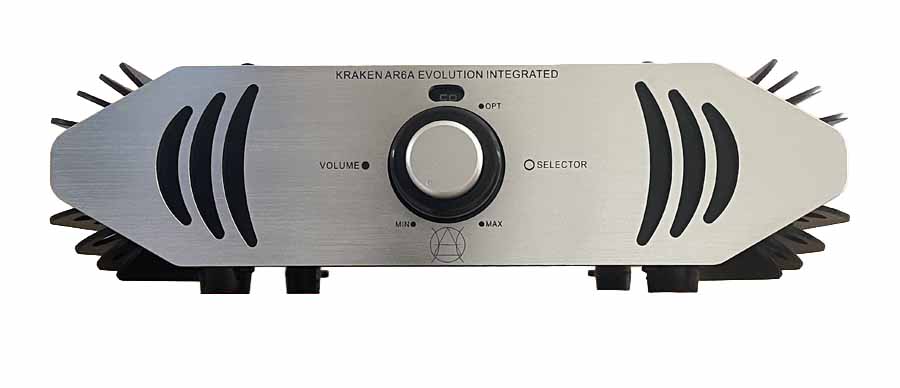
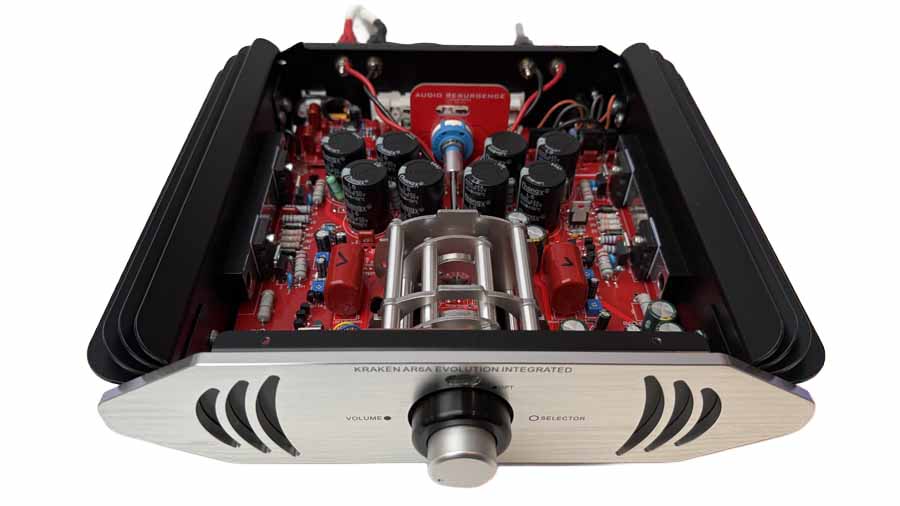
The new Kraken is very similar to the old one, though no longer the Fibreglass fascia painted over with the green Hammerite and with the three knobs on the front. The new amplifier (cleverly) has just a single knob at the centre, or rather a dual knob with a selector for the 6 line-level RCA inputs on the outside and a volume control at the centre. Turning the selector now displays the selected input names through a green illuminated small window above. Whilst the front brushed aluminium front is less radical than the original Alchemist, and tastefully partly hides those side heat-sinks, it is no less iconic with its 3 smiley faces on either side. Indeed, it is perhaps less confusing than the symbolic “indentations” in the original amplifier. The side fins are completely redesigned and indeed need to be, as the original fins had “hot spots” where some areas got hotter than others, due to the way the aluminium was extruded into shape. Now the heat is uniform over the entire area, making for better radiation of the heat, resulting in better reliability and longevity and preventing overheating. The fins are very effective, cooling down really quickly after switching off. This Class A amplifier will understandably get hot! 60°C I was told. I remember the Alchemist Forseti having grab handles at the side as well as fins, so you could probably hang your tea towels on them to dry (don’t try this at home…!)
This amp is Class-A to 30W amplifier will never need to go above 5Watts to get a solid sound, so inferior Class B output will probably never be heard. Let’s just call this a Class A amp, then. Indeed, a black dot at 1am (60%) around the volume control marked “OPT” will tell you where you should set the control at maximum; anything higher will probably annoy your neighbours, let alone start to cause distortion or worse. My 87dB/m efficiency Wilson Benesch Arcs didn’t need the Alps volume control higher than 9 o’clock (20%) at any point in my listening sessions, even in less-compressed and quieter classical music. The amp is rated at 50W (8-ohms) but can be 125W in bridged mode.
The whole amplifier is tiny at 302mm wide, including the fins. The actual section with the electronics is only 220mm. That might seem very small for a Class A amplifier, but don’t forget that the toroidal power supply is in another black box. As standard, the basic Kraken is £1250, but if you select the dual-power supply with its two toroidals (one for each channel), the outlay is £1400. That dual P/S can be bought separately, if you decide to update later, as many Cyrus and Naim fans do with their similarly petite products. The smoothing capacitors are inside the amplifier box, one for each channel, meaning that using the dual-power supply unit, you will get a 100% dual mono-block design amplifier for £1400! Shock horror, the amplifier doesn’t come as standard with a remote, but a version with a cool-looking volume/mute remote (looks like a bar of Pears soap) can be bought if you don’t like to do any exercise. The electronics are unchanged from the original amplifier of the 90’s, bar better and more efficient output devices. The original transistors are no longer available. Inside the Kraken, the electronics are clearly laid out and of very good quality.
The rear has the 5 interestingly labelled line inputs; AUX, DAB, PC, DVD and CD. On the far right are the Phono RCA sockets if the optional MM phono-stage module is to be fitted (marked RCA on the source window at the front), plus a pair of “Record” RCAs far left for you to connect to your cassette recorder input. This output is not linked to the volume control, so not much use with a sub or to bi-amp with another power amp unless it has its own volume control.
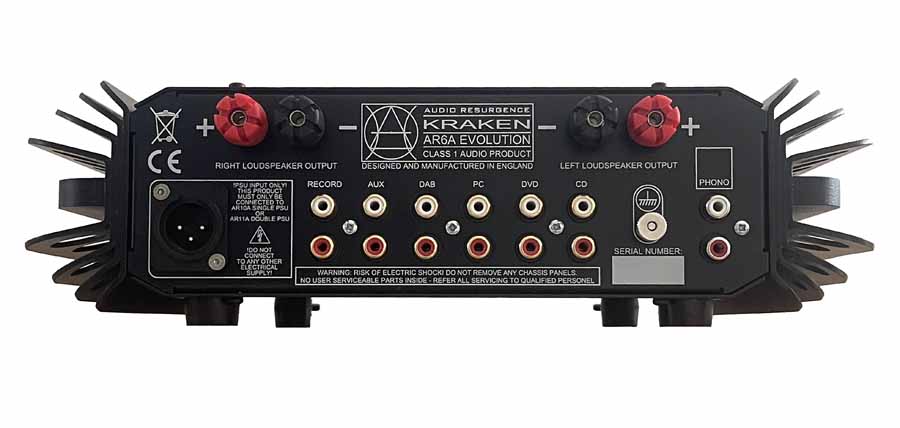
General build quality is solid and tidy, showing considerable value for money and quality for British-made equipment. I was really impressed. The PSU is very simple, with just a toggle off/on switch on the front and connected to the amp via a long fixed 5-pin XLR lead. As the 21st century Kraken has its roots before the word “standby” was commonplace, there are no other power-saving switches to worry about.
SETUP AND USE
Set up couldn’t be easier. It is such a small unit there is no problem in positioning, and the long cable from the power supply unit means that can be tucked away below; as long as you can get to switch it on. There are no balanced inputs so I kept it close to my other components in the review. Moving Magnet was supplied by my Townshend Rock 7/RB300/Ortofon VMS20e and older Hydraulic Reference/SME/Shure V15iv turntables. Townshend Isolda cable was used to connect the Kraken to Wilson Benesch Arc speakers. Using the amplifier was very simple and positive, but the input select window is rather small, so you need to get close to see it. For safety, as the amplifier fins do get very warm, it therefore needs good ventilation above and to the sides.
SOUND QUALITY
First, via my Bluesound Node streamer, was Amy Winehouse’s “Valerie” through my Wilson Benesch Arc loudspeakers. The amount of detail and extended bass gave me one of the best musical sounds I have ever heard of the music from this loudspeaker. Normally, these speakers are very clinical and honest, but her voice here was very detailed and powerful. The track “Cupid” was similarly very clean and exciting to listen to.
Prog Rock band King Crimson and “The Court of the Crimson King” was detailed, energetic and well-controlled; this is a long 10-minute track (and my favourite), and I just wanted to keep playing it over again and again, as there is so much in the recording to get to hear. Brilliantly engineered, the acoustic guitar and flute, close-mic’d drums, organ and Mellotron Mk II, plus Greg Lake’s distinctive vocals (he’s the “L” from ELP), made for a very endearing performance. The long pause at the end of the track, after which is a short, weird pipe-organ melodic sound, just sounded right this time, and also illustrated how noise-free the amplifier is.
Dominique Fils-Aimé’s “Sleepy” didn’t have that effect on me, with all its powerful backing rhythmical drums and guitars, plus meaty vocals. The music sounded as good as I had heard on amplifiers over 3-times the price. This was a great amplifier 35 years ago, and just shows that new isn’t always better. I just regret that I never got to hear a Kraken back in the 90’s. Lots of space between instruments in the following title track “Nameless”, with lots of reverb, note decays and vibrations, were brilliantly painted in my living room. Precision, tightness and excellent soundstage ticked all the boxes for me in this track. Similarly, in Brahms’ Piano Quartets No. 2 an 3 (DG, 2025) gave plenty of depth and sensitivity between the string players, and the piano had a meaty sound that is often missed in “cheaper” amplifiers these days.
Dr Lonnie Smith’s “Paper Tiger” from the album ‘Boogaloo to Beck’ is a funky soul-jazz version featuring several Beck rock numbers from the talented turban-wearing Hammond B3 organist. I just love his style and the sensitivity in all he plays, and here the Kraken plays with meaty bass and energetic and “wide” drum soundstage. That said, the amplifier could still be petite and sensitive when called for. Indeed, just as in the Bach piano recordings of Glenn Gould from my youth, Lonnie similarly adds his own vocal undertones in the quiet sections, which – like in the Bach – did put me off the music at times. The track “Tropicalia” had similarly very tight cymbals and brilliant organ work.
Fittingly, I played some reel-to-reel recordings on my Revox B77, which had been given the Tim de Paravicini magic touch some years back to get better Hz and S/N out of an already excellent machine. Ingram Washington’s ‘Sweet n Low’ sounded the best I had ever heard through my Arc speakers, with smooth but detailed sound from the piano, plus great uniformity from the percussion. This was syrup for the ears. The fact that an amplifier from over 30 years ago sounded just so right now in 2026 made me sad that Archemist’s downfall in 2001 meant that I had to wait so long to hear what could have been. That magic is sure to be extended in the future with Andy and Glen, plus some of Tim’s own work that has not yet been able to be appreciated. For £1250+ this is one heck of a bargain, eeking out musicality in a way I have not heard before at this price. The space and timing of decays of sounds were excellent, particularly in “How do you Keep the Music Playing?”. That question was actually relevant to me and the Revox, as it uses a silly IR light sensor to sense the end of a tape, but still won’t play through translucent yellow leader or “see-through” non-matt-backed tapes. The latter forced me to cover the sensor with BluTac. The sensitivity of the amplifier gave me the chance to really enjoy this, and experimental guitarist Aleksey Revenko’s “Romantic Guitar Music” recorded a few years back at the High-End Munich show. Even the solo acoustic guitar through the Kraken could give both bite and delicacy with equal aplomb.
Vinyl gave an equally musical performance, especially when you consider this add-on is only £75. This design is another one from Tim that hadn’t seen the light of day before now. Mark Knopfler’s double 45rpm ‘One Deep River’ gave me a sea of musicality. The album has very clear and extended bass-end and a tight top, too. If anything “This One’s Not Going to End Well” actually has too much bass-end even for my bass-light Arcs (and there was no need to add my Torus Infrasonic Generator!) The track “Janine” was appropriately sweet and well-formed. Miles Davis’s ‘Freedom Jazz Dance Bootleg vol 5’ is as confusing as the title, a 3-LP set of rehearsals and recordings at Columbia studios in New York between 1966 and 1968. The set is mainly of small segments interrupted by talking, with only a few almost-complete tracks. This triplet is not conducive to serious listening, but the AR6A did give me a chance to get closer to the musicians and what they were trying to do. The sound engineering is excellent, though the loud brass playing could be a little forceful and harsh. However, generally this amplifier removed any glare in music I played, with the saxophone and piano playing sweet and lush, almost valve-like. That sweetness and sense of being hugged by a woollen coat of musicality extended to Lils Mackintosh’s ‘Black Coffee’. I just needed an aperitif of Sambuca or Amaretto to settle me down for the evening.
QUIBBLES
It is impossible to complain about such a good-sounding amplifier for £1250, even if it remains largely the same as before. I thoroughly enjoyed my several weeks of musical engagement, and it would be so wrong to add BT or WiFi.
CONCLUSION
Sometimes the best things in life are the things from the past, like an E-Type Jag or the Aga cooker. They wouldn’t be right in the 21st century if they looked or operated any differently, so it is refreshing to see something as original and musical as the Alchemist being produced once again, just as it was. 50Watts is more than enough for you to hear the valve-like warmth, detail and extended bass end, making the music sound so engaging. I just can’t wait to listen to the next Kraken that Kracks the musical sound barrier. I have given it a well-deserved Reviewer’s Preference award.
AT A GLANCE

Build Quality and Features:
Brilliantly engineered in England and has iconic looks
Adding the phono-stage for £75 is a great feature
Sound Quality:
Very meaty and engaging sound at peanuts money
Value For Money:
For such great build, looks and sound this is the bargain of the year
Add the phono-stage and it’s even better
We Loved:
Exceptional musicality for the price ensuring an engaging and enjoyable experience
Valve-like solid punch
Great looks
Value for money
Excellent MM phono-stage – Tim de Paravicini is reborn!
We Didn’t Love So Much:
Nothing at this price
Elevator Pitch Review: There have been a few HiFi products in the past that have really got people’s attention from day one. When Alchemist brought out their original Kraken, it was so different to the usual silver or black boxes, not just visually, but also in the engineering. It was also excellent value. With Andy Light, Glen Gayle, and later Tim de Paravicini at the helm, it was a great partnership. I never experienced much of it in the 90’s, which is so sad, because listening to the 21st century incarnation from Audio Resurgence has made me think I have probably wasted 30 years of my life. The name “Kraken” is a legendry 12th century sea monster believed to have haunted the waters around Greenland long before American presidents had a go, and its massive tentacles made it very frightening. Whilst the great Tim might sadly no longer be here, Andy, Glen, and Production Director Simon Laland have brilliantly resuscitated the monster back to life for us all to enjoy, in safety. More than that, some of Tim’s hidden gems are also coming to the surface, too.
Price:
£1250 Kraken AR6A and single toroidal PSU
£1400 Kraken AR6A and double toroidal PSU
£75 MM phonostage

Janine Elliot
SUPPLIED SPECIFICATIONS
Input Sensitivity: 200mV For Max Output
Output@1kHz into 8 ohms: >50 Watts RMS
Frequency Response@3V O/P: -3dB @ 100kHz (10Hz-64kHz)
Distortion@15V O/P, 1kHz: <1% THD
Distortion@15V O/P, 10kHz: <1% THD
Residual Noise: <1mV
Power Consumption (Peak): 140W
Dimensions (W x D x H): 302mm x 300mm x 89mm (KRAKEN Only)
Weight: 3.9KG Without PSU