
Mola Mola Perca Power Amplifier
MOLA MOLA PERCA POWER AMPLIFIER REVIEW
Mola Mola Perca is a power amplifier that employs elevated Class-D technology to deliver exceptional on-paper performance, but how does it sound in the real world? Janine Elliot finds out for HiFi PiG.
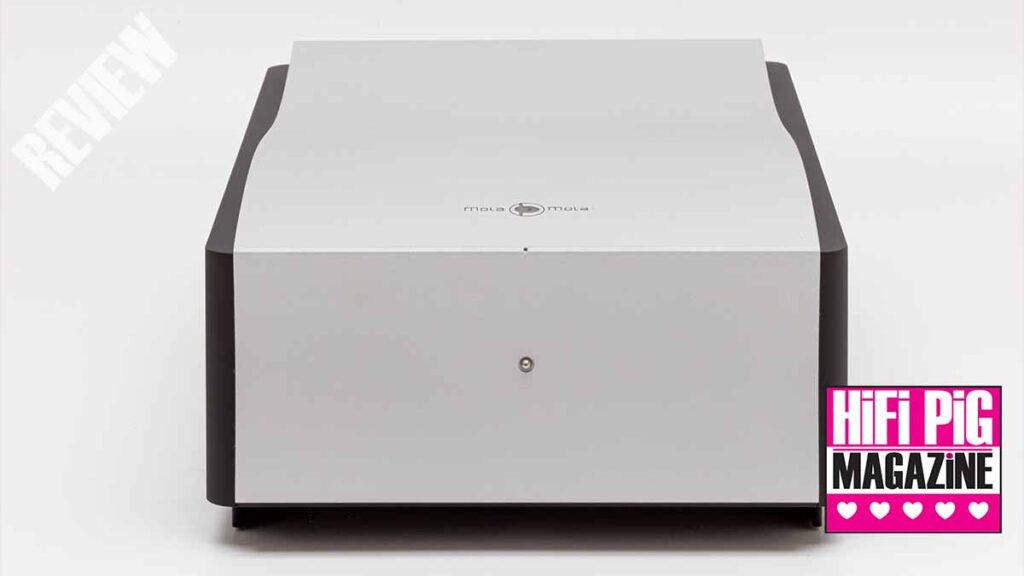
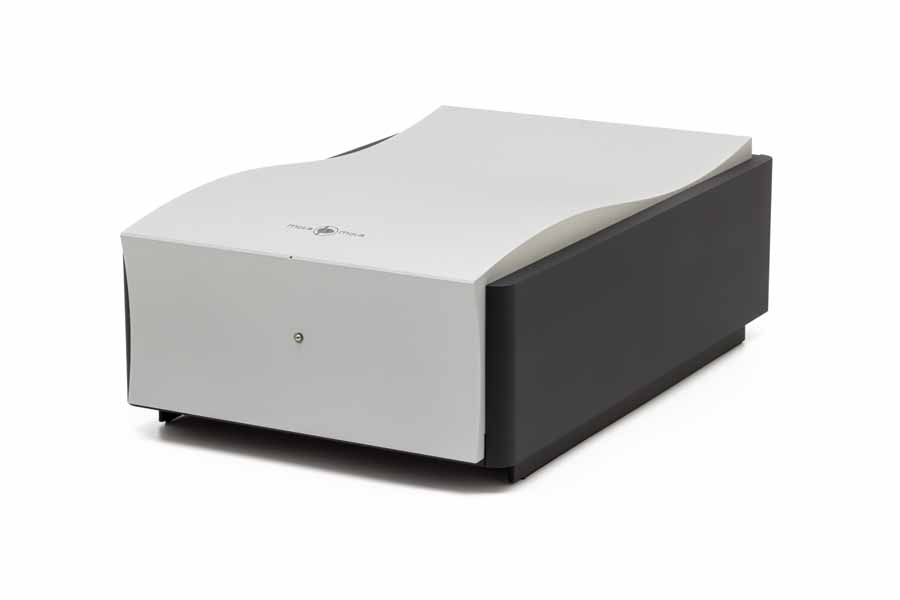
Audio products from Benelux and Scandinavian countries have been making loud noises over the last few decades; I have reviewed and listened to several great-sounding and looking products that would look lovely in my own music room, if only I had more space to put them. Mola Mola must have the most unusual name, though. A Mola Mola is actually an ocean sunfish (the clue is in the company logo), a fish more commonly known as the Sunfish and which can reach weights of up to 2.5 Tons. The HiFi company similarly produces an ocean of products with a wavy top and front, further giving the sense of the tide. Their portfolio is massive; all named after fish and all looking highly sophisticated and ready to ship across the world. Mola Mola is also Latin for “Millstone”, which is figurative speech for something that hinders or handicaps. Rest assured, the music from this £7299 half-width size (215mm wide and 110mm tall) Perca power amplifier is allowed to flourish unhindered. You’ll be pleased to hear I was only awash with its organic sound-waves. Enough of all this paronomasia.
Mola Mola was set up around 2012 (where they showed off a prototype at the Munich High-End Show), really to put Hypex technology into high-end HiFi products, and opened with their Makua preamp and Kaluga monoblock power amplifier, showcasing from the following year, the latter a highly-tweaked Hypex NCORE® NC1200.

I have to say from the start that I was never a fan of early Class-D amplifiers, but when I found out that Mola Mola’s co-founder Bruno Putzeys was also behind the Hypex, NCORE® and Eigentakt Class D designs, I was really keen to take a listen. His background includes developing the UcD (Universal Class D) module for Philips before he later mastered the NCORE® technology at Hypex. Indeed, Mola Mola was jointly set up with Hypex founder Jan-Peter van Amerongen. Hypex is therefore the mother company of Mola Mola. Bruno Putzey is no longer involved with the companies and is now working at Kii, where he continues to develop groundbreaking technologies, this time utilising powered speakers with Active Wave Focussing to maintain perfect time alignment of all drivers. At Mola Mola, his NCORE® technology continues to be used and developed. Sadly, Jan-Peter died in 2021. With no less than 10 ranges of equipment at Mola Mola, I was to be let loose on the Perca. “Perca” means ‘perch’, as in the fish.
BUILD QUALITY AND FEATURES
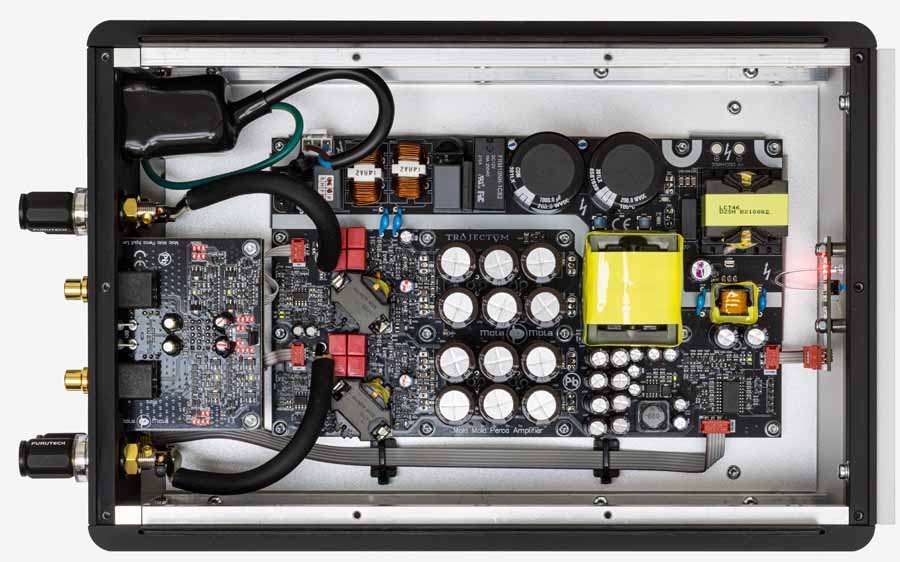
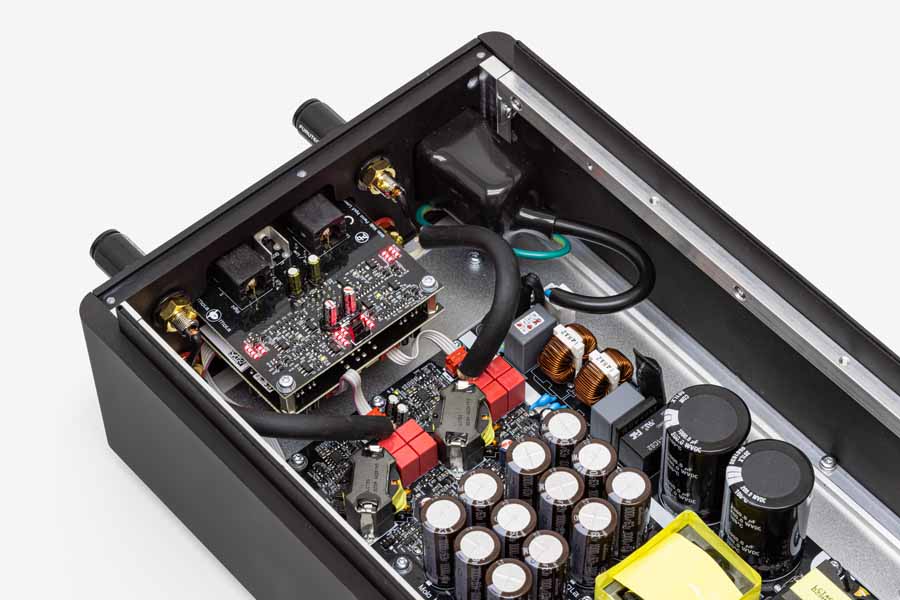
I actually expected to see Hypex PCBs just connected neatly together inside, like that from some Class-D “manufacturers” I have reviewed in the past, but the inside clearly shows that this is not the case. No, they have listened to and modified the electronics to create custom PCBs that are clearly marked as their own, with the “Trajectum” board that also appears in their same size Ossetra mono power-amp and double-the-size Kula integrated amplifier. Both NCORE® and Trajectum use high-feedback and self-oscillating Class-D designs, but the Trajectum is better in many areas; for example, the latter has higher switching frequency, larger bandwidth, lower distortion and lower output impedance. I mentioned in the Hegel H150 amplifier review its large damping factor of 2000. On steroids, this Perca more than doubles that number, resulting in an output impedance of a claimed 2m-Ohm – that’s tiny. This means that mid/bass speaker drivers should work quickly and accurately, and the sound shouldn’t be affected by changes in speaker impedance at different frequencies.
Trajectum Versus NCORE®
According to Mola Mola, distortion on the Trajectum is reduced by at least 20dB and as the design focuses on the important first 50W of output power (in my system, my meters rarely go above 4W!), that first stage distortion is brought down by 40dB. Also, amplifier noise is reduced by 3dB on top of an already silent amplifier design from NCORE®, plus the frequency bandwidth is increased still further, and the amplifier is less affected by noise from the power supply. Of course, being Class-D, that supply is a custom Switch-Mode inside the box. The input stage, though, is an ultra-low-distortion Class-A design on its own board, complete with its own voltage regulation. I have seen several hybrids like this in the past, and they all seem to work well. The company prides itself on creating amplifiers and converters “whose output signal cannot be distinguished, by ear, from the input signal”.










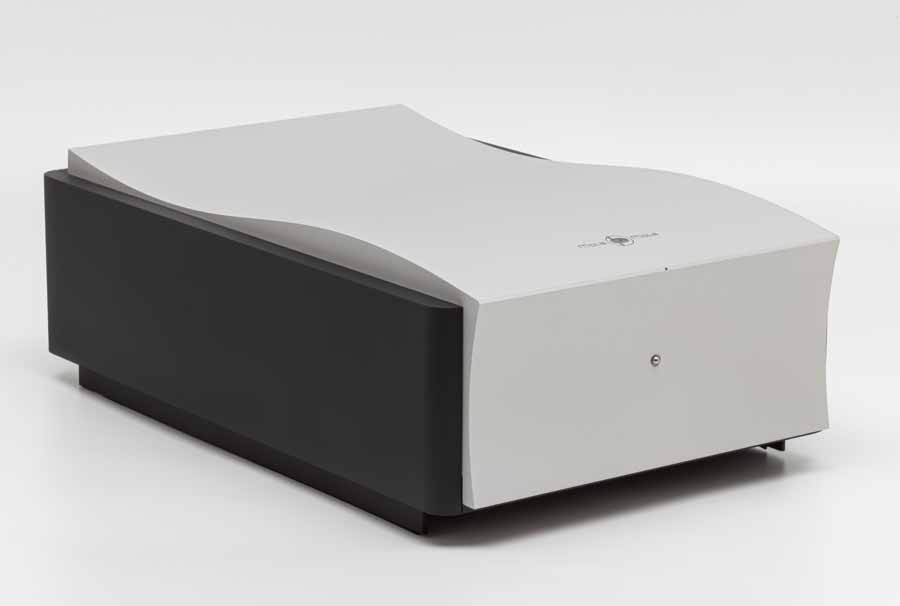
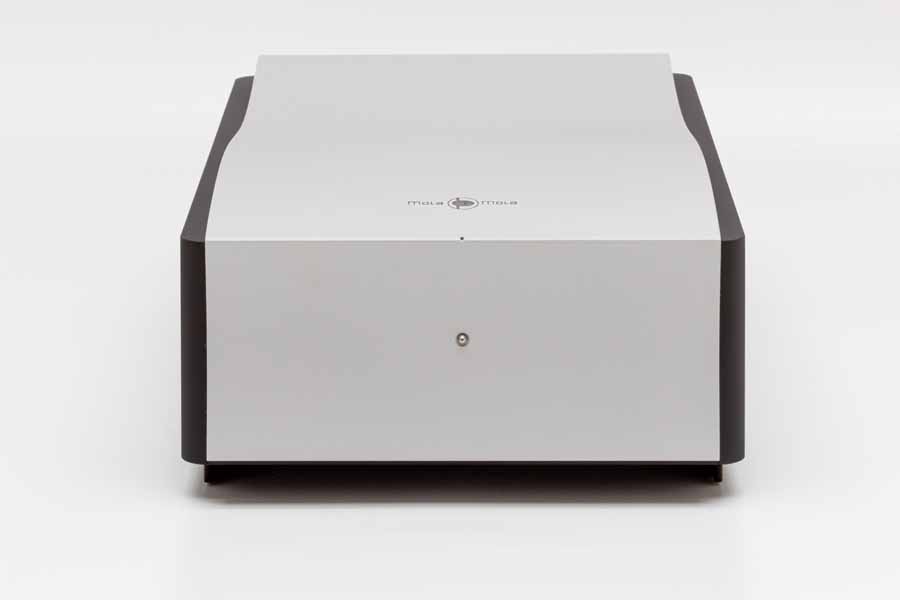
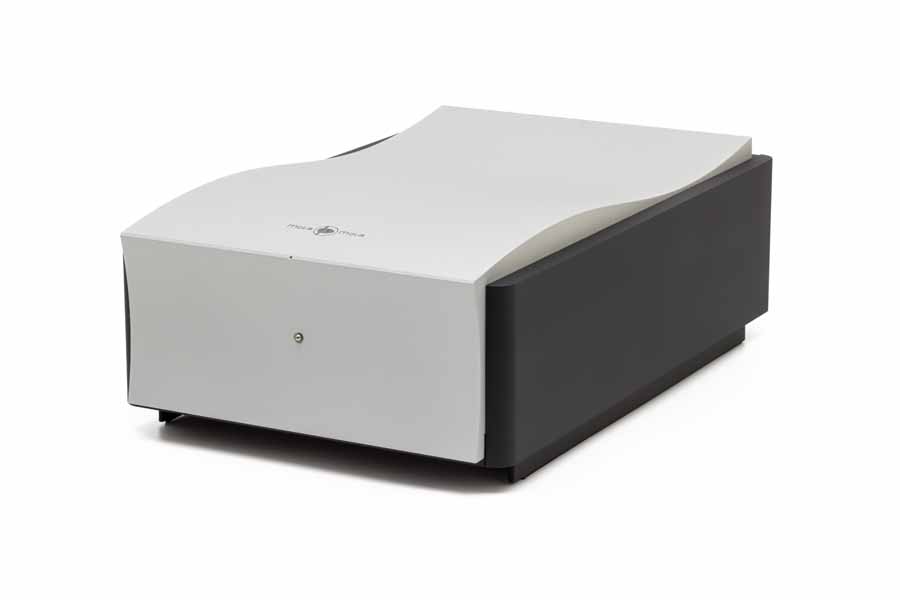
This is a 150W into 8-ohm (300W into 4-ohm) power amplifier matching the company’s £10k Tambaqui DAC, and is far removed from my heavy, large and power-consuming Class-A amplifiers that dim the lights every time I go to switch them on. With just a single tiny nipple on the front to arouse this beauty, the top middle edge has a similarly small LED that goes from an orangey-red colour on standby (there is no main off/on switch) to flashing white for 2 seconds and then after a relay “click”, once all is ready, stays on permanently until you want to switch off this sunfish. What is a really lovely sight to see is that the standby indicator takes several minutes to disappear when you unplug, showing a great power supply residual energy in the smoothing capacitors.
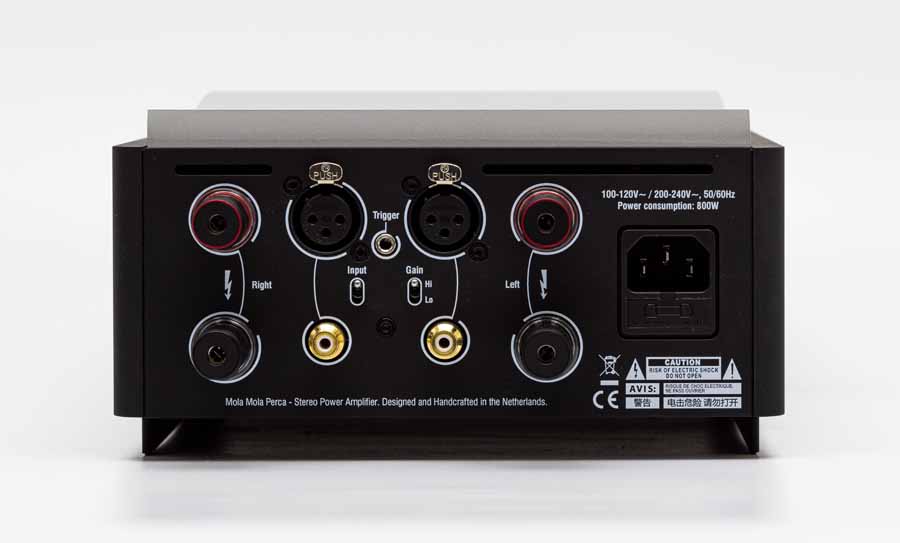
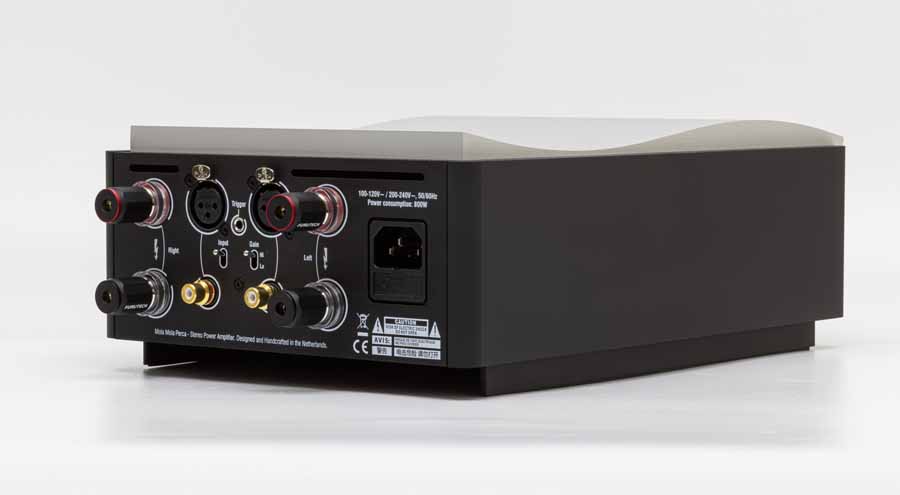
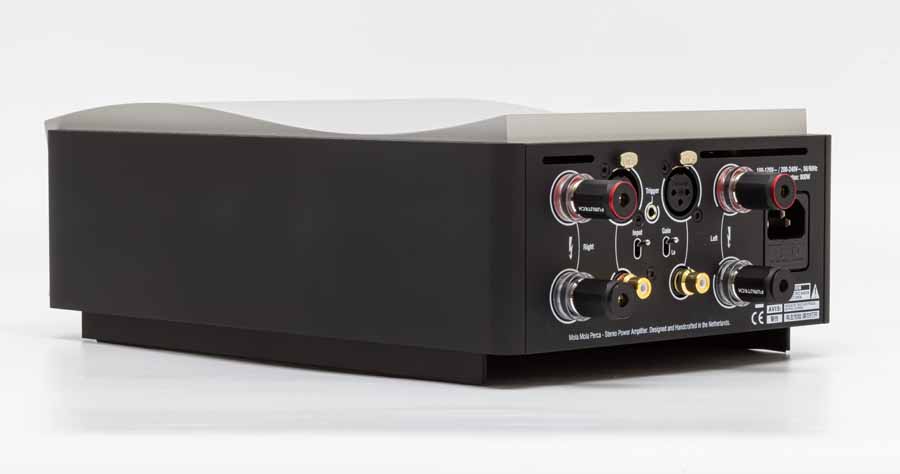
At the rear, things are significantly more complex compared with the front. We have RCA and XLR inputs, both excellent Furutech speaker terminals, a 12V trigger in/out socket and an IEC mains input socket. Changing between the balanced and unbalanced inputs is done by a single “input” switch. I would have rather that it was marked as “XLR” and “RCA” or “bal/unbal” perhaps. Next to this is a switch to choose between high and low input level. This is quite useful if you are a reviewer and want to “A/B” test RCA inputs against XLR, as the difference in level between the two of 6dB is the same as the lo/hi settings. Interestingly, I found the sound different between the lower and higher input settings, even when the sound pressure was kept constant. The build quality, as I have already mentioned, is excellent and fits in with the design talent I regularly see from this part of the world. The rear proudly announces “…handcrafted in the Netherlands”, and it certainly does look handcrafted. This is not an off-the-shelf box from your local DIY store! The unit does get slightly warm, but the efficiency from this type of amplification means that my wallet will be happy, though perhaps not my electricity provider, as Class-D and switch-mode power supplies are highly efficient.
SOUND QUALITY
This is an incredibly low-noise amp, as I expected, coming in at 128dB. The human ear only has a dynamic range up to 120-130dB maximum! Total harmonic distortion isn’t even worth mentioning. Numbers aren’t as important as the sound, though. Best just to use my ears then. I also deployed my quick WB Arcs to really test out the high definition, low distortion and speed attainable on Class -D. “Escualo” from the jazz trio Tangalgo (from their ‘La Zucca Barucca’ album) deploys brilliantly positioned microphones for the double-bass, drums and piano, meaning that I could test – and hear – an exceptionally tight performance and extended frequency response. The fast WB Arcs certainly showed off the high damping factor from the amp, though anything above 200 should be fine. Valve amps don’t even make it to 3-digit numbers if they even dare mention it. Please read my paragraph on the damping factor in the Hegel H150 review to understand how it affects music. The very lowest note on the grand piano was as brilliant as I would expect from a Steinway; those lowest notes have a considerable amount of high-frequency harmonics to give them their distinctive “fast-bright” sound, made manifest so well from the Krell CD player, even if red-book CDs do limit it all to 20kHz. “Libertango” starts with a slow and melancholy minor-key repeated phrase, beautifully and emotionally constructed by the trio. The bowed double-bass line is so sensitively performed by the Perco, with a very large soundstage created from the piano and percussion; with piano top notes far right and deepest bass to the left, I felt I was sitting down at the keyboard myself. Just when you thought all was going to end solemnly and I could relax with my coffee, the music suddenly takes off at great speed, with the pianist and percussionist on steroids. Everything from this amplifier was intensely accurate and fast, yet it could still offer the emotions and conviction I expected from my Class-A. Maybe that initial stage in the amplifier helps. I particularly felt that the case from the XLR input set at “hi”. The lower setting doesn’t quite come across with as much conviction, but I expect different sources/speakers may be slightly different.
The third track on La Zucca Barucca, “El Cod,” is a great chance to test out the accuracy of percussion; the closely-mic’d cymbals have great speed and definition through my silk tweeters and ribbon super-tweeter on the top. Using my passive pre-amplifier via XLRs placed all the way to the Perca effortlessly showed off the tight drum and cymbal definition, and I quite simply had to play this album all the way from beginning to end. That tightness continued with Dean Peer’s improvised guitar solo, cleverly titled “Just Improvise”. This bass guitarist gets notes and harmonics out of a bass guitar that you just wouldn’t think possible. He even wrote a book on how to do it, and this track really does test your speakers and your amplifier in terms of definition, extension, and bass control. The bass depth and the space within all the music worked particularly well when set to “hi”.
Music is a great canvas of sounds and rhythms, and Hans von Koolwijk takes it all a step further with his own sound art improvisation “Sonore Basion”, sculpting music and noises from unusual objects. The Mola Mola was able to create a large, almost 3D, music soundstage. It might all be unusual – and not meet everyone’s idea of what makes music – but the amplifier was able to recreate all the noises, harmonies and harmonics in a very organic way. Even every breath that Ian Anderson ushered in his flute playing in Jethro Tull’s “Mrs Tibbets” gave far more precision and passion to the performance, giving a breath of fresh air into the music.
Turning to classics, the atmosphere from the church in Graham Blyth’s organ playing of Cesar Franck’s “Fuga et Pastorale” was similarly very real and performed with much accuracy.
Turning to my streamer, I played a new album by 86-year-old soul singer Mavis Staples. “Chicago” is a very gritty track, and I wondered how the Perca would deal with the distorted guitars, tons of compression, and even some hum. The track sings about “Things might be better…”, and I guess it could be, but the way this 21st-century creation could have been misinterpreted as being recorded in the 1960s is a marvel of both the recording engineer and Mola Mola. This album shows much influence of Johnny Cash (especially the “Beautiful Strangers” track), and with all its concern for this weird world, it’s no wonder she has worked with Johnny and Bob Dylan as well as Aretha Franklin and Prince in her extensive career. How she could deliver this album with such conviction at this age is amazing. On the Mola Mola, it sounds dynamic and confident. Only on Asia’s 1982 “Without You” with its dated analogue synths from Geoffrey Downes (YES), guitar from Steve Howe (also YES) and drums from Carl Palmer (ELO) did I feel that the sound wasn’t quite as heavy as I wanted it to rock.
QUIBBLES
Mola Mola has a very powerful offering with the Perca, and which certainly perked up my opinion of Class-D in bucket-loads. I couldn’t really find anything I didn’t like apart from the long thin rubber base feet to stop it moving. Oh, and I just don’t like having to leave things on standby.
CONCLUSION
This is a very able Trajectum/NCORE® amplifier putting Class-D rightfully into the echelons of high-end audio. This is a very controlled performer, meeting finite detail with musicality in an exceptionally believable way.
Whilst Class-D is often thought as a cheaper alternative to toroidal-fed amplifiers, the Perca proves that their amplifiers can be equally Classy.
AT A GLANCE

Build Quality:
First class, though I don’t like the built-in side feet
Sound Quality:
Speed and detail are excellent, with great rhythm and drive
Value For Money:
£7299 is in high-end amplifier territory, but this Perca fights off the opposition with plenty of conviction
We Loved:
Speed of detail of top frequencies
Full-bodied and dynamic
Accurate performance of all types of music
Openness and conviction
Good looks
We Didn’t Love So Much:
That my thoughts on Class-D have now changed
Elevator Pitch Review: Hypex have been making ground-breaking Class-D and Ncore® products since 1996, largely thanks to technical wizard Bruno Putzey. Mola Mola is the company set up by them to develop their DIY components into a HiFi brand to show off to the world. But this is no assembled kit of parts, but a totally rethought enterprise taking Hypex ideas as a starting block only, and creating something far better at the end. My experience of Class-D has been both very good and not quite so good, but I knew this one would be really special.
Price: £7299, 9850 USD

Janine Elliot
SUPPLIED BY SOUND DESIGN DISTRIBUTION
SUPPLIED SPECIFICATIONS
Power: 2x 150W 8Ohm 2x 300W 4Ohm
Gain: 22dB or 28dB
Signal/noise ratio:128dB
Distortion (THD and IMD): <0,0003%
Input impedance: 100kOhm
Output impedance: 2mOhm (Or Damping factor >4000)
Bandwidth: 100kHz
.