

Noise Launches Affordable Homestage Soundbar Range
Noise has moved into home audio with four Homestage soundbar systems, starting at ₹4,999 in India. The range is designed to make television sound bigger without asking newcomers to build a complicated system from separate amplifiers and speakers.
The line begins with a simple 2.1-channel bar and climbs to the Homestage 5.2.4, a complete Dolby Atmos package with rear speakers and two subwoofers. That gives beginners a clear upgrade path, from clearer everyday TV audio to a room-filling surround setup.

Quick Reference
- Range: Homestage 2.1, Homestage 3.2, Homestage 5.1 and Homestage 5.2.4
- Prices: ₹4,999, ₹8,999, ₹14,999 and ₹24,999 respectively
- Flagship Output: 700W combined peak output for the Homestage 5.2.4
- Main Feature: True Dolby Atmos on the Homestage 5.2.4
- Connections: HDMI eARC/ARC, optical, USB, AUX and Bluetooth 5.3 on the flagship
- Availability: Available in India in black or silver, depending on mode
Four Models For Different Rooms
The Homestage 2.1 is the simplest model. The first number means it has two main channels, while the .1 tells you there is one bass channel handled by a subwoofer. It is the obvious starting point for a bedroom, desk or smaller television.

The Homestage 3.2 adds a centre channel for voices and uses two subwoofers. The Homestage 5.1 steps up to a five-channel surround arrangement with rear speakers, while the Homestage 5.2.4 is the most complete package in the range.
What 5.2.4 Means
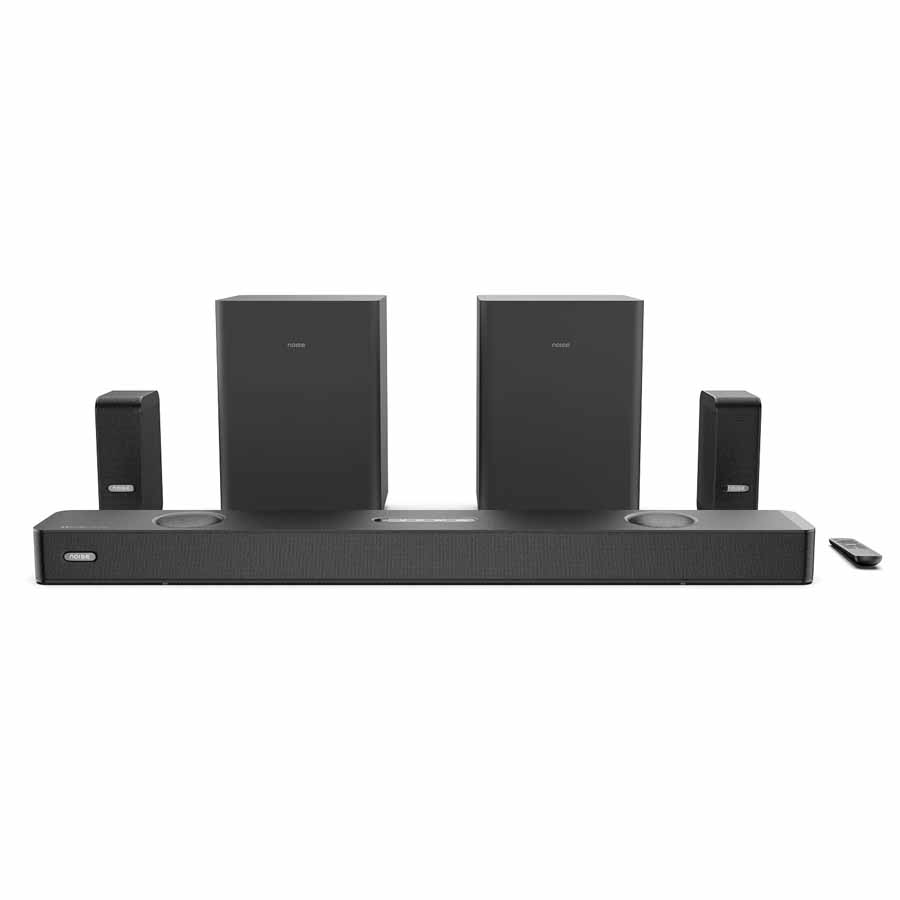
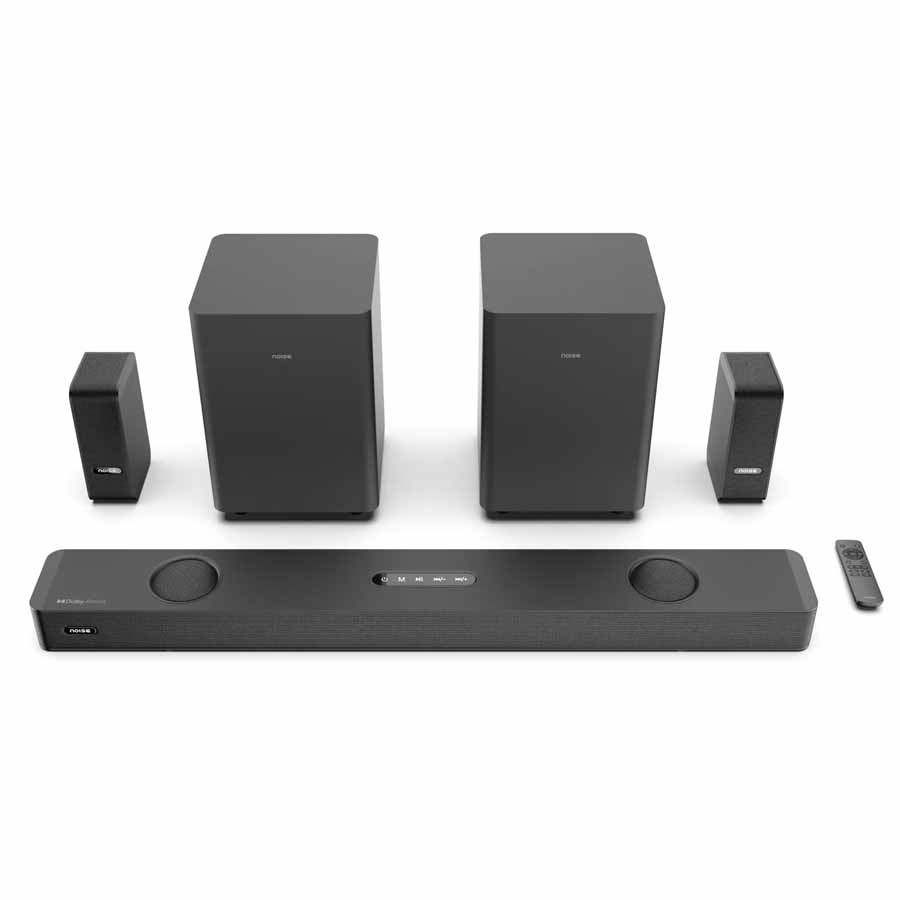
The numbers describe the speaker layout. Five is the number of ear-level channels, two is the number of subwoofers, and four is the number of height channels. Those height channels use upward-firing drivers, which bounce sound from the ceiling to help Dolby Atmos effects seem to come from above.
The flagship system combines a soundbar, two wired subwoofers and two rear satellite speakers. The rear speakers link to the bar wirelessly, although they still need mains power. Noise rates the complete system at 700W peak output, so that figure describes the maximum combined power rather than continuous everyday output.
Connections And Everyday Use
HDMI eARC is the most useful connection for a modern television because it can carry sound and let the TV remote control the soundbar volume. Optical is a handy alternative for older TVs, while USB, AUX and Bluetooth 5.3 provide extra ways to play music.
The Homestage 5.2.4 also offers 12 levels of bass and treble adjustment. That matters because a small room, hard floor or corner position can make bass sound much stronger than it does in a larger, softer room.
Things To Check Before Buying
Dolby Atmos needs compatible films, games or music and the right TV settings. Noise says HDMI eARC or optical can be used, but an HDMI cable is not included. Upward-firing speakers also work best with a fairly flat ceiling that can reflect sound back towards the listener.
The flagship package takes more space than a normal soundbar. You need room for two subwoofers and power sockets near both rear speakers. Measure first, especially if the system is going into a bedroom or shared family space.
A soundbar is not a replacement for every separate HiFi system, but it can be a practical first step when films, games and music all come from the same television. The Homestage range is interesting because it offers clear choices at several starter-friendly prices instead of forcing everyone into the biggest model.
The entry models keep things simple, while the 5.2.4 package introduces newcomers to real surround and height channels at a price that is far below many separate-component home cinema systems.